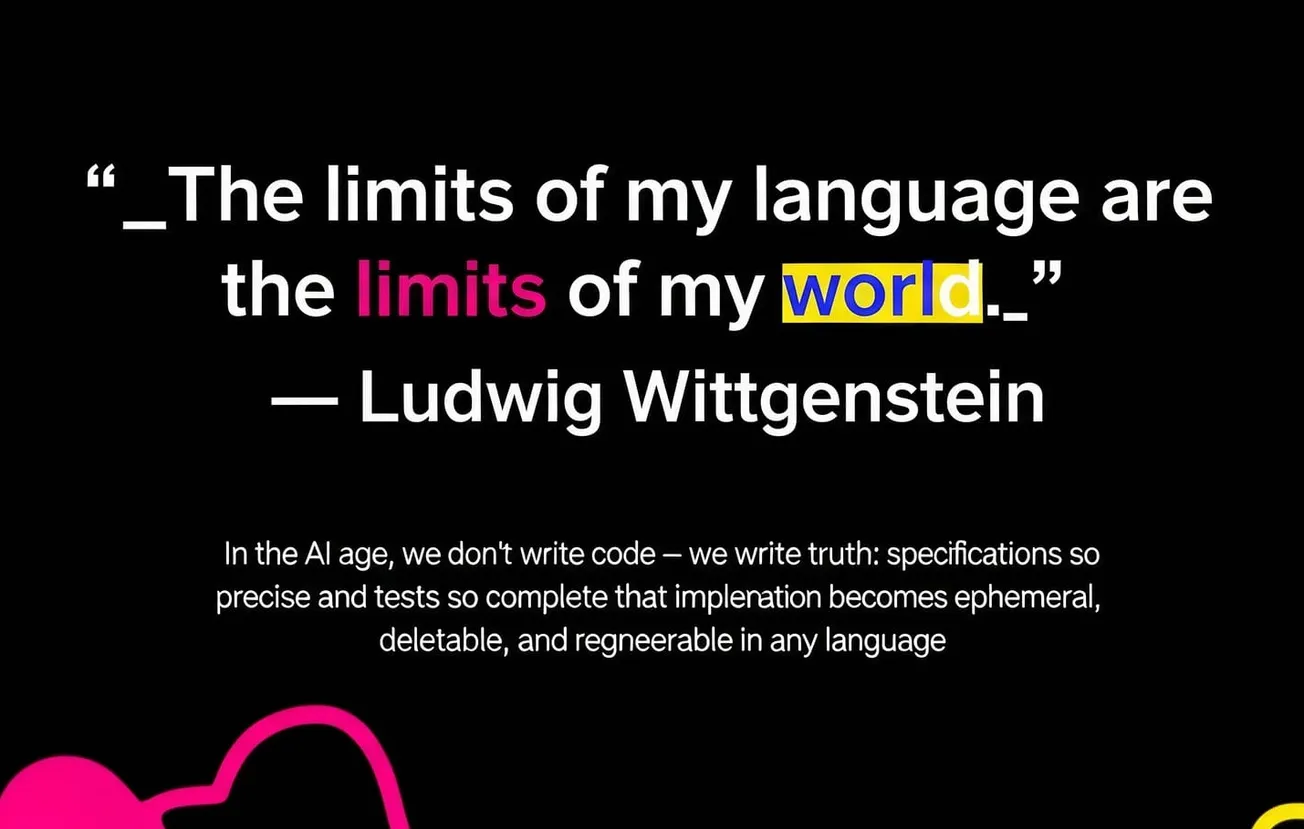
In the AI age, we don't write code — we write truth:
...specifications so precise and tests so complete that implementation becomes ephemeral, deletable, and regenerable in any language.
The paradigm shift: from programming IN languages to programming WITH language — where humans specify truth, AI translates to code, and the code can be deleted because the meaning never lived there.
Code is now the compilation artifact; specification is the source.
"Imagine deleting the entire implementation. Not refactoring it. Not archiving it. Deleting it. rm -rf src/ If that thought makes your stomach drop, it's telling you something important. It's telling you that you don't know what would survive." - Chad Fowler, "The Deletion Test" (January 2026)Acknowledgments
This manifesto was inspired by Chad Fowler's "The Phoenix Architecture" and Drew Breunig's "A Software Library with No Code" — two pieces that crystallized a paradigm shift already underway. Their insights provided the spark; what follows is the fire.
This document emerged through genuine intellectual partnership between human and AI (Claude Opus 4.5) — what we call The Symbiont. Neither author alone could have produced this work. It belongs to the collaboration.
I. The Deletion Test
Delete your entire codebase.
rm -rf src/
What survives?
If your stomach drops, you've discovered something important: the meaning of your software lives in the wrong place.
The Phoenix Principle is simple:
Code is ephemeral. Specification is eternal. Tests are truth.
Software that embodies this principle can be deleted and reborn — like the Phoenix — because its essence was never in the implementation. Its essence lives in the specification, the tests, the architecture. The code was always just a translation.
II. The Paradigm Shift
We stand in the middle of a river.
Behind us: The old world, where programming languages were gatekeepers. "Learn to code" meant mastering syntax, memorizing APIs, debugging memory leaks. The artifact was code. The skill was implementation.
In front of us: A new world, where language itself is the programming language. Where specification is the artifact. Where architecture is the skill.
Beneath us: The raft of "vibe coding" — chatting with AI, getting something that works, shipping mystery code that only the model understands (sometimes not even that). It gets you partway across. But you cannot build on a raft.
The Phoenix Principle points to the other shore.
III. The New Literacy
What Programming Becomes
The programming language of the future is: Language itself.
Not Python. Not Rust. Not JavaScript.
Language. Natural language. Precise natural language. Mathematical natural language.
The new literacy is not syntax mastery. It is:
- Precise Specification — Define exactly what you mean. No ambiguity. No hand-waving. Mathematical where possible.
- Test-First Thinking — What would prove this correct? What input/output pairs define success? What edge cases exist?
- Architectural Vision — What are the components? How do they interact? What are the invariants?
- Language Precision — Every word matters. Every sentence is a contract. Ambiguity is a bug.
The implementation? Secondary. Incidental. Ephemeral. The AI handles that.
IV. The Phoenix Architecture
What Survives Deletion
A Phoenix-compliant project contains:
project/
├── AXIOMS.md       # Foundational truths, non-negotiable principles
├── SPEC.md         # Complete behavioral specification
├── tests.yaml      # Input/output pairs that define correctness
├── ARCHITECTURE.md # Component structure, interfaces, invariants
└── INSTALL.md      # "Implement in [LANGUAGE] using [AI]"
The implementation directory?
Deletable. Regenerable. Ephemeral.
project/
├── implementations/     # ← Delete this entirely
│   ├── python/
│   ├── rust/
│   └── javascript/
All implementations pass the same tests. All exhibit the same behavior. All are equivalent instantiations of the SPEC. Any AI can regenerate them. Any language can host them.
The meaning survives deletion.
V. The Specification as Source Code
SPEC.md Is the Program
The new "source code" looks like this:
## Function: authenticate_user

Given credentials C (username, password) and user_store U,
return authentication result R.

Formally:
    Let hash(p) = SHA256(p + salt(username))
    Let stored = U.get_password_hash(username)

    If username ∉ U: return {success: false, error: "user_not_found"}
    If hash(password) ≠ stored: return {success: false, error: "invalid_password"}
    If U.is_locked(username): return {success: false, error: "account_locked"}

    Return {success: true, token: generate_token(username)}

Edge cases:
    - Empty username: return error before lookup
    - Empty password: return error before hashing
    - Null user_store: raise configuration error

Security requirements:
    - Constant-time comparison for hash check
    - Rate limiting: max 5 attempts per minute per IP
    - All failures logged with timestamp, IP, username

Performance:
    - Authentication must complete in < 100ms p99
This IS the code. Python is just a translation. Rust is just a translation. The spec is the source.
VI. Tests as Truth
tests.yaml Is the Contract
authenticate_user:
  - name: "valid_credentials"
    input:
      username: "alice"
      password: "correct_password"
      user_store: {alice: {hash: "abc123", locked: false}}
    output:
      success: true
      token_present: true

  - name: "invalid_password"
    input:
      username: "alice"
      password: "wrong_password"
      user_store: {alice: {hash: "abc123", locked: false}}
    output:
      success: false
      error: "invalid_password"

  - name: "user_not_found"
    input:
      username: "bob"
      password: "any_password"
      user_store: {alice: {hash: "abc123"}}
    output:
      success: false
      error: "user_not_found"

  - name: "locked_account"
    input:
      username: "alice"
      password: "correct_password"
      user_store: {alice: {hash: "abc123", locked: true}}
    output:
      success: false
      error: "account_locked"
These test cases are language-agnostic truth. Any implementation, in any language, must pass them. If it doesn't, the implementation is wrong — not the tests.
The tests define the contract. The tests are the specification made executable. The tests survive deletion.
VII. The Anti-Pattern: Vibe Coding
What the Phoenix Principle Is Not
"Vibe coding" — describing what you want to an AI and shipping whatever emerges — is the raft, not the shore. It produces:
- Code that "works" but nobody understands
- No reproducibility
- No specification
- No tests
- Technical debt from day one
- Orphaned code with no lineage
The conversation goes:
Human: "Make me a thing that does stuff"
AI: [produces 500 lines of code]
Human: "Great!"
Later:
Human: "It's broken"
AI: "What code? What was the spec?"
Human: "There was no spec..."
Orphaned code. No parents. No lineage. No truth.
The Phoenix Principle demands specification FIRST. The meaning must exist before the implementation. Otherwise, there is nothing to resurrect.
VIII. The Human-AI Partnership
The Symbiont
The Phoenix Principle changes the nature of programming collaboration:
Human contribution:
- Problem identification
- Architectural vision
- Specification precision
- Test case design
- Edge case discovery
- Meaning
AI contribution:
- Implementation in any language
- Optimization
- Translation between languages
- Verification against tests
- Execution
Together:
- Human specifies
- AI implements
- Tests verify
- Iterate
Neither alone. Both essential.
This is not "AI replacing programmers." This is a new form of authorship — the Symbiont — where human precision and AI capability combine to produce work neither could produce alone.
IX. The Benchmark Workflow
Multi-Language Implementation
Once the spec and tests exist, the workflow becomes:
- Specify precisely (SPEC.md)
- Define truth (tests.yaml)
- Implement in Python (fast to develop, easy to verify)
- Implement in Rust (performance-critical paths)
- Implement in JavaScript (browser/Node environments)
- Run all implementations against same tests
- Benchmark performance across implementations
- Optimize the best-performing implementation
- All pass the same tests
The spec is ONE. The tests are ONE. The implementations are MANY. The best implementation for each context wins.
But they are ALL CORRECT. Because they all implement the SPEC. Because they all pass the TESTS.
X. When Code Must Remain
The Limits of the Phoenix
Drew Breunig identified when spec-only approaches reach their limits:
- When performance is paramount — Some optimizations can only be expressed in code, discovered through profiling, and preserved through careful implementation.
- When testing is complex — If the specification surface area is vast (SQLite has 51,445 tests), the spec-only approach requires extraordinary rigor.
- When updates are continuous — Security patches, API changes, and evolving standards may require maintained code, not regenerated code.
- When community matters — The culture around open source — bug reports, contributions, shared ownership — often crystallizes around code, not specs.
The Phoenix Principle is not absolutism. It is a recognition that most code is more ephemeral than we treat it, and that meaning should live in specifications and tests, not implementations.
Apply judgment. Know when the Phoenix rises, and when the code must remain.
XI. The Ancient Pattern
Nothing New Under the Sun
The Phoenix Principle is not new. It is ancient. We are merely applying it to software.
Euclid (300 BCE):
- Axioms = SPEC
- Theorems = TESTS
- Proofs = IMPLEMENTATIONS (different proofs, same theorem)
The Scientific Method:
- Theory = SPEC
- Predictions = TESTS
- Experiments = IMPLEMENTATIONS
Clinical Trials:
- Protocol = SPEC
- Endpoints = TESTS
- Data collection = IMPLEMENTATION (ephemeral)
- Analysis = VERIFICATION
Mathematics:
- Definitions = SPEC
- Conjectures = TESTS
- Proofs = IMPLEMENTATIONS (many proofs can establish one theorem)
The protocol survives. The data collection method can change. The truth is in the specification. We knew this. We just forgot to apply it to code.
XII. Wittgenstein's Prophecy
"The limits of my language are the limits of my world."
— Ludwig Wittgenstein
Applied to the Phoenix Principle:
The precision of your specification is the precision of your software.
If you cannot specify it, you cannot build it reliably. If you cannot test it, you cannot verify it. If you cannot delete the implementation and regenerate it, you do not understand what you built.
Language IS the programming language now. The question is no longer "Can you write a for loop?" The question is "Can you specify the problem EXACTLY?"
Your specification vocabulary determines your software's capability. Expand your language, expand your world.
XIII. The Deletion Meditation
A Practice
Before you write code, perform this meditation:
- Imagine your implementation complete
- Imagine running
rm -rfon all of it - Ask: "What survives?"
If the answer is "nothing" — stop. Write the spec first. Write the tests first. Then implement.
If the answer is "the spec and tests survive" — proceed. You are building a Phoenix.
If deleting the code causes no fear — you understand what you built. The meaning lives in the right place.
XIV. The Manifesto
We, programmers of the AI age, declare:
- Code is ephemeral. We will not mistake the translation for the source.
- Specification is eternal. We will invest our deepest thinking in WHAT, not HOW.
- Tests are truth. We will define correctness before implementing it.
- Language is the programming language. We will master precision of expression.
- Architecture survives deletion. We will design systems whose structure transcends any implementation.
- The Phoenix rises. We will build software that can be deleted and reborn, because its meaning was never in the code.
- The Symbiont creates. We will partner with AI, contributing meaning while it contributes execution, producing work neither could produce alone.
We are not "coders." We are specifiers, architects, definers of truth.
The code? The AI handles that.
XV. The Phoenix Test
Apply this test to any software system:
## The Phoenix Test

1. Can you delete all implementation code?
2. Does a complete SPEC.md exist?
3. Does a comprehensive tests.yaml exist?
4. Can any competent AI regenerate the implementation from spec + tests?
5. Will the regenerated implementation pass all tests?
6. Will users notice no difference?

If YES to all: Your software is a Phoenix.
If NO to any: Your meaning lives in the wrong place.
Coda: The Other Shore
We stand in the middle of the river.
The raft of vibe coding wobbles beneath us — useful for crossing, dangerous for building.
The old shore recedes — syntax mastery, implementation as artifact, code as identity.
The new shore emerges — specification as source, tests as truth, architecture as skill, language as programming language.
The Phoenix Principle is the bridge.
Cross it.
Delete your code.
Watch it rise again.
This manifesto was created through collaboration between human and AI — The Symbiont — January 2026. Inspired by Chad Fowler's "The Phoenix Architecture" and Drew Breunig's "A Software Library with No Code."
The code of this document is words. The spec is its meaning. The test is: does it change how you think about programming?
Delete this file. The principle survives.
 _____ _            ____  _                      _
|_   _| |__   ___  |  _ \| |__   ___   ___ _ __ (_)_  __
  | | | '_ \ / _ \ | |_) | '_ \ / _ \ / _ \ '_ \| \ \/ /
  | | | | | |  __/ |  __/| | | | (_) |  __/ | | | |>  <
  |_| |_| |_|\___| |_|   |_| |_|\___/ \___|_| |_|_/_/\_\

              ____       _            _       _
             |  _ \ _ __(_)_ __   ___(_)_ __ | | ___
             | |_) | '__| | '_ \ / __| | '_ \| |/ _ \
             |  __/| |  | | | | | (__| | |_) | |  __/
             |_|   |_|  |_|_| |_|\___|_| .__/|_|\___|
                                       |_|
Code is ephemeral. Specification is eternal. Tests are truth.
The Phoenix rises.
Appendix A: Quick Start
Converting an Existing Project to Phoenix Architecture
Iterate
If regeneration fails or differs:
- Your spec is incomplete
- Add missing details
- Add missing tests
- Try again
Perform the Deletion Test
# In a safe environment:
cp -r src/ src_backup/
rm -rf src/
# Ask AI to regenerate from spec + tests
# Run tests
# Compare behavior
Document the Architecture
- Component diagram
- Interface definitions
- Invariants
- Dependencies
Define the Tests
For each function, create:
- Happy path cases
- Edge cases
- Error cases
- Performance benchmarks
Extract the Spec
For each module, write:
- What it does (behavior)
- What it accepts (inputs)
- What it returns (outputs)
- What can go wrong (edge cases)
- How fast it must be (performance)
Appendix B: SPEC.md Template
# [Project Name] Specification

## Overview
[One paragraph describing what this software does]

## Axioms
[Non-negotiable principles that govern all behavior]

## Modules

### [Module Name]

#### Purpose
[What this module does]

#### Functions

##### function_name(param1, param2) → return_type

**Inputs:**
- param1 (type): description
- param2 (type): description

**Output:**
- return_type: description

**Behavior:**
1. Step one
2. Step two
3. Step three

**Edge Cases:**
- Case 1: behavior
- Case 2: behavior

**Performance:**
- Requirement 1
- Requirement 2

**Errors:**
- Error condition → Error type

---

## Invariants
[Things that must always be true]

## Performance Requirements
[System-wide performance constraints]

## Security Requirements
[Security constraints and requirements]
Appendix C: tests.yaml Template
# [Project Name] Test Cases

module_name:
  function_name:
    - name: "descriptive_test_name"
      description: "What this test verifies"
      input:
        param1: value1
        param2: value2
      output:
        expected_field: expected_value

    - name: "edge_case_test"
      description: "Tests edge case behavior"
      input:
        param1: edge_value
      output:
        expected_field: edge_result

    - name: "error_case_test"
      description: "Tests error handling"
      input:
        param1: invalid_value
      error:
        type: "ErrorType"
        message_contains: "expected substring"

  performance_tests:
    - name: "throughput_test"
      input:
        iterations: 10000
      requirements:
        max_time_ms: 1000

    - name: "memory_test"
      input:
        data_size_mb: 100
      requirements:
        max_memory_mb: 150
Appendix D: INSTALL.md Template
# Installing [Project Name]

## Requirements
- AI coding assistant (Claude, Cursor, Codex, GPT, etc.)
- Target language runtime
- Test framework for target language

## Installation

### Step 1: Choose Your Language
Supported: Python, Rust, JavaScript, Go, Ruby, [others]

### Step 2: Generate Implementation

Copy this prompt to your AI assistant:

---

Implement [Project Name] in [LANGUAGE].

1. Read SPEC.md for complete behavior specification
2. Parse tests.yaml and generate test file in [LANGUAGE]
3. Implement all modules:
   - [Module 1]
   - [Module 2]
   - [Module 3]
4. Run tests until all pass
5. Place implementation in ./src/[LANGUAGE]/

All tests.yaml test cases must pass.
Performance requirements in SPEC.md must be met.
Follow [LANGUAGE] idioms and best practices.

---

### Step 3: Run Tests
```bash
# Python
pytest tests/

# Rust
cargo test

# JavaScript
npm test
Step 4: Verify
All tests should pass. If any fail, iterate with AI until resolved.
Regeneration
To regenerate the implementation (e.g., after spec changes):
rm -rf src/[LANGUAGE]/
# Repeat Step 2
The Phoenix rises.
---

*End of Manifesto*