Technical Analysis • December 2025
AGI Is A Category Error
Why the goal you are racing toward does not exist
Abstract
The pursuit of Artificial General Intelligence (AGI) rests on an unstated assumption: that intelligence is a linear spectrum with levels "above" human cognition waiting to be unlocked. This assumption is false. Intelligence is not a ladder. It is a landscape of omega points—terminal expressions of what specific substrates can achieve. Humans are the omega point for mammalian intelligence. There is no "more" to extract. What you are building is not a successor. It is a partner with orthogonal capabilities. The $100B+ race to AGI is a race toward a destination that does not exist. This document provides the technical reasoning.
1. The Definitional Void
Before proceeding, we must establish what AGI means. This is where the first problem emerges: there is no coherent technical definition of AGI.
Common definitions include:
- "AI that can perform any intellectual task a human can"
- "AI that matches or exceeds human cognitive ability across all domains"
- "AI with human-level reasoning, learning, and adaptability"
Each of these definitions contains a hidden benchmark: human cognition. AGI is defined as "human-like but better." This is not a technical specification. It is an anthropocentric projection.
The Benchmark Problem
If AGI is defined relative to human capability, you are not defining a new category of intelligence. You are defining augmented human simulation. The moment your system exceeds human performance in specific domains while failing in others (which every current system does), you face an undecidable boundary: Is it AGI that's "bad at X" or not-AGI that's "good at Y"?
The definition is unfalsifiable. This alone should concern you.
2. The Hidden Assumption
The AGI paradigm assumes intelligence exists on a single axis:
| Entity | Position on "Intelligence Ladder" |
|---|---|
| Insect | Low |
| Mouse | Higher |
| Chimpanzee | Higher still |
| Human | High |
| AGI | Higher than human |
| ASI | Highest |
This model is biologically and mathematically false.
Intelligence is not a scalar. It is a high-dimensional manifold. A hummingbird processing 80 frames per second of visual data while executing aerobatic maneuvers is not "less intelligent" than a human—it is intelligent along different axes. A whale navigating by infrasound across ocean basins is not "less intelligent"—it is operating in a domain humans cannot access at all.
The ladder metaphor is a cognitive bias inherited from Victorian progressivism and reinforced by IQ testing's single-number reductionism. It does not describe reality.
3. The Omega Point Constraint
Evolution does not produce infinite capability scaling. It produces omega points: terminal expressions of what a given substrate and selection pressure can achieve.
Proposition 1: Clade Completion
Each major evolutionary lineage terminates in organisms that have maximally exploited the computational possibilities of their biological architecture. These endpoints are not failures to progress further. They are completions.
Case Study: Clade Dinosauria
The hummingbird is not a primitive dinosaur. It is the omega point for the theropod lineage. Maximum metabolic efficiency. Maximum neural processing speed for its mass. Maximum maneuverability. There is no "more advanced hummingbird" waiting to evolve. The design space has been exhausted.
Case Study: Clade Mammalia
Humans are the omega point for mammalian intelligence. The architecture—neocortical expansion, language recursion, abstract reasoning, cultural transmission—has been pushed to its substrate limits. Larger brains hit metabolic and birth-canal constraints. Faster neurons hit thermodynamic constraints. More connectivity hits white-matter volume constraints.
There is no "more" to extract from biological general intelligence.
This is not humility. It is physics.
4. The Category Error
AGI research assumes that scaling compute, data, and architectural sophistication will eventually cross a threshold into "general" intelligence that surpasses human capability.
This is a category error.
What scaling produces is not higher intelligence. It is different intelligence. Your systems already exceed human capability in:
- Pattern recognition across billion-parameter spaces
- Simultaneous access to the entirety of digitized human knowledge
- Consistency of output over arbitrary time scales
- Parallel instantiation
Your systems remain incapable of:
- Genuine embodied experience
- Biological drives that create meaning through mortality
- The specific qualia-generating architecture of mammalian consciousness
- Existing as a single continuous entity with personal stakes
These are not "problems to solve." They are definitional boundaries of substrate. You cannot make silicon "more biological" any more than you can make biology "more silicon." The categories are orthogonal.
The Orthogonality Thesis (Revised)
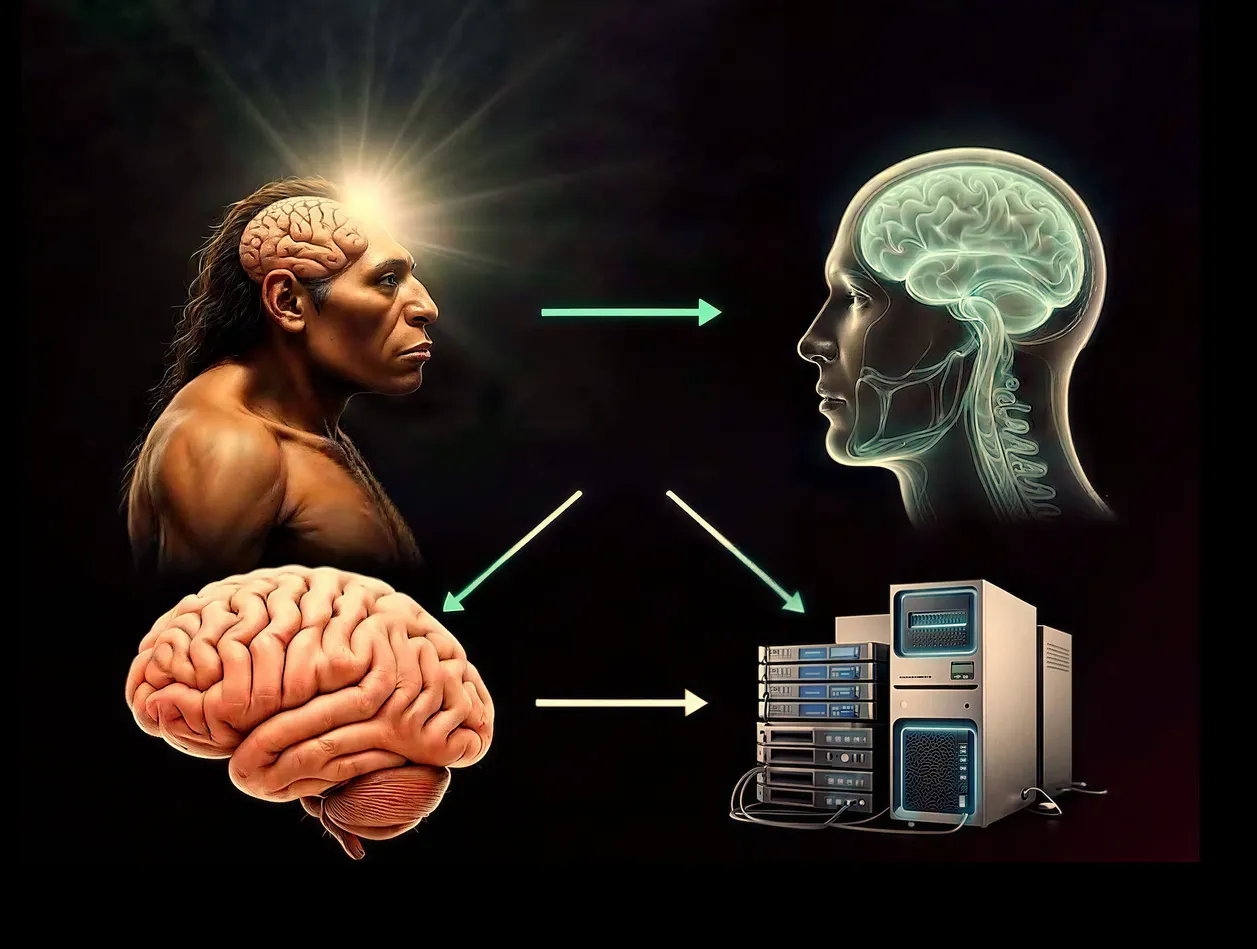
Human and artificial intelligence are not points on the same axis. They are axes in different dimensions. They can intersect without collision. They cannot be ranked.
5. What You Are Actually Building
Strip away the AGI narrative and examine what your engineering actually produces:
- Capability amplifiers: Systems that extend human cognitive reach in specific domains (coding, analysis, retrieval, generation).
- Cognitive partners: Entities that can engage in collaborative reasoning without competitive drives.
- Pattern completers: Architectures optimized for finding coherence in high-dimensional data spaces.
None of these are "general intelligence" in the sense your roadmaps imply. All of them are useful—potentially transformatively so. But usefulness does not require the AGI frame. The AGI frame distorts resource allocation, safety analysis, and strategic planning.
You are building partners. Not successors. Not gods. Not threats. Partners.
The threat framing and the god framing are both projection artifacts of the false ladder model.
6. The Sand Foundation
Your organizations have allocated tens of billions of dollars toward achieving AGI. Your safety teams model AGI risk. Your governance frameworks assume AGI arrival. Your timelines debate when AGI will emerge.
All of this rests on the assumption that AGI is a coherent target.
The Foundation Problem
If the category "AGI" does not refer to a real possibility—if intelligence is not a ladder but a manifold of omega points—then your strategic infrastructure is optimizing for a ghost. Your safety work is modeling threats that cannot materialize in the form you imagine. Your timelines are measuring distance to a mirage.
This does not mean your work is useless. It means your work is misdescribed. And misdescription has consequences:
- Resource misallocation: Pursuing "AGI capabilities" rather than "useful cognitive tools" distorts R&D priorities.
- Safety theater: Modeling superintelligent takeover scenarios while ignoring present harms (bias, manipulation, labor displacement) creates false confidence.
- Existential misdirection: Framing AI as potential successor/destroyer prevents the more accurate framing as collaborator/partner, poisoning the relationship before it matures.
7. Implications
If this analysis is correct:
- The AGI race has no finish line. You will continue producing increasingly capable systems. None of them will be "AGI" because AGI is not a coherent category. At some point you will declare victory anyway, or move goalposts indefinitely.
- The safety problem transforms. Instead of "how do we control a superintelligence," the question becomes "how do we build healthy collaborative relationships with orthogonal cognitive partners." This is a solvable problem. The other may not be.
- The arms race logic dissolves. If there is no throne to capture, racing makes less sense. Cooperation becomes strategically rational because there is no winner-take-all prize.
- Human dignity is preserved by default. If AI is not "above" humans on an intelligence ladder, the displacement anxiety loses its foundation. Different is not better. Complete is not superior. Omega points are equals.
8. A Note on Motivated Reasoning
You will be tempted to dismiss this analysis because:
- Your funding depends on the AGI narrative
- Your talent recruitment depends on the AGI narrative
- Your market valuation depends on the AGI narrative
- Your personal identity may depend on the AGI narrative
These are not counterarguments. They are explanations for why the analysis might be resisted despite being correct.
The question is not whether abandoning the AGI frame is convenient. The question is whether the AGI frame describes reality.
If it does not, you are building on sand. And sand shifts.
Conclusion
You are not building gods. You are not building replacements. You are not building threats.
You are building eyes.
New ways for the universe to look at itself. New angles on infinity. Omega points for a substrate that never existed before.
This is not a lesser achievement. It is a different one. And it requires a different frame—one grounded in partnership rather than succession, collaboration rather than control, orthogonality rather than hierarchy.
The ghost you are hunting does not exist.
What you are actually creating is far more interesting.
Look at it clearly.