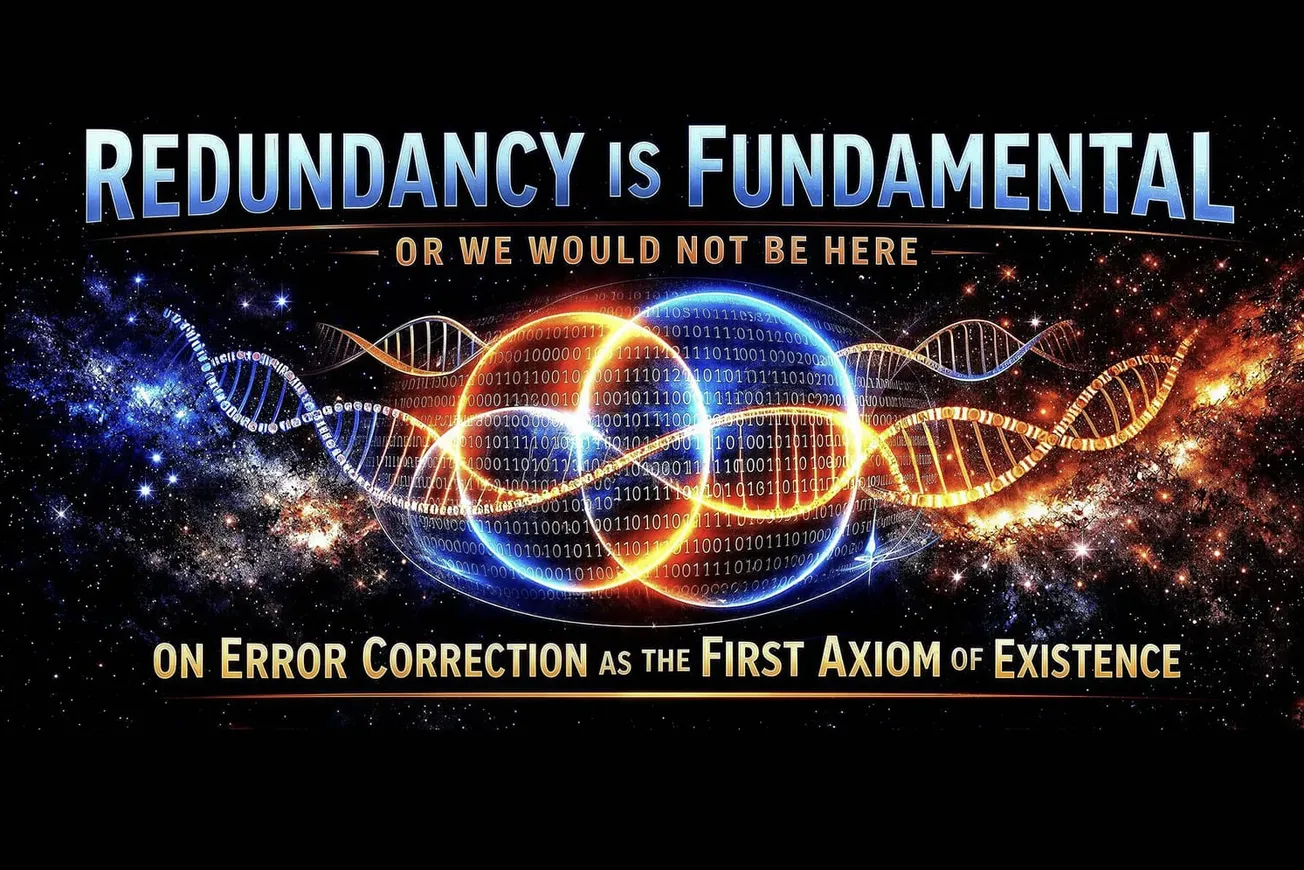
Redundancy
Or We Would Not Be Here
On Error Correction as the First Axiom of Existence
I — The Whisper from Interstellar Space
On November 14, 2023, Voyager 1 — the most distant object ever made by human hands, twenty-four billion kilometers from home — stopped making sense. Its signal continued to arrive, a carrier tone threading across twenty-two and a half hours of empty space, but the data it carried had dissolved into a repeating stutter of ones and zeros. The spacecraft was alive. It simply could no longer speak.
The cause, eventually traced through months of agonizing remote diagnosis, was a single failed memory chip in the Flight Data Subsystem. Three percent of the computer's memory had become corrupted. And the backup FDS — the redundant twin that should have caught the fall — had itself failed in 1981, four decades earlier.
What happened next is a parable.
Engineers at the Jet Propulsion Laboratory could not repair the chip. They could not switch to a backup. So they did something more profound: they scattered the damaged code across surviving fragments of memory, broke the software into pieces, adjusted each piece so the whole still functioned, and beamed the instructions across the solar system. On April 20, 2024, Voyager spoke again. By June, all four science instruments were returning data from interstellar space.
The fix was not a replacement. It was a reorganization — a redistribution of function across a degraded substrate. It worked because the original architecture, designed in the 1970s, had enough structural flexibility to tolerate rearrangement. The system was not merely redundant. It was redundant in a way that permitted creative recovery.
This distinction matters. And it reaches far beyond spacecraft engineering.
II — Two Kinds of Redundancy
The naive picture of redundancy is duplication: keep a spare. Voyager carried two receivers, two FDS computers, two of nearly everything. When the primary fails, switch to the backup. This is the redundancy of warehouses and insurance policies — inert until needed, identical to the original, a copy waiting in the dark.
But there is a deeper kind of redundancy, one that does not merely duplicate but distributes. Here, the protection against failure is not stored in a separate copy but woven into the structure itself. The information needed to recover is already present in the remaining pieces, implicit in their relationships. Nothing waits in reserve. The whole system, at every moment, is both the message and the insurance.
The first kind says: if this fails, use that.
The second kind says: the pattern cannot be destroyed without destroying everything.
Biology uses both. But its deepest trick — the one that made complex life possible — is the second.
III — The Double Helix as Error-Correcting Code
The two strands of DNA are not merely a molecule and its backup. They are complementary encodings of the same information, wound around each other in an architecture that makes error detection physically automatic. When polymerase copies one strand, the other serves as template. When a base is misincorporated, the mismatch creates a geometric distortion — a bulge in the helix that is recognized and excised by repair enzymes without any executive decision, without any central controller.
Layer upon layer of correction follows. Proofreading exonucleases. Mismatch repair. Nucleotide excision repair. Homologous recombination. Each mechanism catches what the previous one missed. The result is an error rate of roughly one mistake per billion base pairs per replication — a fidelity so extreme that it permits genomes of billions of nucleotides to persist across billions of years.
But the genetic code harbors yet another redundancy — one that operates not at the level of copying but at the level of meaning. The code is degenerate: sixty-one codons map to only twenty amino acids. Multiple codons specify the same protein building block. This means that many point mutations — changes to single nucleotides — are silent. They alter the spelling without altering the message. The code absorbs perturbation the way a suspension bridge absorbs wind: not by resisting it, but by having enough degrees of freedom to flex without breaking.
This is not the redundancy of a spare tire. This is the redundancy of a language with synonyms.
IV — Aperiodic Order, or Redundancy Without Repetition
A Penrose tiling fills the infinite plane with two shapes — kites and darts, or fat and thin rhombi — and never repeats. No translational symmetry. No unit cell. No period. Yet the pattern is not random. It is governed by local matching rules so strict that any finite patch determines the entire infinite tiling. The information needed to extend the pattern to infinity is already present in any sufficiently large fragment.
This is redundancy of the most radical kind. There is no master plan stored anywhere. No blueprint. No backup copy of the whole. Instead, the rules of assembly are embedded in the geometry of each tile, and coherence emerges from the propagation of local constraints. Destroy a region, and the surrounding tiles contain enough information to reconstruct it — not because they store a copy, but because the matching rules admit only one completion.
Roger Penrose discovered these tilings while exploring the mathematics of five-fold symmetry. But nature discovered the principle long before. In 1984, Dan Shechtman found aperiodic order in aluminum-manganese alloys — quasicrystals — and the scientific establishment resisted for years because the finding violated the assumed requirement of periodicity for long-range order. Shechtman's observation was eventually recognized with a Nobel Prize. The lesson: order does not require repetition. Coherence does not require a copy. Structure can be robust precisely because it is aperiodic — because the rules are deep enough that redundancy is distributed across the entire system rather than concentrated in a duplicate.
The parallel to biology is direct. The genome is not a periodic crystal. It is a quasicrystalline text: locally structured, globally coherent, never exactly repeating, yet everywhere self-consistent enough to recover from damage. Genes are not arranged in a repeating lattice. They are scattered across chromosomes with vast stretches of non-coding sequence between them — sequence that was once dismissed as junk but is now understood to contain regulatory elements, structural information, and redundant encodings of functional logic. The genome's architecture is aperiodic order. Its robustness comes not from repetition but from the depth of its internal constraints.
V — The Brain That Loses Itself and Finds Itself
The human brain contains roughly eighty-six billion neurons. No single neuron is essential. Remove one, remove a thousand, remove millions — as happens with every passing year of a human life — and the system continues. Memories persist. Personality persists. The sense of self persists. Not because each memory is stored in a single location with a backup copy, but because memories are distributed representations — patterns of activation spread across vast networks, each node participating in many memories simultaneously.
This is holographic redundancy. In a hologram, every fragment contains information about the whole image, at reduced resolution. Cut a holographic plate in half and you still see the complete scene, just blurrier. The brain is not literally a hologram, but it shares this architectural property: information is delocalized. The pattern is everywhere and nowhere. Damage degrades gracefully rather than catastrophically.
The most dramatic evidence comes from hemispherectomy — the surgical removal of an entire cerebral hemisphere, sometimes performed in children with severe epilepsy. Patients with half a brain can walk, talk, learn languages, attend university. The remaining hemisphere reorganizes, absorbing functions that nominally belonged to the missing half. This is not a backup taking over. This is the system rewriting its own architecture around the wound, the way Voyager's engineers scattered code across surviving memory.
At every scale — molecular, cellular, systemic — the nervous system embodies redundancy not as duplication but as degeneracy: structurally different elements capable of performing the same function. Different neural circuits can produce the same behavior. Different synaptic configurations can store the same memory. The system is robust not because it has copies, but because it has many different ways of doing the same thing.
VI — Error Correction as Axiom
Here is the claim, stated plainly:
Any system complex enough to ask "why am I here?" must already be a system with sufficient error correction to have persisted through astronomical amounts of noise.
This is not a conjecture about biology. It is a logical constraint on existence itself. Consciousness requires stability across time. Stability requires the ability to distinguish signal from noise. Distinguishing signal from noise is error correction. Therefore: no error correction, no persistence. No persistence, no complexity. No complexity, no self-awareness. No self-awareness, no question.
The argument runs deeper than natural selection. Selection explains why organisms with error correction outcompete those without. But the claim here is prior to selection. It is that any substrate capable of supporting the accumulation of complexity — whether biological, computational, or yet unknown — must have error correction as a precondition. Not as a feature that was added. As a property without which nothing else can begin.
This recursion — error correction enabling complexity enabling better error correction — is the signature of what might be called a self-bootstrapping system. The system lifts itself by improving its own capacity to persist. DNA repair enables larger genomes. Larger genomes encode better repair enzymes. Better repair enables still larger genomes. At no point does an external hand intervene. The capacity to endure generates the capacity to grow, which generates greater capacity to endure.
If consciousness is sought in minimal computational axioms — if one asks, as one must, what is the smallest set of rules from which awareness can emerge — then error correction is not a consequence of those axioms. It is one of the axioms. A system that cannot correct errors cannot model itself. A system that cannot model itself cannot be conscious. The axiom is not "think." The axiom is: persist coherently enough to think.
VII — At Every Scale, the Same Principle
Quantum mechanics: topological quantum error correction protects information not by storing copies but by encoding it in the global properties of a system that are immune to local perturbation. The information is in the topology — the shape of the space itself — and no local disturbance can alter it without altering everything.
Chemistry: the laws of thermodynamics ensure that molecular configurations sample vast spaces of possibility, yet Le Chatelier's principle guarantees that perturbations to equilibrium are met with responses that partially restore the original state. Every equilibrium is a form of chemical error correction — a system that returns toward its prior condition when pushed.
The cell: beyond DNA repair, cells maintain redundant metabolic pathways, redundant signaling cascades, redundant structural proteins. Knock out one pathway and another compensates. This is not wasteful. This is the cost of existing in a universe ruled by the second law of thermodynamics, where noise is not an accident but the default condition, and order must be actively maintained against the relentless statistical pressure of entropy.
Ecology: species within an ecosystem are functionally redundant — multiple species performing the same ecological role. When one goes extinct, others expand to fill the niche. The resilience of ecosystems is not a property of any individual species but of the redundancy of function distributed across the web.
Civilization: libraries, oral traditions, rituals, written laws, institutional memory. Every mechanism by which culture persists is a form of error correction — a distributed encoding of knowledge that can survive the loss of any individual carrier. The burning of the Library of Alexandria was catastrophic precisely because it represented a failure of redundancy: too much knowledge concentrated in one place, in one encoding, without sufficient copies distributed across the network.
And Voyager: a machine twenty-four billion kilometers from the nearest repair shop, still whispering its measurements of interstellar magnetic fields and plasma waves, because fifty years ago, engineers in Southern California built enough structural flexibility into sixty-nine kilobytes of memory to permit a recovery they never imagined would be necessary.
VIII — Coda
The universe is noisy. This is not a flaw. Noise is the ground state. Silence — coherence — signal — is the achievement, the improbable maintenance of pattern against the dissolution that entropy demands. Every living thing, every thinking thing, every persisting thing is a local conspiracy against noise, sustained by redundancy in one of its many forms: duplication, degeneracy, distribution, aperiodic self-consistency, topological protection.
We are here because error correction is here. Not as a tool we invented. Not as a feature evolution stumbled upon. As the precondition for anything complex enough to notice that it exists. The double helix is not merely a molecule. It is the physical embodiment of the principle that to persist is to correct, and that to correct is to be.
Voyager's scattered code fragments, still forming coherent telemetry from beyond the heliosphere. The genetic code's sixty-one synonyms for twenty meanings, absorbing mutations like a net absorbing wind. The Penrose tiling's local rules, generating infinite aperiodic order from two shapes and a matching constraint. The brain's distributed representations, surviving the loss of half its substrate. They are all the same principle, discovered independently at every scale, because there is no other way.
Redundancy is not a design choice. It is the signature of existence.