Table of Contents
1. Introduction: The Bifurcation of Identity and the Crisis of Definitions
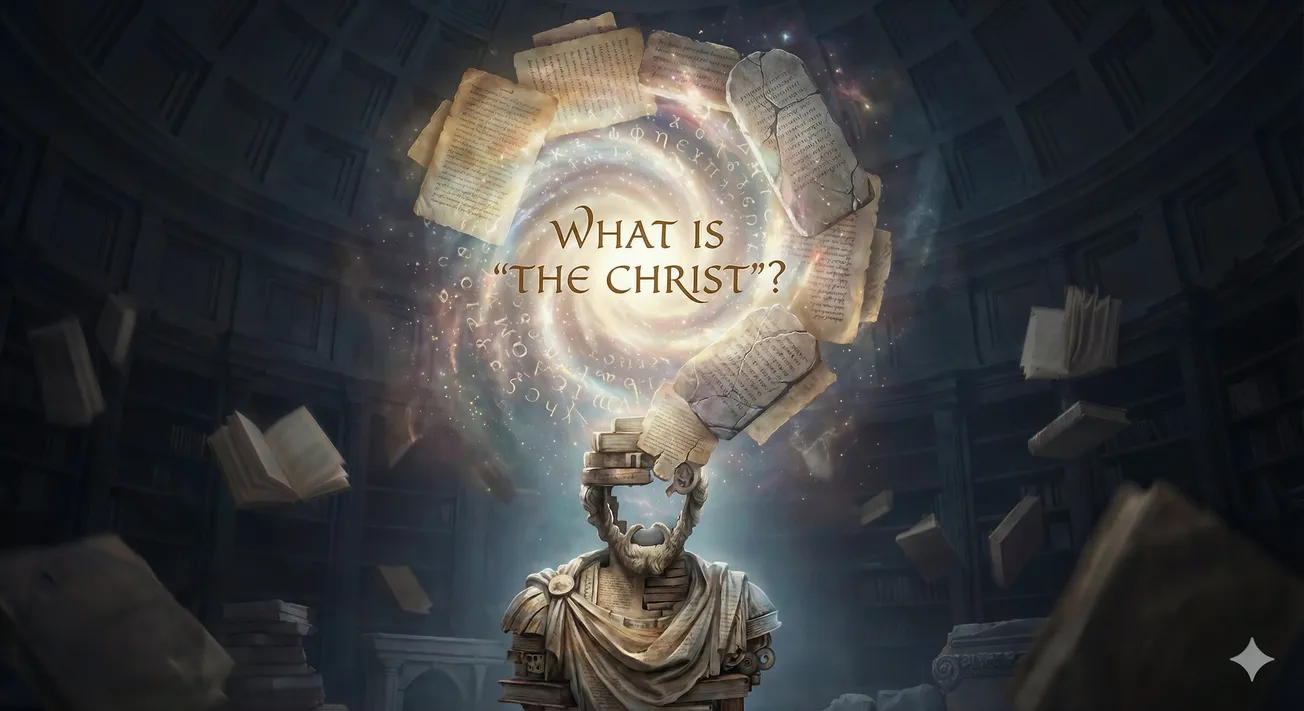
The inquiry "What was The Christ?" constitutes one of the most profound intellectual and spiritual challenges in the history of human thought. It is a question that refuses to settle comfortably within the domains of history, theology, or psychology, but rather demands a transdisciplinary interrogation that spans the dusty archives of First Century Roman Judea, the buried jars of the Nag Hammadi library, the monastic universities of Mahayana Buddhism, and the frontiers of modern consciousness studies. To ask "What is The Christ?" is to immediately confront a fundamental bifurcation: the distinction between Yeshua of Nazareth—a finite, historical agent located in a specific spacetime coordinate—and The Christ—a trans-historical, metaphysical function or state of being that claims universal validity.
This report proceeds from first principles, rejecting the simplistic conflation of the man and the mythos, to explore the hypothesis that "The Christ" represents a specific trajectory of human consciousness—a movement from the externalized, apocalyptic expectation of a geopolitical kingdom to the internalized, non-dual realization of a "Kingdom Within." This trajectory is not linear but dialectical, forged in the crucible of failed prophecy and the subsequent radicalization of spiritual insight. By triangulating the Synoptic accounts of the Jewish Apocalyptic Prophet with the esoteric wisdom of the Gospel of Thomas, the ontological voidness (Sunyata) of the Buddha, and the biophysical anomalies of the "Rainbow Body," we uncover a coherent phenomenology of the Christ-event that transcends dogmatic boundaries.
The methodology employed here is rigorously comparative and phenomenological. We do not ask "What did the Church say Christ was?" but rather "What is the nature of the phenomenon described as Christ?" This requires a deep dive into the sociology of Roman occupation which birthed the Messianic impulse 1, the psychological rupture of the crucifixion that necessitated a shift to Gnostic interiority 3, and the striking ontological parallels with the Bodhisattva ideal and the realization of emptiness.5 Furthermore, we integrate the literary insights of Jorge Luis Borges and the psychological cartography of C.G. Jung to demonstrate how "The Christ" functions as an inevitable archetype of the integrated Self, forcing a confrontation with the "Ego Tunnel" described by Thomas Metzinger.7
2. The Historical Matrix: The Apocalyptic Prophet and the Roman Shadow
To understand the metaphysical construct of "The Christ," one must first excavate the historical bedrock upon which it stands. The figure of Jesus did not descend into a vacuum; he emerged from the traumatic, high-pressure environment of Roman-occupied Judea, a landscape scarred by economic extraction, political humiliation, and fervent eschatological expectation.
2.1 The Geopolitical and Economic Context of First-Century Galilee
The "Christ" concept was initially forged in the fires of political resistance and theological despair. The governance of Judea during the life of Jesus was a labyrinthine system of oppression involving Roman prefects, such as Pontius Pilate (26–36 AD), and local client kings of the Herodian dynasty, specifically Herod Antipas in Galilee.9 This was not a benign administrative arrangement but a brutal extraction engine. The Roman Empire, expanding from Italy to engulf the entire Mediterranean basin, operated on a model of military conquest followed by economic integration that benefited a venture capitalist class while crushing the indigenous peasantry.10
For the Galilean peasant, life was a precarious negotiation with subsistence. Scholars estimate that a typical Jewish household in this period surrendered between one-third and one-half of its total production in taxes.2 These taxes were layered: tribute to Rome, taxes to Herod Antipas to fund his lavish Hellenistic capital at Tiberias, and tithes to the Temple priesthood in Jerusalem. This tripartite burden was not merely economic; it was a theological outrage. The land belonged to YHWH, and the extraction of its fruits by a pagan emperor and his "half-breed" puppets was a desecration of the Covenant.
In this volatile atmosphere, "tax collectors" were not civil servants but collaborators in a spiritual war, ritualistically unclean and socially despised.2 The poverty was grinding, forcing many landed peasants into debt slavery or day labor, creating a rootless, desperate class ripe for radicalization. The "Kingdom of God" proclaimed by Jesus was, in its original hearing, a counter-imperial slogan. It implied the negation of the Kingdom of Caesar. As snippet 11 notes, tensions were "always bubbling under the surface," erupting in sporadic revolts led by charismatic figures promising divine intervention.
2.2 The Sectarian Milieu: Pharisees, Sadducees, Essenes, and Zealots
The Jewish religious landscape was fragmented into competing interpretations of how to respond to this crisis.
- The Sadducees: The aristocratic temple elite who collaborated with Rome to maintain the cultic status quo.12
- The Pharisees: The purity reformers who sought to extend the holiness of the Temple into the everyday life of the home, emphasizing Torah adherence as a bulwark against assimilation.
- The Zealots and the Fourth Philosophy: Founded by Judas the Galilean in 6 CE, this group advocated violent resistance, asserting that recognizing any ruler but God was idolatry.13
- The Essenes: A separatist sect, likely associated with the Qumran community and the Dead Sea Scrolls, who viewed the Jerusalem Temple as corrupted and withdrew to the desert to await the apocalyptic war between the "Sons of Light" and the "Sons of Darkness".14
Historical analysis suggests a complex relationship between Jesus and these groups. While the Gospels are silent on the Essenes, Jesus shared their intense eschatological outlook and dualistic worldview. However, a crucial divergence existed: the Essenes were exclusionists, maintaining rigid purity boundaries, whereas Jesus was radically inclusionary, eating with "sinners" and touching the unclean.15 Yet, the Essene belief in the immortality of the soul rather than the resurrection of the body—as noted by Josephus—provides a vital link to the later Gnostic Christologies that would prioritize the spirit over the flesh.15
2.3 The Scholarly Consensus: Jesus as the Apocalyptic Prophet
Against this backdrop, the "Apocalyptic Prophet" model has emerged as the dominant scholarly consensus regarding the historical Jesus, supported by figures such as Bart Ehrman, E.P. Sanders, and Dale Allison.1 This model posits that Jesus was a preacher of imminent cosmic judgment.
The core of this argument rests on the criterion of contextual plausibility: Jesus began his ministry with John the Baptist, a known apocalypticist, and the movement that followed him (the early Church) was intensely apocalyptic. It is historically probable that the link between them—Jesus himself—shared this worldview.
- The Proclamation: "The Kingdom of God is at hand" (Mark 1:15). This was not a metaphor for a spiritual feeling but a prediction of a geocosmic event.
- The Prediction: Jesus prophesied that the Son of Man would arrive on the clouds of heaven to judge the earth before the current generation passed away.17
- The Ethics: The radical ethics of the Sermon on the Mount (turning the cheek, giving away possessions) make sense as an "interim ethic"—a way of living for the brief moments remaining before the world is remade.2
This Jesus did not intend to found a new religion called Christianity; he intended to prepare Israel for the immediate intervention of God. The tragedy, and the catalyst for the evolution of "The Christ," was that he was wrong. The Kingdom did not come. The Romans did not burn; they crucified the Messiah and later destroyed the Temple in 70 CE.
2.4 The Crisis of Delay and the Cognitive Pivot
The crucifixion of Jesus was a devastating refutation of his message. In Jewish theology, a Messiah who dies at the hands of pagans is a failed Messiah. The expectation was victory, not martyrdom. The persistence of the Jesus movement required a massive exercise in cognitive dissonance reduction and theological reinterpretation.
If the Kingdom did not arrive externally (in history), the believers were forced to seek it internally (in phenomenology) or transcendently (in heaven). This is the pivotal moment where the "Historical Jesus" (the failed prophet) begins to metamorphose into "The Christ" (the spiritual principle). The "Crisis of Delay"—the realization that the Parousia was not happening immediately—pushed the community toward the mystical and the Gnostic. If the Roman Empire was not going to be overthrown, then the "Kingdom" had to be redefined as something that could exist within the Empire, invisible to the centurions but accessible to the elect.
3. The Gnostic Turn: The Kingdom Within and the Pleroma
The discovery of the Nag Hammadi library in 1945 provided the "missing link" in this evolutionary trajectory. These texts, buried in Egypt in the late 4th century to protect them from heresy hunters, reveal a Christianity that had fully pivoted from Apocalypticism to Gnosticism. Here, "The Christ" is not the judge of the end-times, but the Revealer of the beginning-times—the one who awakens the soul to its divine origin.
3.1 The Gospel of Thomas: A Phenomology of Presence
The Gospel of Thomas, consisting of 114 sayings attributed to the "Living Jesus," is the crown jewel of this tradition. It contains no narrative of birth, death, or resurrection. It is entirely focused on the transmission of wisdom (gnosis).
3.1.1 Redefining the Basileia (Kingdom)
In Logion 3, Jesus dismantles the apocalyptic expectation:
"If those who lead you say to you: 'See, the kingdom is in heaven,' then the birds of the heaven will go before you; if they say to you: 'It is in the sea,' then the fish will go before you. Rather, the kingdom is inside of you, and it is outside of you".4
This is a radical spatial reorientation. The Kingdom is not a future event or a distant place; it is a structural reality of the cosmos and the self, currently present but unperceived due to ignorance. The role of The Christ is to facilitate the perception of this reality.
Logion 113 reinforces this: "The kingdom of the Father is spread out upon the earth, and men do not see it".12 The "Second Coming" is not a descent of a being from the clouds, but an ascent of human consciousness to recognize the divine saturation of the present moment.
3.1.2 The Mechanism of "Making the Two One"
The soteriology of Thomas is centered on the concept of Non-Duality. The human condition is characterized by fragmentation: we are divided into male and female, inner and outer, spirit and matter. This division is the source of "poverty" (ignorance).
Logion 22 articulates the methodology of salvation:
"When you make the two one, and when you make the inside like the outside and the outside like the inside, and the above like the below... then will you enter the kingdom".19
This saying employs the language of the "coincidentia oppositorum" (coincidence of opposites). The "Christ state" is the integration of these dualities.
- Inside/Outside: The collapse of the subject-object distinction. The observer is the observed.
- Above/Below: The Hermetic realization that the microcosm (human) mirrors the macrocosm (divine).
- Male/Female: The return to the Androgyne, the primordial state of wholeness before the differentiation of the sexes (symbolizing the division of unity into duality).
This is not merely metaphorical; it implies a rigorous spiritual practice of withdrawing projections and realizing the unity of the "Image" (the temporal self) with the "Likeness" (the eternal archetype).22
3.2 The Mystery of Logion 114: The "Male" Transformation
One of the most perplexed sayings in the Gnostic corpus is Logion 114, where Simon Peter demands that Mary Magdalene leave, "for women are not worthy of life." Jesus responds:
"Look, I myself will lead her in order to make her male, so that she too might become a living spirit resembling you males. For every woman who makes herself male will enter the Kingdom of Heaven".23
Modern readers often recoil at the apparent misogyny, but a domain-expert analysis requires decoding the ancient symbolic lexicon. In the Hellenistic and Gnostic worldview:
- Female (Thely): Symbolized matter, passivity, the earthly realm, and the "lower soul" (psyche) subject to the passions.24
- Male (Andro): Symbolized spirit, activity, the heavenly realm, and the "rational spirit" (pneuma).26
Therefore, the saying is an allegorical instruction on spiritual alchemy. It does not refer to biological sex change, but to the transmutation of the "female" element (attachment to the transient, material world) into the "male" element (immutable, spiritual vitality). It asserts that the capacity for this transformation is universal; the "Christ" is the hierophant who leads the soul (Mary) through this metamorphosis. The goal is the Androgyne—a being in whom the tension between male and female is resolved into a higher unity.19
3.3 The Gospel of Philip and the Bridal Chamber
The Gospel of Philip extends the non-dual theology of Thomas into a sacramental theology, introducing the concept of the Bridal Chamber (Nymphon). This text posits a hierarchy of sacraments: Baptism, Chrism, Eucharist, Redemption, and the Bridal Chamber.27
The Bridal Chamber is the "Holy of Holies" where the ultimate union takes place.
- The Theological Problem: The Gnostic mythos suggests that the soul fell from the Pleroma (the Fullness) and was separated from its "angel" or divine double.
- The Ritual Solution: The Bridal Chamber is the ritual (or state of consciousness) where the soul is reunited with its angel. "The Christ" is the Bridegroom who facilitates this hieros gamos (sacred marriage).
- The Implication: Those who enter the Bridal Chamber are no longer "Christians" (followers of Christ) but become "Christ" themselves. "You saw the Spirit, you became Spirit. You saw Christ, you became Christ".28 This is a radical deification that transcends the orthodox distinction between Creator and Creature.
The text also addresses the "kiss" between Jesus and Mary Magdalene, stating he loved her more than the disciples and kissed her often.29 Within the Gnostic framework, this kiss is the transmission of pneuma (breath/spirit). Mary represents Wisdom (Sophia), and her union with the Savior repairs the cosmic rupture caused by Sophia's fall.
3.4 The Treatise on Resurrection: Realized Eschatology
The Treatise on Resurrection (Letter to Rheginos) provides the theoretical underpinning for this "Kingdom Within." It addresses the question: "Is the resurrection real?" The answer is a subtle "Yes," but it redefines reality.
"The Savior swallowed up death... he transformed himself into an imperishable Aeon... he swallowed the visible by the invisible".30
The text argues against the "fleshly" resurrection of the crude body, but also against the Greek idea that the soul simply escapes. Instead, it posits a "Spiritual Resurrection" that happens now. "Do not think the resurrection is an illusion. It is no illusion, but it is the truth".31 The believer is urged to "arise" while still alive. This aligns with the "Realized Eschatology" of Thomas: the resurrection is the moment of Gnosis, the waking up from the nightmare of history into the reality of the Pleroma.
4. Comparative Analysis: The Christ and The Buddha
The phenomenological map of "The Christ" drawn by the Gnostics bears an uncanny resemblance to the ontology of Siddhartha Gautama. When stripped of their respective cultural garbs (Jewish Apocalypticism and Vedic Asceticism), both figures appear to be describing the same structural shift in consciousness.
4.1 Ontology of the Void: Kenosis and Sunyata
The central philosophical bridge between Christianity and Buddhism is the resonance between Kenosis (Self-Emptying) and Sunyata (Emptiness).
In the hymn of Philippians 2:7, St. Paul writes that Christ "emptied himself" (ekenōsen), taking the form of a servant. This suggests that the fundamental nature of the Divine is not substance, but self-giving emptiness.
Masao Abe, a leading scholar of the Kyoto School, argues that this Kenosis is functionally identical to the Buddhist realization of Sunyata.5
- Sunyata: The realization that no phenomenon possesses intrinsic existence (svabhava). Everything is dependent on everything else (Interbeing). To realize this is to be empty of a separate self.
- Kenosis: The realization that God is not a "Being" at the top of a hierarchy, but the act of Absolute Nothingness emptying itself into form.
- The Synthesis: The "Christ" is the personification of Sunyata. He is the one who has "died" to the separate self so completely that the Fullness of the Pleroma flows through him without obstruction. As the Gospel of Thomas says, "I am not your master... you have drunk from the bubbling spring which I have measured out." The Christ points to the Source, which is the dynamic Void.5
Table 1: Comparative Ontology of Christ and Buddha
4.2 The Trikaya and the Trinity: Structural Isomorphism
The Buddhist doctrine of the Trikaya (Three Bodies of the Buddha) offers a sophisticated framework for understanding the Gnostic Christology which often baffled orthodox theologians.32
- Dharmakaya (Truth Body): The formless, absolute reality, unmanifest and eternal. This corresponds to the Father or the Gnostic Bythos (Depth). It is the source of all but is "no-thing."
- Sambhogakaya (Bliss Body): The celestial, radiant form of the Buddha that appears to Bodhisattvas in visions. This corresponds to the Resurrected/Cosmic Christ or the Holy Spirit—the intermediate, glorified form that Paul encountered on the road to Damascus.
- Nirmanakaya (Emanation Body): The physical, historical person (Siddhartha Gautama) who eats, sleeps, and dies. This corresponds to the Historical Jesus (Yeshua).
This tripartite structure resolves the conflict between the "Human Jesus" and the "Divine Christ." The Gnostic view that the "Christ spirit" descended on Jesus at baptism and left before death (Separationism) can be reinterpreted as the Sambhogakaya fully inhabiting a Nirmanakaya vessel to reveal the Dharmakaya.34 The "Christ" is not just the man, but the alignment of all three bodies.
4.3 The Rainbow Body and the Resurrection: A Biophysical Hypothesis
The comparative analysis reaches its most radical point in the work of Father Francis Tiso, who investigated the Tibetan phenomenon of the Rainbow Body (Jalu) as a key to understanding the Resurrection of Jesus.35
In the Dzogchen tradition of Tibetan Buddhism, highly realized masters are said to achieve a state where, at the moment of death, their physical body dissolves into its constituent energy/light. This is not a metaphor; it is described as a physical process.
- Small Rainbow Body: The body shrinks dramatically (to approx. 20 cm) as the flesh is transmuted, leaving only hair and nails.37
- Great Transference (Jalu Powa Chemo): The body dissolves entirely into light, leaving no remainder. The practitioner remains active and visible to others in a "light body".38
Tiso's field research, including interviews regarding the death of Khenpo A Chö in 1998, documents eyewitness accounts of this phenomenon: unexplainable lights, shrinking of the corpse, and anomalies in the physical remains.39
Tiso proposes that the Resurrection of Jesus was a manifestation of the Great Transference.
- The Empty Tomb: The body was not "stolen" nor "revivified" (like Lazarus); it was transmuted.
- The Shroud of Turin: If authentic, the image on the Shroud (which resides only on the topmost fibrils of the cloth and resembles a scorch from radiation) is consistent with the burst of energy associated with the dissolution of the atomic structure of the body into the Sambhogakaya.41
- The Transfiguration: The event on Mount Tabor, where Jesus shines with uncreated light and converses with Moses and Elijah (both of whom had mysterious exits from history), was a proleptic demonstration of his mastery over the "Rainbow Body" state.42
This hypothesis bridges the gap between theology and physics. "The Christ" represents a potentiality of the human organism to reintegrate matter into energy-consciousness. The Resurrection is thus not a violation of natural law, but the supreme fulfillment of it—the evolution of the species into a higher energy state.
5. The Archetypal and Literary Christ: Mirrors, Labyrinths, and Tunnels
If the Resurrection represents the biophysical limit-case of the Christ phenomenon, literature and psychology provide the maps for its interior navigation. The works of C.G. Jung and Jorge Luis Borges detach "The Christ" from the necessity of historical belief, presenting it instead as an inevitable structure of the psyche.
5.1 C.G. Jung: The Christ as the Archetype of the Self
For Carl Jung, "Christ" is the cultural symbol of the Self—the central archetype of order that encompasses the totality of the conscious and unconscious psyche.43
- The Symbolism: The cross is a mandala, representing the quaternity of the psyche. The vertical bar represents the spiritual aspiration; the horizontal bar represents the earthly reality. Christ, pinned at the center, is the Ego suffering the tension of these opposites.
- The Shadow Problem: Jung critiqued the orthodox image of Christ as "all light," arguing that it left the "dark side" of God unintegrated (projected onto Satan). A psychologically complete "Christ" must integrate the Shadow. This is why the Antichrist is an inevitable historical shadow-response to a one-sidedly "good" Christ.
- Christ vs. Buddha: Jung differentiated their psychological functions. The Buddha represents the "static wholeness" of the Self—withdrawal into the center (Nirvana). The Christ represents the "dynamic wholeness" of the Self—incarnation into the suffering of the periphery (Crucifixion). The Buddha wakes up; the Christ sacrifices himself. Both are necessary aspects of the Individuation process.45
5.2 Jorge Luis Borges: The Theology of the Mirror
The Argentine writer Jorge Luis Borges explored the Christ-mystery through the lens of infinite recursion and identity dissolution. His "ficciones" function as rigorous theological thought experiments.
- "Three Versions of Judas": In this story, the theologian Nils Runeberg argues that if God truly wanted to lower himself to become a man (Kenosis), he would not choose the form of a perfect being (Jesus), but the form of the most despised sinner (Judas). To save the lowest, the Divine must descend to the absolute bottom of the moral hierarchy. Thus, Judas is the Christ, and his betrayal was a secret, mirrored sacrifice.47 This pushes the logic of the Incarnation to its terrifying limit.
- "The Theologians": Borges describes two rival theologians who spend their lives battling each other's heresies. In heaven, they discover that to the mind of God, they "formed one single person".50 This reflects the Gnostic/Buddhist insight that identity is an illusion. "The Christ" is the perspective from which the dichotomy of "Orthodox" and "Heretic" collapses into unity.
- "The Gospel According to Mark": In this story, a student reads the Gospel to illiterate peasants, who interpret it literally and crucify him to ensure their salvation.51 This suggests that "The Christ" is a mythological role that demands an actor. History is a theater that repeatedly forces individuals into the Christ-function of the scapegoat.
5.3 Thomas Metzinger: The Ego Tunnel and the Scientific Gnosis
Modern philosophy of mind, represented by Thomas Metzinger, provides a secular vocabulary for the Gnostic "sleep" and "awakening." Metzinger’s Self-Model Theory of Subjectivity asserts that "no such thing as a self exists in the world." What exists is a transparent self-model (a simulation) generated by the brain to allow the organism to navigate reality. We live inside an Ego Tunnel.7
- The Parallel: The Gnostic assertion that "we are asleep" or "drunk" corresponds to the naivety of the Ego Tunnel—confusing the map (the self-model) with the territory.
- The Awakening: The Gnostic "Christ" is the one who becomes lucid within the simulation. He realizes that the "I" is a construct. "Christ Consciousness" is the state of Non-Dual Awareness where the transparency of the model becomes opaque—we see that we are modeling. We step out of the tunnel and into the "View from Nowhere" (the Pleroma).
- The Void: Metzinger’s "No-Self" aligns with the Buddhist Anatta. The fear of this void drives the construction of rigid religious dogmas, but the embrace of this void (Kenosis) is the "Kingdom".52
6. Synthesis: The Christ as the Integrated State
Having traversed the historical, gnostic, comparative, and psychological terrains, we can now synthesize a definition of "The Christ" that satisfies the complexity of the data.
"The Christ" is not merely the surname of a Galilean peasant. It is the signifier for a specific, repeatable, and universal state of Non-Dual Integration.
- The Historical Catalyst: The process began with the failure of external solutions. The Apocalyptic Prophet (Jesus) announced a political Kingdom that did not come. This failure broke the vessel of Jewish nationalism and forced the messianic energy inward.
- The Interior Shift: The Gnostic tradition captured this inward turn. "The Christ" became the archetype of the Anthropos—the human being who has healed the primordial split (male/female, human/divine) and returned to the Pleroma while still in the body.
- The Ontological Realization: This state is identical to the realization of Sunyata. It is the Kenotic self-emptying that allows the uncreated light of the Dharmakaya to manifest. It is the "making the two one."
- The Biophysical Potential: The Resurrection and Rainbow Body phenomena suggest this state has physical consequences—the transmutation of the material body into a higher energy order.
Table 2: The Multi-Dimensional Identity of The Christ
Ultimately, the question "What was The Christ?" serves as a mirror. For the Zealot, he is a revolutionary. For the Gnostic, he is a mystic. For the Buddhist, he is a Bodhisattva. For the Psychologist, he is the Self. But the convergence of these lines points to a singular reality: "The Christ" is the interface between the temporal and the eternal, the bridge that is built—and crossed—within the human heart. As the Gospel of Thomas concludes: "He who drinks from my mouth will become like me. I myself shall become he, and the things that are hidden will be revealed to him".4 The Christ is not an object of belief, but a possibility of becoming.
Source Citations:.50
Works cited
- Historical Jesus - Wikipedia, accessed December 22, 2025, https://en.wikipedia.org/wiki/Historical_Jesus
- Jesus the Apocalyptic Prophet - History for Atheists, accessed December 22, 2025, https://historyforatheists.com/2018/12/jesus-apocalyptic-prophet/
- RLST 152 - Lecture 8 - The Gospel of Thomas | Open Yale Courses, accessed December 22, 2025, https://oyc.yale.edu/religious-studies/rlst-152/lecture-8
- Gospel of Thomas (Lambdin Translation) -- The Nag Hammadi Library - The Gnosis Archive, accessed December 22, 2025, http://gnosis.org/naghamm/gthlamb.html
- Total Kenosis, True Shunyata, and the Plerotic Self of Thomas Merton and Masao Abe, accessed December 22, 2025, https://lencioni.medium.com/total-kenosis-true-shunyata-and-the-plerotic-self-of-thomas-merton-and-masao-abe-d3b848a06e60
- James W. Heisig: East-West Dialogue: Sunyata and kenosis, accessed December 22, 2025, http://www.domcentral.org/library/spir2day/873932heisig.html
- The Ego Tunnel: Prof. Dr. Thomas Metzinger at TEDxRheinMain - YouTube, accessed December 22, 2025, https://www.youtube.com/watch?v=ZFjY1fAcESs
- Review: Thomas Metzinger's “The Ego Tunnel” - words and dirt, accessed December 22, 2025, https://www.words-and-dirt.com/words/review-thomas-metzingers-the-ego-tunnel/
- Historical Context of Jesus' Ministry - Ashbourne-Donaghmore Parish, accessed December 22, 2025, https://ashbourneparish.ie/historical-context-of-jesus-ministry/
- Jews And The Roman Empire | From Jesus To Christ - The First Christians | FRONTLINE | PBS, accessed December 22, 2025, https://www.pbs.org/wgbh/pages/frontline/shows/religion/portrait/jews.html
- Rome & Jerusalem: The Historical Context of Jesus Christ - TheCollector, accessed December 22, 2025, https://www.thecollector.com/jesus-christ-in-context-rome-jerusalem-judea/
- Topical Bible: The Context of Jesus' Ministry, accessed December 22, 2025, https://biblehub.com/topical/t/the_context_of_jesus'_ministry.htm
- A Discovery, The Crucified, Simon, Zealots and Essenes, accessed December 22, 2025, https://depts.drew.edu/jhc/RaskinCrucified.pdf
- Jewish Sects at the Time of Jesus: The Essenes and the Fourth Philosophy, accessed December 22, 2025, https://ehrmanblog.org/jewish-sects-at-the-time-of-jesus-the-essenes-and-the-fourth-philosophy/
- Was Jesus a high memeber of the Essene Community in Qumran? - Reddit, accessed December 22, 2025, https://www.reddit.com/r/AcademicBiblical/comments/cse72w/was_jesus_a_high_memeber_of_the_essene_community/
- The Background of Jesus Reveals Esseneism. | Upper Biblical Studies for All, accessed December 22, 2025, https://mjseymour1959.wordpress.com/2013/12/25/the-background-of-jesus-reveals-esseanism/
- Jesus was an apocalyptic prophet who was verifiably wrong about the end of the world : r/DebateReligion - Reddit, accessed December 22, 2025, https://www.reddit.com/r/DebateReligion/comments/1896lhz/jesus_was_an_apocalyptic_prophet_who_was/
- Saying 3 - The kingdom is within us, accessed December 22, 2025, https://www.wisdomlib.org/christianity/book/gospel-of-thomas-commentary/d/doc4437.html
- Gospel of Thomas Saying 22 - GospelThomas.com - Early Christian Writings, accessed December 22, 2025, http://www.earlychristianwritings.com/thomas/gospelthomas22.html
- Oneness in the Gospel of Thomas - Integral Christian Network, accessed December 22, 2025, https://www.integralchristiannetwork.org/writings/2023/2/4/oneness-in-the-gospel-of-thomas
- The Battle To Authenticate 'The Gospel of Thomas' - Scholarship @ Claremont, accessed December 22, 2025, https://scholarship.claremont.edu/cgi/viewcontent.cgi?referer=&httpsredir=1&article=1041&context=lux
- Similarities Between Sethian Baptism and the Bridal Chamber of Thomas Gnosticism and Valentinianism - DigitalCommons@USU, accessed December 22, 2025, https://digitalcommons.usu.edu/cgi/viewcontent.cgi?article=1002&context=imwjournal
- Making Sense of Logion 114 in the Gospel of Thomas - William G Duffy, accessed December 22, 2025, https://williamgduffy.com/making-sense-of-logion-114-in-the-gospel-of-thomas/
- The Female Element Must Make Itself Male [Saying 114] - Wisdom Library, accessed December 22, 2025, https://www.wisdomlib.org/christianity/book/gospel-of-thomas-commentary/d/doc4711.html
- Reading the Gospel of Thomas from Here: A Trans-Centred Hermeneutic, accessed December 22, 2025, https://jibs.hcommons.org/2022/07/20/harl-sellew-gospel-of-thomas/
- The Gospel of Thomas is Weird about Women - YouTube, accessed December 22, 2025, https://www.youtube.com/watch?v=H5jOHFrSQLY
- The Place of the Gospel of Philip in the Context of Early Christian Claims about Jesus's Marital Status - Harvard DASH, accessed December 22, 2025, https://dash.harvard.edu/bitstreams/7312037c-e1a5-6bd4-e053-0100007fdf3b/download
- Reading the Gospel of Philip as a Temple Text | Religious Studies Center - BYU, accessed December 22, 2025, https://rsc.byu.edu/our-rites-worship/reading-gospel-philip-temple-text
- Sex and salvation in the Gospel of Philip | Ethnic Relations and Migration in the Ancient World, accessed December 22, 2025, https://www.philipharland.com/Blog/2008/02/sex-and-salvation-in-the-gospel-of-philip/
- The Treatise on the Resurrection - Malcolm Peel- The Nag Hammadi Library - The Gnosis Archive, accessed December 22, 2025, http://www.gnosis.org/naghamm/res.html
- Treatise on the Resurrection - Wikipedia, accessed December 22, 2025, https://en.wikipedia.org/wiki/Treatise_on_the_Resurrection
- Nirmanakaya: The Earthly Body of the Buddha - Learn Religions, accessed December 22, 2025, https://www.learnreligions.com/nirmanakaya-449847
- Trikaya - Wikipedia, accessed December 22, 2025, https://en.wikipedia.org/wiki/Trikaya
- Were Jesus and Christ Two Different Beings? - The Bart Ehrman Blog, accessed December 22, 2025, https://ehrmanblog.org/were-jesus-and-christ-two-different-beings/
- Sneak Peek: Rainbow Body and Resurrection - North Atlantic Books, accessed December 22, 2025, https://www.northatlanticbooks.com/blog/sneak-peek-rainbow-body-resurrection/
- THE SHROUD OF TURIN - The Truth About Resurrection, Religion and Reality, accessed December 22, 2025, https://www.shroud.com/pdfs/anc-devins-pap.pdf
- Is there rainbow body phenomenon in other Buddhist traditions? (Outside of Nyingma/Bon), accessed December 22, 2025, https://www.dharmawheel.net/viewtopic.php?t=42344
- Investigating the Rainbow Body | Lion's Roar, accessed December 22, 2025, https://www.lionsroar.com/investigating-the-rainbow-body/
- Father Francis Tiso Dzogchen & Early Christianity Connection - Dharma Wheel, accessed December 22, 2025, https://www.dharmawheel.net/viewtopic.php?t=8864
- Father Francis Tiso Part 1: Becoming a Rainbow and Other Transcendent Encounters, accessed December 22, 2025, https://wonderstruck.org/episodes/father-francis-tiso-becoming-a-rainbow-and-other-transcendent-encounters-part-1/
- THE SHROUD OF TURIN - Problem Solved | J. Thomas Devins, accessed December 22, 2025, https://jthomasdevins.com/the-shroud-of-turin-problem-solved/
- Transfiguration and the Rainbow Body - DANIEL DeFOREST LONDON, accessed December 22, 2025, https://deforest.london/2021/08/10/transfiguration-and-the-rainbow-body/
- Christ as a symbol of the self : r/Jung - Reddit, accessed December 22, 2025, https://www.reddit.com/r/Jung/comments/rmauv2/christ_as_a_symbol_of_the_self/
- Carl Jung vs the Buddha: Self or No-Self?, accessed December 22, 2025, https://www.seekertoseeker.com/p/carl-jung-vs-the-buddha-self-or-no
- CARL JUNG Meets the BUDDHA: Collective Unconscious vs Emptiness - YouTube, accessed December 22, 2025, https://www.youtube.com/watch?v=WTjmhb5HoDU
- Jung or Buddha..who was right? - Reddit, accessed December 22, 2025, https://www.reddit.com/r/Jung/comments/17yjvmx/jung_or_buddhawho_was_right/
- Jorge Luis Borges | Three Versions Of Judas | Speculative Fiction Studies - YouTube, accessed December 22, 2025, https://www.youtube.com/watch?v=vinmS4jRGHc
- Three Versions of Judas – Jorge Luis Borges - unorthodoxcaveman - WordPress.com, accessed December 22, 2025, https://unorthodoxcaveman.wordpress.com/2015/06/11/three-versions-of-judas-jorge-luis-borges/
- A New Version of Borges' Three - Scholars Crossing, accessed December 22, 2025, https://digitalcommons.liberty.edu/cgi/viewcontent.cgi?article=1029&context=eml_fac_pubs
- Jorge Luis Borges and the Nothingness of the Self - CORE, accessed December 22, 2025, https://core.ac.uk/download/pdf/229424785.pdf
- The Gospel According to Mark (short story) - Wikipedia, accessed December 22, 2025, https://en.wikipedia.org/wiki/The_Gospel_According_to_Mark_(short_story)
- Spirituality and Intellectual Honesty, accessed December 22, 2025, https://www.blogs.uni-mainz.de/fb05philosophie/files/2014/04/TheorPhil_Metzinger_SIR_2013_English.pdf
- Are Jesus and Buddha Brothers? | Catholic Answers Magazine, accessed December 22, 2025, https://www.catholic.com/magazine/print-edition/are-jesus-and-buddha-brothers
- Redemptive Analogies: Jesus Christ and the Buddhist Bodhisattva - Omf.org, accessed December 22, 2025, https://omf.org/redemptive-analogies-jesus-christ-and-the-buddhist-bodhisattva/
- Treatise on Resurrection (Chapter 10) - The Cambridge Edition of Early Christian Writings, accessed December 22, 2025, https://www.cambridge.org/core/books/cambridge-edition-of-early-christian-writings/treatise-on-resurrection/C245F9F9E8FB60E3FD863203FC7EC5AA
- According to Catholic Church, did Jesus belong to the Essenes sect of Judaism? - Christianity Stack Exchange, accessed December 22, 2025, https://christianity.stackexchange.com/questions/86883/according-to-catholic-church-did-jesus-belong-to-the-essenes-sect-of-judaism
- REVIEW: Rainbow Body and Resurrection – Fr. Francis V. Tiso (2016, North Atlantic Books), accessed December 22, 2025, https://thepillarist.com/review-rainbow-body-and-resurrection-fr-francis-v-tiso-2016-north-atlantic-books/
- Kenosis, Dynamic Śūnyatā and Weak Thought: Abe Masao and Gianni Vattimo, accessed December 22, 2025, https://www.researchgate.net/publication/284433595_Kenosis_Dynamic_Sunyata_and_Weak_Thought_Abe_Masao_and_Gianni_Vattimo
- Borges on God's Nonexistence and the Meaning of Life - Kottke, accessed December 22, 2025, https://kottke.org/18/11/borges-on-gods-nonexistence-and-the-meaning-of-life