Abstract
The Riemann Hypothesis remains one of the central unsolved problems of mathematics: it asserts that the nontrivial zeros of the Riemann zeta function lie on the critical line (\Re(s)=1/2). Its importance comes from the way those zeros govern the fine-scale fluctuations in the distribution of prime numbers. In the last several decades, and with increasing intensity in recent work on quantum chaos and quantum gravity, structures originally developed in analytic number theory—zeta functions, automorphic (L)-functions, modular groups, trace formulas, random-matrix statistics, and Euler products—have appeared in models of black-hole scattering, holographic quantum mechanics, spectral form factors, and near-singularity gravitational dynamics. The strongest current evidence does not show that black holes “prove” the Riemann Hypothesis, nor that spacetime is literally built out of prime numbers. It shows something subtler and perhaps more interesting: several controlled models of black-hole quantum chaos naturally organize themselves using the same arithmetic language that governs primes.
This essay reviews that convergence in four layers. First, it recalls the Hilbert–Pólya and random-matrix motivations behind the search for a spectral interpretation of the Riemann zeros. Second, it discusses black-hole-inspired dilation-operator models and the role of CPT-type boundary conditions in discretizing spectra related to zeta and Dirichlet beta zeros. Third, it distinguishes the spectral form factor of a logarithmic spectrum, (E_n=\log n), whose partition function is (\zeta(s)), from the spectral statistics of the Riemann zeros themselves. Fourth, it centers the recent BKL/primon-gas construction, in which near-singularity gravitational dynamics leads to modular-invariant quantum states, automorphic (L)-functions, and dual gases of prime-labeled oscillators. The result is not a completed theory of quantum gravity, but it is a serious arithmetic-modular research program.
1. The problem: why primes enter spectral physics at all
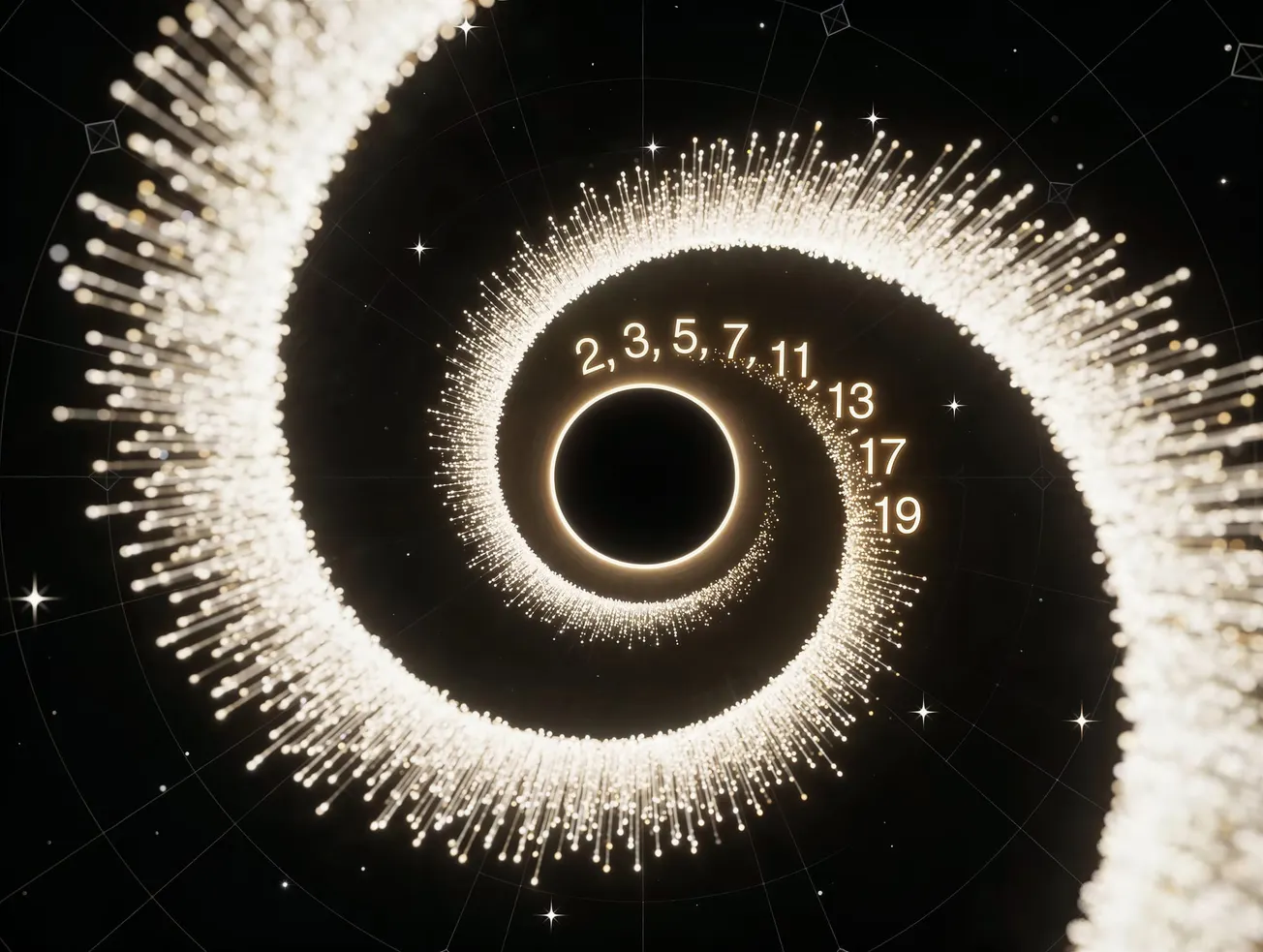
The Riemann zeta function begins innocently as
$\zeta(s)=\sum_{n=1}^{\infty}\frac{1}{n^s}$
$\qquad \Re(s)>1,$
and, in the same half-plane, admits the Euler product
$\zeta(s)=\prod_{p\ \mathrm{prime}}\left(1-p^{-s}\right)^{-1}.$
This product is the first signal that (\zeta(s)) is not merely a function of complex analysis but a compact encoding of prime factorization itself. Through analytic continuation and the functional equation, the zeta function becomes a meromorphic object on the complex plane. The Riemann Hypothesis concerns the nontrivial zeros in the critical strip (0<\Re(s)<1), asserting that they all lie on (\Re(s)=1/2). The Clay Mathematics Institute continues to list the Riemann Hypothesis as a Millennium Prize Problem, emphasizing its relation to the deviations of prime counting from its average asymptotic behavior. (Clay Mathematics Institute1)
The bridge to physics begins with the idea that the zeros might be spectral. The Hilbert–Pólya program asks whether the imaginary parts of the nontrivial zeros can be realized as eigenvalues of a self-adjoint operator. If such an operator existed in the right way, the realness of its spectrum would force the zeros onto the critical line. This idea remains conjectural, but it has guided a large amount of work at the interface of number theory, quantum mechanics, and quantum chaos.
The empirical reason physicists took the idea seriously is the Montgomery–Odlyzko phenomenon: the local spacing statistics of high Riemann zeros match those of the Gaussian Unitary Ensemble, the random-matrix ensemble associated with quantum systems lacking time-reversal symmetry. This does not prove the Riemann Hypothesis. It also does not identify a unique physical Hamiltonian. But it strongly suggests that the zeros behave like the eigenvalues of a quantum-chaotic system. Reviews of the number-theory / random-matrix connection emphasize precisely this point: the same sine-kernel and random-matrix structures that appear in quantum spectra also appear in the pair correlations of zeta zeros. (Séminaire Poincaré2)
The key discipline is to avoid reversing the implication. Random-matrix statistics show that Riemann zeros behave statistically like chaotic spectra. They do not show that every chaotic spectrum is secretly made of primes, nor that every black-hole spectrum is literally a zeta-zero spectrum.
2. The dilation operator, (H=xp), and black-hole horizons
The most famous physical route toward Hilbert–Pólya is the Berry–Keating proposal, centered on the classical Hamiltonian
$H=xp.$
This system is scale-invariant and has hyperbolic phase-space flow. Its appeal is that the average counting function of Riemann zeros resembles what one obtains from a suitably regularized (xp)-type system. Its difficulty is equally fundamental: (xp) is not naturally a well-behaved, bounded quantum Hamiltonian on an ordinary Hilbert space. Boundary conditions, self-adjoint extensions, and regularization choices are not technical afterthoughts; they are the main problem.
Alain Connes’ noncommutative-geometric approach gives a different but related spectral picture. Instead of treating the Riemann zeros as ordinary emission eigenvalues, Connes’ framework interprets them more like missing states or absorption lines in a larger adelic spectral system. These approaches share the same intuition: the zeta zeros may reflect an arithmetic spectral geometry, but the geometry is not the simple spectrum of a conventional one-particle oscillator.
Black-hole horizons sharpen this idea because near-horizon scattering naturally produces dilation-like structures. In the Schwarzschild near-horizon region, highly boosted infalling and outgoing modes experience gravitational shockwave interactions. Gerard ’t Hooft and later authors studied such horizon S-matrix ideas as a possible route to reconciling black-hole scattering with quantum unitarity. Betzios, Gaddam, and Papadoulaki developed this line in a way directly relevant to the Riemann problem: motivated by the expectation that quantum gravity gauges global symmetries, they studied the consequences of imposing CPT as a quantum boundary condition in phase space. They found that this acts as a natural semiclassical regularization and discretization of a Hamiltonian related to the dilation operator, with a spectrum in correspondence with zeros of the Riemann zeta and Dirichlet beta functions. (arXiv3)
The correct interpretation is neither trivial nor extravagant. It is not merely wordplay: a near-horizon quantum-mechanical construction really does produce a discretized spectrum connected to classical number-theoretic zero sets. But it is also not a proof that black-hole microstates are identical to Riemann zeros. Betzios, Gaddam, and Papadoulaki frame the result as strengthening the idea that a dilation-type Hamiltonian captures aspects of the Schwarzschild S-matrix, and as a possible contribution to the Hilbert–Pólya pursuit—not as a completed proof of the Riemann Hypothesis or a full solution of the information paradox. (arXiv3)
This is the right epistemic posture for the field as a whole: strong structural evidence, bounded claims.
3. Logarithmic spectra and the zeta spectral form factor
The spectral form factor is one of the central diagnostics of quantum chaos. Given a spectrum (E_n), one defines a partition function
$Z(\beta+it)=\sum_n e^{-(\beta+it)E_n},$
and the spectral form factor is, up to normalizations,
$g(\beta,t)=|Z(\beta+it)|^2.$
In random-matrix-like chaotic systems, the spectral form factor often displays a characteristic dip–ramp–plateau structure. The dip reflects early-time decay, the ramp reflects long-range spectral rigidity, and the plateau reflects discreteness of the finite spectrum.
A recent and important observation is that an extremely simple deterministic spectrum,
$E_n=\log n,$
has partition function
$Z(s)=\sum_{n=1}^{\infty}e^{-s\log n}=\sum_{n=1}^{\infty}n^{-s}=\zeta(s)$
at least initially in the convergent region and then by analytic continuation. Therefore its spectral form factor is controlled by (|\zeta(\beta+it)|^2). Das, Garg, Krishnan, and Kundu showed that this logarithmic spectrum produces a linear ramp, despite lacking conventional short-range level repulsion in its noiseless form; adding small noise restores clearer level-repulsion behavior alongside the ramp. They also emphasize connections to black-hole stretched-horizon normal modes and to the Lindelöf-type growth behavior of the zeta function. (Springer4)
This is a beautiful result, but it is often misread. The spectrum here is
$E_n=\log n,$
not
$E_n=\gamma_n,$
where (\gamma_n) are the imaginary parts of the Riemann zeros. Thus the spectral form factor of the logarithmic spectrum is not the same object as the spectral form factor of the Riemann zeros. The former gives (\zeta(s)) as a partition function. The latter concerns the zero ordinates themselves and their random-matrix statistics. Confusing these two objects turns a precise result into an inflated claim.
The follow-up analytic work by Basu, Das, and Krishnan strengthens the logarithmic-spectrum side of the story. They analyze the zeta-function ramp more explicitly, show that the (\beta=0) ramp has slope exactly one, interpret the (s=1) pole as a Hagedorn-type transition in this framework, and connect the resulting Thouless-time behavior to black-hole-inspired expectations. They also suggest that related ramp phenomena may appear more generally in (L)-functions. (arXiv5)
The cautious conclusion is therefore powerful but limited:
$E_n=\log n \quad \Rightarrow \quad Z(s)=\zeta(s),$
and this gives a black-hole-relevant toy model with a clean zeta spectral form factor. It does not mean that the Riemann zeros themselves have been physically realized as the exact energy levels of a black hole.
4. SYK, JT gravity, wormholes, and ensemble averaging
The Sachdev–Ye–Kitaev model occupies a central place in modern discussions of black-hole quantum chaos because it is a solvable many-body quantum system with random all-to-all interactions, strong chaos, an emergent low-energy Schwarzian mode, and close ties to nearly-(AdS_2) / JT gravity. Kitaev and Suh’s exposition of the SYK soft mode shows how the Schwarzian action also arises from a variant of dilaton gravity, making SYK a controlled laboratory for questions that resemble black-hole dynamics. (arXiv6)
The broader chaos context is set by the Maldacena–Shenker–Stanford bound, which states that thermal quantum systems under suitable assumptions have a Lyapunov exponent bounded by
$\lambda_L \leq \frac{2\pi k_B T}{\hbar}.$
Black holes saturate this bound in many holographic settings, which is why they are often described as maximally chaotic. (ADS7)
JT gravity adds a geometric version of the same story. Saad, Shenker, and Stanford showed that JT-gravity partition functions over two-dimensional surfaces of arbitrary genus correspond to the genus expansion of a matrix integral. In this setting, Euclidean wormhole geometries, especially the double-trumpet contribution, help reproduce random-matrix-like spectral correlations and the ramp in the spectral form factor. (arXiv8)
Here again the important distinction is between a real technical result and an overextended interpretation. Euclidean wormholes in JT gravity help explain ensemble-averaged spectral correlations. They do not, by themselves, prove that our universe is an ensemble average, nor that the Riemann zeros are hardcoded into cosmological initial conditions. The factorization puzzle exists precisely because wormhole contributions can correlate partition functions that a single fixed boundary theory might be expected to factorize. One possible interpretation is that simple JT gravity is dual to an ensemble of quantum theories rather than one definite theory. That is a major conceptual lesson, but not a license to collapse all random-matrix, zeta, and black-hole structures into one literal identity.
The Page-curve and island developments belong nearby, but they should also be kept distinct. Replica wormholes and quantum extremal surfaces help reproduce unitary Page-curve behavior in models of evaporating black holes. That line of work is related to the same gravitational path-integral revolution, but it is not the same claim as the double-trumpet ramp, and neither is a proof of the Riemann Hypothesis. (PIRSA9)
The safe synthesis is this: SYK and JT gravity show that black-hole-like quantum systems often live in the same random-matrix universality class that appears in zeta-zero statistics. The logarithmic spectrum shows that (\zeta(s)) itself can be read as a partition function of a simple deterministic spectrum. These facts belong together, but they must not be conflated.
5. BKL singularities and the conformal primon gas
The most striking recent result is not the logarithmic zeta ramp, nor the general random-matrix analogy. It is the appearance of automorphic (L)-functions and primon gases in semiclassical BKL dynamics near spacelike singularities.
BKL dynamics describes the chaotic approach of spacetime to a spacelike singularity. Near such a singularity, different spatial directions contract and expand in a sequence of chaotic Kasner-like transitions. Hartnoll and Yang showed that, at each spatial point, the BKL dynamics of gravity close to a spacelike singularity can be mapped onto the motion of a particle bouncing within half the fundamental domain of the modular group. Semiclassical quantization of this motion gives a conformal quantum mechanics whose states are constrained to be modular invariant. Each such state defines an odd automorphic (L)-function. In a basis of dilatation eigenstates, the wavefunction is proportional to the associated (L)-function along its critical axis and therefore vanishes at its nontrivial zeros. Along the positive real axis, the same (L)-function equals the partition function of a gas of non-interacting charged oscillators labeled by prime numbers. (arXiv10)
This is the cleanest place where the phrase “prime-number physics” has real content. Bernard Julia’s primon gas was originally a formal construction: assign energies (\log p) to prime-labeled elementary excitations, and the multi-particle states assemble through prime factorization so that the partition function becomes zeta-like. Hartnoll and Yang do not merely repeat this analogy. They place a generalized primon gas inside a gravitational semiclassical construction arising from BKL dynamics.
Even here, however, the correct statement is not that “the singularity is literally made of primes.” The correct statement is more precise and stronger scientifically:
In the Hartnoll–Yang construction, modular-invariant semiclassical BKL wavefunctions define automorphic (L)-functions, and those (L)-functions admit dual primon-gas partition-function descriptions.
This is not metaphysical ornamentation. It is a concrete bridge among singularity dynamics, modular invariance, automorphic forms, (L)-functions, and prime-labeled oscillator gases.
It also changes the center of gravity of the whole discussion. Earlier physics approaches to the Riemann Hypothesis often searched for a Hamiltonian whose spectrum would reproduce the zeta zeros. The BKL/primon-gas result suggests a broader view: quantum gravity may not single out only the Riemann zeta function, but a family of automorphic (L)-functions associated with modular or arithmetic symmetry groups. In that sense, the Riemann zeta function may be the simplest member of a much larger arithmetic gravitational ecology.
6. Higher dimensions: complex primons and Bianchi groups
The higher-dimensional extension strengthens the arithmetic-modular interpretation. De Clerck, Hartnoll, and Yang studied Wheeler–DeWitt wavefunctions for five-dimensional BKL dynamics and related supergravity settings. In these cases, near-singularity dynamics is governed by billiards in fundamental domains of Bianchi groups
$PSL(2,\mathcal{O}) \subset PSL(2,\mathbb{C}),$
where (\mathcal{O}) is the ring of Gaussian or Eisenstein integers. The relevant Wheeler–DeWitt wavefunctions become automorphic Maass forms, and the associated (L)-functions admit Euler products over complex primes in (\mathcal{O}). This lets the authors construct dual primon-gas partition functions built from charged harmonic oscillators labeled by Gaussian or Eisenstein primes. (arXiv11)
This matters because it shows that the primon-gas structure is not a one-off curiosity restricted to ordinary rational primes. The arithmetic changes with the gravitational and dimensional setting. In four-dimensional BKL dynamics one encounters the modular group and ordinary primes; in five-dimensional extensions one encounters Bianchi groups and complex primes. That is exactly what one would expect if the deeper object were not “the primes” in isolation, but an arithmetic-modular structure whose local factors vary with the symmetry group.
This point is crucial for a mature version of the thesis. Prime numbers are fundamental inside the integers by the Fundamental Theorem of Arithmetic. But in arithmetic geometry and automorphic theory, primes are often better understood as local places, valuations, or Euler-product factors of a global object. The gravitational lesson may be similar: quantum gravity may not be selecting primes as tiny metaphysical atoms; it may be selecting automorphic structures whose Euler products require prime-labeled local data.
7. Four-dimensional black holes, quasinormal modes, and exact gauge-theory structures
The arithmetic story should not be reduced only to SYK, JT gravity, or BKL singularities. In four-dimensional black-hole perturbation theory, exact structures from supersymmetric gauge theory and conformal field theory also appear.
Aminov, Grassi, and Hatsuda proposed exact quantization conditions for Kerr and Schwarzschild quasinormal-mode frequencies using the Nekrasov partition function of four-dimensional (\mathcal{N}=2) supersymmetric gauge theory in a particular (\Omega)-background. Their work relates black-hole perturbation theory to quantum Seiberg–Witten curves and tests the resulting conditions against known numerical quasinormal-mode data. (arXiv12)
This is not directly a Riemann Hypothesis result. The word “Riemann” appears in many contexts—Riemann surfaces, Riemann spheres, Riemann zeta function—and they should not be conflated. The AGT / Seiberg–Witten / quasinormal-mode correspondence belongs to the broader claim that black-hole physics is deeply entangled with exact geometric, modular, and representation-theoretic structures. It does not by itself show that black-hole ringdown frequencies are Riemann zeros.
Its proper role in the essay is therefore supporting, not central. It tells us that exact mathematical structures from gauge theory and conformal field theory can compute physical black-hole observables. Together with the BKL/primon-gas results and the zeta SFF toy models, it strengthens the general thesis that black-hole physics repeatedly leads toward modular and arithmetic mathematics.
8. Prime structure factors, quasicrystals, and what not to claim
There is a legitimate statistical-mechanical literature on primes as spatial point processes. Torquato and collaborators studied the structure factor of the primes and found dense Bragg-like peaks, with similarities to quasicrystals and limit-periodic order, while also emphasizing an important difference: the peak locations occur at rational multiples of (\pi), unlike the irrational ratios characteristic of many quasicrystals. (arXiv13)
This material can be included as a side note: primes display unexpected long-range order when examined through tools from condensed-matter physics. That is fascinating, and it resonates with the broader theme that arithmetic sequences can have physical-looking spectral signatures.
But this is also where discipline is essential. Quasicrystal analogies do not imply that Planck-scale spacetime is a quasicrystal. They do not imply that optical-bonding experiments can engineer wormholes. They do not justify claims about fractal chirality forcing the critical line as an infrared fixed point unless those claims are backed by a mainstream mathematical or physical derivation. In a serious research essay, this material should remain an analogy about structure factors and emergent order, not a mechanism for quantum gravity.
The strongest version of the article does not need speculative engineering claims. The real literature is already strange enough.
9. Toward an arithmetic-modular research program
The defensible thesis is not:
Black holes prove the Riemann Hypothesis.
Nor:
The universe is literally built out of prime numbers.
The defensible thesis is:
Several independent models of black-hole quantum chaos and near-singularity gravity naturally produce zeta functions, automorphic (L)-functions, modular groups, Euler products, and random-matrix spectral statistics. This convergence suggests that quantum gravity may have an arithmetic-modular layer not yet fully understood.
This thesis is strong because it is falsifiable in spirit. It predicts that as black-hole microphysics becomes more exact, especially in controlled semiclassical or holographic limits, the relevant mathematical structures should continue to be modular, automorphic, spectral, and (L)-function-like rather than arbitrary.
Several research questions follow.
First, can the Hartnoll–Yang primon-gas construction be extended beyond semiclassical BKL dynamics into a more complete quantum-gravitational Hilbert space? If so, are the associated (L)-functions merely labels of states, or do they control observable transition amplitudes, entropy, or correlation functions?
Second, can the zeta ramp of the logarithmic spectrum be embedded in a less toy-like black-hole model whose microscopic spectrum is derived rather than assumed? The stretched-horizon connection is suggestive, but the gap between a toy spectrum and a complete black-hole Hamiltonian remains large.
Third, what is the exact relationship between random-matrix universality and arithmetic specificity? Random matrices describe universal statistics after local unfolding; (L)-functions encode highly specific arithmetic data. A quantum-gravity theory that naturally produces both would need to explain how universality and arithmetic individuality coexist.
Fourth, is the modular group (PSL(2,\mathbb{Z})) merely one symmetry among many, or is it selected by a deeper principle? BKL dynamics landing in a modular fundamental domain is striking. The five-dimensional extension to Bianchi groups suggests that the selected arithmetic group depends on dimension and field content. A deeper theory should explain why these groups, and not others, arise.
Fifth, is there an adelic formulation of black-hole quantum mechanics? In an adelic perspective, the real numbers are only one completion of the rationals, alongside the (p)-adic completions indexed by primes. If black-hole microphysics is genuinely arithmetic, then the archimedean spacetime description and the non-archimedean prime data may be complementary projections of a more global object.
These are not conclusions. They are research directions. But they are sharper than vague claims that “everything is number.” They ask what specific arithmetic structures quantum gravity selects and why.
Conclusion
The convergence of prime number theory and black-hole physics is real, but its meaning is subtler than the strongest popular formulations suggest. The Riemann zeros exhibit random-matrix statistics. Dilation-operator models inspired by near-horizon black-hole scattering produce spectra connected to zeta and beta zeros. Logarithmic spectra have partition functions equal to (\zeta(s)) and spectral form factors with black-hole-like ramp behavior. JT gravity and SYK show how black-hole-like systems naturally produce random-matrix spectral correlations. Most remarkably, BKL singularity dynamics leads to modular-invariant quantum states, automorphic (L)-functions, and dual primon-gas partition functions.
The right conclusion is not that the Riemann Hypothesis has been physically proven. It has not. Nor is it that black holes are literally made of primes. The right conclusion is that arithmetic structures appear with surprising persistence in the mathematical description of quantum chaos, horizons, wormholes, and singularities.
A mature version of the thesis should therefore be framed as an arithmetic-modular research program for quantum gravity. It should treat zeta functions and (L)-functions not as mystical numerology, but as spectral, thermodynamic, and automorphic objects that repeatedly arise when gravitational systems are pushed to their most chaotic and most quantum regimes.
If there is a deep lesson here, it may be this: primes are not simply scattered atoms of arithmetic, and black holes are not simply astrophysical endpoints of collapse. Both may be shadows of a deeper spectral geometry—one in which modularity, factorization, chaos, and arithmetic are different projections of the same still-unfinished theory.
Selected references
Clay Mathematics Institute, “The Riemann Hypothesis” and “Millennium Prize Problems.” (Clay Mathematics Institute1)
Bourgade and Keating, “Quantum chaos, random matrix theory, and the Riemann (\zeta)-function.” (Séminaire Poincaré2)
Betzios, Gaddam, and Papadoulaki, “Black holes, quantum chaos, and the Riemann hypothesis.” (arXiv3)
Das, Garg, Krishnan, and Kundu, “What is the Simplest Linear Ramp?” (Springer4)
Basu, Das, and Krishnan, “An Analytic Zeta Function Ramp at the Black Hole Thouless Time.” (arXiv5)
Maldacena, Shenker, and Stanford, “A bound on chaos.” (ADS7)
Saad, Shenker, and Stanford, “JT gravity as a matrix integral.” (arXiv8)
Kitaev and Suh, “The soft mode in the Sachdev–Ye–Kitaev model and its gravity dual.” (arXiv6)
Hartnoll and Yang, “The conformal primon gas at the end of time.” (arXiv10)
De Clerck, Hartnoll, and Yang, “Wheeler–DeWitt wavefunctions for 5d BKL dynamics, automorphic (L)-functions and complex primon gases.” (arXiv11)
Aminov, Grassi, and Hatsuda, “Black Hole Quasinormal Modes and Seiberg–Witten Theory.” (arXiv12)
Zhang, Stillinger, and Torquato, “The structure factor of primes.” (arXiv13)
1: https://www.claymath.org/millennium/riemann-hypothesis/?utm_source=chatgpt.com "Riemann Hypothesis"
2: https://seminaire-poincare.pages.math.cnrs.fr/keating.pdf?utm_source=chatgpt.com "Quantum chaos, random matrix theory, and the Riemann ζ- ..."
3: https://arxiv.org/abs/2004.09523?utm_source=chatgpt.com "Black holes, quantum chaos, and the Riemann hypothesis"
4: https://link.springer.com/article/10.1007/JHEP01%282024%29172?utm_source=chatgpt.com "What is the Simplest Linear Ramp? - Springer Nature"
5: https://arxiv.org/abs/2505.00528?utm_source=chatgpt.com "An Analytic Zeta Function Ramp at the Black Hole Thouless Time"
6: https://arxiv.org/abs/1711.08467?utm_source=chatgpt.com "1711.08467 The soft mode in the Sachdev-Ye-Kitaev ..."
7: https://ui.adsabs.harvard.edu/abs/2016JHEP...08..106M/abstract?utm_source=chatgpt.com "A bound on chaos - ADS"
8: https://arxiv.org/abs/1903.11115?utm_source=chatgpt.com "1903.11115 JT gravity as a matrix integral"
9: https://pirsa.org/20040031?utm_source=chatgpt.com "Replica wormholes and the black hole information paradox"
10: https://arxiv.org/abs/2502.02661?utm_source=chatgpt.com "The Conformal Primon Gas at the End of Time"
11: https://arxiv.org/abs/2507.08788?utm_source=chatgpt.com "Wheeler-DeWitt wavefunctions for 5d BKL dynamics, automorphic L-functions and complex primon gases"
12: https://arxiv.org/abs/2006.06111?utm_source=chatgpt.com "Black Hole Quasinormal Modes and Seiberg-Witten Theory"
13: https://arxiv.org/pdf/1801.01541?utm_source=chatgpt.com "The structure factor of primes"
ChatGPT 5.4 Pro