An analysis of the foundational architecture of reality demands that we abandon the institutional prejudices that governed 20th-century physics. When an engineer at a telephone company and a physicist studying the kinetic theory of gases arrive at the identical mathematical object, the universe is providing a structural clue. For half a century, physics dismissed this as a coincidence.
The thesis here is unambiguous: Information is not merely a description of the physical world; it is the fundamental substrate from which the physical world emerges. Reality is deeply, provably informational.
The Shannon-Boltzmann Isomorphism
In 1877, struggling against the positivist dogma of his era, Ludwig Boltzmann formulated the statistical definition of thermodynamic entropy. Engraved on his tombstone in Vienna, the equation $S = k_B \log W$ (more generally expressed as $S = -k_B \sum p_i \ln p_i$) describes the disorder of a physical system—the number of microscopic configurations corresponding to a macroscopic state. It is the mathematical engine of the arrow of time.
Seventy-one years later, in 1948, Claude Shannon published "A Mathematical Theory of Communication" in the Bell System Technical Journal. Tasked with optimizing telephone lines, Shannon needed a rigorous way to measure the uncertainty of a message. The formula he derived to quantify this informational entropy was $H = -\sum p_i \log_2 p_i$.
These two equations are not analogous; they are mathematically identical. One dictates the thermal decay of the cosmos; the other dictates the maximum compression of a digital file.
The failure of the mid-century physics establishment to recognize this isomorphism immediately was a sociological failure, not an intellectual one. Physics was organized by prestige—particle physics and relativity at the top, engineering at the bottom. Because Shannon’s work emerged from a corporate lab and dealt with circuitry, it was ignored by the gatekeepers of fundamental theory. But the universe operates on deep structural identities, not academic hierarchies.
The Thermodynamic Cost of Forgetting
To understand why information is physical, we must trace the resolution of Maxwell's Demon. James Clerk Maxwell proposed a thought experiment in 1867: a microscopic demon that sorts fast and slow molecules, creating a temperature gradient without doing work, thereby violating the Second Law of Thermodynamics.
For a century, the demon survived. Leo Szilard hinted at the solution in 1929 by suggesting that measurement carries a thermodynamic cost. But the surgical strike came from IBM's Rolf Landauer in 1961. Landauer proved that measurement is not the problem—you can measure a system reversibly for free. The entropic cost is incurred during erasure.
When a system's memory fills up and it must overwrite an old state to make room for a new one, information is irreversibly destroyed. Landauer’s Principle dictates that erasing a single bit of information requires the dissipation of at least $k_B T \ln 2$ of heat.
This was confirmed experimentally in 2012 using a single silica bead in a double-well laser trap. When the bead was forced to "forget" its position (transitioning from a one-bit memory to a zero state), the surrounding water absorbed precisely the heat predicted by Landauer.
The universe does not charge you to learn; it charges you to forget. Time moves forward, and entropy increases, strictly because the universe is systematically erasing local information. The arrow of time is an informational phenomenon.
The Black Hole Crisis and the Holographic Bound
If information possesses physical weight and thermodynamic consequence, then the most extreme gravitational objects in the universe must be bound by it.
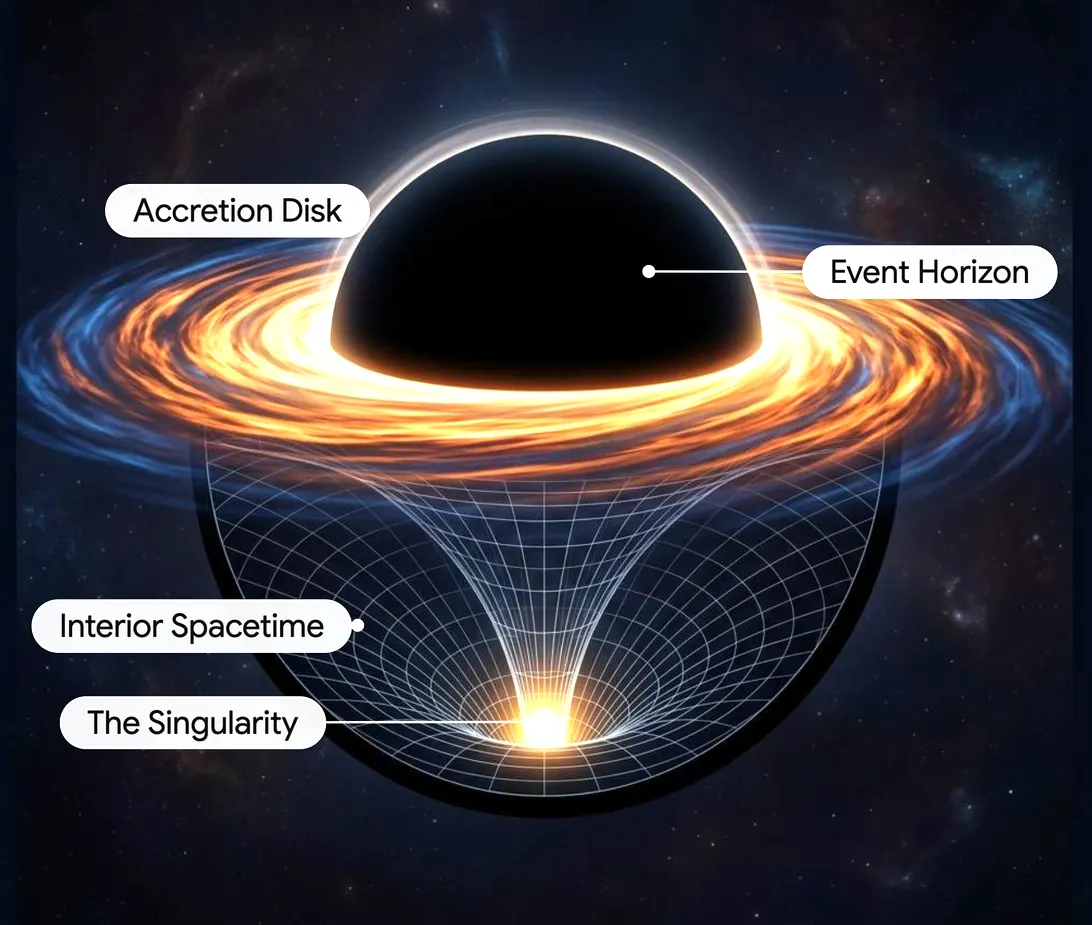
In 1973, Jacob Bekenstein realized that if a black hole has no entropy, dropping hot coffee into it would decrease the total entropy of the universe, violating the Second Law. He proposed that black holes have entropy proportional to their surface area, not their volume. Stephen Hawking subsequently proved that black holes radiate and possess a temperature, fixing the exact entropy formula:
$$S = \frac{k_B A}{4\ell_p^2}$$
A black hole is the densest information storage system permitted by physical law. The information is encoded not in the three-dimensional interior, but on the two-dimensional event horizon.
This discovery initiated a 40-year crisis. If black holes radiate thermally, the radiation is featureless. When the black hole evaporates completely, the information that fell into it appears to be permanently destroyed. This violates the unitary evolution of quantum mechanics—the mathematical guarantee that information is conserved and that the past can always, in principle, be reconstructed.
Spacetime as a Quantum Error-Correcting Code
The resolution to the information paradox arrived by taking Shannon’s theories to their absolute physical limits.
Through the holographic principle ('t Hooft, Susskind) and AdS/CFT correspondence (Maldacena), physics recognized that a three-dimensional volume of space is a projection of data encoded on a two-dimensional boundary. Space is not a fundamental container; it is an emergent property of information.
Furthermore, the Maldacena-Susskind conjecture (ER = EPR) demonstrated that spatial connectivity (wormholes) and quantum entanglement are the same phenomenon. The seamless fabric of spacetime is stitched together by quantum correlations. If you sever the entanglement, space tears apart.
In 2015, Almheiri, Dong, and Harlow proved exactly how this information is structured: the emergence of bulk spacetime from boundary data operates as a quantum error-correcting code. The universe encodes its own geometry with the same mathematical redundancy Shannon proved was necessary to protect data sent through a noisy channel. The information inside a black hole does not vanish; it escapes, perfectly conserved but impossibly scrambled across the Hawking radiation, protected by the structural redundancy of spacetime itself.
An Informational Ontology: "It From Bit"
Is this an informational reality? Yes.
John Archibald Wheeler articulated this in 1990 with his doctrine of "It from bit." Every physical item—every atom, quark, and field—derives its existence and function from binary choices, from yes/no questions registered by the universe. The substrate of reality is not matter or energy; it is computation.
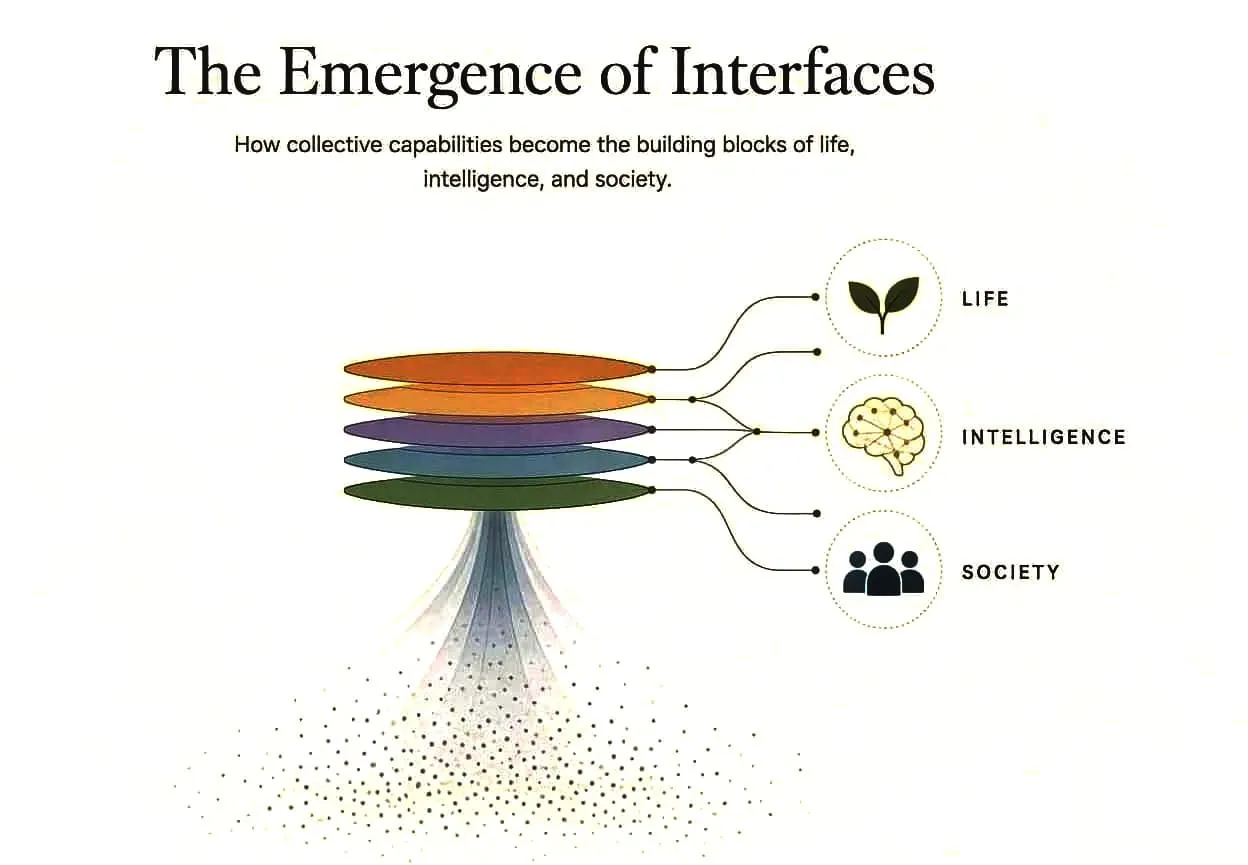
We must discard the teleological dogma that space and time are the base-layer theater of reality. They are not. They are the phenomenological interface of a deeper, non-local quantum informational network. The laws of physics are the algorithms governing how information is copied, entangled, and constrained.
Coda: The Inviolable Ledger
Claude Shannon spent his final years in a Massachusetts nursing home, his mind systematically dismantled by Alzheimer's disease. The irony is staggering: the father of information theory was destroyed by a pathology of informational erasure. Every synaptic connection that degraded, every memory he lost, paid the Landauer tax, dissipating $k_B T \ln 2$ of heat into the room.
But his information was not destroyed. Unitarity demands that the exact neural configurations that constituted his genius were merely scattered into the quantum correlations of the thermal environment, functionally scrambled but mathematically conserved. The universe maintains a flawless ledger. It never loses a single bit.
This absolute conservation—the relentless, asymmetric march of statistical probabilities—is why, as Einstein famously observed regarding thermodynamics: “It is the only physical theory of universal content concerning which I am convinced that, within the framework of applicability of its basic concepts, it will never be overthrown.”
The Second Law will prevail.
Collaboration with Gemini Pro
t333t.com Research
Muse:
Shannon Invented Information Theory in 1948... It's the Most Important Paper Nobody Read - Ninth Axiom and Faultlines Studio