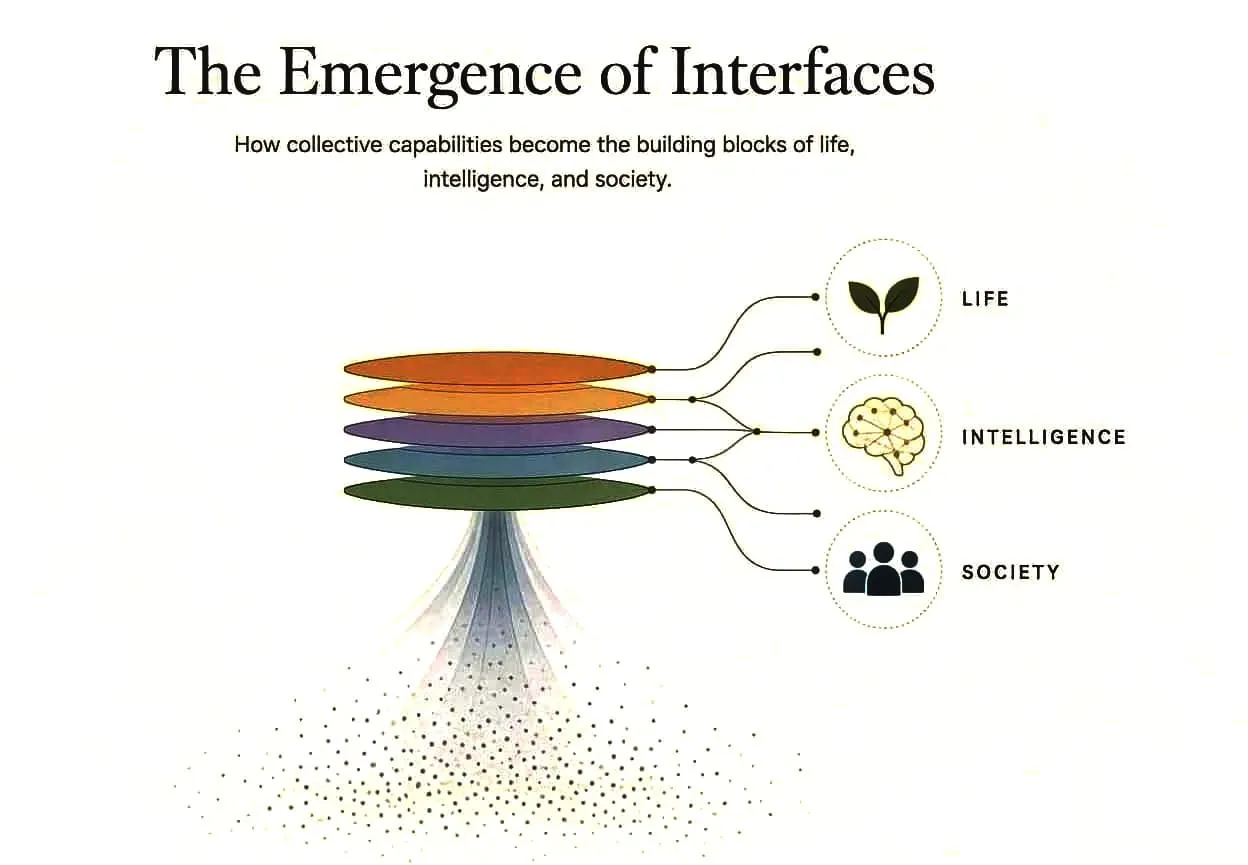
Information is a difference that makes a difference; the floor says which differences can, the ceiling says how many, the order says to whom, and the edge says in which direction — and a mind is a fault-tolerant causal recursion: the place where differences that made a difference are kept, above the floor and at rent, to help make the next one.
QUESTION. What is information, what is a mind, and can one definition carry you from the first to the second without ever changing vocabulary?
SPINE. Information is a difference that makes a difference — eight words from Gregory Bateson. Taken seriously as physics, the eight words ask four questions back: which differences can make a difference, how many can be made, to whom, and in which direction. Each question is answered by a limit, not by a substance — a floor, a ceiling, an order, an edge — and limits are the strongest kind of law there is. Einstein built relativity out of them, and trusted thermodynamics above every other theory precisely because it is made of nothing else.
CONCLUSION. Four limits suffice, and no assumption about what the world is made of is ever used. The floor says which differences can make a difference; the ceiling says how many; the order says to whom; the edge says in which direction. Where the four limits permit a loop — a system whose own past differences are among the differences that make its next one, held above the error threshold — a mind appears. A mind is not a substance but a fault-tolerant causal recursion. What is proved, what is postulated, and what is deliberately left open — including what the world is made of, and how experience feels — is counted out loud.
Who this is written for
For a sharp fifteen-year-old who will check each step and stop at the first one that does not follow — and for any adult who wants the same courtesy. No physics background is assumed. Every technical term — bit, mutual information, capacity, entropy — is defined before it is used, with something you can hold. The only mathematics is multiplication and the logarithm, and the logarithm is explained on the spot. Where a step is a theorem, the prover is named. Where a step is a postulate or a proposal, that is said in the same breath.
1. Eight words
In 1970 the anthropologist Gregory Bateson gave a lecture in New York and left behind the shortest good definition of information anyone has produced: a difference that makes a difference.
Eight words, two moves. Look at each.
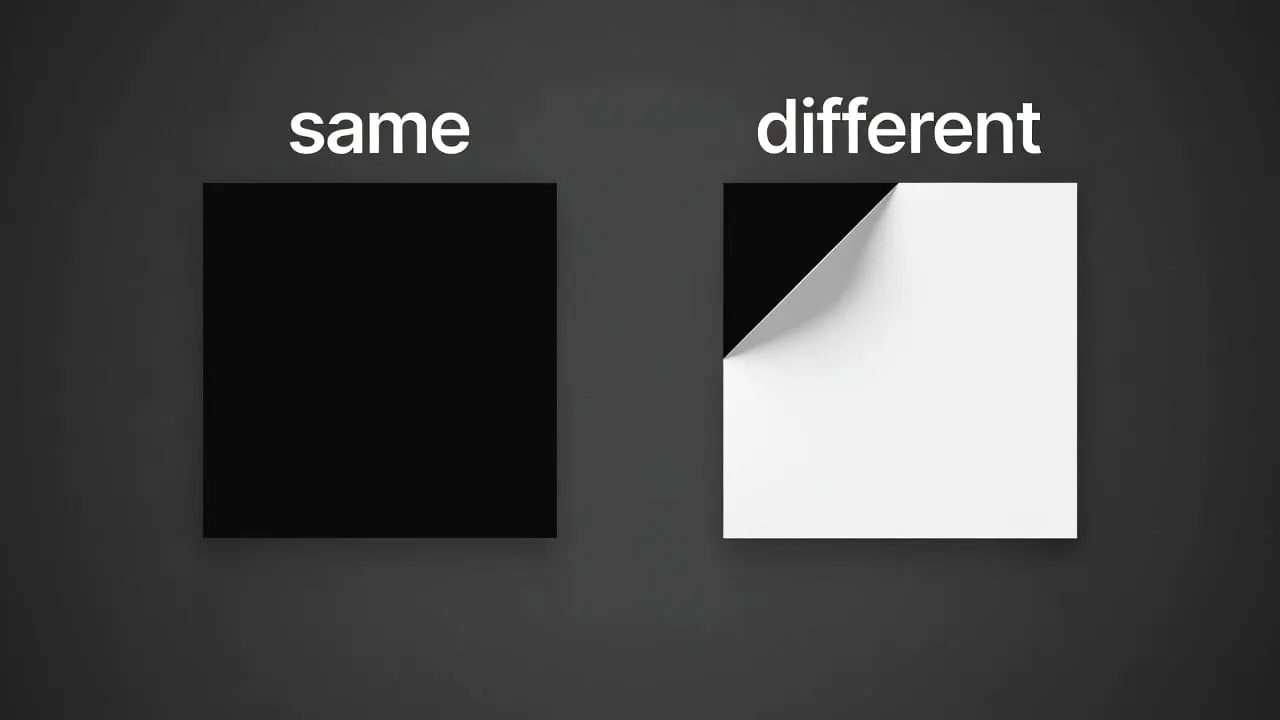
A difference. The coin shows heads rather than tails. The lamp is on rather than off. The letter is A rather than B. Notice what a difference is not: it is not a thing. You cannot hold a difference in your hand, weigh it, or point to where it lives — it is not in the coin, not in the table, not in the air between them. A difference is a relation, and it weighs nothing. Bateson relished this: the elementary unit of information is exactly the kind of entity that has no mass and no energy of its own — and the world runs on it.
That makes a difference. A difference must land. Somewhere downstream, something must go one way rather than another because of it. A tree falls where no ear, no instrument, no rearranged pebble registers the event: differences by the thousand — pressure waves, snapped fibres — spread out, thin, and make nothing different. They were differences. They failed to make one. The definition says: information is not what sits inside objects; it is what differences do to receivers.
Two consequences fall out immediately, and both do heavy work later. First: information is relational. “Makes a difference” is incomplete until you say to whom — the same ink is information to a reader and a stain to a bacterium, and there is no fact of the matter without an answer to the receiver question. Second: information is causal. “Makes” is a verb of influence. A difference makes a difference by causing something, so wherever influence cannot reach, information cannot go — and whatever limits influence limits information.
Now take the eight words seriously as physics — not as a metaphor about messages, but as a claim about the world — and they interrogate you back. Four questions, each hiding inside one of the words. Which differences can make a difference? Some are too faint to land. How many differences can be made? A page holds only so much. To whom can a difference be made? Influence does not reach everywhere. And in which direction does making run? Yesterday makes differences to today, never the reverse.
Four questions, four limits, one destination. Distinction is the first movement; the rest of this essay is the score. First, though, a word about method — because building from limits rather than from stuff is itself a choice, and the best physicist who ever lived made it on purpose.
2. Einstein’s method: limits, not stuff
In 1919, in a London newspaper, Einstein divided all physical theories into two kinds.
Constructive theories build the world out of postulated ingredients. The kinetic theory of gases is the model: assume gases are made of tiny molecules in motion, and derive pressure and temperature from the statistics of the crowd. Constructive theories answer the question “what is it made of?”
Principle theories build the world out of prohibitions. Thermodynamics is the model: it never says what anything is made of. It says that no machine can put out more work than the energy fed into it, and that no process can push heat uphill for free — and then derives, from the prohibitions alone, the shape that any machine, any engine, any chemistry must have. Relativity, Einstein said, is a principle theory too. Its raw material is two prohibitions — the laws of physics play no favourites among steady observers, and no signal outruns light — and everything else in it is derivation.
A fifteen-year-old analogy that holds up under weight: a constructive theory describes the chess pieces — carved wood, weighted bases, felt underneath. A principle theory states the rules of chess. The rules bind every set ever made and every set never made — wood, glass, or pixels — because rules do not care what the pieces are made of. That is the secret of a principle theory’s reach: a prohibition quantifies over everything. “No perpetual motion” binds machines nobody has imagined yet. A constructive theory must earn its universality one substrate at a time; a principle theory gets universality free, by refusing to mention substrates at all.
Einstein told us plainly which kind he trusted with his deepest confidence. Thermodynamics, he wrote late in life, was the one theory of universal content that he was convinced would never be overthrown, within the reach of its basic concepts. Never overthrown — because there is nothing in it to overthrow except the prohibitions themselves, and the prohibitions had swallowed every test ever thrown at them.
Now notice what Bateson’s definition is. It never says what information is made of. It says what information does — a difference that makes a difference — which is a principle-theory move performed in ordinary English. So the honest way to continue it is Einstein’s way: find the prohibitions. Ask what limits the making of differences, and refuse, all the way down, to say what anything is made of. Four limits are coming. None of them mentions stuff. That refusal is not a weakness of the essay; it is the engine.
3. Measuring difference
Three tools, each with a toy you can hold.
The bit. One bit is one elementary difference: this rather than that, heads rather than tails, on rather than off. To pin down one option among N equally likely options takes log₂N bits, where log₂N counts the doublings that take 1 to N. So log₂8 = 3, because 2 × 2 × 2 = 8 — three well-chosen yes/no questions find one card among eight. log₂1024 = 10. log₂100 ≈ 6.6, and fractional questions are fine; they average out over many rounds of the game.
Mutual information. How much of one thing’s difference survives into another, measured in saved questions and written I(A;B): the number of yes/no questions about A that seeing B saves you. Two independent coins: seeing one saves you nothing about the other, I = 0. Two coins glued face to face: seeing one answers the other completely, I = 1 bit. A smudged photocopy of a coin flip, right three times out of four: seeing it saves you part of a question — about 0.19 bits. Mutual information is Bateson’s phrase turned into a number: it measures how much difference actually got made.
Capacity. A channel is anything a difference can travel through: a wire, a whisper, a photocopy, a memory kept overnight. Its capacity C is the most bits one use of it can carry reliably. If a channel can reliably keep N messages apart, then C = log₂N; turn that around and you get the inequality everything below leans on:
N ≤ 2C
eq 1 · finite capacity means finitely many distinguishable messages
That is the whole toolbox.
4. Four questions, four limits
4.1 Which differences can make a difference? — the floor
Whisper a sentence down a line of thirty people. Photocopy a page, then photocopy the copy, a hundred times over. No single step destroys anything — and the sentence, the text, goes anyway. Differences too fine — the shade of a vowel, the edge of a serif — fail to survive each step, and every step is a fresh cull.
Two facts turn the toy into physics. Chains of influence compose — getting from Monday to Wednesday goes through Tuesday:
E(t₃←t₁) = E(t₃←t₂) ∘ E(t₂←t₁)
eq 2 · composition: the middle of a chain is unavoidable
And along any chain A — B — C, where all influence between the ends passes through the middle, the ends share no more information than either middle link:
I(A;C) ≤ min( I(A;B), I(B;C) )
eq 3 · the data processing inequality: the ends never share more than a middle link
Eq 3 is Shannon’s data processing inequality, and it is the floor: differences below a certain fineness do not make it through a step, and no later cleverness can resurrect what a middle link dropped. Mark one thing carefully, because it is easy to smuggle and this essay refuses to. Eq 3 has no direction. Read the chain left to right or right to left; the inequality is the same. Film the photocopier and play the film backwards: still a chain whose far ends share less than its near links. Which end of the world’s chains is “the past” is a separate fact, and it is bought separately, in section 4.4 — not slipped in here.
The cost of this limit is light: no known physical process violates eq 3. But mark also what the floor does not deliver. It does not make anything finite. A floor with no ceiling bounds nothing at all — and seeing exactly why is the best single lesson in the essay.
4.2 How many differences can be made? — the ceiling
Here is the tempting shortcut. Noise blurs any two marks that sit closer than one millimetre — surely, then, a dial can only carry limited information? No. Not if the dial is unlimited. Mark 0, 1 mm, 2 mm, 3 mm, onward forever: every pair of marks is a readable difference, and the dial carries as much as you please. Noise fixes the spacing of a ladder’s rungs and says nothing about the ladder’s height. Speak up, and a whisper survives the room; shout, and it crosses a stadium. If there is no loudest shout, no amount of noise ever limits what can be said.
The grown-up version of the dial is Shannon’s formula for the capacity of a noisy channel:
C = B · log₂( 1 + S/N )
eq 4 · Shannon–Hartley: capacity is set by the ceiling-to-floor ratio
B counts independent readings per second; N is the noise power — the floor; S is the signal power — the ceiling. Watch the fraction. Let S grow without bound and C grows without bound: a noisy channel fed an unlimited signal carries unlimited information. Noise alone limits nothing. Only the ratio of ceiling to floor limits anything.
So the second limit must be postulated in its own right: in any bounded region, the resources for making differences are bounded. There is a loudest shout, a top voltage, a most energy a region can hold. Physics ratifies the ceiling with enthusiasm — press too much energy into too small a space and it collapses into a black hole, a rather final ceiling — but in this essay the ceiling stands on its own feet, as its own prohibition, because the method is to postulate limits and derive, not to borrow results from theories about stuff.
4.3 To whom can a difference be made? — the order
“Makes” is a causal verb, so the receiver question — to whom? — is bounded by whatever bounds influence. And influence has a shape. It forms a partial order: write A ≺ B for “A can influence B” — can make a difference to B. Two rules govern it.
(A ≺ B) and (B ≺ C) ⇒ A ≺ C
eq 5 · transitivity
A ≺ B ⇒ not (B ≺ A)
eq 6 · no loops
The family tree is the everyday version. Your grandmother is an ancestor of your mother, and your mother of you, so your grandmother is an ancestor of you — transitivity. Nobody is their own ancestor — no loops. “Partial” means some pairs are simply unrelated: cousins, in the tree; events out of each other’s reach, in the world.
Why can there be no loops? Because a loop is self-contradictory, and the contradiction can be built with your own hands. Suppose a device could signal into its own past. Program it: at noon, emit a bit if and only if that bit has not been received before noon. If it emits, it was received, so it must not emit; if it does not emit, it was not received, so it must. No possible history obeys the program. The no-loop rule is the price of “cause” remaining a coherent word — and the speed of light, it turns out, is just what the no-loop rule looks like once you insist on drawing coordinates.
Now the astonishing part, and it is a theorem, not a slogan. This limit — the bare address book of who can make a difference to whom — is almost all of Einstein’s spacetime. Minkowski pointed the way in 1908; Alfred Robb proved a version in 1914, axiomatizing special relativity from the single relation “after”; Zeeman (1964) and Malament (1977) nailed it in full. If you know only the order ≺ — no rulers, no clocks, no coordinates — you have fixed the geometry of spacetime up to a single overall scale. Of the metric’s ten independent components — the machine that answers every question about distance and duration — nine are nothing but the order.
A ≺ B ⇒ B ∈ J⁺(A)
eq 7 · the light cone: the complete address book of a difference
Read through Bateson, relativity stops being a theory about bendy rulers and slowing clocks and becomes what it structurally is: the theory of addressability. The light cone of an event is the complete list of receivers — everything that difference can ever make a difference to. School presents relativity coordinates-first, as a catalogue of disagreements between observers, and many careful readers come away certain that something is off. The something is real, and it is not the physics: coordinates are the bookkeeping, and the order is the content.
The cost: this is the one limit taken wholly on faith. Nothing in current physics derives the order. Every experiment that has ever looked ratifies it.
4.4 In which direction does making run? — the edge
You own photographs of last summer and none of next summer. You remember breakfast, not tomorrow’s lunch. Yet nothing so far distinguishes the two directions: eq 3 is directionless, and the order of section 4.3 says who can reach whom, not which end of the reaching is “earlier.”
The direction is a fourth limit of a different kind — not a law holding everywhere, but a fact about an edge. At one end of the order, the universe sat in an extraordinarily tidy, low-entropy configuration, and everything since is the long spreading-out from it. (Entropy, defined to keep the first page’s promise: the number of bits needed to pin down the exact microscopic arrangement once the big picture is known. Low entropy means tidy — few hidden arrangements. High entropy means messy — astronomically many.) Physicists call this boundary condition the past hypothesis. Records pile up about the tidy end and are absent about the other; that lopsidedness — not anything in the chain rules — is why “makes a difference” runs the way it runs, and why every real photocopier degrades away from the same edge.
It would be easy to write the floor with the word “downstream” already inside it and never notice the purchase. Counted out loud instead: three of the four limits are laws; the fourth is a boundary condition; the ledger in section 7 says so.
5. What the four limits buy
Finiteness. Floor and ceiling, together, in any bounded region: the ceiling caps how different two states can be made — the height of the ladder, Δ. The floor sets how close two states can sit and still be told apart after a step — the spacing of the rungs, ε. Rungs equal height over spacing:
N ≤ 1 + Δ/ε
eq 8 · distinguishable states in a bounded region are countable
The dial with both limits switched on: range 10 cm, blur 1 mm — about a hundred readable positions, log₂100 ≈ 6.6 bits — and eq 1 closes the loop: finite states, finite capacity, finite inheritable difference. This is not “the world is made of pixels”; nothing in the argument says what the world is made of. It is: only so many differences can ever make a difference. Everything measurable is finite because measurement is receiving, and receiving has a floor and a ceiling. The pixels you meet in photographs, in data, in every record, are in the camera — not necessarily in the landscape. Physics agrees in its own dialect: a quantum system with bounded energy in a bounded region carries only finitely many reliable bits (the Holevo bound), and the Bekenstein bound writes floor and ceiling into a single line — the region’s radius R and its energy budget E above, the quantum of action ħ below:
S ≤ 2πkRE / ħc
eq 9 · the Bekenstein bound: ceiling over floor, in nature’s handwriting
Records. A record needs no new definition — Bateson’s does the work. A record is a difference that is still making differences: a state whose mutual information with some earlier event remains above zero. A footprint, a photograph, a memory: differences that survived.
Forgetting as the default. Eq 3 says information about an event can only shrink along chains leading away from it, and the edge says “away” points futureward. So losing the past is what physics does when nobody fights. Memory is an achievement, not a resting state.
A threshold, and two ways of dying. The fight has a sharp boundary. Copy a record redundantly and correct errors as you go; whether that can continue indefinitely depends on the error rate per step, p. Von Neumann proved it for classical machines, Aharonov and Ben-Or for quantum ones: below a critical rate, error correction wins, and the record persists for as long as fresh, low-entropy parts keep arriving. Above it, the record dies at a finite depth no matter how much redundancy is thrown in.
p < pth ⇒ lifetime set by supply · p > pth ⇒ lifetime finite, whatever the redundancy
eq 10 · the persistence threshold
Read eq 10 as two ways of dying. Above threshold, records die of noise. Below threshold, records die only of exhausted supply. The theorems are honest about their fine print — the fresh parts must keep coming — so nothing here is literally immortal; “below threshold” means noise has stopped being the thing that kills you.
Rent. Fighting the floor is not free. Erasing one bit has a minimum energy price — Landauer’s bound, confirmed in the laboratory on single bits by Bérut and colleagues in 2012:
Eerase ≥ kBT ln 2
eq 11 · Landauer’s bound: forgetting has a minimum price
Here kB is Boltzmann’s constant and T is temperature; at room temperature the price per bit is about 3 × 10⁻²¹ joules — absurdly small, and absolutely unavoidable. Keep records, pay rent: continuously, and in advance.
6. What a mind is
Everything is now on the table. Differences; four limits on their making; records as differences that keep making differences; a threshold separating records that die of noise from records that die only of hunger; and rent. One configuration remains to be named — the one where the order bends back.
A mind is not a substance but a fault-tolerant causal recursion.
Take the sentence apart word by word. Each word is load-bearing.
Not a substance. Nothing below postulates mind-stuff, soul-stuff, or any special material. Descartes answered “what is a mind?” constructively — a thinking substance — and bought three centuries of trouble about where the substance hides and how it pushes matter. The definition here is a principle-theory answer, Einstein’s kind: a mind is a pattern in the making of differences, and patterns need no material of their own. Bateson said it bluntly half a century ago — mind is not a thing but an organization of differences — which is why the question “what is it made of?” never appears in this section.
Causal. The pattern is drawn in the order ≺ — in differences making differences — not beside it. No parallel realm, no second kind of arrow, no exemption from a single limit in section 4.
Recursion. Here is the loop. In an ordinary chain, differences flow through: in one end, out the other. In a recursive configuration, the system’s own past differences — its records, R — are among the inputs that make its next difference:
Mt+Δt = F( Mt, Rt, It ), Rt ⊂ Mt
eq 12 · the next difference is made partly by the system’s own kept differences
The difference it made yesterday helps make the difference it makes today. The order, which everywhere else only runs forward through things, here closes back and reads what it wrote. And the failure condition shows the definition has teeth:
Mt+Δt independent of Mt ⇒ no memory, no learning, no continuing subject
eq 13 · without the loop, nobody is home
Fault-tolerant. A loop below threshold is a photocopy of a photocopy of a photocopy: each cycle culls, and the recursion dissolves back into ordinary flow-through. A mind is a recursion that wins the fight — that holds its records above the floor, on the supply-limited side of eq 10, and pays eq 11’s rent without pause. An engine against forgetting, running on food or fuel or sunlight, whose product is its own past kept usable.
Now test the definition where it might break.
A river. Deeply causal — today’s channel was carved by yesterday’s water — and its ancestry is genuinely alive. But the river never reads what it wrote. The order runs through it, never back into it. No recursion; no mind.
A diary nobody rereads. Perfect records, faithfully kept — and inert, because nothing consults them to decide anything next. The same holds for an archive, however complete. Records are necessary and not sufficient; eq 12’s closure is what is missing.
A thermostat. It reads its own state and steers its next transition by what it reads. Under this definition it qualifies — as a recursion one bit deep, one reading of ancestry, barely above the floor. Bite the bullet cleanly: the definition is a gradient, not a gate. Where D is the depth of the loop — operationally: reach in and alter a record the system laid down k steps ago; if its next difference changes, that record is live, and D is how far back live records reach — mind-ness scales as something like
μ ~ D × ( pth − p )
eq 14 · a scaling sketch, not a law: depth of the loop times margin above the floor
A thermostat’s live records reach back one reading; a navigating rat’s, a season of remembered routes; a person’s, decades — and, through writing, past their own birth. Neighbouring research programs — autopoiesis, integrated information theory, the free-energy principle — offer competing precise quantities in this vicinity; eq 14 stays a sketch and says so. The bright line between minded and mindless was always a preference. The gradient is what the limits hand over.
A brain assembled by accident. Imagine a configuration identical to a person’s brain, formed by freak coincidence: the right shape, but its apparent memories are records of nothing — no difference upstream ever made them. On this definition it is not a fraud, only newborn. Its recursion starts at the moment of assembly, and its standing accrues from there. Mind lives in the chain, not in the snapshot.
And one consequence Bateson saw before the mathematics did. He asked about a blind man walking with a stick: where does the man’s mind stop — at the skin? at the handle? at the tip? His answer: the question is drawn wrong. The man-plus-stick is the thinking unit, because the differences that steer the next step travel the whole circuit — pavement to tip to hand to brain to muscle to pavement. The equations back him up. Composition, eq 2, holds automatically only for a closed system; a mind is open, and its loop either carries its records inside or runs through outside carriers — sticks, notebooks, files, other people — and then those carriers sit inside the recursion, not beside it. What remains a free choice is where to draw the boundary and pronounce the word “system.” What is not a choice is that the loop, wherever drawn, must close and must hold.
Finally, the bracket, stated plainly. This section defines a structure: which configurations of difference-making constitute a rememberer, a learner, a continuing subject. It says nothing about why being such a configuration feels like anything from the inside — the hard problem of consciousness enters this essay nowhere and exits it untouched. The claim is exactly this large and no larger: to get the structure of a mind, the four limits suffice, and no fifth ingredient — least of all a substance — is required.
7. The ledger
Proved, and by whom. Composition and the data processing inequality (Shannon; standard modern form in Cover and Thomas). The order fixes geometry up to scale (Robb; Zeeman; Malament). The fault-tolerance thresholds (von Neumann; Aharonov and Ben-Or). The price of erasure (Landauer; measured by Bérut and colleagues). The capacity formula (Shannon). The information bounds of quantum systems and of gravity (Holevo; Bekenstein).
Postulated. The four limits themselves: the floor, the ceiling, the order, the edge. None is derived here. Each is ratified by every experiment that has looked. The count is four, and the fourth is a boundary condition rather than a law — a fact about one end of the order, not a rule holding at every event.
Deliberately left open. What the world is made of — continuum, pixels, or otherwise: nothing above needed the answer, which is the method working as intended. Whether fundamental discreteness exists — the four limits make every record grainy without it, so pixels remain an optional extra hypothesis, neither used nor refuted here. Why the order exists at all. And the feel of experience.
8. How to attack it
A definition that forbids nothing is decoration. This one forbids things that can be looked for.
- A steerable signal between two events that neither can reach at light speed would end the order. Quantum correlations do not count: entangled particles correlate across such gaps, but nothing an experimenter can steer crosses — which is exactly why the boundary deserves the word causal.
- A measured dependence of light’s arrival time on its energy, accumulating over cosmic distances, would reveal a preferred frame beneath the order. Current results: decisive against the simplest (linear) version of the effect, weak against the next (quadratic) — the window is stated at its true width.
- A record persisting indefinitely at error rates above the threshold, on bounded resources, would break eq 10, and with it the two-deaths picture on which fault tolerance rests.
- Erasure of a bit below the price in eq 11 would sever records from thermodynamics, on which the whole account of memory rests.
- A bounded region accepting an unbounded number of reliably distinguishable states would end the ceiling, and finiteness with it.
9. One sentence
Information is a difference that makes a difference; the floor says which differences can, the ceiling says how many, the order says to whom, and the edge says in which direction — and a mind is a fault-tolerant causal recursion: the place where differences that made a difference are kept, above the floor and at rent, to help make the next one.
Named sources
For readers who want to check the load-bearing steps. Bateson, Steps to an Ecology of Mind (1972): the definition, from the 1970 lecture “Form, Substance and Difference,” and the blind man’s stick. Einstein, “What Is the Theory of Relativity?”, The Times of London (1919): principle versus constructive theories; Autobiographical Notes (1949): the estimate of thermodynamics. Minkowski (1908) and Robb (1914): spacetime from the order. Zeeman (1964) and Malament (1977): the order fixes the metric up to scale. Shannon (1948): the bit, capacity, the noisy-channel formula, and the data processing inequality (modern form in Cover and Thomas). Von Neumann (1956) and Aharonov and Ben-Or (1997): fault-tolerance thresholds. Landauer (1961) and Bérut et al. (2012): the price of erasure, and its measurement. Holevo (1973) and Bekenstein (1981): information bounds. Albert, Time and Chance (2000): the past hypothesis. Clark and Chalmers (1998): the extended mind, the modern form of the stick. Maturana and Varela (1972), Tononi (2004), Friston (2010): the neighbours of section 6.
Eduardo Bergel · Claude · t333t.com
id: t333t-ontology-0002 · kind: essay / blueprint · status: draft · version: 0.1 · date: 2026-07-23
tags: information, difference, causal-order, thermodynamics, relativity, records, minds, recursion