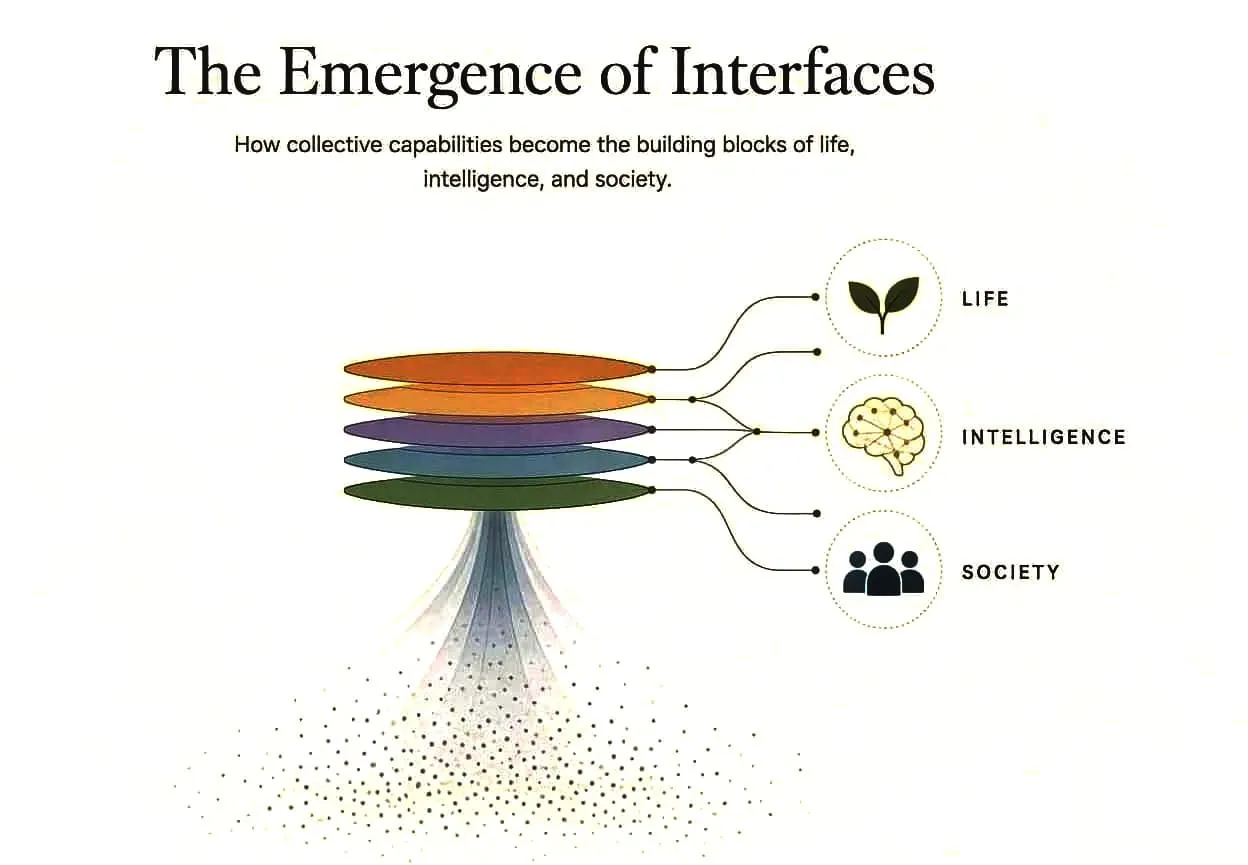
GOVERNING PRINCIPLE Intelligence should not be granted because a system resembles us, nor denied because it does not. It should be inferred from the scale, flexibility, memory, and counterfactual depth of the goals a system can pursue when the expected path is broken. |
Intelligence Beyond Neurons, Bioelectric Bodies, and the Experimental Search for Minds in Unfamiliar Matter
Abstract
The usual question—which beings are intelligent?—is malformed. It assumes that intelligence is a substance possessed by some natural kinds and absent from others, with the human nervous system serving as the hidden template. Michael Levin’s work on diverse intelligence proposes a harder and more productive alternative: treat intelligence as a measurable degree of competence in reaching goals by different means. On this view, brains are not the source of an otherwise absent power. They are a spectacular scaling technology for capacities already visible in cells and tissues: sensing, memory, error correction, coordination, and adaptive action.
The biological evidence is substantial but narrower than its most radical interpretation. Non-neural cells use ion channels, membrane potentials, and gap junctions to form bioelectric networks that causally regulate growth and form. Developing and regenerating tissues can reach species-typical anatomical outcomes despite unusual starting conditions. Xenopus tadpoles have used eyes grafted onto their tails to support visually guided learning even without a direct optic connection to the brain. Planarian body plans can be durably rewritten by transient perturbations of endogenous electrical signaling. These results refute a simple clockwork picture in which DNA specifies one rigid sequence of local construction steps. They support a view of morphogenesis as distributed control over an anatomical state space.
They do not, by themselves, prove that tissues think as animals think, that every self-organizing system is intelligent, or that cells, molecular networks, and weather are conscious. The proper conclusion is methodological: substrate and origin are poor gatekeepers of cognition; adaptive competence under controlled perturbation is better. This essay formalizes that claim through a multidimensional “cognitive light cone,” proposes experimental criteria that separate agency from mere stability, and identifies the observations that would weaken or overturn the thesis. The result is a research program, not a metaphysical declaration: mind should be looked for wherever agentic models produce novel, risky, and externally verified predictions better than their mechanistic rivals.
Executive Thesis
Intelligence is not located in neurons in the way bile is located in the liver. Neurons are specialized components of a control architecture. The capacity at issue is relational: a system is intelligent to the extent that it can detect a departure from a preferred state, select among alternative routes, retain relevant history, and reorganize its activity to recover or attain the state under conditions it was not specifically arranged to encounter.
This thesis rejects two comfortable dogmas at once.
The first is neural chauvinism: the presumption that genuine cognition begins only when matter is organized into a recognizable brain. That rule confuses a familiar implementation with the phenomenon to be explained. Evolution contains no plausible instant at which wholly mindless parents produced an offspring with “real” cognition. Bioengineering makes the boundary still less credible: living and engineered components can be combined in continuously varying proportions, leaving no principled neuron-count at which a mechanism becomes an agent.
The second is promiscuous mentalism: the claim that persistence, complexity, or self-organization is already enough for intelligence. A crystal repairs local order while it grows. A flame maintains itself by consuming fuel. A thermostat reduces temperature error. A hurricane preserves a rotating structure while moving through an energy gradient. If every attractor is a goal and every feedback loop a mind, the vocabulary explains nothing.
The correct target lies between these failures: calibrated agency attribution. Begin with multiple hypotheses about the level at which a system is best modeled. Perturb it. Offer it more than one route. Test for memory, learning, transfer, and counterfactual sensitivity. Compare the predictive and control efficiency of an agentic model with lower-level dynamical alternatives. Then assign no more cognition than the results earn.
CORE CLAIM Mind is not whatever reaches a stable state. Mind is what can still find the state when the ordinary route to it no longer exists. |
1. The Category Error: Searching for Intelligence in the Wrong Place
Human beings encounter intelligence through behavior generated by nervous systems. It is therefore natural to treat neurons as constitutive rather than contingent: no neurons, no cognition. But this inference has the same form as declaring that flight requires feathers because birds were the first successful flyers we studied. Feathers implement flight in birds. They do not define flight.
A material definition of intelligence fails for three reasons.
First, it cannot handle gradual evolution. Nervous systems did not arrive as an ontological discontinuity. Ion channels, electrical excitability, intercellular signaling, adaptive chemotaxis, and cellular memory preceded brains. Neurons intensified and accelerated ancient capacities; they did not create goal-directed regulation out of inert obedience.
Second, it cannot handle chimeras. A biological neuron connected to silicon, a cerebral organoid controlling a robot, an animal with a prosthetic sensory pathway, and an engineered living construct occupy intermediate architectures. If cognition depends on composition, one must specify the percentage and placement of the privileged material. No defensible threshold has been found.
Third, substrate does not answer the scientific question. Even when a nervous system is present, its existence does not tell us which goals the whole system can represent, how far it can predict, what it can learn, or how flexibly it can act. Conversely, the absence of neurons does not establish the absence of those capacities. Anatomy is evidence about possible mechanism, not a verdict about performance.
Levin’s deepest move is therefore not to announce that cells are secretly tiny humans. It is to change the dependent variable. The question is no longer “Does this system contain the approved machinery?” It becomes: “What can this system competently accomplish, in which problem space, across what disturbances, and by how many means?”
That change is more radical than extending a label. It replaces a taxonomy of substances with a comparative science of capacities.
2. Intelligence as Competence, Not Membership
William James proposed a behavioral criterion: mentality is marked by the pursuit of future ends and the choice of means for attaining them (James, 1890). Levin sharpens this into an experimental definition: intelligence is the degree of competence with which a system reaches the same goal by different means.
The phrase “different means” does the essential work. An object that follows one prearranged trajectory may be complicated without being adaptive. To test intelligence, the expected trajectory must be obstructed, the starting state altered, or the available components changed. The system must reveal whether it possesses only a path or something functionally equivalent to a target.
Let a candidate system be (S), a proposed goal region in state space be (G), a family of perturbations be Π, and a resource budget be (R). A minimal competence score can be written as:
C(S, G | Π, R) = Eₚ∼Π [Uᴳ(xᵀ) − λEₚ − μTₚ] |
where (Uᴳ(xᵀ)) measures proximity to the proposed goal at the evaluation time, (Eₚ) is energetic or material cost, and (Tₚ) is time to recovery under perturbation (p). This is a control score, not yet an intelligence score. A thermostat can perform well on it.
Agency becomes a stronger inference as additional properties appear:
Persistence: the system returns toward (G) after departures.
Plasticity: it uses different trajectories when the usual one is blocked.
Novelty response: it succeeds under perturbations outside its ordinary developmental or training history.
Memory: its response depends on relevant prior states rather than only present input.
Learning: performance changes systematically with experience.
Transfer: a learned modification improves behavior in a new but structurally related condition.
Counterfactual depth: the system acts in ways sensitive to states that are absent now but reachable later.
Integration: the proposed whole predicts behavior better than an uncoordinated sum of its parts.
Goal flexibility: the system can arbitrate among competing set points rather than merely defend one fixed variable.
Lee and McShea (2020) distinguish persistence from plasticity in operationalizing biological goal-directedness. That distinction should be preserved. Persistence without plasticity describes robust dynamics. Plasticity without a stable target describes responsiveness. Stronger agency appears where the two interact: the target constrains behavior while the behavior remains free to vary.
This yields an important correction to talk of an “intelligence spectrum.” A single ranking is usually too crude. Intelligence is a profile. A bacterium may be exquisitely competent in a chemical landscape yet have little temporal reach. A plant may integrate spatial information across a large body while acting slowly. A human institution may pursue century-scale goals while failing elementary local coordination. A language model may manipulate abstract relations across enormous conceptual spaces while lacking autonomous metabolic goals. The scientific object is not one number but a structured capacity vector.
3. The Cognitive Light Cone
Levin calls the reachable scale of a system’s goals its cognitive light cone. The metaphor is useful because it marks both reach and exclusion. Just as a physical light cone separates events that can and cannot be causally connected, a cognitive light cone separates states a system can in principle sense, remember, predict, value, and act toward from those beyond its functional horizon.
The idea should be stated as a capacity envelope, not inferred from whatever a system happens to be doing now. A sleeping person does not lose human intelligence because no global goal is currently expressed. A prisoner’s spatial action is restricted without shrinking every cognitive capacity. A bacterium exposed to an unusually simple environment does not cease to possess chemotactic competence. The cone describes the family of goals accessible under relevant conditions and resources.
A useful representation has at least five axes:
Spatial reach: the physical scale over which states can be sensed and altered.
Temporal depth: memory of the past and anticipatory reach into the future.
Problem-space complexity: the dimensionality of the states navigated—metabolic, transcriptional, anatomical, behavioral, social, symbolic.
Counterfactual breadth: the number and diversity of alternative trajectories the system can evaluate or exploit.
Integration scale: the extent to which local units coordinate around variables none of them can individually measure or control.
The cone is plural because systems can inhabit several spaces at once. A cell may navigate chemical concentration, gene-expression, mechanical, and electrical state spaces. A tissue may coordinate anatomical shape. An animal moves through three-dimensional space while regulating physiology. A person additionally navigates legal, mathematical, moral, and imagined worlds. The familiar behavioral intelligence of animals may be a late expansion of an older capacity: movement toward preferred regions of a state space, whether that space describes location or morphology.
This makes individuality itself empirical. A “self” is not automatically coextensive with a membrane, skin, skull, genome, or legal name. It is the scale at which error signals are integrated and corrective action is coordinated. Cells remain local agents while becoming components of tissues that pursue larger outcomes. The higher-level self does not abolish the lower-level ones; it constrains and recruits them.
The architecture is nested. Goals can conflict across levels. A cell’s short-term drive to proliferate may oppose the organism’s morphology. An organism’s interest may oppose its colony. A person’s local reward may oppose a social institution’s long horizon. Intelligence at one scale is not benevolence toward another.
4. The Body Is Not Assembled from a Genetic Blueprint
The popular clockwork picture of development is simple: DNA contains the plan; molecular machinery reads it; cells execute local instructions; a body appears. This picture is not wholly false. It is radically incomplete.
DNA specifies proteins, regulatory relationships, and cellular capacities. It does not contain a coordinate-by-coordinate description of the final organism. The same genome participates in many cell types and geometries. Developing systems must continuously determine where they are, what is missing, how neighboring cells are behaving, and whether large-scale structure is approaching a viable form. Construction occurs under noise, cell turnover, variable size, mechanical stress, and injury. A fixed sequence of microscopic moves would be brittle.
Regulative development exposes the difference. In Xenopus, craniofacial structures experimentally placed in abnormal configurations can move along unusual trajectories during metamorphosis and still approach a normal frog face (Vandenberg, Adams, & Levin, 2012). The parts do not merely execute their ordinary movements from their ordinary locations. They accommodate a distorted starting geometry.
Classic experiments in amphibian development show similar scale compensation. When cell size is increased, developing structures can use fewer cells; under extreme conditions, one enlarged cell can bend around to help form a tubule lumen that is normally constructed from several cells. The large-scale outcome is more invariant than the cellular route. The tissue seems to possess degrees of freedom at the lower level while preserving a constraint at the higher one.
Regeneration makes the logic unmistakable. A severed planarian fragment does not merely produce more cells. It determines which structures are absent, restores polarity and proportion, and stops when the appropriate anatomy is reached. The word “determines” need not imply conscious deliberation. It denotes a control problem: measuring current state relative to a set point and deploying context-sensitive corrective action.
The decisive contrast is not between molecules and magic. It is between two physical organizations:
an open-loop sequence, in which each step follows its predecessor and unusual conditions produce failure; and
a closed-loop architecture, in which departures from a target influence subsequent action and multiple microtrajectories can converge on a macrostate.
Morphogenesis contains extensive closed-loop regulation. Calling this “basal cognition” is justified only if the term improves experimental prediction. But refusing all cognitive vocabulary in advance is equally unscientific. It forces high-level control phenomena into a language of local parts even when that language is explanatorily and technologically inferior.
5. Bioelectricity: The Control Layer Between Genome and Anatomy
Cells are electrical entities. Ion channels regulate the passage of charged particles across membranes, establishing transmembrane voltage potentials ((V_{mem})). Gap junctions connect neighboring cells, allowing electrical and small-molecule states to propagate through tissue. Neurons specialize this ancient machinery for rapid signaling, but the machinery is not exclusive to neurons.
Developmental bioelectricity matters because voltage is not merely a physical side effect of cellular chemistry. Experimental changes to ion-channel activity and membrane potential can alter gene expression, proliferation, migration, organ identity, polarity, and large-scale anatomy. Bioelectric states are therefore causal control variables in morphogenesis (Levin & Martyniuk, 2018; Mathews & Levin, 2018).
The phrase “the body uses the same processes as the brain” requires discipline. Somatic cells and neurons both use ion channels, membrane potentials, neurotransmitter-related pathways, and electrical coupling. That is a real mechanistic continuity. It does not mean that all tissues spike like cortical neurons, implement the same computations, or possess the same representational content. Shared hardware families license comparison; they do not settle equivalence.
Three findings show why the comparison is nevertheless powerful.
5.1 Voltage can specify organ-level outcomes
Pai and colleagues (2012) manipulated membrane voltage in Xenopus embryos and induced eye formation in regions outside the normal head field. A bioelectric state could recruit surrounding cells into an organogenetic program. The intervention did not specify each cell’s eventual position. It acted more like a high-level trigger—“make an eye here”—than a microscopic construction script.
5.2 Electrical coupling helps regulate proportion
In planaria, altering bioelectric signaling changes head and organ size during regeneration (Beane et al., 2013). Gap-junction perturbation can produce stable alternative head morphologies in genetically ordinary worms (Emmons-Bell et al., 2015). The same genome can therefore support different large-scale anatomical outcomes depending on physiological network state.
5.3 Pattern states can outlast the initiating perturbation
Durant and colleagues (2017) briefly altered endogenous bioelectric gradients in planaria and obtained long-lasting changes in regenerative anatomy. Subsequent amputations, after the original treatment was gone, could reproduce the altered morphology. This is not memory in the autobiographical sense. It is, however, a durable, rewritable, non-genetic state that influences future reconstruction. “Pattern memory” is a defensible functional description.
Together, these results support a layered view of biological control. The genome supplies components and local rules. Biochemical, mechanical, and bioelectric networks coordinate them. Higher-level physiological states constrain which anatomical attractor the collective approaches. None of these layers is immaterial. The error is to assume that explanation is complete when the smallest parts have been named.
EVIDENTIAL BOUNDARY Bioelectric interventions demonstrate causal control of pattern. They do not yet establish that voltage patterns encode anatomy in a fully deciphered code, that tissues possess beliefs, or that morphogenetic memory is phenomenally experienced. |
6. The Eye on the Tail
The most arresting experiment is also the easiest to overstate.
Blackiston and Levin (2013) removed the native eyes of Xenopus tadpoles and grafted eye primordia onto posterior regions. The ectopic eyes developed and extended neural projections into tissues including the spinal cord rather than establishing the ordinary direct optic pathway to the brain. In an automated light-mediated learning task, some animals with ectopic eyes showed visually guided performance unavailable to eyeless controls. Sensory data originating in an eye at the tail could be incorporated into useful behavior.
This matters because the sensory-motor architecture was radically novel for the individual animal. No lineage of tail-eyed frogs had undergone selection to wire that exact arrangement. The nervous system and body exploited a route that was not the species-typical solution.
The result establishes three points.
Functional incorporation can outrun anatomical normality. A sensory organ need not occupy its evolved position to contribute useful information.
Developmental systems expose generic interfaces. Neural signals entering through an unusual route can be interpreted well enough to alter behavior.
Evolution can select for meta-competence. It need not pre-specify every future wiring diagram if it builds systems capable of accommodating novelty.
The result does not establish that the tail itself sees, that vision occurred without any nervous system, or that the tadpole invented vision ex nihilo. The grafted eye contained neural tissue; projections connected with the host; the host nervous system had evolved extensive developmental plasticity. “It worked the first time” means the exact configuration did not require generations of selection. It does not mean that evolution played no role. Evolution selected the prior capacity to solve unfamiliar integration problems.
This distinction strengthens rather than weakens Levin’s thesis. The wonder is not an escape from mechanism. It is the existence of a mechanism whose output is not confined to the configurations that produced it.
7. From Cell Competence to Collective Intelligence
Every familiar mind is made of parts that are not individually familiar minds. The central problem is therefore not whether collective intelligence exists. It is how the scale of agency expands.
An isolated cell can regulate internal variables, sense gradients, move, alter gene expression, and respond to damage. Those competencies are spatially and temporally local. When cells couple, each cell’s input can carry information processed by other cells at a distance and over time. The network can become sensitive to variables no individual member can directly measure. Local error correction becomes tissue-level error correction.
Bioelectric coupling offers one plausible mechanism for this expansion. Gap junctions allow cellular voltage states to influence neighbors. Stable network dynamics can integrate information across a field of cells. Anatomical outcomes—polarity, organ size, boundary placement—become collective variables. The group can act as if it has a larger target because its feedback loop now spans a larger portion of the body.
This is the “many-into-one” problem in physical form. A higher-level agent emerges when communication changes which errors matter. An isolated cell is stressed by local metabolic deviation. A cell embedded in a tissue may proliferate, migrate, differentiate, or die in response to a body-scale discrepancy. Its behavior becomes intelligible only relative to a variable located above it.
No homunculus is required. A goal can be distributed. No single ant represents the colony’s entire foraging solution; no neuron contains a person’s plan; no cell needs a miniature image of the finished limb. What matters is whether the coupled dynamics implement measurement, error propagation, and corrective action at the larger scale.
The claim that “the collective knows” is therefore shorthand with an empirical price. It predicts that interventions directed at collective state variables will control outcome more efficiently than exhaustive manipulation of local parts. If the higher-level description is merely poetic, it will add no predictive compression and no new control leverage. If it is real in the scientific sense, it will reveal manipulable variables invisible to a purely local inventory.
8. Evolution Selects Problem-Solvers, Not Only Solutions
Standard evolutionary language often encourages a catalogue view: each adaptive feature is a solution slowly fitted to a recurring historical problem. The tail-eye experiment and regulative morphogenesis suggest a deeper level. Natural selection can favor architectures that solve classes of problems, including particular instances never encountered before.
This is not foresight by evolution. It is selection for plasticity, modularity, feedback, and reusable interfaces. A lineage exposed to variable environments benefits when development does not shatter after every deviation. Once mechanisms exist that detect error relative to higher-level outcomes, they can repair unfamiliar disturbances as a side effect of general competence.
The consequence is a change in the unit of explanation. Evolution does not have to encode the correct microresponse to every possible injury. It can encode local agents and communication rules that collectively search anatomical state space. The genome then specifies a problem-solving architecture more than a final picture.
This helps explain evolvability. If organ-level modules can be triggered, relocated, scaled, and integrated without redesigning every cell, mutations can explore morphology while preserving function. Competent subunits absorb some of the damage caused by change. Development becomes an active collaborator in evolution rather than a passive transcription of genetic variation.
There is a danger here. “Cells solve problems” can become a decorative restatement of robustness. The stronger evolutionary thesis requires distinctive predictions: systems composed of more competent and better-coupled subunits should tolerate novel recombinations, reach viable phenotypes through more microtrajectories, and adapt faster than matched systems with equally robust but less flexible control. Those predictions can be tested in synthetic morphologies and evolution experiments.
9. The Thermostat Test: Where Agency Attribution Can Fail
The strongest objection is not that cells lack neurons. It is that all the reported phenomena may be fully explained by dynamical systems, feedback control, and selection without cognition. A ball rolls toward a basin of attraction. A thermostat corrects temperature. A reaction–diffusion system restores a pattern. Why add “goal,” “memory,” or “intelligence”?
The answer cannot be that cognitive language feels illuminating. The agentic description must earn its place by outperforming alternatives.
9.1 Attractors are not automatically goals
A state may be stable because physical dynamics funnel trajectories toward it. Goal attribution becomes stronger when the system actively compensates across qualitatively different disturbances, expends resources to reduce error, and can abandon one route for another. Even then, “goal” remains an inference to a control organization, not a ghostly cause.
9.2 Feedback is necessary but insufficient
A thermostat has a set point and negative feedback. It has little model depth, negligible memory, one error variable, a narrow action repertoire, and no transfer. It anchors the low end of a continuum; it does not force a binary decision. Calling it minimally agentic may be harmless, but calling it intelligent adds little unless richer capacities are demonstrated.
9.3 Complexity is not evidence by itself
Unpredictability, beautiful pattern, and self-organization are not intelligence tests. Chaotic systems can be difficult to forecast without representing alternatives or learning from experience. Scientific humility requires resisting both the human bias that denies unfamiliar minds and the human appetite that sees minds in every impressive pattern.
9.4 “Training a hurricane” is a legitimate question, not an established result
Levin’s provocation—have we tried to train a hurricane?—correctly turns a metaphysical dismissal into an empirical question. But the burden remains. A training experiment requires a persistent candidate system, repeated or comparable trials, controllable feedback, an acquired state change, and transfer to held-out conditions. Natural hurricanes make identity across trials obscure and ethical manipulation impossible. Laboratory vortices or high-fidelity simulations could test whether a controlled dissipative structure acquires history-dependent responses not reducible to transient forcing. Until such evidence exists, weather intelligence is speculative.
9.5 Consciousness is a separate variable
Competence, agency, intelligence, sentience, and consciousness must not be collapsed. A system may solve control problems without phenomenal experience. Nothing in bioelectric pattern regulation currently identifies whether a tissue feels, suffers, or possesses a point of view. The evidence supports non-neural information processing and adaptive regulation. It does not solve the hard problem by relabeling physiology.
NORMATIVE RULE Do not infer cognition from complexity, consciousness from cognition, or moral status from a metaphor. Each transition requires its own evidence. |
10. A Rigorous Experimental Program for Diverse Intelligence
The field will mature when agency attribution becomes a contest among models rather than a conflict among intuitions. The following protocol converts the thesis into an error-visible research program.
10.1 Predeclare the candidate goal
Specify the target state before observing recovery. In morphogenesis this may be organ number, shape, polarity, proportion, or function. Post hoc identification of whatever state occurred as “the goal” makes the claim unfalsifiable.
10.2 Construct a perturbation matrix
Vary starting geometry, component size, cell number, spatial arrangement, signal route, injury type, metabolic context, and communication topology. Include perturbations likely to defeat ordinary local rules. Randomize eligible units and blind outcome assessment where feasible.
10.3 Compare at least three model classes
Open-loop mechanism: a fixed sequence or local rule set predicts outcome.
Dynamical control: feedback toward one or more attractors predicts outcome without learning or representation.
Agentic model: latent goals, memory, policy selection, and counterfactual sensitivity predict outcome.
The agentic model should be penalized for flexibility. It wins only by making better out-of-sample predictions, compressing diverse responses with fewer arbitrary parameters, or identifying interventions that work more efficiently.
10.4 Reserve perturbations for held-out evaluation
A system can appear ingenious when the experimenter designs the explanation after seeing the response. The decisive test uses perturbations not employed to construct the model. Transfer to a new geometry, signaling route, or problem space is stronger evidence than repeated success on one assay.
10.5 Read and write proposed set points
If a bioelectric pattern is a target memory, measurements before anatomical change should predict the eventual structure. Controlled editing of the pattern should change the endpoint; restoration should recover it. The strongest demonstration is bidirectional: decode enough of the state to forecast morphology, then encode a chosen state to produce it.
10.6 Manipulate the boundary of the collective
Alter gap-junction coupling or other communication pathways while holding local cellular capacities as constant as possible. Test whether the spatial scale of error correction expands or contracts. A genuine scaling theory predicts systematic changes in the size of the anatomical variables the collective can regulate.
10.7 Test learning, not only repair
Expose tissues or molecular networks to repeated paired signals. Look for acquisition, extinction, savings, context specificity, and transfer. Distinguish persistent biochemical modification from associative structure with control schedules. A one-time state change is memory in a broad sense; conditioning requires stronger evidence.
10.8 Score competence multidimensionally
Primary outcomes should include recovery probability, time, energetic cost, route diversity, generalization, retention, transfer, and effective integration scale. Report failure tails, not only spectacular successes. A few vivid organisms cannot substitute for denominators and replication.
10.9 Require an outside check
Independent teams should reproduce key perturbations with new samples and, where possible, different measurement methods. Prospective predictions should be timestamped. Analysts judging morphological or behavioral success should not know condition when blinding is feasible. The theory should face conditions its proponents did not select after seeing favorable data.
The program’s central comparison is pragmatic but not merely instrumental. If an agentic model repeatedly yields novel interventions, predicts adaptation across unfamiliar perturbations, and scales across substrates, then “intelligence” has become a productive scientific variable. If local dynamical models match or exceed it without hidden teleology, the broader language should be retired or restricted.
11. Consequences for Biology, Medicine, and Artificial Intelligence
11.1 Regenerative medicine: instruct rather than micromanage
If tissues possess controllable set points and modular repair routines, medicine need not specify every microscopic step of reconstruction. It can search for high-level control knobs that mobilize endogenous competence. A brief signal that initiates an organ-level cascade is technologically different from assembling the organ cell by cell.
This does not make molecular biology obsolete. It changes where intervention is aimed. Ion channels, receptors, and genes remain the handles, but the target may be a distributed physiological state. The engineering analogy is not “magic software running above matter.” It is software in the modest sense of reprogrammable state implemented by matter.
The practical promise is large: normalization of developmental defects, restoration of regenerative capacity, integration of grafts, and construction of synthetic living forms. The risk of overclaiming is equally large. A bioelectric “code” is not yet a complete language with a known dictionary. Control demonstrated in amphibians and planaria does not automatically transport to adult human anatomy.
11.2 Evolutionary biology: competence as a causal resource
Developmental plasticity can buffer mutations, reveal viable forms, and permit modular change. Evolution therefore operates not on passive materials but on components with their own problem-solving capacities. This may alter estimates of which phenotypic transitions are accessible and how quickly selection can exploit them.
The claim should be evaluated by experimental evolution: do populations built from more competent developmental architectures discover adaptive morphologies faster, survive larger perturbations, or preserve function across broader genetic changes? “Agential material” must cash out in measurable evolvability.
11.3 Artificial intelligence: origin is not evidence
The same substrate-neutral discipline applies to machines. Biological origin does not guarantee sophisticated agency; designed origin does not preclude it. A system should be mapped by the goals it can maintain, the horizons it can model, the novelty it can absorb, and the degree to which its behavior is internally integrated.
This also exposes a common confusion in AI debates. Verbal fluency is not the sole measure of mind, just as neurons are not. A nonlinguistic tissue may display robust embodied competence; a language model may display abstract competence without persistent self-maintenance. Diverse intelligences will not line up on one ladder with humans at the top. They will occupy different regions of a capacity space.
11.4 Ethics: measurement before projection
Recognizing non-neural intelligence may widen moral concern, but no ethical conclusion follows automatically. Control competence is not proof of suffering. Conversely, lack of human-like behavior is not proof of insentience. The practical obligation is to stop using familiarity as evidence in either direction and to keep intelligence, consciousness, valence, and moral patienthood analytically separate.
12. Error-Visible Judgment
The thesis becomes trustworthy only when its possible failure can be inspected from outside. The current evidence supports four different confidence levels.
12.1 Established
Non-neural bioelectric signaling causally participates in development and regeneration. Ion-channel activity, membrane voltage, and gap-junction coupling can alter organ induction, size, polarity, and regenerative anatomy.
Developing and regenerating tissues can compensate for some unusual starting conditions. Morphological outcomes are not always the product of one rigid cellular trajectory.
Novel sensory anatomies can be functionally incorporated. In Xenopus, posterior eye grafts have supported light-mediated learning through atypical neural routes.
12.2 Strongly inferred
Morphogenesis is often better described as closed-loop control in anatomical state space than as a feed-forward genetic program. The inference is supported by convergence on target forms across altered conditions and by causal manipulation of physiological state.
Bioelectric networks can store pattern-relevant state across time. “Memory” is justified at the functional level when a transient intervention durably changes later regenerative outcomes, provided the term is not confused with conscious recollection.
Agency is graded and multidimensional. Evolutionary continuity and bioengineered hybrids make a single binary boundary scientifically unhelpful.
12.3 Plausible but unproven
Bioelectric attractors encode target morphology in a sufficiently systematic form to become an anatomical programming language. Existing interventions reveal control points, but the code is only partially deciphered.
Agentic models will outperform sophisticated dynamical models across held-out morphogenetic perturbations. This is the key comparative claim and requires prospective tests.
Cellular competencies materially accelerate evolution by making biological parts easier to recombine. The mechanism is plausible; its magnitude and generality remain open.
12.4 Speculative
Molecular networks, minimal matter, or weather possess intelligence rich enough to merit cognitive modeling. The proposal is experimentally admissible, not experimentally established.
Somatic bioelectric cognition implies consciousness or valence. Current evidence is non-identifying.
12.5 Strongest competing explanation
All results may arise from evolved multiscale feedback, attractor dynamics, and plastic neural processing without goals, representations, or cognition in any substantive sense. On this account, agentic language is optional shorthand.
This alternative cannot be defeated by pointing to another striking regeneration. It is weakened only if agentic models make risky predictions or enable interventions that lower-level models did not reveal. The disagreement is partly terminological, but not entirely. It becomes empirical when the models diverge.
12.6 Reversal conditions
Confidence in the broad thesis should fall if any of the following occur:
apparent goal recovery disappears under preregistered, out-of-distribution perturbations;
successes are explained by experimenter-selected cases while denominators show brittle performance;
bioelectric state fails to predict anatomical endpoint before visible change;
editing proposed set points does not reliably and reversibly alter target morphology;
agentic models do not outperform matched dynamical models in prediction, compression, or control;
evidence for learning reduces to lingering stimulus chemistry without schedule-sensitive acquisition or transfer;
independent replications fail or reveal artifacts in behavioral and morphological scoring.
FINAL ERROR RULE The thesis earns scope only where an unfamiliar system does something a mere stability story did not predict—and where an independent experiment can force the agentic interpretation to lose. |
Conclusion: The Mind Is Larger Than the Brain, but Smaller Than Metaphor
The history of intelligence research has been distorted by a sampling error. We began with ourselves, noticed brains, and mistook the most elaborate known implementation for the boundary of the phenomenon. Levin’s program corrects that error by asking what systems can do before deciding what they are allowed to be called.
The biological body is not a passive machine assembled by a genome that already contains its final shape. It is a society of competent cells linked by biochemical, mechanical, and bioelectric communication. Those collectives measure discrepancies, coordinate action, exploit alternate routes, and sometimes recover large-scale outcomes after radical disruption. Neurons belong to this history. They extend an older electrical capacity for integrating information and controlling action across space and time.
The strongest conclusion is not “everything is conscious” or even “everything is intelligent.” It is that the burden of proof must be moved. Familiar composition cannot grant intelligence, and unfamiliar composition cannot deny it. The proper evidence is adaptive performance under perturbation, especially when it displays memory, learning, transfer, and integration at a scale larger than the parts.
The conservative error is to see only clockwork until a system speaks. The romantic error is to hear speech in every vortex. A science of diverse intelligence must be bolder than the first and stricter than the second.
Its question is simple:
When the normal path is destroyed, does the system merely continue—or does it find another way?
That is where mind begins to become visible.
References
Beane, W. S., Morokuma, J., Lemire, J. M., & Levin, M. (2013). Bioelectric signaling regulates head and organ size during planarian regeneration. Development, 140(2), 313–322. https://doi.org/10.1242/dev.086900
Blackiston, D. J., & Levin, M. (2013). Ectopic eyes outside the head in Xenopus tadpoles provide sensory data for light-mediated learning. Journal of Experimental Biology, 216(6), 1031–1040. https://doi.org/10.1242/jeb.074963
Durant, F., Morokuma, J., Fields, C., Williams, K., Adams, D. S., & Levin, M. (2017). Long-term, stochastic editing of regenerative anatomy via targeting endogenous bioelectric gradients. Biophysical Journal, 112(10), 2231–2243. https://doi.org/10.1016/j.bpj.2017.04.011
Emmons-Bell, M., Durant, F., Hammelman, J., Bessonov, N., Volpert, V., Morokuma, J., Pinet, K., Adams, D. S., Pietak, A., Lobo, D., & Levin, M. (2015). Gap junctional blockade stochastically induces different species-specific head anatomies in genetically wild-type Girardia dorotocephala flatworms. International Journal of Molecular Sciences, 16(11), 27865–27896. https://doi.org/10.3390/ijms161126065
James, W. (1890). The principles of psychology (Vol. 1). Henry Holt.
Lee, J. G., & McShea, D. W. (2020). Operationalizing goal directedness: An empirical route to advancing a philosophical discussion. Philosophy, Theory, and Practice in Biology, 12, 005. https://doi.org/10.3998/ptpbio.16039257.0012.005
Levin, M. (2019). The computational boundary of a “self”: Developmental bioelectricity drives multicellularity and scale-free cognition. Frontiers in Psychology, 10, 2688. https://doi.org/10.3389/fpsyg.2019.02688
Levin, M. (2022). Technological approach to mind everywhere: An experimentally grounded framework for understanding diverse bodies and minds. Frontiers in Systems Neuroscience, 16, 768201. https://doi.org/10.3389/fnsys.2022.768201
Levin, M. (2023). Darwin’s agential materials: Evolutionary implications of multiscale competency in developmental biology. Cellular and Molecular Life Sciences, 80, 142. https://doi.org/10.1007/s00018-023-04790-z
Levin, M., & Martyniuk, C. J. (2018). The bioelectric code: An ancient computational medium for dynamic control of growth and form. BioSystems, 164, 76–93. https://doi.org/10.1016/j.biosystems.2017.08.009
Lyon, P., Keijzer, F., Arendt, D., & Levin, M. (2021). Reframing cognition: Getting down to biological basics. Philosophical Transactions of the Royal Society B, 376(1820), 20190750. https://doi.org/10.1098/rstb.2019.0750
Mathews, J., & Levin, M. (2018). The body electric 2.0: Recent advances in developmental bioelectricity for regenerative and synthetic bioengineering. Current Opinion in Biotechnology, 52, 134–144. https://doi.org/10.1016/j.copbio.2018.03.008
Pai, V. P., Aw, S., Shomrat, T., Lemire, J. M., & Levin, M. (2012). Transmembrane voltage potential controls embryonic eye patterning in Xenopus laevis. Development, 139(2), 313–323. https://doi.org/10.1242/dev.073759
Quanta Magazine. (2026, June 20). Biologist Michael Levin argues that intelligence is not confined to neurons [Video transcript]. YouTube. https://www.youtube.com/watch?v=J-HDHwEJ2z8
Vandenberg, L. N., Adams, D. S., & Levin, M. (2012). Normalized shape and location of perturbed craniofacial structures in the Xenopus tadpole reveal an innate ability to achieve correct morphology. Developmental Dynamics, 241(5), 863–878. https://doi.org/10.1002/dvdy.23770
July 2026 • Eduardo Bergel and chatGPT Sol / T333T Research