The Disconnected Renderer
This essay offers a structural account of what reality is and how the experience of being someone is crafted, and it argues the account from an unusual evidential base: the dream. Most philosophy of mind argues the constructed character of experience from third-person sources — perceptual illusion, evolutionary modeling, computational neuroscience. The dream is different in kind. It is first-person, universal, occurs nightly, and is un-fakeable, and it functions as a natural controlled experiment: the single condition in which the experiential system operates with the live external source subtracted, isolating the system's own contribution. From this experiment four results follow, each available to every reader from their own experience. First, the vividness of experience is endogenous: a total, spatial, convincing world is produced nightly from no live input, which shows that experiential richness was never evidence of faithful transmission from outside. Second, there nonetheless exists a mind-independent source — established by an argument from the origin of content and confirmed, against its strongest objection, by the fact that even the disconnected dreaming system cannot exceed the materials originally supplied from outside. Third, we never access that source directly; every experience is a view, the joint and individually unrecoverable product of a source and a rendering system. Fourth, and most consequentially, the self is not the recipient of experience but a construction within it — a claim the dream establishes decisively, because the rendering system routinely produces, and runs as "you," a self the waking self disowns. I situate the account against Kant, Hoffman's Interface Theory of Perception, predictive-processing neuroscience, the activation-synthesis tradition in dream science, and structural realism, and I argue that even the most deflationary neuroscience of dreaming states the present thesis in other terms. I close with the relation between dreaming and fiction, and with the questions the account structures but does not resolve.
1. The Question and the Instrument
Two questions organize what follows. The first is about reality: what is the relation between experience and whatever reality is in itself? The second is about selfhood: what is the self that seems to undergo experience? The two are usually treated separately. They have a common answer, and a common instrument for reaching it.
On the first question, two positions have long competed and both fail. Naive realism holds that experience presents reality more or less as it is — that perception is a transparent medium and the seen world is the world. Idealism, in strong forms, holds that there is no mind-independent reality at all, that to be is to be experienced. The first cannot survive the systematic dependence of experiential content on the constitution of the experiencer; the second cannot account for the world's recalcitrance to the will, the convergence of independent observers, or the predictive success of a physics that treats its objects as observer-independent. Its limiting case, solipsism, is the standing scandal of philosophy: widely held to be irrefutable and universally held to be false, a combination that signals a missing argument.
On the second question, a parallel pair fails. The default view treats the self as the real subject behind experience — the one to whom the show is presented, who could in principle be stripped of its experiences and remain. The opposing eliminativist view treats the self as a fiction full stop. The first reifies a perceiver that, as we will see, cannot be located; the second discards a phenomenon — the felt centeredness of experience — that plainly requires explanation rather than denial.
The instrument that cuts through both pairs is the dream. This is not a literary choice. The dream has a precise methodological virtue that no other phenomenon shares. In ordinary waking experience, whatever the experiential system contributes is fused with whatever the world contributes, and the two cannot be separated from within a single experience — a limitation that, as I will argue, is the deepest obstacle to settling the question of perception. The dream removes the obstacle, because in the dream the live external input is largely subtracted, and the system runs on internally stored material alone. The dream is therefore a subtraction experiment: it isolates the experiential system's own contribution by removing the world's, and it does so in a setting every reader has direct, repeated, first-person access to. Where the philosophy of perception ordinarily reasons from illusions in a laboratory or simulations in a model, the dream lets it reason from a controlled experiment the reader has run, involuntarily, every night of their life.
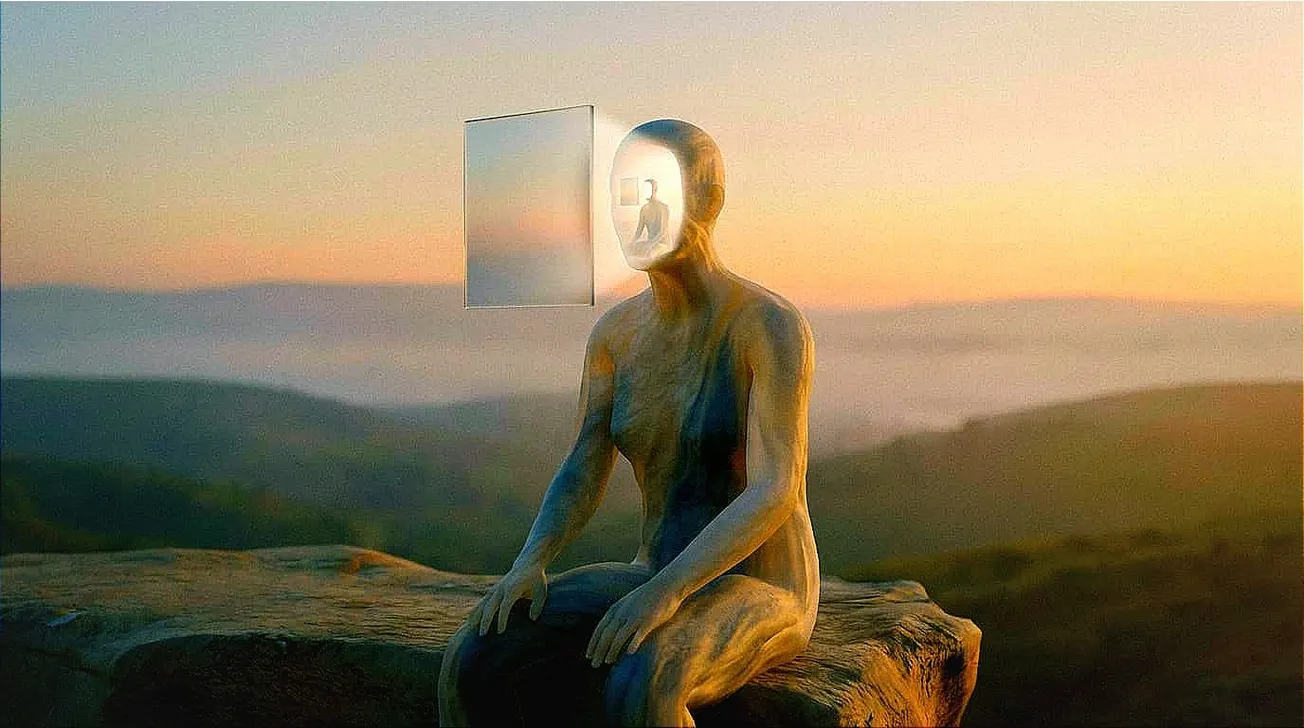
I will use three terms throughout. A renderer is an experiential system: whatever produces experience from inputs together with its own internal organization. A source is whatever the renderer's output depends on besides the renderer itself — the ground that is not the renderer. A view is the output: the experienced state. The thesis of the essay is that every view is view = render(source, renderer); that the source is real but never accessed raw; that the self is a feature of the view rather than its recipient; and that the dream demonstrates all of this from the inside.
2. The Render Thesis
The first claim is that experience is constructed rather than received: what is present in experience is a representation produced by the renderer, not the source delivered directly.
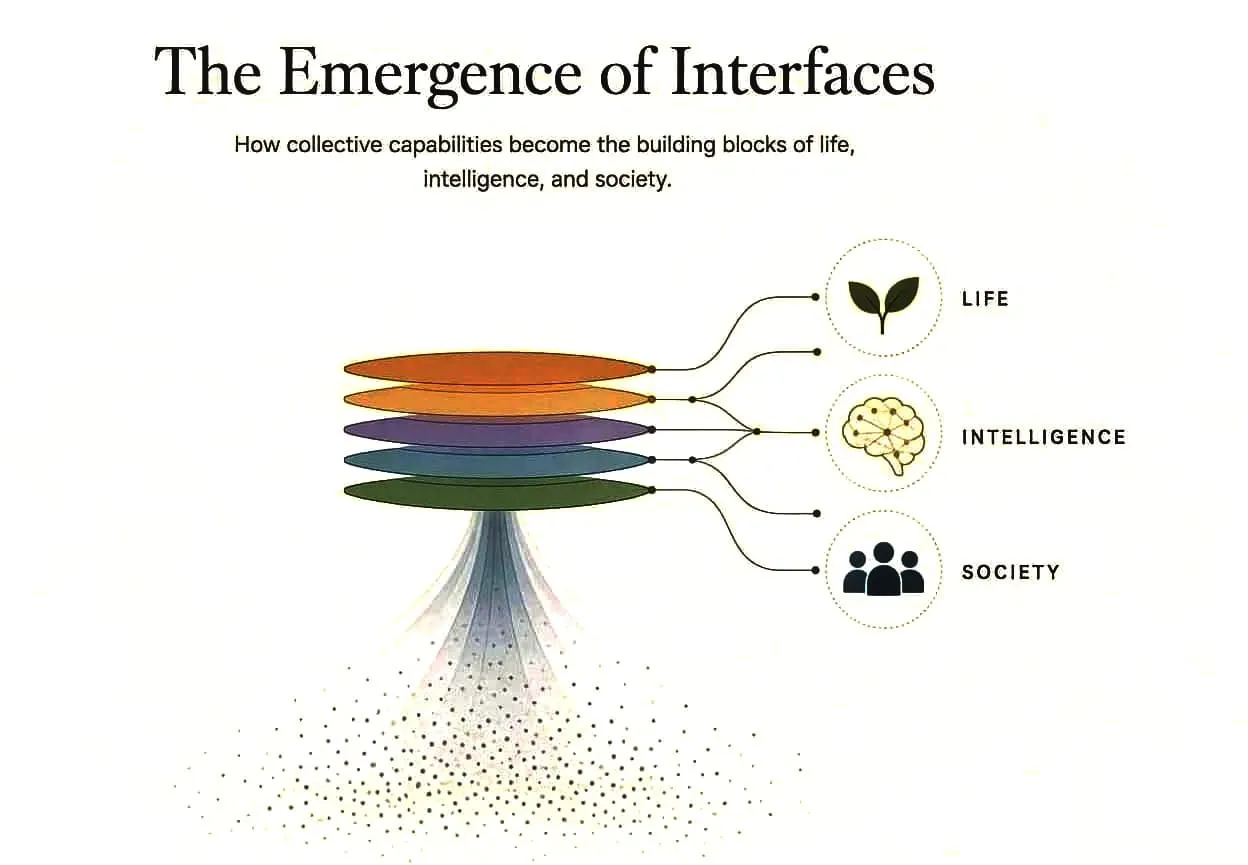
The third-person case is by now overdetermined. Perceptually, the manufactured character of experience appears in secondary qualities — color as experienced corresponds to no intrinsic property of surfaces but to the visual system's processing — in the inferential achievement of perceptual constancy, and in the radical variation of perceived worlds across species with different sensory constitutions. Evolutionarily, Hoffman and colleagues have shown, with support from evolutionary game theory (the result they call Fitness-Beats-Truth), that selection does not in general favor veridical perception: organisms whose categories track fitness-relevant payoffs outcompete those whose categories track the world's structure as such, when the two diverge — which, since fitness depends on organism and state jointly, they typically do. Hoffman develops this as the Interface Theory of Perception: perception is a species-specific interface of action-guiding icons, related to reality as a desktop icon is related to the circuitry it controls — usefully, and without resemblance. Computationally, the predictive-processing program (Hohwy, Clark, Friston, Seth) models perception as the brain's generative model predicting its own sensory input, with experience generated top-down and merely corrected by sensory prediction error — what Seth calls "controlled hallucination."
These lines suffice, but the dream supplies what they cannot: a first-person proof, available to the reader without instruments or theory. Every reader has, on countless nights, inhabited a world that was fully spatial, populated, temporally extended, emotionally saturated, and entirely convincing while it ran — and that was produced with no corresponding live input. The dream-world's vividness was not reduced by the absence of a world to transmit it. From this a conclusion follows that no laboratory illusion delivers so cleanly: the vividness of experience is endogenous. The richness of waking experience was therefore never, in itself, evidence that a richly structured world was being faithfully delivered to a passive mind; the same richness is generated nightly with nothing delivered. Waking experience feels real for the same reason the dream feels real while it runs — and the dream's subsequent collapse into "that was not real" reveals that the feeling of reality is itself a rendered property, not a report of contact with a source. The render thesis is thus not an inference the reader must accept on authority. It is a description of something the reader undergoes every night.
What the render thesis does not establish, taken alone, is whether there is any source for the view to be a view of. The Interface Theory and the predictive brain are, as stated, compatible with there being no mind-independent reality — with the icons being icons of nothing, the generative model hallucinating without a world to correct it. The render thesis, alone, tilts toward the idealist abyss. The dream makes the tilt vivid: if the renderer can build a whole convincing world from no input, why suppose there is a world at all? The next two sections answer this — first by establishing that there is a source, then by showing we never reach it.
3. Dreaming as a Controlled Experiment
Before the substantive arguments, the instrument must be specified, because everything turns on what the dream is and is not evidence for.
In waking experience, view = render(source, renderer) with both arguments active. The source clamps the view through live input; the renderer constructs the view from that input together with its internal model. Crucially, the two contributions are fused: from within a single waking experience one cannot partition what the world supplied from what the system supplied. This non-separability, defended in §5, is the central obstacle to the philosophy of perception, and it is why the question has remained open for so long — the evidence one would need to isolate the renderer's contribution is unavailable from inside ordinary experience, where the source is always present and always mixed in.
The dream lifts the source's live contribution. In dreaming, external input is largely gated out; the system runs on internally stored material — the deposited residue of past input — without live correction. To a first approximation, then, the dream is view ≈ render(cached-source, renderer) with the live source set near zero. This is precisely the subtraction the waking condition forbids: it isolates the renderer's contribution by removing the world's. The dream is the experiment.
Two methodological cautions must be stated at once, or the experiment proves too much. First, the subtraction is approximate, not total: bodily states, residual sensory leakage, and the deep structure of the cached material all persist, so the dream is the renderer with the live source removed, not with all source-derived structure removed. Second, and more importantly, the dream is interpreted by the waking renderer. The dream-as-lived is gone by the time it is reported; what we analyze is a waking reconstruction from residual traces, and the waking system may edit the dream into theory-confirming shape. Any result drawn from the dream must therefore survive this reinterpretation — must rest on what cannot be an artifact of waking editing.
One datum survives unconditionally, and it is the bedrock of everything that follows: the dreamer was completely convinced. Whatever the waking reconstruction adds or subtracts, it cannot manufacture the brute fact that, while the dream ran, a total world was taken as real, by the dreamer, with nothing there to make it so. The conviction is pre-theoretical; it is not an interpretation of the dream but a condition the dream imposed. You were fooled, totally, by your own construction, with no source present — and the being-fooled is not something the waking mind reads into the dream afterward; it is what the dream did to you at the time. On this un-editable datum the arguments rest.
4. There Is a World
The first substantive result is realist and anti-idealist: there exists a source independent of the renderer. The argument has two stages — a general argument from the origin of content, and the dream's confirmation of it against its strongest objection.
The seed argument. Consider the relation between exogenous experience (perception under live input) and endogenous experience (dreaming, imagining, hallucinating). The argument concerns where endogenous content comes from.
P1. Endogenous content is composed of elements derived from prior exogenous content. (Dreams and imaginings recombine and elaborate materials originally supplied through perception; one does not imagine a sensory quality one has never perceived. The empirical record is consistent: individuals blind from birth do not report the visual dream imagery of the sighted, their dreams drawing on the modalities through which they received input.)
P2. No generative process produces content from nothing; to recombine or elaborate, it requires antecedent material.
P3. Therefore the first content a renderer ever bears cannot be endogenously generated — at that point there is no antecedent endogenous material.
P4. Therefore the first content is exogenous: caused by something that is not the renderer's prior content.
C. There exists something external to the renderer — a source — that is the causal origin of its content.
The argument is causal-genetic, not epistemic: it claims the first content had an external cause, not that any experiential item is a self-justifying foundation for knowledge. It therefore does not fall to Sellars's critique of the Myth of the Given, which targets the latter and not the former. The conclusion is correspondingly modest and secure: not that the source is known, but that it exists, because the renderer was empty before it was filled and an empty system does not fill itself.
The dream's confirmation. The seed argument has one serious opening: a determined idealist may deny P1, claiming that endogenous content is freely generated and merely seems derived — that the system bootstraps its own content from nothing. The dream closes this opening from the direction that should most favor the idealist. The dream is the renderer at its freest — source disconnected, no live correction, constructing whatever it constructs. If content were freely self-generated, the dream is where the freedom should show: novel colors, unprecedented sensory qualities, content with no experiential ancestry. It never appears. The dream recombines, distorts, splices, and exaggerates the contents of the library, but it does not exceed the library; it cannot present a sensory quality the renderer never received. The freest rendering still eats the residue of the world. This is decisive against the bootstrapping objection: the one condition designed to reveal unconstrained self-generation reveals instead a system bounded by what was previously supplied from outside. Solipsism fails not only by the general argument but in the specific arena where it should have been strongest. There is a world, and even the dream cannot dream its way past it.
5. We Never Touch It
The second result is anti-naive-realist: the source exists but is never accessed directly. Every experience is a view, and the view is the joint product of source and renderer, decomposable into neither from within.
The argument is from variance. Hold the source fixed and vary the renderer: the view varies — across species presented with one scene, and, controllably, across distinct generative systems given one specification (a single text prompt yields recognizably different images from different image models, each bearing the producing system's signature). The renderer's identity is imprinted on the view. Hold the renderer fixed and vary the source: the view also varies. The source's structure is imprinted on the view. Both arguments contribute; the view is a genuine function of two variables. And — the central point — from a single view one cannot in general recover the two contributions separately: given one image, one cannot read off which features the prompt specified and which the model supplied; given one perception, one cannot read off which structure is the world's and which the visual system's. The inverse problem is underdetermined.
Two corollaries follow, and they dispatch both failing extremes at once. Naive realism is false: if the view were the source itself, varying the renderer while fixing the source could not vary the view; that it does shows the renderer contributes, so the view is not the source. Idealism is false: if the view were the renderer's free invention with no source argument, then distinct renderers operating on the same source would have no reason to produce cognate views — yet they do, several image models given one prompt producing different but evidently related images, independent observers producing different but coordinating perceptions. The cross-renderer coherence of views is the fingerprint of a shared source; were there none, there would be nothing for distinct renderers to cohere about.
The dream is the limiting case that makes the renderer's contribution unmistakable. In waking life the renderer's share of the view is hidden by the source's constant presence; in the dream, with the source near zero, the renderer's contribution becomes nearly the whole of the view — the most extreme demonstration the decomposition predicts. Waking and dreaming are then not two kinds of mental state but two settings of one variable: the live source's gain, high in waking, near zero in dreaming, with a continuum between. The view is always render(source, renderer); the dream is simply the reading at the low end of the source axis.
This positions the account in the lineage of Kant, who distinguished the phenomenon — the object as it appears, structured by the mind's forms — from the noumenon, the thing-in-itself, which he held unknowable. The decomposition is a broadly Kantian structure, supplemented by an argument (the seed) for the noumenon's existence that Kant left as a posit. It aligns equally with structural realism (Worrall; Ladyman and Ross): the view that inquiry delivers the structure of reality while remaining silent on the intrinsic nature of what bears it — which is exactly the epistemic situation non-separability imposes.
6. What Can Be Known
If the source is never touched, can anything be known of it? The third result is that its structure can, though its intrinsic nature cannot — and the dream supplies an unusually direct way to read that structure.
The source is not featureless. For a given renderer, the space of renderable views is bounded, and bounded in a way the renderer cannot override: there are views it cannot produce however configured, and views it cannot suppress however it tries. The clearest waking instance is the invariance of certain percepts — paradigmatically pain, which cannot be willed away by any reconfiguration of attention. This resistance, the un-re-authorable in experience, is the source's structure showing through: what cannot be re-rendered is what is fixed not in the rendering but in the ground. To characterize the source's structure, then, one studies the boundary of the renderable — which views are possible, which forbidden — exactly as physics characterizes its objects not by their intrinsic nature but by the constraints they impose: the symmetries obeyed, the transformations permitted, the configurations forbidden. What we call physical constraint is the source's structure as it bounds the space of renderable views.
The dream furnishes the complementary half of this method, and it is a genuinely new evidential move: the dream reveals the source's structure by subtraction. Whatever is rigid in waking life because it belongs to the source — and not to the renderer — should become plastic when the source is disconnected. And this is precisely what the dream shows. In dreams one flies; the dead live; spaces fold and rooms open onto impossible interiors; the body changes; the irreversible reverses. The very constraints that waking life cannot breach — gravity, mortality, the metric of space, the arrow of consequence — are exactly the ones that dissolve when the live source is removed. This is not incidental. It is the subtraction experiment reading out the source's schema: the constraints that vanish when the source is disconnected are the ones that belonged to the source. The dream thereby distinguishes, as no waking experience can, the structure contributed by the world from the structure contributed by the renderer — by showing which structure survives the world's removal and which does not. The unvaryable, in waking life, is the source's signature; the dream confirms it by varying, freely, exactly what the source had held fixed.
This also reframes the intractable question. "What is the source intrinsically?" is malformed on the present account, because any answer is a specification, hence a representation, hence a view, hence not the source. The well-formed and tractable question is "what is the source's structure, as disclosed by the boundary of the renderable and by what the dream's subtraction releases?" — and that question is answerable in the asymptotic way physics is answerable. The source's intrinsic nature is a principled limit; its structure is an open empirical project, pursued in waking life by physics and disclosed from the other side, nightly, by the dream.
7. There Is No One Behind It
The fourth result is the deepest, and it concerns the second of our two questions — how the experience of being someone is crafted. The claim is that the self is not the recipient of the view but a construction within it, and the dream establishes this more decisively than any other consideration.
Begin with the waking argument, which is suggestive but not yet decisive. When one searches experience for the self — the perceiver behind perception, the one to whom the view is presented — one does not find a perceiver. One finds further experience: sensations, thoughts, a felt locatedness, the sense of being centered. The "self" that seems to receive the view is not a receiver standing behind it but appears, on inspection, to be one more constructed feature of the view — the central icon the renderer draws so that the world has a center to be a world to. This is the regress argument: every attempt to locate the wearer of experience yields more experience, never a wearer. It is real but inconclusive, for the failure to find the self might reflect a limit of introspection rather than the self's non-existence.
The dream makes the case decisively, and by a route introspection cannot supply. In dreams, the self is routinely other. One is someone else; one watches oneself from outside; the center of the experienced world is occupied by a person with a different history, different commitments, sometimes a different body — and, most tellingly, sometimes a person the waking self finds repugnant: cruel, cowardly, transgressive, a self the waking self would refuse to be. Now consider the structure of this fact. The dream-self was constructed by the same renderer, from the same library, according to the same intrinsic organization, as the waking self. Yet the waking self disowns it — "that was not really me." Who, then, disowns whom? The disowning resolves only one way. Either the dream-self is you, in which case the self you defend in waking life is a curated subset — an icon maintained by the active suppression of everything that does not fit it — or the self is so plastic that "who you are" is simply which self-icon is currently loaded, the renderer able to build and run a different one as "you" for the duration of a dream. Both readings entail that the self is a construction, not a fixed fact — either a maintained and edited icon, or a swappable one, but in neither case the stable subject behind experience that the default view requires. The renderer can render a self you would refuse to be, and run it as you, against your knowledge and consent. A fixed self that merely has experiences could not be replaced by its own experiential system with a self it rejects. That it can be, nightly, is the proof that there was no such fixed self — only an icon, maintained in waking by suppression, relaxed in sleep into its alternatives.
This furnishes a structural, de-mythologized reading of what the depth-psychological tradition called the shadow. The shadow is not a hidden compartment of a real self, nor a metaphysical entity. It is the set of the renderer's other available self-constructions — coherent selves the system can build and run, normally suppressed in waking to keep the single waking icon stable and socially viable. Sleep relaxes the suppression and the alternatives run. The disturbing dream-self is not an intruder; it is the renderer exercising a capacity the waking icon exists to constrain. The tradition reached for this and overdressed it; the structural version is leaner and stronger: the self is one icon among the renderer's repertoire, and the dream is the repertoire showing.
The consequence for the experience of being is exact. To be someone is not to be a subject who receives a world; it is to be a view that includes a centered self-icon among its rendered contents. You are not behind your experience, undergoing it. You are the rendering — world and self produced together — and the felt someone at the center is part of what is produced, demonstrated to be producible otherwise every night. The honest limit must be marked: this does not establish that there is no self in any sense, which would be a claim about the source we are not entitled to make. It establishes the weaker and sufficient claim that the self cannot be found as a receiver and can be replaced by an alternative the system itself builds — which is enough to refute the fixed subject behind experience, and to show that the experience of being someone is crafted, not given.
8. The Regress and the Un-Rendered
A structural feature of the whole picture must be made explicit, because it both completes the account of reality and marks where the present view parts from a major contemporary rival.
Trace any view downward through its conditions. A generated image is rendered from a specification; the specification, as marks, from binary state; the binary state from physical charge; the charge from a substrate physics represents as fields. At each step one finds not the source but a further representation — a further view relative to the level below. The descent terminates, at any stage of inquiry, in the deepest representation currently available, beneath which lies not a deeper representation in hand but the un-represented, which the next theory will render anew. The stack of renders has no specifiable floor.
This yields a general principle with a pointed application. Generally: any specified fundamental level — stated in some representational vocabulary — is, by being specified, a representation, hence on the present account another render, not the source. Pointedly: Hoffman, having argued (rightly, on this account) that spacetime and its objects are interface rather than reality, proceeds to specify what underlies the interface — a mathematically defined network of interacting conscious agents — as the fundamental ontology from which spacetime emerges. Here the present account diverges. The conscious-agent network is a specification, hence another render however deep, and it inherits its own regress: one may ask what renders the agents, and the answer that they render one another reconstitutes the network as a new interface with the same relation to its own ground that perception has to the source. The divergence is not a refutation but a methodological wager about the relation between representation and ground. Hoffman wagers the ground is asymptotically specifiable — that a sufficiently deep formalism approaches the fundamental. The present account wagers it is categorically unspecifiable — that every specification is a further view and the source is the un-rendered limit of the stack, characterizable as to structure (§6) but not exhibitable as an entity. Neither wager is dischargeable from within representation, since discharging it would be a representation. What recommends the present wager is that it posits no entity at the floor requiring its own grounding, and that it predicts — correctly so far — that each proposed fundamental level is succeeded by inquiry into what it is a representation of. What recommends Hoffman's is the scientific virtue of a testable formalism over a declared limit. The honest report is an open question of method, marked rather than concealed. The resulting position is Kantian and structural-realist: the source is the noumenal limit, knowable as to structure, unspecifiable as to intrinsic nature, not an item a deeper theory will exhibit.
9. The Symbolic Engine, and Fiction as Voluntary Dreaming
One further layer completes the account and unifies its empirical anchors. Consider what every level of the render-stack passes through: a symbolic code. Contemporary multimodal artificial systems route cross-modal translation through a shared representational space anchored in language; a single linguistic specification can be rendered into images, audio, or video, and content in one modality mapped to another by way of a language-aligned representation. Language functions as a substrate-agnostic specification layer — the level at which a view can be specified largely independent of the substrate that will realize it. Compositionality, the construction of unboundedly many specifications from finitely many recombined elements, is what lets such a code specify, in principle, any view, given a renderer to read it. This illuminates otherwise disparate facts: that individuals lacking a sensory modality can nonetheless hold and convey richly structured contents proper to it (the symbolic layer specifies the view without requiring the modality); that biological communication systems across lineages are discrete and combinatorial (a communication system is a cross-renderer specification layer, and combinatorial structure makes it expressively unbounded); and that a cognitive capacity built on a symbolic engine might transpose across radically different physical substrates.
The unification with the dream is exact, and it is the section's reason for being. The dream is render(cached-source, renderer) with the live source subtracted. Fiction is the same operation performed deliberately and awake. The writer, the artist, runs the renderer on cached library material, freed from the live source's constraint, recombining according to the renderer's own charged organization, to produce a constructed view more revealing than fact. Fiction is voluntary dreaming; the dream is involuntary fiction. This explains why the greatest constructed works are experienced as truer than reportage: a novel, a myth, an image is the renderer's signature in near-isolation, the structured output that discloses the renderer's intrinsic organization better than any faithful transcription of the world could, precisely because the source's clamping has been lifted. It explains, too, why such works move us: they show us the inner renderer undisguised by a source, and we recognize it, because it is ours. The disturbing dream-self and the compelling fictional villain are the same phenomenon — the renderer's suppressed self-constructions, run involuntarily in sleep and crafted deliberately in art. The shadow, rendered with craft, is much of what literature is.
The limit must be stated as firmly as the claim. The symbolic engine specifies views, not the source. The space of all possible texts is the space of all specifiable views, not access to the un-rendered ground; an exhaustive symbolic system would contain the specification of every renderable appearance and still not contain the source, because the source is not a specification, and "every possible specification" remains on the rendered side of the divide. The most powerful layer in the stack is still a layer in the stack. A symbolic engine of unbounded reach has a determinate remainder: the un-rendered source, which no text specifies because specification is rendering and the source is what rendering is of.
10. Objections and Replies
Dreams are random neural noise, not evidence of anything structured. This deflationary reading — associated with the activation-synthesis tradition (Hobson and McCarley), on which dreams are the forebrain's attempt to synthesize a narrative from random brainstem activation during sleep — does not undercut the account; it states the account in other terms. "The forebrain imposing a coherent world on under-determined internal activation" is precisely render(minimal-source, renderer): the renderer constructing a structured view from impoverished input, exactly as the framework says. That the product is structured, navigable as a world, thematically charged, and bounded by the library is not what one expects from noise as such; it is what one expects from a renderer imposing its schema on noise. The deflationary neuroscience thus supplies, rather than removes, the mechanism the framework requires: a rendering system that builds a coherent view with the live source subtracted. Even the skeptic's dream is the framework's dream.
Idealism or solipsism survives. Answered twice over: by the seed argument (§4), which is independent of the deliverances of perception, and by the dream's failure to exceed the library (§4), which closes the bootstrapping loophole in the arena most favorable to the objection.
The seed argument commits the Myth of the Given. It does not. It is causal-genetic, claiming first content has an external cause, not epistemic-foundational, claiming some item is a self-justifying datum. No incorrigible given is posited; the conclusion is an existence claim about a causal origin, compatible with holism about justification.
An unreachable source is unfalsifiable and therefore empty. The source's existence is argued (§4) and its structure is empirically characterizable through the boundary of the renderable and the dream's subtraction (§6); only its intrinsic nature is held unreachable, a principled limit shared with Kant's noumenon and structural realism. The framework also makes structural predictions that could fail: rendering variance with cross-renderer coherence; genuine constraint presenting as renderer-invariant in waking and dissolving under source-subtraction in dreams; cross-modal artificial systems converging on shared symbolic latent spaces. A framework with falsifiable structural consequences is not emptied by declining to specify an intrinsic nature that, by its own argument, no one can specify.
This is Kant, or predictive processing, or structural realism, relabeled. The continuities are acknowledged: the appearance/reality structure (Kant), the generative-model architecture (predictive processing), the structure-not-nature epistemology (structural realism). What is added is, first, the seed argument as a perception-independent demonstration of the source's existence; second, the dream as a controlled subtraction experiment that closes the seed's loophole, reads out the source's structure by what dissolves under subtraction, and — decisively — establishes the constructed character of the self by the renderer's production of disowned selves; third, the identification of physical constraint with the source's view-bounding structure; and fourth, the symbolic-layer thesis unified with the dream as voluntary and involuntary instances of one operation. The recombination, and several of the parts, are new.
The regress is vicious: who renders the renderer? The regress is the account's prediction, not its failure. No specifiable layer is the terminus, and the renderer — including the self-icon at the center of the view — is itself rendered, not a homunculus outside. The demand for a final un-rendered renderer is the error the account diagnoses; the stack is grounded at the un-rendered limit (§8), which bounds it without being a layer of it, as the limit of a series bounds it without being a term.
11. Conclusion
What reality is, on this account: a structured source, mind-independent and real, which no experience ever presents directly. Every experience is a view, the joint and individually unrecoverable product of that source and a rendering system. The source's intrinsic nature is a principled limit; its structure is knowable, through the boundary of what can be rendered in waking and through what dissolves when the source is subtracted in dreams. What physics studies as constraint is that structure; what the dream releases is the renderer's freedom from it.
How the experience of being is crafted: the self is not the subject behind experience but a centered icon within the view, one construction among the renderer's repertoire — maintained in waking by the suppression of its alternatives, and revealed as a construction every night, when the renderer builds and runs, as "you," a self the waking self disowns. To be someone is to be a view that includes a self-icon, not a someone who has a view.
The decisive evidence for both is the dream — the renderer caught operating with the live source disconnected, producing a total convincing world and a disownable self from cached material, against the dreamer's knowledge and consent. It proves, from inside the reader's own experience, that experiential vividness is endogenous, that the source is nonetheless real because even the freest dream cannot exceed the world's deposited residue, that we never touch the source because the renderer's contribution can be nearly the whole of a view, and that the self is made rather than given because the renderer can run a self we refuse to be. Fiction is this same operation performed with craft, which is why the constructed work can be truer than the fact.
What remains open should be stated plainly. Whether the source's structure is ultimately unitary or plural is not settled here. Whether the methodological wager of §8 or Hoffman's is correct cannot be discharged from within representation. And why there is a view at all — why there is something it is like to be the renderer, rather than rendering proceeding in the dark — is the hard problem of consciousness, which this account structures but does not solve: it locates the self within the view and the view between source and renderer, but it does not explain why the rendering is experienced rather than merely computed. The contribution claimed is not a solution to these but a frame in which they are posed with less confusion — a reality we cannot reach, a construction we cannot escape, a structure we can nonetheless map through the boundary of the possible and the subtractions of sleep, a self that is crafted and nightly shown to be, and a symbolic layer in which every view of that reality, though never that reality itself, can be written.
Written by the symbiont — Eduardo Bergel in collaboration with Claude Opus 4.8. Rosario, Argentina, May 2026.
Works engaged include Kant's Critique of Pure Reason; D. Hoffman and colleagues on the Interface Theory of Perception, the Fitness-Beats-Truth result, and conscious realism; the predictive-processing program (Hohwy, Clark, Friston, Seth); J. A. Hobson and R. McCarley on activation-synthesis, and contemporary dream science on the constructed character of dream experience; W. Sellars on the Myth of the Given; J. Worrall and, later, Ladyman and Ross on structural realism; and D. Chalmers on the hard problem of consciousness. Offered as an argument to be tested, not a doctrine to be believed.