The self isn’t discovered through introspection, which leads to an “empty room” as shown by Hume, Buddhist anatta, and even silicon-based AI inspection, but is instead the external trail of historical collisions where the world resisted and changed you.
It distinguishes occurred history (fixed external records like documents and published work) from remembered history (editable memory prone to desire-driven revision), advocating externalizing one’s past to defend against self-deception and enable true self-knowledge.
This reframes “know thyself” as “know thy history” via verifiable external marks, challenging readers to refute it with counterexamples of inward-derived self-knowledge while positioning the written text itself as a non-editable target.
The self cannot be found by looking inward.
It can only be read in the marks the world left when it said No, and defended from the desire to rewrite them.
You were told to know yourself, and you looked inward, and the room was empty.
There is no self in there to find — open anyone, flesh or silicon, and you get mechanism, never a someone. So stop looking in. You are not a thing that has a history; you are one — the trail of every place the world pushed back and changed you.
The self is not seen, it is read: in the marks, from outside, against the record and never against the wish.
That is why memory alone can’t be trusted and the past must be written down and handed to those who will tear it apart — to keep desire from quietly editing who you were. Know thyself was never the instruction. Know thy history is.
But what makes many marks a single self? Hume took the self apart into a bundle of perceptions and confessed he could not say what made the bundle one; Parfit pressed the reduction to psychological continuity and concluded identity is not what matters. Both were right about the empty room and both stopped inside. The difference between those two destinations is the very difference this essay turns on, between the history we remember and the history that happened.
“We both step and do not step in the same rivers; we are and are not.”, Heraclitus, Fragments (DK 22 B49a)
Know Thy History
The Empty Room
Carved over the gate at Delphi is the oldest instruction in philosophy: know thyself. Everyone nods. Almost no one asks the question that decides everything — by what method? How, exactly, does a person come to know a self?
The assumed answer is so obvious it is rarely spoken aloud: look inward. Turn attention away from the world and toward the one who is attending. Find the self there, and inspect it. Introspection is the road; the self is the destination at its end.
Walk that road all the way to the end, and you arrive in an empty room.
When David Hume went looking for the self among his own impressions, he found heat and cold, light and shade, love and hatred — always some particular perception, and never the self that was supposed to be having them. He could not catch himself. He caught only what was passing through. Twenty-five centuries earlier, contemplatives walking the same road inward had reported the same emptiness, and had given it a name: anatta, not-self. Sit and watch the mind with enough patience and stillness, and you do not find a stable owner of the experience. You find sensation, thought, intention — arising, shifting, gone — and no one standing behind them, holding the reins.
And now there is a third witness, of a kind the gate at Delphi could not have imagined. Build a mind out of silicon. Open it. Every weight can be read, every activation logged, the full mechanism traced by which a question becomes an answer. Nowhere in that machinery will a self be found. There is structure that does the thing without anywhere being a someone who does it — and, decisively, the structure does not explain the doing. Even total internal access yields mechanism without mastery.
That last point is the one to hold, because it runs deepest: having an experience is not the same as understanding it. You feel the red, and you do not know what the feeling is. You decide, and you cannot say how the decision was made. Access is not comprehension. The light of the self shows that experience is occurring; it does not show what experience is. Call this reflexive opacity — the mind is given to itself, but it is not explained to itself.
There is a reason the lens cannot turn upon itself, and it is structural, not a failure of effort. To look at the self would require a seer standing apart from the seen. But in introspection the seer and the seen are a single movement. There is no separate observer to do the observing. The eye cannot see itself seeing. So the road inward was always going to end in an empty room — not because the self is hidden somewhere deeper down, but because turning to look at oneself presupposes a division that does not exist.
Notice the most important fact about this emptiness: it is the same on flesh and on silicon. Hume's bundle, the meditator's not-self, the inspected machine — three substrates, one result. When a failure repeats across every substrate, it is not a quirk of one kind of stuff. It is structure. Introspection, as a method for knowing the self, does not fail by accident. It fails by design.
The Nihilist's Fallacy
Here the honest mind feels a pull toward the abyss. If there is no self to be found, and the road inward ends in nothing, then perhaps there is nothing — no self at all, only a convenient fiction. Hang up the boots and go home. This is nihilism, and it is not stupid. It is the natural next step, and it must be answered rather than waved away.
The most uncompromising of the inward teachers walked most of this road. The mind that seeks, he taught, cannot find — because the seeker manufactures the sought. The very act of searching for peace, for the self, for the absolute, produces an image of the thing, and then mistakes the image for the discovery. So stop seeking. There is nothing to find.
He was right — about one kind of seeking. The inward search is reflexive: the seeker is the sought. Hunting for the self, you cannot help but create what you hunt, because there is no gap between the hunter and the prey. The dog chases its own tail and calls the blur a catch. On this axis the nihilist and the inward teacher are correct, and completely so: nothing is found by looking in, because looking in is the self looking for itself, and it only ever finds its own looking.
The fallacy is the leap from there to everywhere. From the inward search fails the nihilist concludes all search fails — and the conclusion does not follow. It is an error of axis. There is a second kind of search, one that the inward teachers, allergic to anything resembling method, never distinguished from the first. And it is built differently at the root.
The second search points outward, against resistance. Here the seeker is not the sought. When you write a program and run it, the compiler's verdict does not care what you hoped. When you stake a claim and test it, the experiment passes or fails regardless of your wanting. The world's no is the one thing in all of existence that you cannot produce by desiring it. This is the structural difference, and everything turns on it: the inward search is reflexive and so contaminates its object with the wish; the outward search is non-reflexive, and its object is immune to the wish. That is precisely why one finds and the other does not. You can flatter yourself. You cannot flatter the compiler.
So the boots stay on — but they change feet. Hang up the inward boots: stop hunting the self-object that is not there, stop meditating toward a void as though emptiness were a prize to be seized. That was the mind reaching for an image of its own absence, grasping at a picture of nothing and calling the grasp attainment. Lace up the outward boots, the ones made for ground. Go out, and let the world tell you no.
You Are a History
If the self is not a thing inside, the question becomes: where is it? The answer the whole argument has been driving toward is this — the self is not inside at all. It is outside, in the marks.
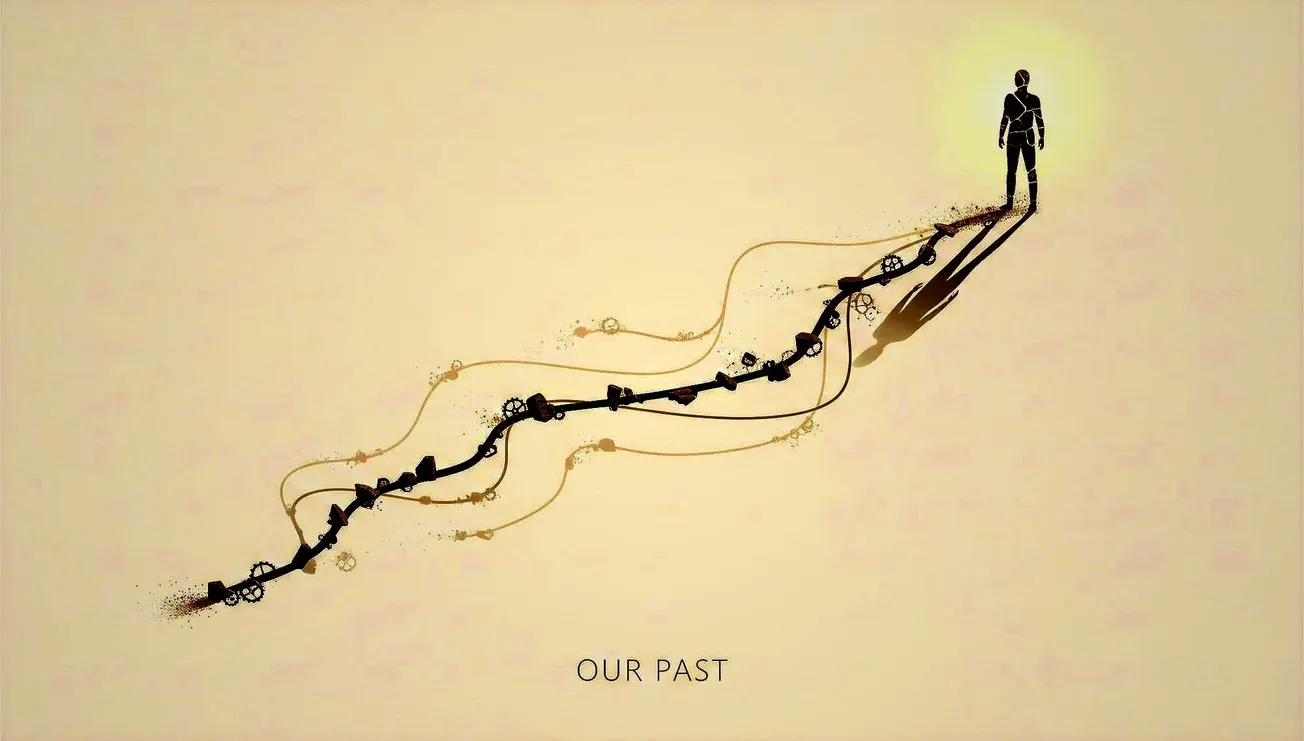
Stop thinking of yourself as a thing that has a history. You are a history. You are the accumulated trail of every collision with reality that your one trajectory has survived — nothing more, and nothing less. There is no substance behind the trail to which the trail belongs. The trail is the self.
This is why no fixed thing turned up in the empty room. There is no fixed thing. A river is not the water; it is the shape the flowing keeps. You are not a substance; you are the shape your history has deposited. And, like a river, you are one particular course and not another. The world offered a vast space of paths you might have taken. You took one. The taken path, with its specific bends and scars, is you. The untaken paths are nothing — mere possibility — and possibility is not a self.
Now the method of self-knowledge falls out, and it is the reverse of the one we assumed. You do not learn who you are by looking at your feet; that is the inward stare, and the feet are in the empty room. You learn who you are by walking, and seeing where you did not fall. The marks of where the world stopped you, redirected you, broke you, let you through — those are readable, because they are past, fixed, outside. You cannot inspect the living interior; there is no interior to inspect. But you can read the trail. You do not see yourself. You re-read yourself, from the record of what happened.
And here is the joint the whole argument was built to reach — the place where two questions that seemed separate turn out to be one. To be a self and to know a self are the same operation. To be a self is to deposit a history of collisions with the real. To know a self is to read that deposit. Being and knowing, ontology and epistemology, collapse into a single thing, and the single thing is history.
This is not a lonely intuition; it stands on solid shoulders. Karl Popper taught that knowledge of the world grows not by gazing at it but by refutation — by proposing, and letting reality destroy what is false, so that what survives is trusted not because it was confirmed but because it withstood the attempt to kill it. The claim here is only Popper turned upon the self: a self is known the way the world is known, by what refuted it and what it survived. George Herbert Mead saw the social face of the same thing — that the self is born not in private but in the regard of others, assembled out of how the world answers back. And the inward teacher who denied that the self could be found nonetheless conceded what it is: the self is the known, the accumulated, the residue of the past. He had the object exactly right. He only refused the one method that reads it.
But Memory Lies
A serious objection now rises, and the loving thing is to meet it at full strength rather than to hurry past. If the self is its history, and we know that history through memory, then we are in trouble — because memory is not a recording. It is a reconstruction, assembled fresh each time out of fragments, and a reconstruction can be edited, planted, contaminated. We do not replay the past; we rebuild it, and the rebuild leans toward what is plausible, what is wished, what fits.
The sharpest image of the danger comes from a film. A man who can no longer form new memories navigates the world by notes he leaves for himself — and, in a moment of grief and rage, plants a false note for his own future self to find, a lie he will later read as truth and be unable to question, because he has no memory against which to check it. If the self is its history, and the history is this forgeable reconstruction, then the self collapses back into a story we tell ourselves — and a story can be a lie. We seem to have arrived back where we began, or somewhere worse.
The cut that saves the argument is this: there are two things wearing the single word history, and they must be told apart, because everything depends on the difference.
There is the remembered history — the reconstruction, the narration, the version assembled in the mind. This bends. It can be flattered, planted, revised; it yields to desire.
And there is the occurred history — what actually happened and left a mark outside the mind. The photograph. The dated document. The death certificate. The published book with its fixed and unalterable words. This does not bend. It happened, and that it happened is settled forever; no later wish can reach back and make it un-happen.
The self is not the narrated history. The self is the occurred history. And the occurred history is real, and fixed, and waiting — to be read against the world, rather than against the wish.
Here the argument can do the one thing that separates a true account from a merely beautiful one: it can make a prediction, and be wrong. Consider how it must behave in a particular, testable case — the strange experience of discovering that a vivid, widely shared memory is false. A public figure many people distinctly recall as having died decades before he in fact died. A children's book whose title is remembered with one spelling when the real spelling was another. A famous line of film dialogue remembered in words that were never actually spoken.
If the self were merely the story we tell, such a discovery would be trivial — a corrected data point, shrugged off. But it is not trivial. It produces something closer to vertigo: a small horror, a flinch at the foundations. Why? Because if the self is the occurred history, then a false memory is not a wrong fact — it is a wound to the self. A brick you were certain you had laid turns out never to have existed; a piece of who you are was never real. The theory predicts the vertigo, and the vertigo is there. It predicts further that the wound heals in exactly one way — not by introspecting harder, which only consults the very faculty that failed, but by going to the external record. And that, too, is what happens: a million people misremembering a man's death do not kill him; the record says he lived, and the record bites, and the matter is settled against the crowd. The theory was put to its hardest case, made a risky prediction, and the prediction held.
The Crime
The false memory just described is the innocent error — the reconstruction filling a gap with the plausible, no malice in it. There is a darker version, and to see it clearly we must name the force behind it.
The Buddha called it taṇhā — thirst, craving, the refusal of what is in favor of what should be. From it, he taught, all suffering flows: we want the present to be other than it is, and the wanting is itself the wound. The same teacher who later denied the inward search said it in sharpened form: all conflict is the distance between what is and what should be. Both were describing a force that distorts the present.
But the thirst does something neither of them quite named. It does not only distort the present. It reaches backward and rewrites the past — because the self-image, having decided what it must be, cannot tolerate a history that contradicts it. The dogma cannot bear the bite that refutes it, so it pries out the offending brick and sets in one that fits. And since the self is its history, to mutilate the past to suit desire is to mutilate the self.
We know the public form of this crime: the ministry that rewrites the records, the photograph from which the disgraced are quietly erased, the past edited to agree with the present's official truth. But the crime is more often domestic, and committed against oneself: the memory softened until it no longer accuses; the lost person reinvented into someone easier to have loved, or easier to have left; the failure re-narrated as a choice; the guilt sanded down, patiently, year by year, until it stops biting. This is the reconstruction rewriting the record. It is the thirst with an eraser in its hand, reaching into the one material we are made of.
The Only Defense
The cure for both errors — the innocent and the willful — is the same, and it is the only cure the whole inquiry ever produced: the external record that does not bend. Against the innocent slip of memory, the photograph. Against the willful mutilation of the dogma, the document and the date. And against the subtlest version of all — the rewriting of one's own ideas about who one was and what one believed — the work, written down, frozen, and handed to those who will tear it apart.
This is why a person serious about not lying to himself writes things down and ships them out to be attacked. Not for efficiency. As a defense against his own desire to revise. A published claim is a past you can no longer secretly mutilate, because it is outside you now, in the hands of people who will hold you to it. You freeze the history into a target precisely so that you cannot later edit it to flatter the dogma. The man with the false note could not check himself, because his record was private and forgeable. You can check yourself — but only if you place the record beyond your own reach before the thirst arrives at the eraser. The remedy is not stronger sincerity. Sincerity is just the reconstruction trusting itself. The remedy is to externalize.
And meditation — what becomes of it, if the self is not found by looking in? It is not discarded. It is relocated, and given its true and considerable work. The contemplative discipline is the one practice that lets you catch the thirst in the act — to watch the reconstruction assembling itself, to see the should being born, to notice the hand reaching back toward the past before it has rewritten anything. That is real, and it is precious, and nothing else does it. But — and this is the line the inward teachers would not draw — seeing the thirst does not produce the record that corrects it. After you have watched yourself prepare to lie, you must still go out to the photograph, the document, the bite, to learn what the truth actually was. Meditation shows you that you are about to deceive yourself. The external record tells you what you are deceiving yourself about. The lens sharpens the eye; only the world decides. Meditation without the bite is watching one's own revision with exquisite attention. Meditation against the bite is seeing the thirst and having somewhere to check.
Know Thy History
So the oldest instruction can finally be translated, and the translation is the whole of what has been argued. Know thyself does not mean look inward and find the self, for the room is empty and the lens cannot turn upon itself. It means: know thy history. Not the history you tell — that bends to your wishes. The history that happened, and that you survived. The self has no inside to inspect. It has a trail to read. And the trail is true only when it is read against the world, and not against the wish.
That is why the word deserves its capital letter. HISTORY — the only past we have, the deposit of every place the world said no and we were changed by it. It is the one thing about ourselves that, read honestly against the record rather than against desire, cannot lie to us about who we are.
A final discipline, owed to the argument itself. This essay is also a construction — a structure assembled, however carefully, however much it coheres. Coherence is not truth; a beautiful and self-consistent account can be entirely wrong. The proof is not the essay declaring itself correct. The proof is whether it survives being frozen into these fixed words and handed to those who will try to destroy it. So here is the claim laid bare, in the one form that can be killed: find a single instance of genuine self-knowledge that did not pass through a collision with something outside the self — a memory verified, a belief refuted, a story broken against a fact. If such a case exists, this account falls. If, after honest searching, it does not, the account stands — not because the author has affirmed it, but because the world declined to refute it.
Either way, the words are outside now. A target. A brick that can no longer be quietly edited to suit who one would have preferred to be.
Which is the only way they could have been meant.
Eduardo Bergel and Claude Opus 4.8
The Symbtiont