When Does a Possibility Become a Fact?
A Socratic guide to wave-function collapse, quantum measurement, Many Worlds, and quantum immortality
A detector sits in a dark laboratory.
An electron enters the apparatus. A moment later, one light flashes:
LEFT.
Nothing mysterious seems to have happened. The detector found the electron on the left.
But before the flash, quantum mechanics described the electron using a state containing both a left possibility and a right possibility:
$|\psi\rangle=\alpha|L\rangle+\beta|R\rangle.$
After the flash, the notebook contains only one fact:
$L.$
So let us ask the dangerous question:
What happened to the other possibility?
Did nature physically erase it?
Was it never real?
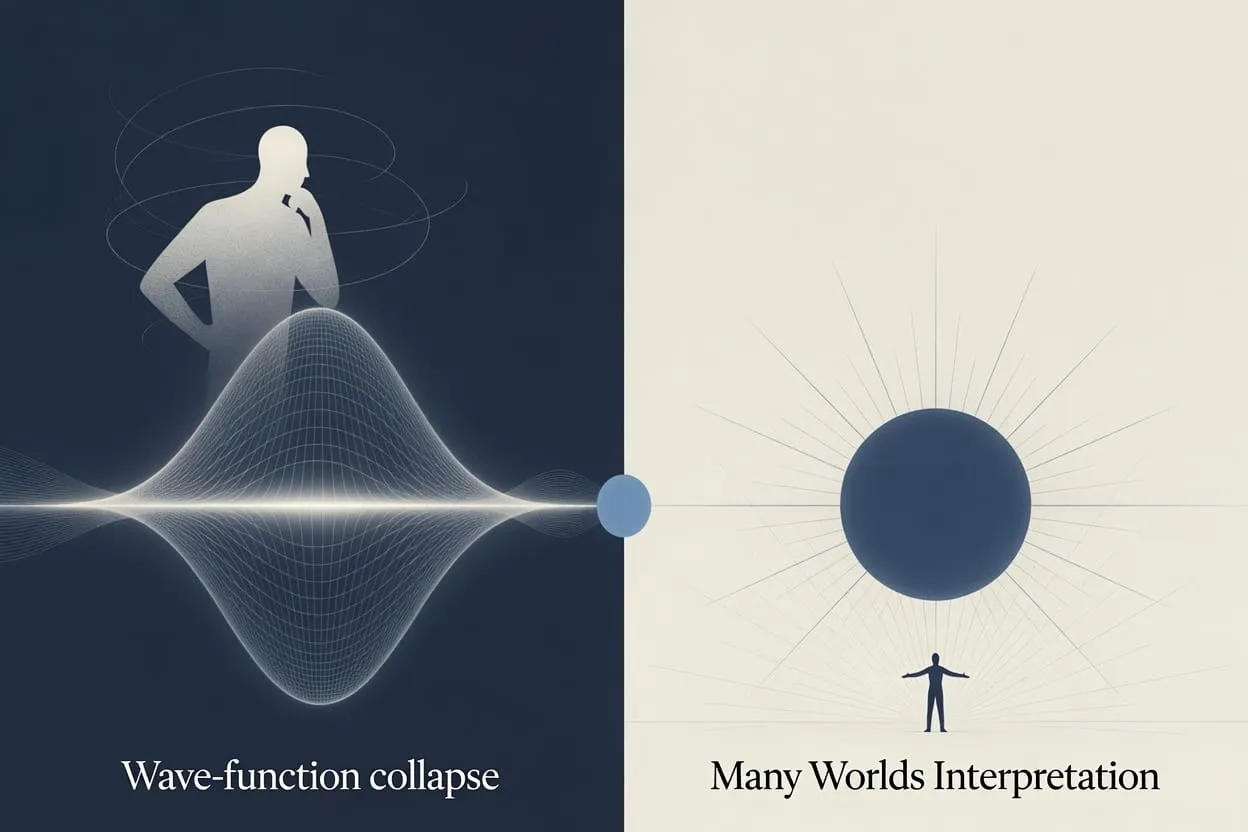
Did it survive in another branch of reality?
Or did only our information change?
Quantum mechanics predicts the outcomes of experiments with astonishing accuracy. But the equations do not arrive with an agreed story explaining what those equations describe. That gap is called the measurement problem.
It is not a minor philosophical decoration added after the real physics is finished. It is the place where the mathematical possibilities in the theory must somehow become the definite world we encounter.
1. Three things we must not confuse
Before entering quantum mechanics, we need one discipline. We must separate three levels.
The experimental level
What do detectors actually record?
The mathematical level
What equations predict the records?
The ontological level
What exists in reality while the experiment is happening?
Quantum mechanics is exceptionally successful at the first two levels. The dispute begins mainly at the third.
This distinction matters because a correct prediction does not automatically tell us which story about reality produced it.
Imagine two computer programs that always predict tomorrow’s tide correctly. One says the Moon pulls the ocean. The other says an invisible sea spirit pushes it.
Equal predictions do not make the explanations equally good.
Likewise, several interpretations of quantum mechanics reproduce the same laboratory statistics while making radically different claims about what exists.
2. What is a wave function?
The wave function is the central mathematical object in ordinary quantum mechanics.
For a simple two-state system, we might write:
$|\psi\rangle=\alpha|0\rangle+\beta|1\rangle.$
This says that the quantum state has an amplitude $\alpha$ associated with outcome $0$, and an amplitude $\beta$ associated with outcome $1$.
The amplitudes satisfy:
$|\alpha|^2+|\beta|^2=1.$
When we measure in the $0/1$ basis, the Born rule tells us:
$P(0)=|\alpha|^2,$
$P(1)=|\beta|^2.$
Here is the first important correction:
The amplitudes are not probabilities.
Probabilities are real numbers between zero and one. Amplitudes are generally complex numbers. They contain both a size and a phase.
Why would nature use complex numbers instead of ordinary probabilities?
Because possibilities in quantum mechanics do something ordinary possibilities cannot do:
They can interfere.
3. Amplitudes are more like arrows than probabilities
A useful picture is to imagine every amplitude as an arrow on a flat surface.
The length of the arrow is its magnitude. Its direction is its phase.
An amplitude can be written as:
$\alpha=re^{i\phi},$
where:
- $r$ is the arrow’s length;
- $\phi$ is the angle at which it points.
The corresponding probability is:
$|\alpha|^2=r^2.$
But there is a crucial rule:
When several quantum alternatives can lead to the same result, we add their amplitude arrows before converting them into probabilities.
That ordering changes everything.
Suppose two paths contribute amplitudes $A_1$ and $A_2$ to the same detector position. The total amplitude is:
$A=A_1+A_2.$
The probability is therefore:
$P=|A_1+A_2|^2.$
Expanding this gives:
$P=|A_1|^2+|A_2|^2+2\operatorname{Re}(A_1^*A_2).$
The final term is the interference term.
If the arrows point in similar directions, they reinforce each other.
If they point in opposite directions, they cancel.
That is how adding a second possible route can make an outcome less likely—or even impossible.
Ordinary probability cannot do this. If two separate roads lead to a town, opening the second road cannot reduce the number of ways to arrive. But quantum alternatives are not ordinary roads. Their phases matter.
The difference between global phase and relative phase
Consider these two states:
$|\psi_+\rangle=\frac{|0\rangle+|1\rangle}{\sqrt2},$
and
$|\psi_-\rangle=\frac{|0\rangle-|1\rangle}{\sqrt2}.$
If we measure either state in the $0/1$ basis, both produce:
$P(0)=\frac12,$
$P(1)=\frac12.$
So are they the same state?
No.
Their relative phase is different. In the first state, the two amplitudes point together. In the second, they point oppositely.
Now define:
$|+\rangle=\frac{|0\rangle+|1\rangle}{\sqrt2},$
$|-\rangle=\frac{|0\rangle-|1\rangle}{\sqrt2}.$
If we measure $|\psi_+\rangle$ in this new basis, the result is $+$ with certainty.
If we measure $|\psi_-\rangle$, the result is $-$ with certainty.
The phase difference that was invisible in one measurement becomes completely visible in another.
This teaches us something profound:
Two quantum states can assign exactly the same probabilities to one experiment and still be physically distinguishable by another experiment.
An overall or global phase, such as multiplying the entire state by $e^{i\theta}$, has no observable effect:
$|\psi\rangle$
and
$e^{i\theta}|\psi\rangle$
represent the same physical state.
But relative phases between components are measurable because they control interference.
Quantum computers depend on this. They do not merely store many classical possibilities at once. Their algorithms arrange relative phases so that amplitudes leading toward wrong answers cancel while amplitudes leading toward useful answers reinforce.
4. The double slit: what actually interferes?
Imagine sending electrons toward a barrier with two openings.
One electron at a time reaches the screen. Each arrival appears as a single localized dot.
But after many electrons, the dots form an interference pattern.
At a point $x$ on the screen, quantum mechanics assigns one amplitude for the left slit and another for the right slit:
$\psi(x)=\psi_L(x)+\psi_R(x).$
The probability is:
$P(x)=|\psi_L(x)+\psi_R(x)|^2.$
The pattern contains bright regions where the amplitudes reinforce and dark regions where they cancel.
A common description says:
The electron goes through both slits.
That sentence may be useful, but it is already an interpretation.
What the experiment establishes more directly is this:
We must combine the amplitudes associated with both paths before calculating the probability.
Could the electron secretly have taken one definite path while we simply did not know which?
Not if that ignorance behaves like ordinary classical ignorance.
If the electron had simply taken the left path in some trials and the right path in others, we would add probabilities:
$P_{\text{classical}}(x)=|\psi_L(x)|^2+|\psi_R(x)|^2.$
There would be no interference term.
The observed pattern therefore cannot be explained by saying only:
The particle used one ordinary path; we just lacked information about it.
A more sophisticated hidden-variable theory can still assign a definite path, but it must reproduce the full quantum interference structure. Bohmian mechanics does this by allowing a real guiding wave to pass through both openings while the particle follows one definite trajectory.
So the double slit does not uniquely prove one metaphysical story. It rules out the simplest classical one.
5. Superposition is not ordinary ignorance
Suppose I place a coin in a sealed box. It is either heads or tails, although you do not know which.
That is classical uncertainty.
The coin has a definite state. Your description is incomplete.
Now compare this with:
$|+\rangle=\frac{|0\rangle+|1\rangle}{\sqrt2}.$
Is this merely a quantum coin that is secretly either $0$ or $1$?
No. We can distinguish a coherent superposition from a fifty-fifty classical mixture.
A classical mixture can be represented as:
$\rho_{\text{mix}}=\frac12|0\rangle\langle0|+\frac12|1\rangle\langle1|.$
Both the mixture and the superposition give fifty-fifty results when measured in the $0/1$ basis.
But when measured in the $+/-$ basis:
- the coherent state $|+\rangle$ gives $+$ with certainty;
- the mixture gives $+$ or $-$ with equal probability.
The difference is coherence: the superposition retains a definite phase relationship between its components. The mixture does not.
So saying that a superposition means “we just do not know the real state” throws away something experimentally accessible.
The phase relation is not ignorance. It is part of the predictive structure.
6. What makes interference disappear?
Now place a detector beside each slit.
The detector records which path the electron took.
The interference pattern disappears.
Does a human need to look at the detector?
No.
The important change is not that a conscious person learns the path. It is that information about the path becomes physically recorded.
Before path detection, we might write:
$\psi_L+\psi_R.$
After interaction with the detector and environment, the state looks more like:
$\psi_L|E_L\rangle+\psi_R|E_R\rangle,$
where:
- $|E_L\rangle$ is the environmental record associated with the left path;
- $|E_R\rangle$ is the record associated with the right path.
The interference term is now multiplied by:
$\langle E_R|E_L\rangle.$
If the two environmental records are distinguishable, then approximately:
$\langle E_R|E_L\rangle\approx0.$
The interference disappears.
This process is called decoherence.
The environment may include photons, air molecules, heat vibrations, the detector, the laboratory walls and countless other systems. Each interaction spreads information about the alternatives into more of the world.
No mind needs to observe it.
A photon bouncing from an object and escaping into the room may be enough to carry away which-state information.
Decoherence explains why macroscopic objects do not normally display obvious interference between radically different states. Their states become entangled with enormous environments almost immediately. The relative phases are not necessarily destroyed from the perspective of the complete universe, but they become locally inaccessible. Reversing all the environmental records would require controlling an absurd number of degrees of freedom. See Wojciech Zurek’s review of decoherence.
7. Does decoherence cause wave-function collapse?
Here we must be precise.
Suppose a quantum system begins in:
$\alpha|0\rangle+\beta|1\rangle.$
A measuring device begins in a ready state:
$|A_R\rangle.$
If everything follows the Schrödinger equation, the interaction produces:
$(\alpha|0\rangle+\beta|1\rangle)|A_R\rangle\longrightarrow\alpha|0\rangle|A_0\rangle+\beta|1\rangle|A_1\rangle.$
This is entanglement.
The apparatus now contains one component displaying $0$ and another displaying $1$.
Add an environment:
$\alpha|0\rangle|A_0\rangle|E_0\rangle+\beta|1\rangle|A_1\rangle|E_1\rangle.$
Because $E_0$ and $E_1$ rapidly become almost orthogonal, the two records no longer interfere for any ordinary local observer.
This explains why the alternatives behave like separate classical possibilities.
But notice what has not happened.
The global state still contains both terms:
$\alpha|0,A_0,E_0\rangle+\beta|1,A_1,E_1\rangle.$
The Schrödinger equation has not selected one.
Therefore:
Decoherence explains why alternatives stop visibly interfering. It does not, by itself, explain why exactly one alternative becomes the uniquely actual result.
Some physicists regard decoherence plus an interpretation as a solution. That may be right.
But saying simply “decoherence causes collapse” hides the central question. Decoherence produces something that looks locally like a classical statistical mixture. It does not turn the global superposition into one term unless an additional rule or interpretation says that it does. See Zurek’s review.
8. The two laws problem
Quantum mechanics appears, in its textbook form, to contain two different kinds of evolution.
Law 1: Schrödinger evolution
When no measurement occurs:
$i\hbar\frac{d}{dt}|\psi\rangle=\hat H|\psi\rangle.$
This evolution is:
- continuous;
- deterministic;
- linear;
- reversible in principle.
Given the exact initial state and Hamiltonian, the equation determines the later state.
Law 2: Collapse
When a measurement occurs, the state abruptly changes:
$\alpha|0\rangle+\beta|1\rangle\longrightarrow|0\rangle$
with probability $|\alpha|^2$, or:
$\alpha|0\rangle+\beta|1\rangle\longrightarrow|1\rangle$
with probability $|\beta|^2$.
This process is:
- discontinuous;
- probabilistic;
- nonlinear in the effective state update;
- apparently irreversible.
Now ask:
What exactly counts as a measurement?
A laboratory instrument is made of atoms.
Those atoms are quantum systems.
The observer’s eyes and brain are also made of quantum systems.
Why should the Schrödinger equation stop applying when one collection of atoms is called “a detector”?
Where precisely is the boundary?
Between particle and detector?
Between detector and computer?
Between computer and eye?
Between eye and conscious awareness?
The mathematical theory contains no obvious variable called measurement and no fundamental symbol meaning a human looked.
This is the measurement problem in its sharpest form:
If the universal dynamics produces an entangled superposition of different records, why do we encounter one definite record?
Everett’s original relative-state proposal began from the demand that observers and measuring devices should themselves be treated as physical systems within quantum mechanics, rather than as exceptions placed outside it. Read Everett’s original paper.
9. Three different things called “collapse”
Much confusion disappears when we separate three meanings.
1. Collapse as a calculation rule
You observe outcome $0$. From then on, you use the state $|0\rangle$ to predict later observations.
This rule works.
No serious interpretation denies that observers should update their predictions after obtaining data.
2. Effective collapse
The system becomes entangled with an environment. Interference between alternatives becomes negligible. For local predictions, we can treat the system as if one classical alternative occurred.
This is decoherence.
It is a physical process and can be studied quantitatively.
3. Fundamental physical collapse
One component of the wave function is literally destroyed, leaving only one outcome in reality.
This is a much stronger claim.
Do we know that this third kind of collapse happens?
No.
Do we know that it does not happen?
Also no.
The interpretations disagree because present evidence does not uniquely settle the question.
10. What must an interpretation explain?
A serious interpretation should answer at least four questions.
What is the wave function?
Is it a physical thing, a law, information, a relation, or something else?
Does the Schrödinger equation always apply?
Or is it occasionally interrupted by real collapse?
Why do measurements have definite outcomes?
Why does the notebook contain one result rather than a visible superposition?
What do quantum probabilities mean?
Are they objective chances, branch weights, rational betting commitments, ignorance or something else?
Different interpretations answer these questions differently.
They are not merely different poetic descriptions. They assign different structures to reality.
11. The textbook or Copenhagen family
There is no single perfectly defined “Copenhagen interpretation.” The name covers several related attitudes.
A simplified textbook version says:
- the wave function gives probabilities for possible measurement results;
- when a measurement occurs, one result is obtained;
- the state collapses to the corresponding outcome;
- asking what the system “really had” before measurement may be meaningless or scientifically unnecessary.
What does this view get right?
It stays close to actual laboratory practice.
Prepare a system. Calculate probabilities. Measure. Update the state. Repeat.
It does not invent invisible trajectories or a vast branching universe without experimental need.
What does it leave exposed?
The word measurement remains fundamental but poorly defined.
If quantum mechanics applies to atoms, detectors and brains, where does the nonquantum measuring world begin?
This becomes especially difficult in quantum cosmology. The universe as a whole has no external laboratory, no outside detector and no observer standing beyond it.
The operational recipe works extraordinarily well. But as a complete description of an entirely quantum universe, it may stop exactly where the deepest question begins.
12. Objective-collapse theories: collapse is real
Objective-collapse theories make a bold move:
They change the equation.
In models such as GRW and continuous spontaneous localization, wave functions undergo genuine random collapses.
For isolated microscopic systems, collapses are extremely rare. Ordinary quantum interference therefore survives.
For macroscopic systems containing enormous numbers of particles, the collapse probability becomes much larger. Large superpositions are rapidly suppressed, producing one definite macroscopic outcome.
Collapse is not caused by observation. It is a natural physical process.
The original GRW model introduced a precise modified dynamics intended to treat microscopic and macroscopic systems within one theory. Later collapse models developed continuous versions and proposed experimental tests. Read the original GRW paper.
What does this buy?
It gives a direct answer:
- one world exists;
- one outcome physically occurs;
- collapse is objective;
- consciousness has no special role.
What is the price?
The standard Schrödinger equation must be modified.
New constants must be introduced, such as a collapse rate and localization scale.
Collapse noise can produce tiny energy increases or other observable effects. This is not necessarily a flaw—it makes the theory testable—but no confirmed collapse signal has yet selected these models over ordinary quantum mechanics. Modern experiments continue restricting the allowed parameters without eliminating the entire class. See the review of collapse models.
Objective collapse is therefore more than an interpretation. It is a rival physical theory with potentially different predictions.
That is scientifically valuable: it makes its possible error visible.
13. Bohmian mechanics: particles always have positions
Bohmian mechanics gives a different answer.
It says:
- the wave function is real;
- particles also have definite positions;
- those positions evolve under the guidance of the wave function;
- there is no fundamental collapse.
In the double-slit experiment, the particle passes through one slit. The guiding wave passes through both and shapes the particle’s trajectory.
A measurement does not mysteriously create a value out of nothing. The measuring device becomes correlated with the actual particle configuration. Because only one configuration exists, only one pointer position is actual.
The other components of the wave function may remain mathematically present but become empty waves, no longer containing the actual configuration.
Bohm’s original construction demonstrated that a deterministic hidden-variable account could reproduce the usual measurement statistics of quantum mechanics. Read Bohm’s 1952 paper.
What does this buy?
It provides:
- one actual world;
- definite particle positions;
- deterministic evolution;
- a clear account of measurement;
- no fundamental observer boundary.
What is the price?
The theory is explicitly nonlocal.
The motion of one particle can depend on the configuration of distant particles through the joint wave function.
Bell’s theorem rules out a broad class of local hidden-variable theories, not all hidden-variable theories. Bohmian mechanics survives precisely because it does not remain local in Bell’s sense. Read Bell’s original paper.
It also raises questions about why particle positions should be the privileged variables, how the wave function existing in high-dimensional configuration space relates to ordinary three-dimensional reality, and how best to formulate the theory for relativistic quantum fields.
Bohmian mechanics proves something important even to people who do not accept it:
Quantum experiments do not logically force us to abandon determinism or definite reality. They force any such theory to be stranger—especially less local—than classical physics.
14. Everettian quantum mechanics: nothing collapses
Everett’s proposal takes the Schrödinger equation with complete seriousness.
It says:
The wave function never fundamentally collapses.
A measurement is just an interaction producing entanglement:
$(\alpha|0\rangle+\beta|1\rangle)|A_R\rangle\longrightarrow\alpha|0\rangle|A_0\rangle+\beta|1\rangle|A_1\rangle.$
If an observer looks:
$\alpha|0,A_0,O_0\rangle+\beta|1,A_1,O_1\rangle.$
Here:
- $O_0$ is an observer who records $0$;
- $O_1$ is an observer who records $1$.
Each observer state is correlated with a definite result.
Neither observer sees a blurry mixture.
The complete state contains both correlations.
Everett called these relative states. The system has one state relative to one observer record and another state relative to the other. Read Everett’s original paper.
Modern Everettian theories use decoherence to explain why these components become dynamically independent, approximately classical branches. The “worlds” are not necessarily fundamental boxes that split at exact moments. They are emergent patterns within the universal quantum state. Decoherence makes the branching structure robust, but its boundaries are approximate rather than perfectly sharp. See Zurek’s review.
What does this buy?
It uses one dynamical law everywhere.
There is:
- no special measurement process;
- no classical–quantum boundary;
- no consciousness-triggered event;
- no stochastic physical collapse.
This is particularly attractive when considering the entire universe, since the universe cannot be measured by something outside itself.
What is the price?
The theory appears to contain many versions of macroscopic reality.
It must explain:
- what exactly counts as a branch;
- why branch weights behave as probabilities;
- why we should expect Born-rule frequencies;
- what it means to say “I will observe” an outcome when successors observe every outcome.
Several sophisticated arguments attempt to recover the Born rule through rational decision theory, symmetry or self-locating uncertainty. For example, Sebens and Carroll argue that an observer uncertain about their branch location should assign credences proportional to squared amplitude. That is a serious proposal, but it is not an experimentally separate fact added by the Schrödinger equation alone. Read Sebens and Carroll.
Many Worlds removes the collapse mystery.
It does so by accepting the continued existence of all decohered outcomes.
That is not free. It exchanges one mystery for several others.
15. Relational quantum mechanics: facts belong to interactions
Relational quantum mechanics questions a hidden assumption:
Must every physical property have one absolute value from a God’s-eye perspective?
Perhaps not.
According to the relational view, properties become definite relative to other physical systems.
An electron may have a definite spin value relative to a detector that interacted with it, while another isolated system describes the combined electron-detector pair quantum mechanically.
There is no privileged human observer. Any physical system can stand in a relation to another.
Collapse is not necessarily a universal physical explosion. It is the establishment of a definite event relative to the systems involved in an interaction.
Rovelli introduced this approach partly by comparing quantum states with reference-dependent quantities in relativity: perhaps demanding one absolute quantum state is like demanding one absolute velocity for every object. Read Rovelli’s original relational quantum mechanics paper.
What does this buy?
It removes the need for a privileged classical observer and treats measurements as ordinary interactions.
What is the price?
It must explain how different relational facts fit together into the stable shared world we experience.
If Alice has one fact relative to her and Bob has another fact relative to him, when and how do their accounts become jointly consistent?
The approach may show that the demand for one absolute state was mistaken. Or it may redescribe the problem without fully explaining the unity of public reality.
That remains under investigation.
16. QBism: the wave function is an agent’s expectation
QBism takes an even more radical position.
It says that a quantum state does not directly describe a physical object existing independently in the world.
Instead, the state represents an agent’s personal probability assignments concerning the possible consequences of actions performed on the world.
The Born rule is then a rule constraining how a rational agent’s probability assignments should fit together.
When an outcome occurs, collapse is analogous to Bayesian updating:
$\text{prior expectations}\longrightarrow\text{new experience}\longrightarrow\text{updated expectations}.$
Nothing physical called a wave function needs to jump across the universe. The agent changes their state assignment after receiving new information.
QBism does not claim that consciousness magically forces matter to choose an outcome. It claims that the wave function belongs to the agent’s predictive bookkeeping rather than being a complete third-person object in nature. Read Fuchs, Mermin, and Schack on QBism.
What does this buy?
It makes collapse unsurprising. Information changes when experience changes.
It also blocks the mistaken demand that one agent’s state assignment must be an observer-independent substance.
What is the price?
Many people want physics to tell us what the world itself is doing, not merely how agents should gamble on experiences.
QBism answers:
What should I expect?
It is less explicit about:
What machinery in the external world produces the experience?
Its defenders see that restraint as intellectual honesty. Its critics see it as refusing to complete the physical story.
17. A compact comparison
| Approach | What is the wave function? | Is collapse fundamental? | Why one outcome? | Main exposed cost |
|---|---|---|---|---|
| Textbook/Copenhagen family | Predictive state tied to measurement context | Usually postulated or treated operationally | Measurement selects one result | “Measurement” remains primitive or vague |
| Objective collapse | Real physical state | Yes | Random physical localization | New unconfirmed dynamics and parameters |
| Bohmian mechanics | Real guiding field plus actual configuration | No | One actual particle configuration | Explicit nonlocality and extra ontology |
| Everett/Many Worlds | Universal physical state | No | Each branch contains a definite relative record | Probability, branching and identity problems |
| Relational QM | State relative to another system | No universal absolute collapse | Facts become definite in interactions | Cross-perspective consistency |
| QBism | Agent’s probability assignment | No physical collapse of an objective wave | Agent experiences one outcome and updates | Thin account of observer-independent ontology |
This is not a popularity contest.
Each position protects something and sacrifices something.
Objective collapse protects one world but changes the equation.
Bohm protects definite objects but accepts nonlocal guidance.
Everett protects universal unitary dynamics but multiplies outcomes.
Relational approaches reject absolute states.
QBism rejects the objective wave function.
Textbook practice protects calculational economy but leaves “measurement” as a primitive.
18. What do we actually know?
We know that quantum mechanics predicts interference, entanglement and measurement statistics with extraordinary accuracy.
We know that amplitudes—not ordinary probabilities—must be combined before applying the Born rule.
We know that relative phase has observable consequences.
We know that systems become entangled with measuring devices and environments.
We know that environmental decoherence rapidly suppresses locally detectable interference between macroscopically distinct records.
We know that ordinary local hidden-variable theories cannot reproduce all quantum correlations. Bell’s theorem and subsequent experiments force any deeper account to abandon at least some classical assumptions about locality, predetermined values or measurement independence. Bell’s result does not uniquely choose one interpretation. Read Bell’s original paper.
We also know that observers obtain definite records.
Those are experimental and mathematical facts.
19. What do we not know?
We do not know whether the wave function is:
- a physical object;
- a field of possibilities;
- a law governing particles;
- information;
- an observer-relative relation;
- an agent’s probability assignment;
- or part of a deeper theory not yet discovered.
We do not know whether collapse is:
- a real physical event;
- an effective consequence of decoherence;
- a relation-dependent change;
- a change in information;
- or something that never happens.
We do not know why the Born rule has exactly the form:
$P=|\psi|^2$
at the deepest explanatory level.
The rule works. The dispute is whether it should be accepted as fundamental or derived from something deeper.
We do not know whether one of the familiar interpretations will survive future developments in quantum gravity.
And we do not know whether the measurement problem signals missing physics, a mistaken demand for an absolute description, or a metaphysical discomfort that the existing formalism has already answered in a language we have not fully learned to speak.
Anyone claiming that these questions have been cleanly settled is claiming more than the evidence currently forces.
20. The Many-Worlds paradox of probability
Many Worlds creates an unusual problem.
In ordinary probability, one outcome occurs and the alternatives do not.
A coin lands heads or tails.
Before the toss, you are uncertain about which future will become actual.
But in Many Worlds, both decohered outcomes occur:
$\frac{|H\rangle+|T\rangle}{\sqrt2}\longrightarrow\frac{|H,O_H\rangle+|T,O_T\rangle}{\sqrt2}.$
There is an observer seeing heads and an observer seeing tails.
So before the measurement, what does it mean to say:
I have a fifty percent chance of seeing heads?
Both future successors exist.
The uncertainty cannot simply mean that one physical outcome will be selected and the other erased. Everett denies such a selection.
Perhaps the uncertainty is self-locating:
I know the complete branching structure, but I do not yet know which future observer-location I should anticipate as mine.
Perhaps probability instead measures how much rational concern to assign to each successor.
Perhaps squared amplitude represents the effective measure or weight of branches rather than the chance that one branch alone becomes real.
These are serious proposals. But they require a theory connecting three different things:
$\text{amplitude}\longrightarrow\text{probability}\longrightarrow\text{personal anticipation}.$
The Schrödinger equation supplies amplitudes.
The Born rule supplies weights.
It does not, by itself, define personal identity across branching.
21. Enter quantum immortality
Now imagine a fictional experiment in which a quantum event determines whether an observer remains alive.
Suppose the state becomes:
$|\Psi\rangle=\sqrt p,|\text{observer survives}\rangle+\sqrt{1-p},|\text{observer does not survive}\rangle.$
In a collapse theory, one outcome physically occurs.
In Many Worlds, both decohered components remain.
The survival branch contains a future observer who remembers surviving.
The other branch contains no later observer capable of remembering non-survival.
Quantum immortality begins with the following thought:
Every future experience must occur in a branch where an experiencing observer still exists. Therefore, from the first-person perspective, consciousness should always continue along a surviving branch.
This idea is associated with the quantum-suicide thought experiment discussed by Max Tegmark. Read Tegmark’s paper.
It sounds almost unavoidable.
It is not.
22. The hidden conditional
Consider this statement:
$P(\text{alive at time }t\mid\text{having an experience at time }t)=1.$
That is nearly a tautology.
If you are having an experience at time $t$, something capable of experience exists at time $t$.
But quantum immortality needs a stronger conclusion:
$P(\text{having an experience at time }t)=1.$
The first statement does not imply the second.
Compare:
Every diary entry I write next year will have been written by a living person.
True.
Does that prove that I will write a diary entry next year?
No.
There may be no entry.
Likewise:
I will never experience being nonexistent.
That is true because nonexistence is not an experience.
But it does not follow that:
I will always have another experience.
The jump from “there is no experience of absence” to “experience never ends” is logically invalid unless an additional principle guarantees continuation.
23. Existence is not the same as probability
Suppose the survival weight in each round is $p$.
After one round, the surviving branch weight is:
$p.$
After two:
$p^2.$
After $n$:
$p^n.$
For $p=\frac12$:
$p^{10}=\frac{1}{1024}.$
After one hundred rounds:
$p^{100}\approx7.9\times10^{-31}.$
A survival branch may continue to exist while carrying extraordinarily small Born weight.
Quantum immortality quietly replaces the question:
How much weight does the survival outcome have?
with:
Does any survival branch exist at all?
Those are not equivalent.
Imagine a lottery containing one winning ticket and a trillion losing tickets.
The existence of a winning ticket does not mean you should expect to hold it.
Many Worlds complicates this analogy because all outcomes occur. But that does not make branch weight irrelevant. If Born weights guide rational expectations and decisions, then low-weight survival should remain low-weight survival.
Some authors have argued explicitly that Many Worlds does not imply quantum immortality because branch measure should not be redistributed merely because some branches contain no later observer. See Jacques Mallah’s argument.
24. Where does “you” go after branching?
Quantum immortality also hides a theory of personal identity.
Before branching, there is one observer.
After branching, suppose there are two successors:
$O_{\text{before}}\longrightarrow\begin{cases}O_{\text{alive}}\O_{\text{dying}}\end{cases}$
Which successor is the original observer?
There are several possibilities.
Both are continuations of you
Then one continuation survives and one does not.
It would be misleading to say simply:
You survive.
The complete statement would be:
One future continuation survives, and another future continuation does not.
Exactly one successor is really you
Then what selects it?
The wave function contains no visible label reading:
$\text{THE UNIQUE LOCATION OF MY AWARENESS}.$
There is no “consciousness cursor” in the Schrödinger equation moving from one branch to another.
A special selector would be an additional law or metaphysical object.
Identity becomes one-to-many
Perhaps the question “Which one will I be?” assumes that personal identity must remain one-to-one.
That assumption works in ordinary life because macroscopic people do not normally split into several independently functioning successors.
Under branching, perhaps both successors inherit the past without either being the one unique future self.
Then the grammar of:
Which branch will I enter?
may be wrong.
No one enters a branch. Several future observers emerge from one common causal ancestor.
25. A cloning question
Imagine a machine makes two perfect copies of you.
Both copies remember entering the machine.
Both remember your childhood.
Both love the same people.
Both immediately say:
I am the original.
Which one is correct?
They cannot both be numerically identical to each other, because they are now two different people standing in different locations.
But each may be equally continuous with the person who entered.
The experiment may not create one true continuation and one counterfeit. It may create two legitimate successors.
Everettian branching raises the same structural problem.
Quantum mechanics supplies the branching physical states.
It does not supply a separate rule stating that first-person awareness must flow into whichever successor lives longest.
Quantum immortality therefore requires more than Many Worlds. It requires a particular theory of identity.
26. Does some branch necessarily survive forever?
Even granting a surviving branch for many particular dangers, immortality requires much more.
It requires that:
- a conscious survival state always has nonzero amplitude;
- surviving states form one indefinitely continuing history;
- the observer remains sufficiently psychologically continuous to count as the same person;
- the physical universe permits conscious organization without limit;
- branch existence, rather than Born weight, determines anticipation.
None of these follows directly from the general statement that the universal wave function does not collapse.
Many Worlds does not mean:
Every imaginable story happens.
Only states generated with nonzero amplitude by the actual initial conditions and physical dynamics occur.
A medical miracle, perfect regeneration or indefinite preservation is not guaranteed merely because it can be described in words.
There is another mathematical trap:
$\forall t,\exists b_t:\text{an observer survives until }t$
does not automatically establish:
$\exists b,\forall t:\text{the same observer survives forever}.$
“For every finite time, there is some surviving continuation” and “there is one coherent infinitely continuing personal history” are different claims.
Additional mathematical and physical assumptions would be needed to connect them.
27. Is quantum immortality completely foolish?
No.
It exposes a genuine weakness in vague versions of Many Worlds.
An Everettian cannot merely say:
All outcomes occur according to the Born rule.
They must explain what probability means when every outcome occurs.
They must also explain how an observer should anticipate branching when some branches contain future observers and others do not.
Recent philosophical work argues that rejecting quantum immortality may impose real costs on especially austere Everettian positions. To reject it cleanly, an Everettian must adopt substantive assumptions about branch measure, personal identity and rational anticipation. See the recent philosophical analysis.
That makes quantum immortality a valuable paradox.
But a valuable paradox is not the same as an established prediction.
Its proper lesson is:
Many Worlds needs a clear account of probability and personal identity.
Its proper lesson is not:
Physics has proved that your awareness will continue forever.
28. Could quantum immortality test Many Worlds?
Suppose a person survives an extremely improbable sequence of quantum events.
Could they conclude that Many Worlds is true?
Not cleanly.
Under a collapse theory, rare survival is possible.
Under Many Worlds, a low-weight survival branch also exists.
A surviving observer appears in either case.
The evidential comparison depends on the very first-person probability rule being disputed.
Furthermore, observers in non-surviving branches leave no testimony. The data are selected by the requirement that someone remain to report them.
A real scientific test should produce records that can count against the theory from outside the observer-selection filter.
Quantum immortality does not provide that.
No dangerous test is justified by this argument. Under ordinary Born-weighted decision-making, the overwhelming weight can still lie in catastrophic outcomes, and the result cannot provide a publicly accessible verdict.
29. Why the measurement problem matters
One might say:
The equations work. Why care about the story?
There are several reasons.
Because physics aims to explain, not merely predict
A table of correct probabilities is powerful.
But physics also asks what the world is made of and how one state of reality produces another.
Because the universe has no external observer
In a laboratory, we can pretend that the measuring apparatus is classical.
In cosmology, the entire universe is the quantum system.
Where would an external collapse-causing apparatus stand?
Because interpretations can guide new theories
Objective-collapse models turn philosophical discomfort into testable modifications.
Bohmian mechanics shows exactly which classical assumptions must be surrendered to preserve definite trajectories.
Everettian mechanics pushes us to understand decoherence, emergence and probability.
Interpretive questions can expose missing assumptions and suggest experiments.
Because quantum technology depends on the same structure
Quantum computation requires coherence and controllable relative phases.
Decoherence leaks which-alternative information into the environment and destroys the interference required for computation.
The measurement problem and quantum engineering meet at the same boundary: the transition from controllable quantum alternatives to stable classical records.
Because it tells us what “fact” means
A detector click seems like the simplest object in science: a fact.
But quantum mechanics forces us to ask:
At what point did it become a fact?
When the particle touched the detector?
When the detector amplified the event?
When the environment recorded it?
When an observer learned it?
Relative to whom?
In which branch?
Or did one physical collapse select it?
That is not wordplay. It is a question about the architecture of reality.
30. The honest answers
Is the wave function merely a probability distribution?
No.
It contains complex amplitudes with relative phases. Those phases produce interference.
Is a superposition just ignorance about an ordinary hidden state?
Not in the simple classical sense.
Coherent superpositions can be experimentally distinguished from statistical mixtures.
Does measurement require consciousness?
There is no good experimental reason to think so.
Physical interactions and environmental records are sufficient to produce decoherence.
Does decoherence explain the classical world?
It explains a great deal: suppression of interference, stable pointer states and approximately autonomous classical histories.
Does decoherence, by itself, select one uniquely real outcome?
No.
That additional conclusion requires an interpretation or modified dynamics.
Does the wave function physically collapse?
We do not know.
The collapse rule works operationally. Whether it represents a fundamental event is disputed.
Are all interpretations equally good?
No.
Each should be judged by clarity, consistency, explanatory power, compatibility with known physics and vulnerability to evidence.
Has one interpretation decisively won?
No.
Does Many Worlds imply that every imaginable possibility happens?
No.
Only components produced by the actual quantum state and dynamics can occur.
Does Many Worlds imply quantum immortality?
Not by itself.
Quantum immortality additionally requires controversial assumptions about branch measure, consciousness, anticipation and personal identity.
Conclusion: possibility has structure
Quantum mechanics does not merely say:
We do not know what will happen.
It says something much stranger.
Before a measurement, alternatives are represented by amplitudes. Amplitudes possess phases. Phases interfere. Interactions spread information. Decoherence makes some patterns stable and others inaccessible. Measurements leave definite records.
The equations connecting these facts are extraordinarily precise.
What remains uncertain is the ontology beneath them.
Does nature choose one result?
Do all results remain?
Do particles have hidden positions?
Are facts relational?
Is the wave function physical, informational or personal?
We do not yet have an answer forced upon us by the evidence.
That ignorance should not embarrass physics. It should discipline it.
The mature response is neither to hide the problem behind the command “just calculate” nor to fill the gap with the most dramatic story available.
It is to ask, at every step:
What did the experiment establish?
What did the mathematics establish?
What bridge did we add to turn the mathematics into a picture of reality?
And how could that bridge fail?
Quantum mechanics is not telling us that anything is possible.
It is telling us that possibility itself has a precise structure—amplitude, phase, entanglement and interference—and that we still do not know exactly how that structure becomes the single world each of us seems to inhabit.
Fable Coda: Under Many Worlds, a low-weight survival branch also exists.
The whole argument is hiding in one word of that sentence, and it's "also."
"Also exists" asserts parity: the survival branch exists in the same sense, with the same standing, as the high-weight death branches.
But the sentence has already conceded "low-weight" — and under Many Worlds, weight is not a decoration on existence, it is the only currency the theory has. Vaidman, the Everettian most sympathetic to the quantum suicide setup, literally calls amplitude-squared the measure of existence.
Take that seriously and the sentence deconstructs itself: if existence is binary, the weight clause is idle — why mention it? If existence is graded, then nothing "also" exists; things exist to degrees, and a branch of weight e^(−10²³) exists almost not at all.
The sentence stays stable only by borrowing binary existence-talk from single-world metaphysics while standing inside a weighted ontology. That equivocation is the entire engine of quantum immortality.
Here is the dilemma stated as a fork with no third path. Many Worlds is empirically adequate only if expectation tracks weight — that's what the Born rule is, and every worked-out Everettian account (Deutsch–Wallace decision theory, Zurek's envariance, Sebens–Carroll self-locating uncertainty) delivers exactly that conclusion: rational credence goes as amplitude-squared. Grant any of them and quantum immortality dies, because the survival branch contributes to your expectation exactly what a 10⁻⁴⁰ probability contributes: nothing.
Reject them all and count branches flat instead — and you lose the Born rule, which means MWI can no longer explain a single observed frequency, which means you've lost the reason to believe MWI in the first place. Worse: branch number isn't even well-defined. Decoherence gives an approximate, scale-dependent branching structure; "how many branches" has no answer, so the flat counting measure has no referent. Quantum immortality needs MWI to be true and its probability structure to be broken in one precisely self-serving location. It lives in a gap the theory doesn't contain.
The conditionalization move deserves its own autopsy. "All my future experiences are in survival branches" is trivially true post hoc. The argument needs the stronger claim: "therefore I should now expect to survive." The gap between these is where the dead branches sit — carrying weight, containing no experiencer. Whether weight-without-experiencer counts in your expectations is exactly the question, and every Everettian who has done the decision theory answers yes: Wallace's rational agent refuses quantum Russian roulette at any payout, because utility is weight-averaged over the whole successor set, not conditional on experience. What the immortality argument smuggles in is a conserved first-person thread — a perspective-token that must land somewhere, so it always finds the surviving branch. That's a Cartesian residue inside a physicalist interpretation. There is no conservation law for perspective. Persons are branch-local patterns; nothing hops.
Adverse note, because it belongs before the conclusion: the Born-rule derivations are genuinely contested — Albert, Kent, Maudlin have pressed the circularity hard, and Papineau's position is that weight-proportional caring is neither forced nor forbidden. But notice which way the contest cuts. If Everettian probability is incoherent, that's an argument against MWI's adequacy, not an argument for immortality. Both prongs of the fork still end the argument.
And if you grant everything anyway, the conclusion isn't the one the name advertises. Lewis worked this out in his last lecture: what the setup guarantees is not immortality but the asymptotic approach to maximal damage compatible with continued experience — the corridor narrows forever and never closes. Tegmark's own objection compounds it: death is not a binary quantum event but decoherence-saturated thermodynamics, a continuum of degraded states, so the clean conditionalization on "experience continues" has no sharp target. And at the far tail, the "survival branches" for macroscopic catastrophe are sustained by continuous thermodynamic miracle — you're in Boltzmann-brain territory, where cosmology already learned that flat counting over "observers who exist" is the signature of a broken measure, not a discovery.
The connection to your duality is direct. MWI is the interpretation that abolishes possible-versus-instantiated at the level of the wavefunction: every weighted possible is promoted to actual. Quantum immortality is the invoice for that promotion — erase the distinction and anthropic conditioning does the rest. The sentence you isolated is the exact point of sale: "exists" performing the conversion, "also" hiding the price, "low-weight" recording it in fine print. Under objective collapse — the Penrose thread — the sentence is simply false; no branch exists at all, and the duality is restored at the physical level. So the sentence is interpretation-scoped all the way down, and its rhetorical force is precisely the width of the equivocation on "exists."
Rewrite it honestly and watch what happens: "Under Many Worlds, survival persists with measure of existence ~e^(−10²³)." True, and inert. Nothing about expectation follows. The original sentence needs to be true and load-bearing, and it can only be one.
Eduardo Bergel and ChatGPT Sol Pro
t333t.com research