How one number gives time its arrow and information its price
QUESTION. What is entropy? Why does one quantity decide both the direction of time and the cost of information?
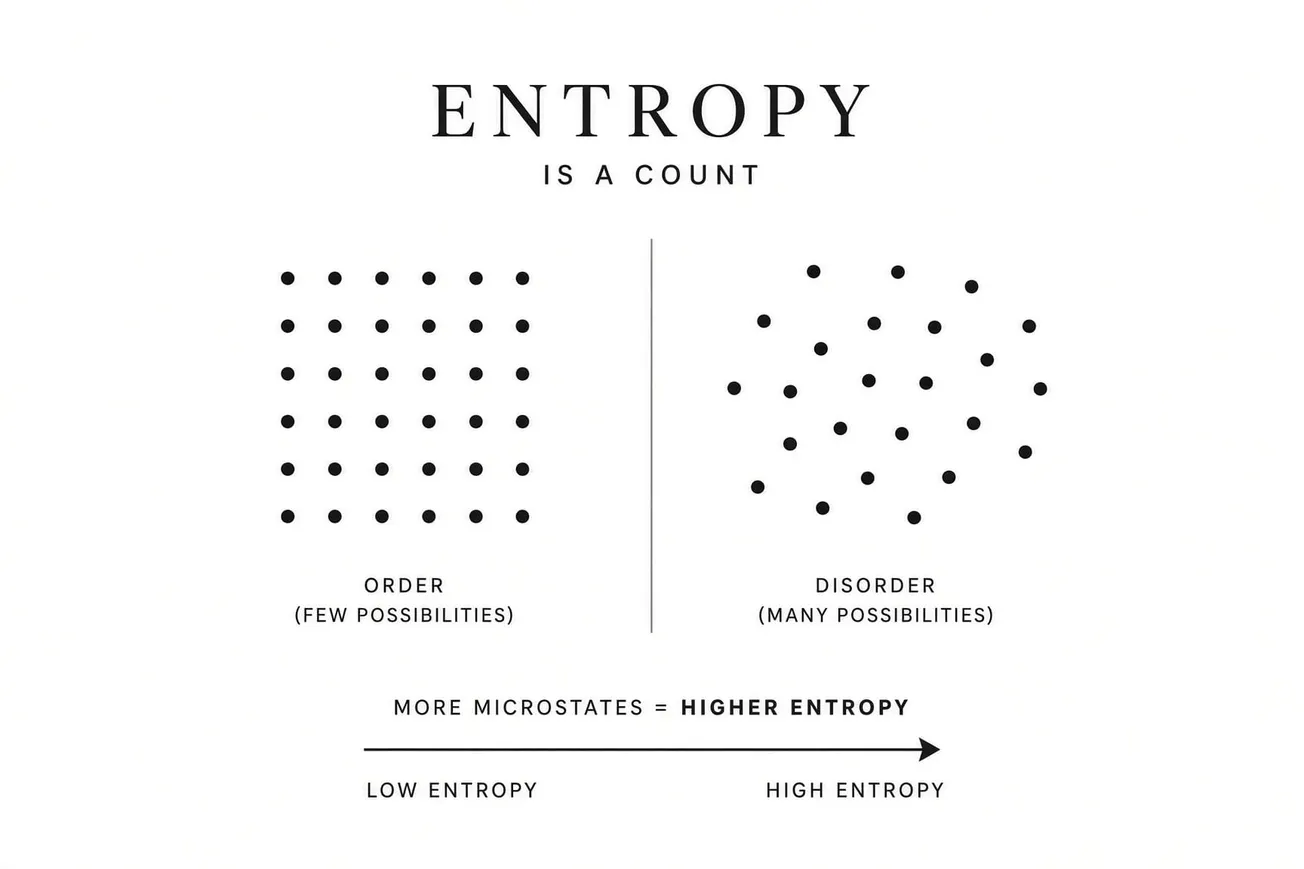
SPINE. Entropy is the logarithm of a count. The count is the number of exact microscopic arrangements that fit one coarse description. For everyday objects, the counts of different descriptions differ by ratios like 10^(10^22) — numbers too large to print. So matter drifts toward the descriptions with the larger counts, and it does not drift back. That drift is the Second Law of thermodynamics. It is arithmetic, not force. The laws of motion contain no direction of time; the arrow of time exists because the universe began in a state with an abnormally small count, and everything since — engines, eggs, memories — slides down that one slope. Information closes the circle: the entropy of a description equals the number of yes/no answers missing between the description and the exact arrangement. Entropy is missing information. Because information is missing count, every bit has a physical price: erasing one bit, anywhere, releases at least a fixed minimum of heat. One number, three faces: a count, an arrow, a bit.
CONCLUSION. The Second Law can be built from counting plus one measured fact: the low-count start of the universe. The counting, this article builds from zero, and you can check every step. The measured fact, nobody has derived. The article ends on that open question and leaves it open.
Who this is for, and the rules of this text
This article is for a reader who will multiply when the text says "multiply," and who distrusts every sentence that cannot be checked. Age is not a requirement. The requirements are: integer arithmetic, a calculator, and one afternoon.
The text obeys five rules:
- Every technical word is defined before it is used.
- Every large claim comes with a check that you can do yourself. Checks appear in boxes.
- One word keeps one meaning through the whole text.
- No outside reference is required. Names and dates appear only as history, never as homework.
- The answer comes first. The reasons follow.
1. The answer first
Entropy is the logarithm of a count.
That is the whole definition. The rest of this article does three things. First, it builds the count, from coins. Second, it shows why the count only grows, and why that growth is the direction of time. Third, it shows that the same count, read from the other side, is information — and that a single bit of information carries a minimum price in heat.
Three claims, then:
- What entropy is. Entropy measures how many exact arrangements hide behind one coarse description.
- What entropy does to time. The laws of motion have no arrow. The arrow comes from a fact about the start of the universe, and entropy is the ruler that measures the slope.
- What entropy does to information. Entropy is the information you do not have. Because of that, information is physical: to forget one bit costs heat, with an exact minimum.
Nothing in these claims requires trust. Each one gets built and checked below.
2. Tool 1: microstates, macrostates, and the count
Take four coins. Flip all four.
An exact result is a sequence, for example: heads, tails, heads, heads. Call one exact sequence a microstate. Micro means small-scale: the microstate records everything.
Now describe the same result coarsely: "three heads." That coarse description is a macrostate. Macro means large-scale: the macrostate records only a summary and forgets the rest.
One macrostate contains many microstates. Count them for four coins:
| Macrostate | Microstates in it | Count |
|---|---|---|
| 0 heads | TTTT | 1 |
| 1 head | HTTT, THTT, TTHT, TTTH | 4 |
| 2 heads | HHTT, HTHT, HTTH, THHT, THTH, TTHH | 6 |
| 3 heads | HHHT, HHTH, HTHH, THHH | 4 |
| 4 heads | HHHH | 1 |
The number in the last column is the count of the macrostate. Its symbol is W. The count is the central object of this article. Everything else is built on it.
Check 1. Write the six microstates of "2 heads" yourself, on paper, without looking at the table. Confirm there is no seventh. This is the only time the article asks you to count by brute force. After this, arithmetic takes over.
For larger numbers, listing fails and a formula takes over. The number of ways to choose which k coins out of n show heads is written C(n, k). You do not need its formula here; you need two of its values, which any calculator with an "nCr" button will confirm:
- C(100, 50) ≈ 1.01 × 10^29
- C(100, 100) = 1
Notation, defined once: 10^29 means a 1 followed by 29 zeros. This is called scientific notation, and this article uses it for every large number.
So: with 100 coins, the macrostate "50 heads" contains about 10^29 microstates. The macrostate "100 heads" contains exactly one. Same coins. Same physics. The only difference between the two descriptions is the count — and the count differs by a factor of 10^29.
Hold that ratio. It is small compared to what comes.
3. Tool 2: probability is a ratio of counts
Assume each individual sequence of 100 fair coins is equally likely. This is the fair-coin assumption, and for coins it is obviously right: no law of coin-flipping prefers HHTT over HTHT.
Under that assumption, the probability of a macrostate is simple division:
probability of a macrostate = (count of that macrostate) ÷ (total count of all microstates)
The total count for 100 coins is 2 × 2 × 2 ... one hundred times, which is 2^100 ≈ 1.27 × 10^30.
So:
- Probability of "100 heads" = 1 ÷ 1.27 × 10^30 ≈ 8 × 10^−31.
- Probability of "50 heads" = 1.01 × 10^29 ÷ 1.27 × 10^30 ≈ 0.08, or about 8%.
Notice what happened. No force pushes coins toward "half heads." No law forbids "all heads." The asymmetry is pure counting: there are vastly more ways to be near half-and-half than to be extreme. Probability follows the count, because probability is the count, divided by a constant.
This one idea, scaled up, will become the Second Law of thermodynamics. But first, one more tool.
Check 2. Confirm 2^10 = 1,024, which is close to 10^3. Therefore 2^100 = (2^10)^10 ≈ (10^3)^10 = 10^30. You have just computed a thirty-digit number with no calculator. This trick — convert powers of 2 into powers of 10 — gets used again below.
4. Tool 3: the logarithm
Counts multiply. Take two separate systems: 100 coins on one table and 100 coins on another. The combined microstate is one sequence from table one and one from table two. So the combined count is the product:
W(both) = W(table one) × W(table two)
Multiplication of thirty-digit numbers is miserable. There is a standard tool that converts multiplication into addition: the logarithm.
Definition. The logarithm base 2 of a number, written log₂, answers the question: "2 to what power gives this number?" Examples:
- log₂(8) = 3, because 2^3 = 8.
- log₂(1,024) = 10, because 2^10 = 1,024.
- log₂(2^100) = 100.
The property that matters: the logarithm of a product is the sum of the logarithms.
log₂(A × B) = log₂(A) + log₂(B)
So if we work with log W instead of W, combining two systems means adding two numbers instead of multiplying two monsters. Also, the logarithm tames size: the count 10^29 becomes log₂(10^29) ≈ 96. A thirty-digit monster becomes a two-digit number. Nothing is lost — the logarithm is reversible — but everything becomes handleable.
That is the entire reason entropy is defined with a logarithm. Not mystery. Bookkeeping.
5. The definition: S = k log W
Entropy, symbol S, is defined as:
S = k × log W
where W is the count of microstates in the macrostate, and k is a constant that fixes the units.
Two choices of units matter:
- Bits. Use log base 2 and set k = 1. Then entropy is measured in bits, and the entropy of a macrostate is a plain number: "50 heads out of 100 coins" has entropy log₂(1.01 × 10^29) ≈ 96 bits. Remember this unit; Section 12 shows it is not a coincidence that it sounds like computing.
- Joules per kelvin. Physicists, for historical reasons explained in Section 8, use natural logarithms and set k = k_B = 1.38 × 10^−23 joules per kelvin. This k_B is called Boltzmann's constant. It is not deep. It is a currency conversion between "bits" and the units in which temperature was measured before anyone knew what temperature was.
History, in three lines. The word "entropy" was coined in 1865 by Rudolf Clausius, a German physicist, from the Greek tropē, "transformation"; he chose it deliberately to resemble the word "energy." Clausius could measure entropy changes but could not say what entropy was. In 1877 Ludwig Boltzmann, in Vienna, answered: entropy is the logarithm of a count. The equation S = k log W is carved on Boltzmann's tombstone.
One caution before matter enters. For coins, "equally likely microstates" was obvious. For atoms, it is an assumption: among all exact arrangements with the same total energy, no known law of physics prefers one over another. That assumption cannot be proven from scratch here. What can be said: every prediction built on it, for two centuries, in every laboratory that checked, has held. In this article it is the one imported assumption, and it is now on the table, labeled.
6. Matter is coins
Everything so far was coins. Now replace coins with atoms, and the arithmetic becomes physics.
First: atoms are real, and they have been counted. In 1905 Albert Einstein showed that if liquids are made of molecules, then a dust grain floating in water must jitter in a specific, calculable way, because molecules bombard it unevenly from all sides. The jitter was known (it is called Brownian motion); Einstein predicted its exact statistics. In 1908 Jean Perrin measured the jitter and extracted the number of molecules per gram. The modern value: one gram of hydrogen contains about 6 × 10^23 molecules. A liter of ordinary air contains about 2.5 × 10^22 molecules.
Now build the physical version of the coin game. Take a sealed box of air. Paint an imaginary line down the middle. Each molecule is either in the left half or the right half. Each molecule is a coin: left = heads, right = tails. The box is a game of 2.5 × 10^22 coins.
Two macrostates:
- All-left: every molecule in the left half. Count: W = 1.
- Half-half: molecules evenly spread. Count: W ≈ 2^(2.5 × 10^22) divided by a factor that does not matter at this scale.
The ratio between the two counts is about 2^(2.5 × 10^22). Convert with the trick from Check 2: that is roughly 10^(7.5 × 10^21) — a 1 followed by 7,500,000,000,000,000,000,000 zeros.
Check 3. How long is that number, physically? Suppose you print 3,000 zeros per page. You need 2.5 × 10^18 pages. Stack them at 10,000 pages per meter: the stack is 2.5 × 10^14 meters tall. Divide by the speed of light, 3 × 10^8 meters per second: light needs about ten days to travel from the bottom of the stack to the top. You cannot print this number. You can only point at it.
This is why air never gathers in one half of your room. Not because a law forbids it. Because "all-left" is one microstate and "spread out" is 10^(10^21)-ish microstates, and the molecules, wandering blindly among microstates, land in the giant macrostate with a certainty that differs from 100% by an amount no instrument in the universe could detect.
Small systems show the honest picture. Ten molecules in a box do occasionally gather on one side — probability 1 in 1,024, so it happens all the time. The Second Law is not absolute at small counts. It becomes absolute-for-all-practical-purposes as the count grows, and everyday objects sit at 10^22 and beyond, where "practically absolute" and "absolute" cannot be told apart by any possible experiment.
7. The Second Law is arithmetic. Retire the word "disorder."
Now state the law properly.
Second Law of thermodynamics. An isolated system — one that exchanges nothing with the outside — drifts toward the macrostates with larger counts, and once in the largest, it stays, apart from fluctuations too small to matter at large counts. Equivalently: the entropy of an isolated system does not decrease.
Read the mechanism again, because textbooks routinely get it wrong. There is no entropy force. Molecules do not know about entropy. Each molecule follows plain mechanics — it flies straight, it bounces. The drift toward high counts is what blind wandering looks like when the destinations differ in size by factors of 10^(10^21). The Second Law has the same status as this statement: "shuffle a deck of cards and it will not come out sorted." Not forbidden. Outnumbered.
Now retire a word. Most textbooks say entropy measures "disorder." Delete that. "Disorder" is a human aesthetic judgment; the count is arithmetic, and when the two disagree, the count wins. A demonstration: pour marbles into a jar and shake. The marbles settle into neat crystal-like layers. The layered arrangement looks more ordered — and it has higher entropy, because when spheres pack into a regular lattice, each sphere gains more room to rattle locally, and the count of microstates goes up. Physicists confirmed this in computer experiments in 1957: hard spheres crystallize to gain entropy. Order won the count. So "disorder" fails as a definition exactly where it gets tested.
While retiring words, retire these too. Entropy is not energy (energy is conserved; entropy grows). Entropy is not a substance (nothing flows when entropy increases; a count changes). Entropy is not a force (Section 6). Entropy is not an opinion (Section 16 handles the one honest worry hiding here). Entropy is the logarithm of a count. Keep only that.
8. Temperature is an exchange rate
The word "temperature" has appeared zero times so far, on purpose. Now build it — because once temperature is built correctly, the direction of heat flow stops being a mystery and becomes one line of arithmetic, and the price of a bit (Section 13) becomes computable.
First, one more physical fact about microstates. For atoms, a microstate specifies positions and velocities. Energy is the conserved quantity of motion and configuration: the First Law of thermodynamics states that energy is never created or destroyed, only moved and transformed. Adding energy to a system opens new microstates, because there are more ways to share out more motion. So each system has a curve: count W as a function of its energy E, and the curve rises.
Now the key question. Two bodies, A and B, touch. A small packet of energy can pass between them. Energy conservation permits the packet to go either way. Which way does it go?
Answer by counting. Define, for each body, its gain:
gain = (increase in log W) per (unit of energy received)
The gain measures how much a body's count grows when you feed it energy. Move the packet from A to B. A's log-count falls by A's gain (times the packet size); B's log-count rises by B's gain. The total count grows if B's gain is larger than A's gain. And the total count growing is exactly the Second Law's drift. Therefore:
Energy flows, on its own, from the body with the smaller gain to the body with the larger gain.
That is the complete rule. Now define temperature as the reciprocal of the gain, with the constant k_B inserted to match historical units:
1/T = k_B × gain
A large gain means a low temperature; a small gain means a high temperature. Substitute into the rule above: energy flows, on its own, from high temperature to low temperature. Heat flowing from hot to cold is not an extra law of nature. It is the coin arithmetic of Section 3, wearing units.
Read the definition again, because it says what temperature is: temperature is the exchange rate between energy and entropy. A hot body is entropy-rich; feeding it energy barely increases its count, so it gives energy away cheaply. A cold body is entropy-hungry; the same energy packet opens enormously many new microstates for it. Equilibrium — "the same temperature" — is the point where the gains match and the total count sits at its maximum, with nothing left to gain by moving energy either way.
Two consequences fall out immediately.
Consequence 1: the quantity k_B T. At temperature T, the energy cost of one unit of entropy is fixed by the exchange rate. In bits: buying one bit of entropy decrease costs k_B T ln 2 of energy, where ln 2 ≈ 0.693 converts between logarithm bases. At room temperature, T = 300 kelvin:
k_B T ln 2 = 1.38 × 10^−23 × 300 × 0.693 ≈ 2.9 × 10^−21 joules.
Memorize the shape of that number, not its digits: a few zeptojoules. It is the price tag that returns in Section 13.
Consequence 2: the maximum efficiency of every engine ever built. A heat engine takes heat from something hot, produces work, and dumps waste heat into something cold. How much work can it produce, at best? From the definition of temperature, a body at fixed temperature T that receives heat Q gains entropy Q/T. Now do the ledger for one engine cycle:
- The engine takes heat Q_hot from the hot body. The hot body's entropy falls by Q_hot / T_hot.
- The engine dumps heat Q_cold into the cold body. The cold body's entropy rises by Q_cold / T_cold.
- The engine returns to its starting state each cycle, so its own entropy change is zero.
- The Second Law demands the total not decrease: Q_cold / T_cold ≥ Q_hot / T_hot.
- Energy conservation: work W = Q_hot − Q_cold.
Combine lines 4 and 5:
W ≤ Q_hot × (1 − T_cold / T_hot)
No engine — steam, gasoline, jet, nuclear — can beat this bound. It was first found by Sadi Carnot in 1824, from steam-engine reasoning, before anyone knew atoms existed; here it fell out of counting in five lines. This is the framework showing its teeth: a definition built from coins just capped the horsepower of every machine on Earth.
Check 4. A power plant runs its boiler at 500 kelvin and its cooling tower at 300 kelvin. Compute the bound: 1 − 300/500 = 0.40. No design, however clever, can convert more than 40% of that boiler heat into work. Real plants at those temperatures reach roughly 30–35%. Two hundred years of engineering, and the count has never lost.
9. The scandal: the laws of motion have no arrow
Now the second question of the title: time.
Start with a scandal that most physics courses hide. Film two billiard balls colliding. Now run the film backward. The reversed film shows another perfectly legal collision — momentum conserved, energy conserved, every law obeyed. Nothing in the film tells you which direction is the real one. This is a general property: the microscopic laws of motion are time-symmetric. Reverse every velocity of every particle, and the system retraces its history exactly, and every step of the retraced history obeys the same laws. Newton's mechanics has this symmetry. Its quantum successor has it too, in the form that matters here. (Particle physics contains one small, measured exception; Section 16 weighs it and shows it cannot carry the load.)
Now film an egg falling and breaking. Run that film backward: shell fragments leap from the floor, assemble, and the egg rises into a hand. Everyone instantly knows the reversed film is fake. Yet zoom in: every molecular collision in the reversed film is individually legal, by the same symmetry as the billiard balls.
So here is the scandal, stated cleanly. The laws permit the un-breaking of the egg. The un-breaking never happens. Therefore the never-happening is not written in the laws. Something else forbids it. What?
In 1876 Josef Loschmidt aimed this exact objection at Boltzmann: your molecules obey time-symmetric laws, so for every entropy-increasing history there exists a velocity-reversed, entropy-decreasing twin — legal, and by symmetry just as "possible." How can counting produce an arrow out of arrowless laws?
Boltzmann's answer, sharpened by the century that followed, has two parts. Part one: the reversed twin is legal but aimed. To un-break, the fragments' molecules need velocities coordinated to fantastic precision — a conspiracy of 10^22 particles all pointed at one microstate out of 10^(10^21). Blind wandering never finds it. Part two is deeper, and it is the next section.
10. The arrow comes from the start
Here is part two, and it is the pivot of the whole article.
"Entropy increases toward the future" contains a hidden assumption. Watch it appear. Why is the broken egg's entropy higher tomorrow? Because almost all microstates of "broken egg" wander into even-larger-count macrostates. Fine. But run the same counting logic toward the past, and it says the same thing: almost all microstates of "broken egg" also came from larger-count macrostates. Pure counting, applied symmetrically, predicts entropy higher in both directions — a valley at now. That prediction is wrong about the past: yesterday the egg was whole, and "whole egg" is a smaller-count macrostate than "broken egg."
So the counting argument alone cannot be the full story. It needs one extra input: the fact that the past had lower entropy. Add that input and everything locks. Today's entropy is higher than yesterday's because yesterday's was low. Yesterday's was higher than last year's because last year's was lower still. Follow the chain back — through the formation of the Earth, of the Sun, of the galaxies — and the chain terminates at the beginning of the universe, which must have had, by everyday standards, an absurdly, extravagantly low entropy.
This terminal fact has a name: the Past Hypothesis. The universe began in a macrostate of extraordinarily small count. It is a boundary condition — a fact about where the universe started, not a law about how it moves. Every one-way process you have ever seen — mixing, breaking, burning, cooling, aging — is the same single slide, still in progress, down the slope from that one small beginning.
One honest objection must be answered before this settles. Astronomers observe the early universe directly (in light that has traveled for billions of years), and it looks like a nearly uniform hot gas. But Section 6 said uniform-spread is the high-count macrostate! Was the early universe high entropy after all?
The resolution is gravity, and it flips an intuition. For air in a box, gravity is negligible, and uniform is the giant macrostate. For matter at cosmic scale, gravity dominates — and gravity is attractive, so clumping releases energy: matter that falls together speeds up and heats up, and that released motion-energy opens colossal numbers of new microstates. Under gravity, uniform is the small macrostate and clumped is the giant one. The endpoint of clumping is a black hole, and a black hole is the entropy champion of the universe: in 1972–1975 Jacob Bekenstein and Stephen Hawking showed that a black hole carries entropy proportional to the area of its horizon, and the numbers are grotesque — a black hole with the mass of the Sun has roughly 10^19 times the entropy of the actual Sun.
So the smooth early universe was not the boring, generic state it appears. Gravitationally, it was a razor-fine special state — spread perfectly evenly when spread-evenly is the rarest thing matter under gravity can do. Roger Penrose estimated how rare: comparing the count of the initial smooth macrostate to the count of the largest available macrostate gives a probability of about 1 in 10^(10^123). Check 3 measured a stack of pages ten light-days tall for a far smaller exponent; this number's zeros do not fit in the observable universe if you write one zero per atom. It is an estimate, not a measurement to three decimals — but no serious accounting makes the beginning anything other than fantastically special.
Now assemble the arrow of time, in four numbered lines:
- The microscopic laws have no direction. (Section 9.)
- The universe began in a macrostate of extremely small count. (Measured; not derived.)
- From a small-count state, blind wandering moves toward large-count states, with certainty-minus-10^(−10^21). (Sections 3, 6.)
- Therefore entropy rises in one direction, and every macroscopic one-way process points that way. We call that direction "the future."
The arrow of time is not in the laws of motion. It is the visible slope of a slide that started 13.8 billion years ago, and the egg on your kitchen floor is at the bottom of a very small local stretch of it.
11. Memory points down the slope
One more consequence of the arrow, and it is personal: it explains why you remember breakfast and not tomorrow.
Define a record: a stable physical trace, here and now, that is reliably correlated with an event at another time. A footprint in sand. A photograph. A tree ring. A crater. A memory in a brain. All of physics writes with the same pen, so all records obey the same rules, and two rules matter.
Rule one: a record needs a blank. Smooth sand can record a footprint; churned sand cannot. Unexposed film can record a face; fogged film cannot. A blank is a locally low-entropy, prepared state — a small-count macrostate held ready, so that when the event strikes it, the trace stands out against the smoothness. Where do blanks come from? Preparing one means pushing a small system into a small-count state, and Section 8 gave the price: local entropy decrease must be paid for by exporting at least as much entropy elsewhere. Blanks exist only because the world still has entropy slope left to spend — only because of the Past Hypothesis. A universe already at maximum count contains no smooth sand, no unexposed film, no ready neurons. Nothing there can write.
Rule two: writing costs. When the foot presses the sand, sound and heat leave the scene; when a neuron stores a memory, the brain exports heat. Every act of recording pushes some entropy out into the environment. Records are little low-entropy structures built on credit, and the credit is drawn from the slope.
Put the two rules together and point them at time. A record correlates a prepared low-count state (before) with a trace (after) — the entire mechanism is built out of the entropy gradient, and it can only face one way along it. To hold a record of tomorrow, your brain would need to be, today, reliably correlated with a macrostate that the blind wandering has not selected yet — which is exactly the un-breaking egg's conspiracy again, one microstate pre-aimed out of 10^(10^21). So brains, photographs, footprints, and tree rings all point the same direction, and it is the same direction the egg breaks in. You remember the past because memory is a record, and records are children of the slope.
This is also what the feeling of time "flowing" is made of. At every moment, you stand with an enormous, ever-growing archive of records on one side of you and none on the other. The lopsidedness of the archive is the felt difference between past and future. The flow is the accumulation.
12. Information is the same count, seen from the missing side
Now the third question of the title: information. This section shows that information is not merely related to entropy. It is the same quantity, read in the other direction.
Start with a game you know: twenty questions. One player thinks of a thing; the other asks yes/no questions. Each answer, if the question is chosen well, cuts the remaining possibilities in half. Twenty halvings: 2^20 ≈ 1,000,000. Twenty yes/no answers can locate one thing among a million.
In 1948 Claude Shannon, an engineer at Bell Telephone Laboratories, turned that game into a definition. The bit is the amount of information in one yes/no answer that halves the possibilities. A message that picks out one option from W equally likely options carries log₂ W bits — because that is how many halvings the job takes. Note the formula: logarithm of a count. Shannon needed the logarithm for the same two reasons as Section 4: independent messages should add, and counts multiply.
Now hold Shannon's definition next to Boltzmann's, and read Section 5 again with new eyes. The macrostate "50 heads out of 100 coins" has entropy log₂(1.01 × 10^29) ≈ 96 bits. What does that number mean? It means: if you know the macrostate and want to know the exact microstate, you must ask 96 more yes/no questions. The entropy of a macrostate is precisely the amount of information the macrostate withholds about the microstate.
Entropy is missing information. The count W measures the hidden possibilities; log W measures, in bits, the gap between what the coarse description says and what is exactly true.
Same mathematics, opposite bookkeeping direction. Shannon counts what a message tells you; Boltzmann counts what a summary hides from you. One quantity, two signs of attention. (History records a joke about this. Shannon, unsure what to call his quantity, asked the mathematician John von Neumann, who — as Shannon told the story — advised "entropy," for two reasons: the mathematics was already named, and since nobody knows what entropy really is, in any debate Shannon would hold the advantage. An anecdote, told by a participant; label it as such and enjoy it.)
This identity is why the Second Law can be restated with no new content: as an isolated system evolves, the information that its macrostate withholds about its microstate does not decrease. The world, described coarsely, leaks detail. Where the detail goes is Section 14. What the detail costs is Section 13 — because the identity just proven has a consequence with teeth: if entropy is information, and entropy exchanges for energy at rate T (Section 8), then information must exchange for energy too. There must be a price per bit. There is.
13. The demon, the bit, and the price of forgetting
In 1867 James Clerk Maxwell — the physicist who unified electricity, magnetism, and light — invented a monster to test the Second Law, and it took physics 115 years to kill it. The monster is worth the tour, because its defeat is where "entropy is missing information" stops being philosophy and starts costing joules.
The demon. A box of air, divided by a wall with a tiny door. At the door sits a tiny observer — Maxwell's demon. Air molecules move at many speeds; temperature reflects the average. The demon watches molecules approach. When a fast one comes from the left, he opens the door; slow ones he blocks. On the right side, fast molecules accumulate: it heats up. The left cools. The demon has produced a hot side and a cold side — a temperature difference, which Section 8's engine could turn into work — using only observation and a frictionless door. Total entropy: down. Second Law: apparently broken by anyone clever enough to look at molecules one at a time.
The bit made explicit. In 1929 Leo Szilard distilled the demon to its skeleton: one single molecule in a box, one wall you can slide in, one piston. If you know which half the molecule is in — one bit of information — you can insert the wall, let the molecule push the piston as it bounces, and extract work from a single-temperature environment. Szilard computed the amount: knowing one bit lets you extract up to k_B T ln 2 of work. Recognize that expression from Section 8, Consequence 1. One bit of information is worth one bit of entropy, cashable at the going exchange rate T. Information had acquired a market price. But then the mystery sharpened: if a bit of knowledge can buy work out of thin air, the Second Law is dead — unless acquiring or handling the bit has a cost that balances the books. Where is the cost?
The bill arrives. In 1961 Rolf Landauer, at IBM, found it — not in measuring, but in forgetting. Any memory is a physical object with (at least) two distinguishable states: a groove in sand, a magnetized patch, a charged capacitor, a neuron. To erase a bit means to reset the memory to a standard state ("0") regardless of what it held. Count what erasure does: two possible physical states (held-0, held-1) are compressed into one (0). The memory's count W drops by a factor of 2; its entropy drops by one bit. Section 8's exchange rate now applies with no mercy: a local entropy decrease of one bit must be paid by exporting at least one bit of entropy to the environment — as heat, at least
k_B T ln 2 ≈ 2.9 × 10^−21 joules per bit erased, at room temperature.
This is Landauer's principle: forgetting has a minimum price, set by temperature, payable in heat. Landauer compressed it into three words that name the whole subject: information is physical.
The demon audited. In 1982 Charles Bennett closed the case. The demon must store each observation — "fast," "slow" — in some physical memory before acting on it. Bennett showed the measurement itself can, in principle, be performed at zero entropy cost. But the demon's memory is finite. To keep working, he must erase old records to make room — and each erased bit costs him k_B T ln 2 of heat dumped into the very gas he is sorting, which is exactly the entropy his sorting removed. The ledger balances to the joule. The demon does not break the Second Law; he takes out a loan from his own notebook, and Landauer is the collector. The Second Law survived 115 years of the best attack ever designed against it — and the survival required that entropy and information be the same currency. This principle left the blackboard in 2012, when experimenters erased single bits held by a microscopic particle and measured the heat: the Landauer minimum, confirmed.
Check 5. Your laptop erases a one-gigabyte file: 8 × 10^9 bits. Landauer floor at 300 kelvin: 8 × 10^9 × 2.9 × 10^−21 ≈ 2.3 × 10^−11 joules — twenty trillionths of a joule. Real computers spend at least a million times more per bit, on wires and switching; engineering is still far from the floor. But the floor is real, it is measured, and no computer, brain, or alien technology gets under it except by cooling toward absolute zero, where T shrinks the price.
One reframing completes the section, and it will feel like a light switching on. What is heat, in this language? When a sliding block grinds to a stop by friction, the First Law says its energy of motion is not lost — it is transferred into the jiggling of molecules. What is lost is your bookkeeping of it: one number you knew (the block's velocity) has been scattered into corrections to 10^23 molecular velocities you will never measure. The energy is intact; the information about where the energy is is gone from every ledger you can keep. That is what "waste heat" means: energy whose description has been erased. Heat is energy that has been informationally abandoned — and now you can see why erasing information produces heat: they were always the same transaction, read from its two sides.
14. Nothing is lost; it becomes unreadable
Section 13 ended on a claim that should bother you: "the information is gone from every ledger you can keep." Gone where? This section answers, and the answer contains the most misunderstood fact in the subject.
Here is the fact. The exact microscopic laws — classical and quantum alike — never merge two different microstates into one, and never split one microstate into two. Distinct pasts lead to distinct futures; distinct futures came from distinct pasts. Consequence: if you track the system at full microscopic resolution, the count of possibilities you started with is carried forward exactly, forever. At the finest grain, information is conserved. Total. Always.
But Section 7 said entropy grows. Both statements are true, and their coexistence defines the subject. Watch them coexist in a glass of water.
Put one drop of black ink in the glass. Stir. The swirl stretches, folds, thins, pales, and in a minute the water is uniformly gray. Macrostate ledger: entropy up, hugely — "one drop here" was a small-count description, "uniform gray" is a giant one. Microstate ledger: nothing lost. Every ink molecule's position still depends, exactly, on where the drop entered and how you stirred; run the exact laws backward and the gray would reassemble into the drop. The initial condition has not been destroyed. It has been transcribed — from one number you could read (the drop's location) into quadrillions of precise correlations among molecular positions that no instrument can read.
That is what entropy increase is, mechanically: information flowing from the few coarse variables you track into the many fine correlations you cannot track. Nothing in the universe forgets. But the universe's handwriting gets smaller and smaller, and your ledger has a minimum font size. The growth of entropy is the growth of the unreadable.
Two refinements make this precise enough to trust.
Refinement one: chaos is the transcription engine. How fast does readable become unreadable? Most many-particle systems are chaotic, which has an exact meaning: two microstates that start almost identical separate exponentially — their difference doubles every fixed interval (for air molecules, roughly every collision, nanoseconds). Flip the statement around and it becomes a statement about information: to predict a chaotic system twice as far ahead, you need the initial condition to twice as many digits. Each doubling-time, the system's coarse, visible behavior comes to depend on one more digit of the initial condition — one digit deeper than any measurement you took. A chaotic system is a machine that excavates its own initial condition, hauling microscopic digits up into macroscopic consequence at a fixed rate per second. What looks like freshly generated randomness is old buried detail, surfacing. Chaos manufactures no information; it digs.
Refinement two: the reversal is real, where hands can reach. If the fine information truly survives, someone should be able to reverse a mixing and get the entropy back. Someone has. In 1950 Erwin Hahn took a sample of atomic nuclei, all spinning in step, and let them drift out of step — an ink-drop mixing, apparent entropy rising as the alignment dissolved into a jumble. Then one crafted radio pulse flipped every spin, the drift ran in reverse, and the jumble re-assembled into alignment: the "spin echo," performed daily now in hospital MRI machines. The unreadable was read back, because the system was small enough and gentle enough to reverse exactly. Now scale honestly: to un-stir the ink you must reverse 10^23 velocities with exponentially fine precision — chaos doubles any error every collision, so a single stray photon's kick, amplified for nanoseconds, reroutes everything. Irreversibility is not a decree in the laws. It is 2^(10^22) standing between you and the aim.
Read the Second Law one final time with everything in place: fine-grained information is exactly conserved; coarse-grained information drains, one excavated digit at a time, from every ledger any inhabitant of the universe can keep. Both clauses, together, are the truth. Most statements of the law assert the second clause and lose the first.
15. What the sun really sells
The account is nearly complete: the count is built, the arrow is sourced, the bit is priced. One question remains, and it is the one you are made of. If entropy only ever climbs, what pays for the obvious descents all around you — plants assembling from air, rivers carving order, a brain building a memory of this sentence? The answer is a budget, and the budget is worth auditing, because almost everyone misstates it.
The common statement: "Earth gets its energy from the Sun." Audit it. Earth's average temperature is roughly steady year over year. A body at steady temperature holds steady energy — so Earth must radiate away, to space, essentially all the energy it absorbs from the Sun. Energy in ≈ energy out. In net energy, the Sun sells Earth approximately nothing. Then what is Earth buying?
To see it, one last piece of physics, built in two sentences. Light comes in packets called photons, and a photon's energy is set by its type: the visible photons emitted by the Sun's 5,800-kelvin surface each carry about twenty times the energy of the infrared photons that 290-kelvin Earth radiates into space (the ratio of the temperatures: 5,800 / 290 = 20). So the steady-energy budget balances like this: for every one solar photon Earth absorbs, it emits about twenty infrared photons.
Now count, because you know how. Same total energy, chopped into twenty packets instead of one, each packet free to fly in its own direction with its own timing: vastly more arrangements. The outgoing radiation carries the same energy but roughly twenty times the entropy of the incoming. Earth is a machine that imports low-entropy energy and exports the same energy at twenty times the entropy — and the difference, the entropy gap, is the only thing the Sun actually sells. That gap is Earth's entire budget for making exceptions: every local descent — every leaf built, every river pattern, every neuron's blank prepared for a record (Section 11) — is paid for by widening the photon exchange, well inside the gap. Erwin Schrödinger put it in 1944, in a small book asking What Is Life?: organisms do not feed on energy; they feed on low entropy. (You now hold the sharper version: they feed on the photon count ratio.)
This audit also retires a famous confusion. "Evolution builds complex order, violating the Second Law" — you can now grade that claim yourself. The law governs isolated systems; Earth is a torrent, 10^37 bits-worth of entropy export per second flowing through it. Local order built inside a torrent, at the torrent's expense, is not a violation. It is the torrent, spending.
And the audit ends at you. Reading this article, your brain runs at about 20 watts, and what those watts do is Sections 11 and 13 in the flesh: preparing blanks, writing records, erasing scratch space at k_B T ln 2 or above per bit, exporting the heat of it through your skin into the room, into the air, into the twenty-to-one photon stream to space. The memory you will have of this page tomorrow points at today — not by psychology, but by the same accounting that keeps the egg broken. You are a local, temporary, self-reading record, written on the slope, in heat.
16. Open wounds
House rule: adverse results are reported before conclusions. Five wounds, stated plainly. Every account of entropy has them; most accounts hide them.
Wound 1. The Past Hypothesis is measured, not derived. The entire arrow of time hangs on the low-count start (Section 10), and physics has observed that start but cannot yet explain it. Why did the universe begin in a macrostate of probability 1 in 10^(10^123)? Proposals exist — mechanisms that would make smooth beginnings generic, universes budding from universes, cycles — and they are speculations under active debate, none established. The most important fact in this article is the one without a derivation.
Wound 2. Gravitational entropy has no general formula. Section 10 leaned on "clumped beats uniform, under gravity," and on the black-hole area law. The area law is solid. But no general recipe exists for counting the microstates of an arbitrary lump of gravitating matter — the count that made everything else in this article computable is, for gravity, still uncomputable except at the black-hole extreme. Worse, black holes evaporate (Hawking, 1974), and for decades the evaporation seemed to destroy fine-grained information, violating Section 14's conservation. Most theorists now hold, on calculations from the last several years, that the information escapes and conservation survives — but the audit of that claim is genuinely unfinished. This is a live crack in the foundations, not a decorative one.
Wound 3. The count depends on the coarseness, and honesty requires facing it. Entropy is the log-count of microstates per macrostate — but who chose the macrostates? Section 2 chose "number of heads" and ignored the sequence; a different choice gives a different W. Does that make entropy subjective? Answer in two steps. First: the choice is not free. Usable macrostates must be built from variables that are measurable, stable, and slow — pressure, volume, head-counts — and physics, not taste, decides which variables those are; any agent that can act on the world at all ends up with equivalent ledgers, and ratios like 10^(10^21) crush whatever differences remain. Second, the residue, stated without flinching: a being that tracked all 10^23 coordinates exactly would see no entropy increase, ever — for it, no arrow. Could such a being exist? Do the accounting from Section 13: its memory must store more physical states than the system it tracks, and every update it performs pays Landauer's toll — tracking the world exactly costs more world than there is. The all-seeing bookkeeper is not merely absent; it is unaffordable inside the universe it would audit. So: entropy is relative to a ledger, and every possible inhabitant of the universe is forced to keep one. The arrow is objective for everyone who can exist. That is the honest formulation, and it is weaker than "objective, full stop" — the wound is real, and this is its true size.
Wound 4. The laws are not perfectly time-symmetric, and it does not help. Section 9 simplified. Since 1964, experiments on certain unstable particles (kaons, later B-mesons) show a small, real asymmetry between the two time directions in the fundamental laws — directly confirmed in the 1990s and 2010s. Report it, then weigh it: the effect is tiny, appears only in exotic decays, and has the wrong shape to do the arrow's work — a box of air, or of kaons, still mixes by counting, and the un-breaking egg is no less outnumbered. The everyday arrow remains statistical, sourced by the Past Hypothesis. The asymmetry is a genuine fact about the laws and a spectator to this article.
Wound 5. The far future is an extrapolation. If the slide simply continues, the universe ends in "heat death": maximum count, no gradients, no engines, no blanks, no records, no observers — Section 11 run to its terminus. Perhaps. That extrapolation spans 10^100 years on physics tested for 10^2, in a universe whose dominant ingredients (dark energy, dark matter) are named but not understood. Hold it as what it is: the straightest line through the known points, drawn very far past them.
17. One number, three faces
The question was: what is entropy, and how is it related to time and information? The article is the answer; here is its skeleton, in six lines.
- Entropy is the logarithm of a count: how many exact microstates fit one coarse macrostate. (Sections 2–5.)
- Counts of everyday macrostates differ by ratios like 10^(10^21), so isolated matter drifts toward big counts and never back: the Second Law, which is arithmetic, not force. (Sections 6–7.)
- Temperature is the exchange rate between energy and entropy; from it, in five lines, the maximum efficiency of every engine ever built. (Section 8.)
- The laws of motion have no arrow; the universe's low-count beginning does. Time's arrow is the entropy slope, and memory itself — every record, including yours — is built facing down it. (Sections 9–11.)
- Entropy is missing information: the bits a summary withholds about the exact state. Therefore information is physical, forgetting has a minimum heat price of k_B T ln 2 per bit — measured — and Maxwell's demon pays it. (Sections 12–13.)
- At the finest grain nothing is ever lost; entropy's growth is information becoming unreadable, dug out of initial conditions by chaos and buried in correlations no possible ledger can hold. The Sun sells Earth an entropy gap, not energy, and every living descent — including the memory you are forming now — spends from it. (Sections 14–15.)
Strip the article to its load-bearing frame and only two members remain. One: counting, plus the fair assumption of Section 5 — everything in lines 1, 2, 3, 5, and 6 is that, unfolded, and you checked its joints yourself in five boxes. Two: a single measured fact — the beginning was small.
The counting, you now own; it will hold your weight anywhere you stand on it. The fact has no derivation. Every arrow in the universe, including the one your own memory rides, points away from an event whose improbability we can calculate and cannot explain.
One law derived. One fact measured. One question open. Stop here.
Appendix A. The cast, in order of appearance
- Sadi Carnot (1824) — asked how much work heat can give; found the engine bound before atoms were established.
- Rudolf Clausius (1865) — defined and named entropy from measured heat and temperature.
- Ludwig Boltzmann (1877) — identified entropy as the logarithm of a count; the equation is on his tombstone in Vienna.
- Josef Loschmidt (1876) — aimed the reversibility objection that forced the Past Hypothesis into view.
- James Clerk Maxwell (1867) — built the demon, the finest attack the Second Law ever faced.
- Albert Einstein (1905) — showed Brownian jitter counts molecules; Jean Perrin (1908) counted them.
- Leo Szilard (1929) — reduced the demon to one molecule and one bit; priced the bit at k_B T ln 2.
- Erwin Schrödinger (1944) — stated that life feeds on low entropy, not energy.
- Claude Shannon (1948) — defined information as log-count; John von Neumann supplied the name, and the joke.
- Erwin Hahn (1950) — reversed a mixing; the spin echo, proof the fine grain survives.
- Rolf Landauer (1961) — found the minimum heat price of erasing a bit; "information is physical."
- Jacob Bekenstein & Stephen Hawking (1972–1975) — gave black holes entropy proportional to horizon area.
- Charles Bennett (1982) — closed the demon's ledger: measurement can be free; erasure pays.
- Roger Penrose (1989) — estimated the improbability of the beginning: 1 in 10^(10^123).
Appendix B. Vocabulary, one line each
- Microstate — one complete exact arrangement of a system.
- Macrostate — one coarse description; contains many microstates.
- Count (W) — the number of microstates in a macrostate.
- Entropy (S) — k × log W; in bits, the yes/no questions between the description and the exact truth.
- Bit — the information in one answer that halves the possibilities.
- Energy — the conserved quantity; moved and transformed, never created or destroyed.
- Gain — a system's increase in log-count per unit of energy received.
- Temperature (T) — the reciprocal of the gain: the exchange rate between energy and entropy.
- k_B T ln 2 — the minimum heat price of erasing one bit at temperature T; ≈ 2.9 × 10^−21 joules at room temperature.
- Record — a stable trace, now, correlated with an event at another time; requires a blank; costs exported entropy.
- Chaos — exponential separation of nearby microstates; the excavator that turns buried initial-condition digits into visible behavior.
- Past Hypothesis — the measured, underived fact that the universe began in a macrostate of extremely small count.
— end of v0.1 —
Eduardo Bergel & Claude Fable · t333t.essays · v0.1 · 2026-08-19 · shipped to be attacked - The Symbiont