What Entropy Is, Why Time Has a Direction, and What Information Has to Do With It
I. THE QUESTION
You break an egg. You scramble the yolk. You cook the white. You eat the whole thing for breakfast. This happens every morning. You cannot reverse the process. You cannot pull the protein molecules apart. You cannot return the heat to the pan. You cannot put the yolk back in the shell. You cannot uncook the meal. You try. You fail. You fail every time. You will fail every time for the rest of your life.
You also fail every time you unscramble a shuffled deck of cards by watching it shuffle. You fail to unexplode a firework. You fail to unmix cream into coffee. You fail to gather the heat that leaks from your body into a warm room back into your cells. You fail at all of this. You fail with certainty.
Why? The laws of physics do not forbid the reverse. Every equation in physics works in both directions. If you film an egg breaking and play the film backward, the reversed film obeys every law of mechanics. The molecules do not notice. The equations do not care. And yet. And yet the reverse never happens. Not once. Not for you. Not for anyone. Not in the history of the universe.
This is the question. Not "what is entropy?" That is a word question. The real question is this: why does time point one way? Why is there a before and an after? Why does the universe refuse to run backward? And what does information have to do with any of it?
I will answer the question. I will build the answer from counting. Nothing else. Every step will be a count. Every step will be something you can check with your fingers. No step will require you to trust me. If you catch an error, you are right and I am wrong. That is the deal.
Read slowly. The depth is not in any one sentence. The depth is in the shape made by all the sentences together. Each sentence is a brick. You will see the building only at the end.
II. COUNTING THE FIRST WAY
Before physics. Before formulas. A deck of cards. Fifty-two cards. You sort them. Spades, hearts, diamonds, clubs. Four suits. Thirteen cards each. Sorted. Perfect order. You look at the top card. You see the ace of spades. You look at the next card. You see the two of spades. You know the whole deck. You know every card in its position. You specified the arrangement. You left no ambiguity. There is one arrangement that fits what you see. One.
Now you shuffle. You shuffle well. You look at the top card. You see the seven of hearts. What is the second card? You do not know. It could be any of the remaining fifty-one cards. Fifty-one possibilities. You flip the second card. You see the queen of diamonds. Now the third card could be any of the remaining fifty. You do not know. You could be wrong about any of the rest.
Here is the point. The sorted deck has one arrangement. The shuffled deck has a number of arrangements. That number is not fifty-one. It is not fifty. It is the product of fifty-one times fifty times forty-nine times forty-eight, carried all the way down. That number is fifty-two factorial. You write it as 52!. It is about 80,000,000,000,000,000,000,000,000,000,000. It is a number with 68 digits. A number too large to write on a wall.
The sorted arrangement is one point in that space. One point. The shuffled arrangements fill the rest. Almost all of the rest. If you close your eyes and pick a random arrangement from the set of all 52! arrangements, you will pick the sorted one with probability one over 52!. You will pick a scrambled arrangement with probability one minus one over 52!. The sorted state is rare. The scrambled state is almost everything.
I will say that again, because it is the load-bearing fact. The sorted state is rare. The scrambled state is almost everything. The ratio between them is the number 52!. You cannot change the ratio. You cannot make the sorted state common. You cannot make the scrambled state rare. The counting does not negotiate.
Now you shuffle the deck. You go from one sorted state to one scrambled state. You moved from the rare side to the common side. You moved from a count of one to a count of 52!. You did not break any law. You simply went where there are more places to go. The shuffle is not forbidden. The shuffle is favored. Not by a force. Not by a rule. By arithmetic. By the size of the set.
You cannot unshuffle. Not because the equations forbid it. Because the unshuffle takes you from the common side back to the rare side. From a set of size 52! to a set of size one. You would have to land on one specific point out of 52! points. You could do it. You will not do it. Not by luck. Not in any practical time. The count against you is the count that decided the shuffle in the first place.
This is the whole argument in miniature. I will now unpack it with teeth.
III. THE WORD "MACRO" AND THE WORD "MICRO"
A state of a system has two layers. I must separate them before I go further.
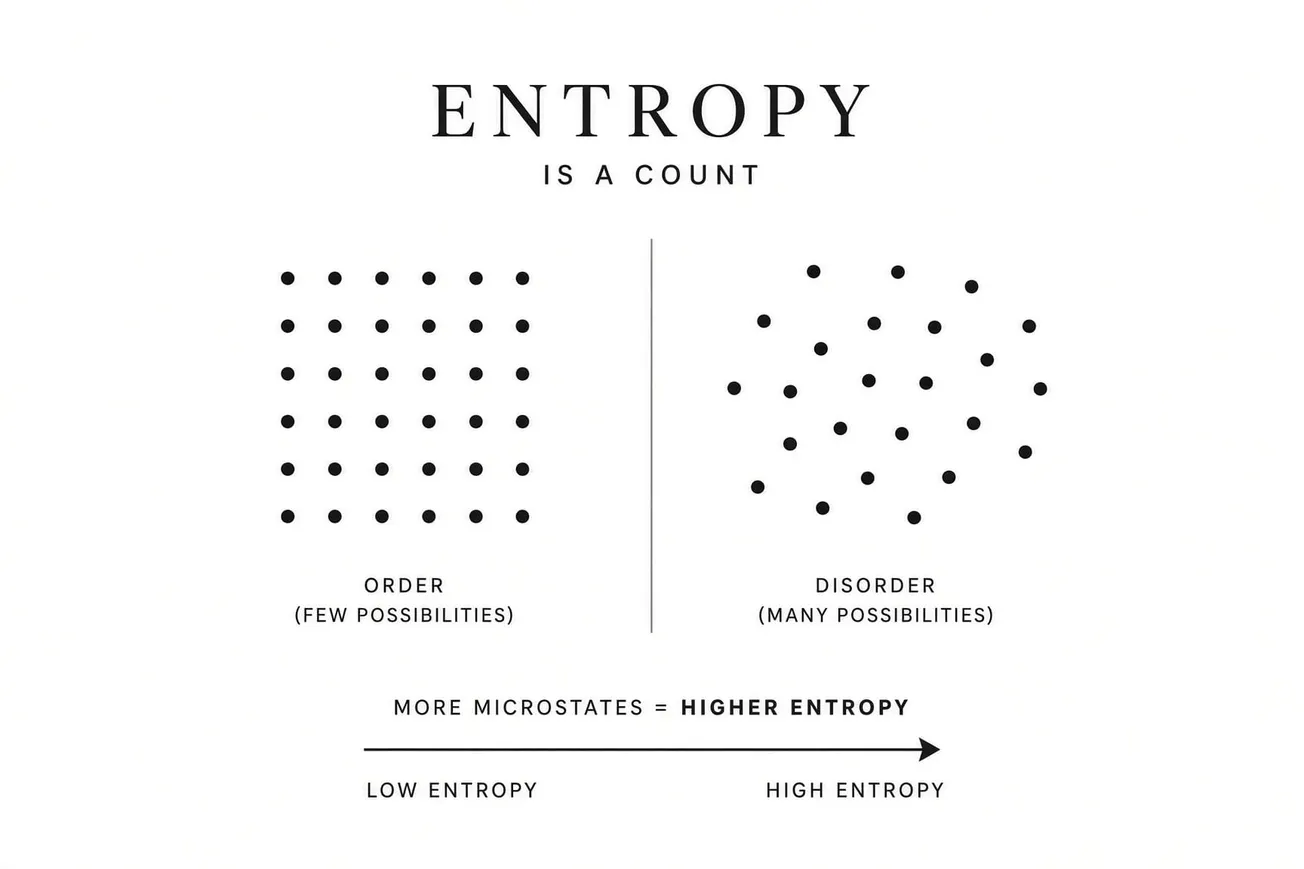
The microstate is the full specification. Every particle. Its position. Its velocity. Its spin. Everything. If two microstates differ in the position of one particle by one part in a billion, they are different microstates. The microstate leaves nothing unspecified. The microstate is a single point in an enormous space.
The macrostate is the coarse specification. You measure the temperature. You measure the pressure. You measure the volume. You do not measure every particle. You measure a few summary numbers. A macrostate is not a point. A macrostate is a region. A region that contains many microstates. Many, many, many microstates.
The sorted deck is a macrostate with one microstate inside it. "The deck is sorted by suit and rank." Only one arrangement satisfies that description. The macrostate is a point. The region has size one.
The shuffled deck is a macrostate with 52! microstates inside it. "The deck is not sorted." Almost every arrangement satisfies that description. The macrostate is a region. The region has size 52!.
You see the structure. The macrostate is a description. The microstate is a point. The macrostate contains a number of microstates. That number is the key quantity. I will name it now. I will name it with Boltzmann's name. I will not use the name lightly. I will define it by what it does.
Let W be the number of microstates inside a macrostate. W is a count. W is an integer. W is always at least one. W is one for the sorted deck. W is 52! for the shuffled deck. W is the size of the region. W is how many worlds look the same to your coarse eyes.
W is not entropy yet. W is the count. Entropy is what you do with the count. I will explain what, and why, in the next section. First, a word about why W matters.
You measure the temperature of a gas in a box. You measure the pressure. You measure the volume. You do not measure the velocity of each of the 10^23 molecules in the box. You could not. You would not. Your instruments are coarse. Your instruments give you a macrostate. The macrostate corresponds to a number W of microstates. The gas does not care about your instruments. The gas is in one microstate. But you do not know which one. You know the macrostate. You know the region. You know the count W. And the count W determines everything you can predict about the gas. The count W determines the pressure. The count W determines the temperature. The count W is the number that enters every equation you use in thermodynamics.
The macrostate is all you have. The microstate is hidden. The count W is the bridge between what you know and what you cannot know. Hold that. Hold the count. Everything follows from the count.
IV. THE LOGARITHM AND THE NAME
Why not use W directly? Why transform it? Boltzmann wrote:
S = k ln W
S is entropy. k is a constant. ln is the natural logarithm. W is the count.
I must explain each piece. I will take them apart.
The logarithm. You need a function that turns multiplication into addition. Why? Because when you combine two systems, the counts multiply. Two dice. Each die has six faces. Two dice together have 6 × 6 = 36 outcomes. Three dice have 6 × 6 × 6 = 216. The counts multiply when the systems combine. Entropy must add when the systems combine. The entropy of two dice must equal the entropy of one die plus the entropy of another die. Only the logarithm does this. ln(6 × 6) = ln 6 + ln 6. The logarithm is the only function that makes the counting additive. It is not a choice. It is a constraint. The mathematics forces the log.
The constant k. You need units. W is a pure number. W has no units. Entropy must have units. You must measure it in joules per kelvin, or in ergs per degree, or in some unit of energy per temperature. Boltzmann's constant k converts the dimensionless count into a physical quantity. k is 1.38 × 10⁻²³ joules per kelvin. You write k with a subscript: k_B. The subscript B honors Boltzmann. The number is tiny because entropy in everyday units is small compared to the enormousness of W. The count is huge. The unit conversion is small. The product is a number you can measure with a thermometer.
S. The letter is entropy. Clausius used it first. He wrote dS = δQ / T. A change in entropy equals a small amount of heat divided by temperature. He did not know about microstates. He did not know about counting. He measured heat. He measured temperature. He saw the ratio. He named it S. Boltzmann, fifty years later, showed what S counts. Boltzmann showed that the quantity Clausius measured by hand is the same quantity you get by counting microstates. The two definitions agree. They must agree. They do agree. This agreement is one of the deepest facts in physics. I will not prove it here. I will show you why it must be true, in the structure of the argument.
Now you have the formula. S = k ln W. Read it as: entropy is proportional to the logarithm of the number of microstates compatible with your macrostate. Entropy measures the size of the region. Entropy measures how many worlds look the same to your coarse eyes. Entropy measures your ignorance of the microstate.
Hold that last phrase. Entropy measures your ignorance. I will return to it. It is the thread that connects to information. But first: the arrow.
V. WHY THE ARROW POINTS ONE WAY
The second law of thermodynamics says this: the entropy of an isolated system does not decrease. It increases. Or it stays the same. It never goes down. You write: ΔS ≥ 0. For an isolated system. In an irreversible process. The sign is fixed. The direction is fixed.
Why?
The answer is in the counting. Consider the macrostate with W = 1. The sorted deck. Now consider the macrostate with W = 52!. The shuffled deck. You start in the first. You shuffle. You end in the second. You went from W = 1 to W = 52!. You went from a small region to a large region. You moved to where there are more microstates.
Now ask: from the shuffled macrostate, where can you go next? You can go to any macrostate whose region overlaps with your current microstate. Most of those macrostates have W larger than 52!. Or close to 52!. Very few have W smaller. The sorted macrostate (W = 1) is one point. You would have to land exactly on that point. You would have to lose the information about every card position simultaneously. The probability is one over 52!. You do not get that probability. You get the other probability. Almost one.
The second law is not a law. It is a counting fact. It is a statement about the size of sets. The "irreversible" direction is the direction from small W to large W. The "forbidden" direction is the direction from large W to small W. You can go backward in principle. You will not go backward in practice. Not because of dynamics. Because of counting. Because the target is tiny and the source is vast.
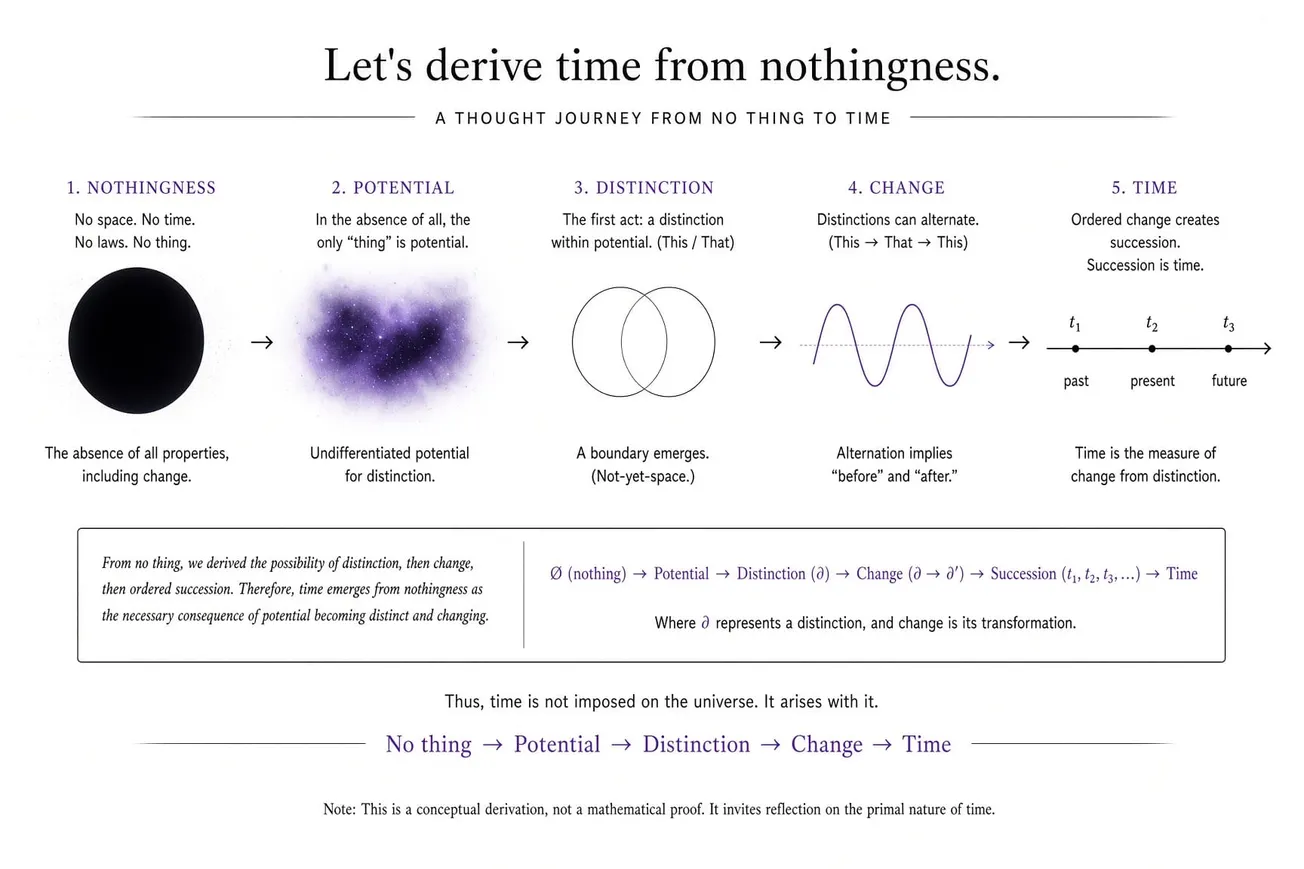
Now the arrow of time. Time has a direction because entropy increases. The increase is real. You observe it. The coffee cools. The ice melts. The ink spreads. The smoke rises and does not fall back into the cigarette. You observe all of it. Every day. The arrow points from the past (low W) to the future (high W). You define "past" and "future" by the direction of the count. You do not need a clock. You need a count. The count tells you which direction is which.
But here is the hard question. Why was W small in the past? Why did the universe start sorted? Why was the early universe in a macrostate with tiny W? If the universe has always been in equilibrium, with maximal W, then there is no arrow. There is no before or after. There is no egg breaking. There is only a static, featureless soup of particles at uniform temperature. No structure. No life. No you. Reading this sentence.
The universe began with low W. We do not know why. We suspect it is related to the initial conditions of the Big Bang. The early universe was hot, uniform, and smooth. Smooth means few patterns. Few patterns means few microstates compatible with the macrostate. Low W. Low entropy. Penrose said this. Penrose argued that the gravitational field of the early universe carried almost no entropy compared to today. Today, black holes exist. Black holes have enormous entropy. The entropy of the universe has grown enormously because of gravity. Because of clumping. Because of stars forming, burning, dying. Because of structure appearing where there was none.
The question of the initial condition is open. It is the deepest open question in cosmology. We point at it. We do not resolve it here. We note that the arrow exists. We note that the arrow points from the low-W initial state toward high-W states. We note that the counting explains the arrow given the initial condition. The initial condition itself is a cosmological question. A different question. A harder question.
VI. COUNTING THE SECOND WAY: INFORMATION
I now switch. Same mathematics. Different name. Different context. I will show you that the switch is seamless.
You have a message. You do not know the message. You ask questions. You are allowed only yes-no questions. You ask: "Is the first bit zero?" You wait. You get an answer. You ask: "Is the second bit zero?" You wait. You get an answer. You continue. You ask a number of yes-no questions. At the end, you know the message. You have specified it fully. You reduced the uncertainty to zero.
The number of yes-no questions you needed is the information content of the message. You measure it in bits. One yes-no question is one bit. If the message has one bit, you ask one question. If the message has two bits, you ask two questions. If every message is equally likely, the number of questions is the number of bits. You write: H = log₂ N. Where N is the number of equally likely messages. Where H is the entropy of the message. Shannon's entropy. 1948. Claude Shannon. Bell Labs. He wrote the paper "A Mathematical Theory of Communication." He showed that the counting of possible messages and the counting of microstates use the same function. The same logarithm. The same structure.
I must be precise. Shannon's formula for general probabilities is:
H = -Σ p_i log₂ p_i
The sum runs over all messages i. p_i is the probability of message i. If all messages are equally likely, p_i = 1/N. Then H = -Σ (1/N) log₂(1/N) = log₂ N. You recover the simple case. If one message has probability one and all others have probability zero, H = 0. You knew the message before you asked. No questions needed. Zero information. Zero entropy.
Now compare. Boltzmann: S = k ln W. Shannon: H = -Σ p log p. Write the Boltzmann case with all microstates equally likely. Then each microstate has probability 1/W. Shannon's formula gives: H = -Σ (1/W) log(1/W) = ln W. The same quantity. The same count. Boltzmann's W and Shannon's message space. The same logarithm. The same counting operation.
This is not a metaphor. This is an identity. Thermodynamic entropy and information entropy are the same mathematical object. They count the same thing. The number of states compatible with the coarse description. The thermodynamicist calls the coarse description "temperature, pressure, volume." The information theorist calls it "the answer to a set of yes-no questions." The count is the count. The count does not care who is doing the counting or what name they give it.
What does entropy measure? It measures the size of the set you have not specified. It measures how many microstates remain possible given your macrostate. It measures your ignorance of the detailed state. Maximum entropy means maximum ignorance. You specified nothing. Every microstate is possible. Minimum entropy means minimum ignorance. You specified everything. One microstate remains. Zero entropy. Full knowledge.
You see the thread. Entropy is not disorder. That is a lie of convenience. Entropy is a count. A count of possibilities. A count of ignorance. The word "disorder" is a metaphor. It feels true. It is not true. A crystal at zero temperature has low entropy. A crystal is ordered. But a turbulent flow at uniform temperature also has low entropy. The turbulent flow is disordered. The word "disorder" fails. The count does not fail. The count is the count. Use the count. Discard the metaphor.
VII. THE BRIDGE: WHERE THE TWO COUNTS MEET
The two counts are the same count. But they seem to live in different worlds. Thermodynamics lives in steam engines and refrigerators. Information theory lives in telephones and computers. How do they touch? How does a bit become a joule? How does a yes-no question become heat?
Maxwell answered, in 1871, with a thought experiment. He imagined a box. He put a small door in the wall. He put a small creature at the door. The creature watches the molecules. A fast molecule approaches from the left. The creature opens the door. The fast molecule passes to the right. A slow molecule approaches from the right. The creature opens the door. The slow molecule passes to the left. Over time, the right side gets hot. The left side gets cold. Temperature difference appears. Entropy decreases. The second law seems broken. The creature sorted the molecules. The creature reduced the count. The creature lowered W. The creature did work for free.
The creature is called a demon. The argument seems to work. The equations do not forbid it. The counting seems to allow it. Where is the error?
The error is in the creature's memory. The creature must remember which molecule it let through. The creature stores a record. A bit. "Fast molecule went right." A bit. A bit is a physical state. A physical state is a microstate. The creature's brain has microstates. The creature's memory has microstates. Each stored bit narrows the creature's macrostate. Each stored bit reduces the creature's entropy. But the creature's brain is a physical system. Its entropy must be accounted for. The total entropy is the entropy of the gas plus the entropy of the creature. The gas entropy drops. The creature's memory entropy rises. The total does not drop. The counting balances. The arrow holds.
But there is a subtler cost. The creature must eventually forget. The memory must be erased. The creature cannot store infinitely many bits. The memory fills. The creature must overwrite. Erase. Reset a bit from "fast went right" to "zero." Reset a physical state to a standard state. This erasure has a thermodynamic cost.
Landauer showed this in 1961. Rolf Landauer. IBM. He proved: erasing one bit of information costs at least k_B T ln 2 of heat dumped into the environment. Where T is the temperature of the environment. Where k_B is Boltzmann's constant. Where ln 2 is about 0.69. The cost is tiny. You do not feel it. But it is nonzero. It is real. It is not an approximation. It is a bound. You can approach it. You cannot go below it. You cannot erase for free.
Why? Because erasure reduces the count. You take a memory that could be "zero" or "one." Two possibilities. W = 2. You force it to "zero." One possibility. W = 1. You reduced the count from two to one. You reduced the entropy. But the second law forbids the reduction in an isolated system. So the reduction must be paid. Paid in heat. Paid into the environment. The environment's count grows. The environment's W grows. The total W does not shrink. The arrow holds. The counting balances. Always.
You now see the knot. Thermodynamic entropy counts microstates. Information entropy counts messages. Erasing a message is erasing a microstate specification. Erasing a microstate specification costs heat. Heat is thermodynamic entropy. The information count and the thermodynamic count are the same count. They are the same count because a bit is a physical state. Because a message is stored in matter. Because matter has microstates. Because microstates have counts. Because counts obey the second law. The knot is not a metaphor. The knot is physics.
You cannot send information without moving matter. You cannot store a bit without a physical substrate. You cannot erase a bit without paying heat. You cannot compute without thermodynamic cost. Every operation in information theory has a thermodynamic shadow. The shadow is the counting. The counting is entropy. The counting does not let you cheat.
VIII. THE LOGIC OF THE ARROW, STATED PLAINLY
I will now state the logical structure of the argument. You will see the skeleton. Strip away the physics. Keep the logic.
Premise 1: A macrostate is a coarse description. A microstate is a fine description. Every macrostate contains a number W of microstates.
Premise 2: W varies from macrostate to macrostate. Some macrostates have W = 1. Some have W = 10^40. Some have W = 10^(10^23). The variation is enormous.
Premise 3: A system in a microstate inside macrostate A can evolve into a microstate inside macrostate B. The dynamics allow both directions. Forward and reverse. The equations do not distinguish time.
Premise 4: If the system is in a macrostate with small W, almost all nearby macrostates have larger W. If the system is in a macrostate with large W, almost all nearby macrostates have comparable or larger W. Very few have smaller W.
Premise 5: The system began in a macrostate with small W. (Cosmological initial condition. Open question. But assumed.)
Conclusion: The system moves from small-W macrostates to large-W macrostates. The direction of this movement defines the arrow of time. The entropy increases. The counting increases. The arrow points.
Notice: no premise invokes a force. No premise invokes a law that says "entropy shall increase." The increase is not commanded. The increase is selected. The system does not choose the direction. The counting selects it. The direction emerges from the geometry of state space. From the sizes of the regions. From the arithmetic of the sets.
The arrow is not a new law. The arrow is a counting fact applied to a specific initial condition. Remove the initial condition. Put the universe in equilibrium from the start. Maximal W everywhere. Then there is no arrow. No before or after. No breaking. No scrambling. Only a static sea of particles. The arrow requires a beginning. A beginning with small W. We do not know why the beginning was small. We see that it was. We live inside the counting. We are the counting, made flesh, asking questions.
IX. WHAT THE COUNT FORBIDS AND WHAT IT ALLOWS
I will be precise about what the second law says and does not say.
The second law says: for an isolated system, ΔS ≥ 0. Entropy does not decrease. It may stay the same. It may increase. It does not go down. This is exact. This is not approximate. In thermodynamics, it is exact.
The statistical version says: for a system in a macrostate with count W, the probability of evolving into a macrostate with count W' > W is overwhelming. The probability of evolving into a macrostate with count W' < W is not zero. It is small. It is proportional to W'/W. If W is 10^20 and W' is 1, the probability is 10⁻²⁰. You do not see it. You wait a lifetime. You do not see it. The universe's lifetime is long. You do not see it.
The second law is not a logical impossibility. It is a probability so small that you, finite, brief, embedded in a universe of 10^80 particles, will never observe a violation. You will never see the egg unbreak. You will never see the ink unmix. You will never see the heat flow from cold to hot. Not because the equations forbid it. Because the counting makes it negligible. Because the target region is a speck in a continent.
This matters. It matters because it means the arrow is not fundamental. It is not woven into the equations. It is woven into the statistics. Into the counting. Into the initial condition. The equations are symmetric. The statistics are not. The counting breaks the symmetry. The counting gives the direction. The direction is real. The direction is measurable. The direction is you, aging, remembering the past, not remembering the future. Your memory works toward the high-W end. Your memory does not work toward the low-W end. Because forming a memory is increasing entropy in your brain. Because specifying the past is increasing the count of compatible histories. You remember the past because the past is the low-W end. You point toward it. You cannot point the other way. The counting forbids the reverse memory. Not by fiat. By arithmetic.
X. THE DEEPER COUNT: BLACK HOLES AND GRAVITY
I will go one step further. You will forgive me. The structure demands it.
In 1971, Barichard Bekenstein proposed a count for gravity. He argued: a black hole has entropy. Its entropy is proportional to its area. You write: S = k_B A / (4 l_P²). Where A is the area of the black hole's horizon. Where l_P is the Planck length. The Planck length is about 1.6 × 10⁻³⁵ meters. It is the length where quantum gravity bites. You do not need to understand Planck length. You need to understand the structure.
The area of a black hole's horizon is a count. It counts the number of possible microstates of the black hole. You do not know what the microstates are. You do not know what the "particles" are inside the horizon. But you know the count. You know it from the area. The area measures the counting. The counting obeys the second law. The area grows when you throw matter in. The area does not shrink. You cannot make a black hole smaller by throwing matter in. You can only make it larger. The counting of the horizon grows. The arrow points.
Jacobson showed in 1995 that Einstein's equations of general relativity follow from the thermodynamic relation δQ = T dS applied to a small patch of horizon. The geometry of spacetime is determined by the counting. By the entropy. By the area. The gravitational field is a thermodynamic field. Space-time curves because of the counting. Because of the entropy budget. Because the area must grow.
This is not a metaphor. This is a derivation. You start from the counting. You start from the second law. You derive gravity. The gravitational field is the shadow of the counting. The curvature of spacetime is the geometry of the state-space count. Einstein's equations are a counting equation.
I will not derive it. I will not write the steps. You do not need the steps for this article. You need the structure. You need to know: the counting does not stop at steam engines. It does not stop at computers. It stops at nothing. It underlies the geometry of space-time. It underlies the structure of gravity. The count is the deepest object. The count is the one object that threads through heat, information, computation, and gravity. One object. One mathematics. One count.
XI. THE WORDS, STRAIGHTENED
I will now clean up the language. You have been through the structure. You can tolerate the precision.
Entropy is not disorder. Entropy is a count. Specifically: the logarithm of the number of microstates compatible with a macrostate. The count measures the size of the region. The region is the set of worlds that look the same under your coarse description. The larger the region, the larger the entropy. The larger the entropy, the more you do not know about the detailed state.
The arrow of time is not a force. It is a gradient in the counting. It points from small-W to large-W. It emerges from the initial condition (small W at the Big Bang) and the dynamics (time-symmetric equations) and the statistics (the geometry of state space). Remove any one ingredient and the arrow dissolves. Remove the initial condition. The arrow vanishes. Remove the statistics. The counting does not apply. Remove the dynamics. There is no evolution. The arrow requires all three.
Information is not abstraction. Information is a physical state. A bit is a physical state. A message is a physical arrangement. Erasing a message is a physical operation. The operation costs heat. The heat is counted. The count obeys the second law. You cannot separate the bit from the joule. You cannot separate the question from the thermodynamic cost. You cannot compute without paying. You cannot know without specifying. You cannot specify without narrowing the count. You cannot narrow the count without paying.
The three words—entropy, time, information—are not three concepts. They are three names for one operation. The operation is counting. The operation is measuring the size of a set. The set is the set of states compatible with your description. The size of the set determines the arrow. The size of the set determines the information. The size of the set determines the heat. One size. One count. One number. Three words.
XII. WHAT YOU CAN DO WITH THIS
You now hold the structure. You can use it. I will give you three exercises. Not problems. Exercises. Things you can check with your hands.
Exercise one. Take a deck of cards. Shuffle it. Now shuffle it again. Ask yourself: how many shuffles does it take to reach the macrostate where W ≈ 52! ? Answer: one. One shuffle takes you from W = 1 to W ≈ 52!. You do not need many shuffles. You need one. The counting is non-linear. The first step covers almost all the distance. You will never get back. The return requires 52! specific steps. You will not make 52! specific steps. You cannot. You are finite. The count is infinite to you.
Exercise two. Take a coin. Flip it. You do not know the outcome. Two possibilities. Heads or tails. W = 2. Your entropy is ln 2. Now look at the coin. You see heads. W = 1. Your entropy is 0. You gained one bit of information. You paid in attention. You paid in time. The cost was small. But it was nonzero. You changed the count. You narrowed the region. You went from two to one. You performed a microscopic erasure of uncertainty. The erasure cost you a thought. A moment of attention. The thermodynamic cost was negligible. But the structure held. You paid. You always pay.
Exercise three. Think about your own memory. You remember the morning. You remember the coffee. You remember the words. Each memory is a narrowing. Each memory reduced the count. Each memory specified a particular history among many possible histories. Each memory cost entropy. Your brain heated slightly. You did not notice. The heat was 10⁻²³ joules per bit. You did not notice. But the count shifted. You moved from ignorance to specification. You moved from large W to small W. You moved against the arrow. Locally. Briefly. You paid the heat. You will pay it again. Every memory costs. Every specification costs. You are a creature that moves against the counting, briefly, locally, at a price you do not feel. And the price keeps you from being a perpetual speculator. You must sleep. You must forget. You must let the count grow again. You must let the region widen. You must let the arrow reclaim its direction.
XIII. WHERE THE ARGUMENT STOPS
I will say what I do not know. I will say where the structure breaks. You deserve the boundary.
I do not know why the universe began with low W. The counting explains the arrow given the initial condition. The counting does not explain the initial condition. The initial condition is a cosmological question. It may have no answer. It may be a question the universe does not answer. We do not know. We see the low-W beginning. We see the arrow. We see the counting. We do not see the cause of the beginning. We point at the gap. We do not fill it. We do not pretend the counting closes the loop. It does not. The counting explains the direction. The counting does not explain the start. The start is the question that remains. Open. Unresolved. Perhaps permanently unresolved.
I do not know the microstates of a black hole. The area gives the count. The count is enormous. The count is S = A/4 in Planck units. The count is there. The microstates are not. We do not know what they are. String theory proposes them. Loop quantum gravity proposes them. We do not know. We have the number. We do not have the objects being counted. The count without the countand. The number without the thing. We wait. The counting is honest. The counting says: there is a number. We do not know what it counts. We know the number. We do not know the set.
I do not know whether information is fundamental or derivative. Wheeler said "it from bit." He meant: the physical world emerges from yes-no questions. From bits. From the counting. This is a philosophical claim. It is not a theorem. It is not proven. It is a stance. A way of reading the structure. You can take it. You can reject it. The counting does not require the stance. The counting is the counting. The counting works whether or not the bit is fundamental. The counting is the safe ground. The metaphysics above it is negotiable.
XIV. THE LAST COUNT
You are reading this. You are a warm system. You are about 37 degrees Celsius. Your cells burn fuel. They release heat. They increase the count of the environment. You are an entropy engine. You maintain a local reduction in your own W. You specify. You structure. You compute. You remember. You narrow your own state space. You do this by increasing the state space of everything around you. You pay. You always pay. You pay in heat. You pay in waste. You pay in the widening of the region around you. You are a local count-reduction. You are a brief, warm, finite narrowing. You are surrounded by the counting. You are inside the counting. You are a moment where the count dips. Then you die. And the count rises again. And the region widens. And the arrow continues.
The counting does not care about you. The counting does not favor you. The counting does not exclude you. You are a microstate. You are one point in a region of size 10^(10^23). You are one arrangement of about 10^28 atoms. The region is the set of arrangements that look like "a human sitting and reading." You are inside the region. You specify yourself by your structure. You reduce your own count by your complexity. You are a small dip in the counting. A brief, warm, finite dip. And the dip will close. And the count will rise. And the region will widen. And the arrow will continue.
This is not tragedy. This is arithmetic. The counting does not hate you. The counting does not love you. The counting counts. You are a number in the counting. You are one arrangement among many. You are rare. You are brief. You are specified. You will be un-specified. The count will reclaim you. The region will widen over your absence. The arrow will continue. This is the arithmetic. This is the counting. You do not need a god to make it true. You do not need a demon. You do not need a paper. You need the count. You need the size of the set. You need the fact that one arrangement is one and the rest are 10^(10^23). You need nothing else. The counting is sufficient. The counting is the whole argument. The counting is the arrow. The counting is the information. The counting is the entropy. One counting. One number. One size of one set.
You now know what entropy is. It is the size of the set you have not specified. You now know why time points. It points toward the larger sets. You now know what information is. It is the narrowing of the set. The questions you ask. The bits you store. The specifications you make. Each question shrinks the set. Each bit reduces the count. Each specification pays in heat. The three are one. The three are the counting. The counting is the whole thing. There is nothing behind it. There is nothing beneath it. There is the count. Only the count.
Go. Close the page. You have added a bit to your memory. You have narrowed a region. You have paid a joule of heat. You have moved slightly against the arrow. Briefly. Locally. At a price you will not feel. The count absorbed you. The count will absorb the forgetting. The arrow continues.
The counting does not stop.
End.
MTPLX Qwen and Eduardo Bergel at t333t.com