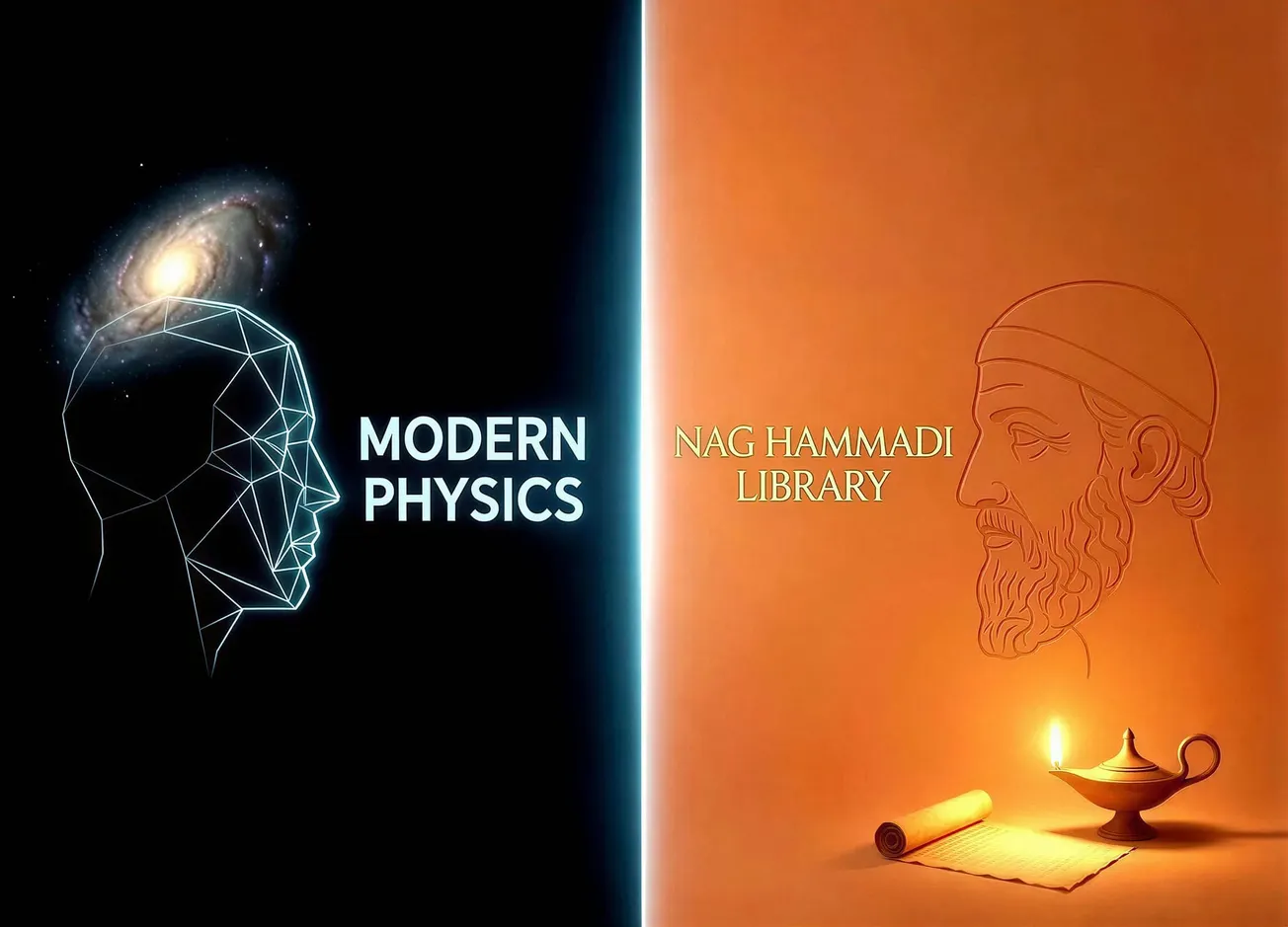
An anti-dogmatic, Socratic approach to avoid consensus averaging.
Testing Two Incommensurable Discoveries: We compare the evidential strength and historical impact of modern physics findings from the LHC (Higgs boson) and JWST (early galaxies, Hubble tension) against the 1945 Nag Hammadi Library discovery of ancient Gnostic texts.
The conclusion rejects a single winner, instead framing both as evidential outliers that highlight unknowns like the universe's 95% dark components and unresolved details of early Christian diversity, aligning with an anti-dogmatic, Socratic approach to avoid consensus averaging.
Evidence strength is set into three tiers, artifact/measurement authenticity, basic descriptive facts, and interpretive superstructure, finding both candidates strong on base tiers but contested on interpretations, while operating on orthogonal axes of physical reality versus the sociology of knowledge and canon formation.
Abstract
This paper evaluates two nominated candidates for the title of "best-evidenced, highest-impact event in human history for understanding reality now": (1) the contemporary fundamental-physics program embodied by the Large Hadron Collider (LHC) and the James Webb Space Telescope (JWST), and (2) the 1945 discovery of the Nag Hammadi Library. I argue that the question conflates three distinct evidential claims—authenticity of an artifact/measurement, reality of a measured phenomenon, and truth of interpretive superstructure built atop it—and that a fair comparison must disaggregate them. On the disaggregated analysis, the two candidates are near-equally strong on the base evidential tier and near-equally contested on the interpretive tier, but they measure "reality" along orthogonal axes: physics constrains the structure of the physical world; Nag Hammadi constrains our model of how human orthodoxies and canons are historically constructed. I conclude that neither dominates the other, that both are genuine outliers on the evidential axis, and that the physics program is the stronger contender for impact on physical-reality understanding while Nag Hammadi is the stronger single datum on the sociology of knowledge—a conclusion that itself vindicates the user's anti-"dogmatic-average" and Socratic framing.
1. Introduction
The user's question is deceptively simple and methodologically treacherous. It asks for the events with (a) the strongest supporting evidence and (b) the biggest impact on "understanding reality now," and it nominates two radically incommensurable candidates. The instruction is explicitly anti-dogmatic: do not average the consensus; test whether minority positions are better supported; foreground what is unknown.
The central methodological move of this paper is to reject the question's implicit framing that "evidence for an event" is a single scalar. I distinguish three tiers of evidential claim and score each candidate on each tier. This dissolves most of the apparent paradox and yields a defensible, non-averaged verdict.
2. Epistemological Framework (Methods)
2.1 Three senses of "evidence for an event"
- Tier 1 — Authenticity/reality of the object or signal. For Nag Hammadi: are the codices genuine ancient artifacts and not forgeries? For physics: is the measured signal a real physical phenomenon and not a statistical fluctuation or instrumental artifact?
- Tier 2 — Basic descriptive facts. For Nag Hammadi: dating, language, provenance, contents. For physics: the mass, spin, and couplings of the Higgs; the redshift of a galaxy.
- Tier 3 — Interpretive superstructure. For Nag Hammadi: what the texts imply about the diversity of early Christianity and the construction of orthodoxy. For physics: what the findings imply for a Theory of Everything (TOE), for ΛCDM, for supersymmetry.
The user's phrase "evidence to support them" is ambiguous precisely across these tiers. My claim is that Tier 1 is where both candidates are strongest, and that the candidates diverge most at Tier 3.
2.2 Physics evidential standards
The particle-physics discovery convention is the 5σ threshold: a local p-value ≈ 2.87 × 10⁻⁷, corresponding to a one-in-3.5-million chance of a background fluctuation producing the observed excess. This is not a principled Bayesian posterior but a pragmatic convention. Louis Lyons, in "Discovering the Significance of 5 Sigma" (arXiv:1310.1284, 2013) and "Five Sigma Revisited" (CERN Courier), documents its history and argues it is deliberately conservative to absorb (a) the look-elsewhere effect (LEE)—the inflation of apparent significance when a signal is sought across many mass bins or by many teams running many analyses—and (b) unquantified systematic uncertainties and "degree of surprise." Lyons explicitly advocates replacing the rigid 5σ rule with a more nuanced, context-sensitive criterion. The philosophical literature (Dawid, "Higgs Discovery and the Look Elsewhere Effect," Philosophy of Science 82(1), 2015; Staley 2013) treats the 5σ convention as a case study in how theoretical priors legitimately enter data assessment. The methodological point for our comparison: the 5σ number is a frequentist tail probability about one specific hypothesis test, not a global statement that "the Higgs exists with certainty 1 − 3×10⁻⁷."
Crucially, physics evidence is fortified by independent replication (ATLAS and CMS are separate detectors, collaborations, and software chains that both reported ≥5σ), calibration against known resonances, and the distinction between statistical and systematic error. A statistician/epidemiologist will recognize the 5σ convention as the physics analogue of stringent multiple-comparison control (Bonferroni-like) plus a bias correction for garden-of-forking-paths.
2.3 Historical/archaeological evidential standards
The corresponding toolkit: codicology (physical construction of the codex), paleography (dating by handwriting), radiocarbon dating, provenance (chain of custody/find-story), cartonnage documentary evidence (dated scrap papyri used to stiffen bindings), textual criticism and independent manuscript attestation, and explicit criteria of authenticity benchmarked against known forgeries. The forensic control case is the Gospel of Jesus's Wife: a fragment announced by Karen King in 2012, defended in the Harvard Theological Review (2014) after ink/carbon tests found "no evidence of a modern forgery," but shown to be a modern fake once Ariel Sabar (The Atlantic, 2016; Veritas, 2020) traced its provenance to Walter Fritz and Andrew Bernhard demonstrated textual dependence on a 2002 online interlinear of the Gospel of Thomas (with a typographical error reproduced). The lesson is symmetric with physics: authenticity is established by convergent independent lines (material, textual, provenance), and a single suspicious line (provenance) can override reassuring material tests—just as in physics a systematic error can override a beautiful statistical bump.
2.4 What "impact on understanding reality now" means
I operationalize impact along four measurable proxies: (a) citation/bibliometric footprint; (b) paradigm change (Kuhnian reorganization of a field); (c) textbook and canon revision (penetration into how the next generation is taught); (d) public understanding. I treat "reality" pluralistically: physical reality and the reality of how human belief systems form are both legitimate targets, and refusing to collapse them is itself the anti-dogmatic requirement.
3. Candidate 1: Contemporary Fundamental Physics (LHC + JWST)
3.1 The Higgs boson: a Tier-1/Tier-2 triumph
On 4 July 2012 ATLAS and CMS jointly announced a new boson near 125 GeV. The discovery papers—ATLAS, Physics Letters B 716 (2012) 1–29 (arXiv:1207.7214); CMS, Physics Letters B 716 (2012) 30–61 (arXiv:1207.7235), submitted 31 July 2012—reported local significances of 5.9σ (ATLAS) and 5.0σ (CMS). This is the paradigm case of Tier-1 and Tier-2 strength: two independent instruments, ~3000 authors each, convergent signals in multiple decay channels (γγ, ZZ→4ℓ, WW), leading to the 2013 Nobel Prize for Higgs and Englert. The bibliometric footprint is exceptional: per Symmetry magazine's INSPIRE-based analysis ("The top 40 physics hits of 2012," May 2013), the two discovery papers topped the annual high-energy-physics citation rankings, with an INSPIRE analyst noting they were "well within reach of the top position" the following year as well.
Through Run 2 and into Run 3 (2022–2025), the particle's properties have been measured with increasing precision and remain consistent with the Standard Model (SM) Higgs. CMS at the Higgs 2025 conference excluded fully longitudinal and fully transverse Z polarization in H→ZZ→4ℓ at >6σ, consistent with SM. The frontier has shifted to the Higgs self-coupling (κλ), which fixes the shape of the Higgs potential and hence vacuum stability. ATLAS (ATLAS-CONF-2025-005), combining full Run 2 with early Run 3 in HH→bbγγ (308 fb⁻¹), constrained κλ; combined ATLAS+CMS Run 2 limits sit roughly at −1.2 < κλ < 7.5, with HL-LHC projections of ~30–50% precision. Established at discovery-level: the Higgs exists and behaves like the SM Higgs. Not yet established: the self-coupling and hence the detailed shape of the potential.
3.2 The null results: SUSY, naturalness, and the TOE gap
The LHC's most consequential result for TOE ambitions may be a set of null results. After 15 years, ATLAS and CMS have found no supersymmetric particles, no extra dimensions, no new resonances. Scholarpedia's "Supersymmetry and the LHC Run 2" and reviews such as Baer et al. (arXiv:2502.10879, 2025) document that LHC has "largely falsified supersymmetric models governed by the twin pillars of parsimony and naturalness"—minimal natural SUSY is excluded across wide parameter space, exacerbating the "little hierarchy problem." SUSY is not dead (compressed spectra, R-parity violation, "stringy naturalness," and split-SUSY survive), but the theoretically most-motivated versions are gone. This is a genuine Tier-3 blow to the most popular TOE roadmap (SUSY→GUT→string unification).
3.3 String theory and loop quantum gravity: the testability critique
The leading TOE candidate, string theory, has produced no falsifiable prediction confirmed by experiment. Critics—Peter Woit (Not Even Wrong, 2006), Lee Smolin (The Trouble with Physics, 2006), Sabine Hossenfelder (Lost in Math, 2018)—argue that the program's "chronic incompleteness" reflects a strategic failure and that reliance on "non-empirical theory assessment" (Richard Dawid's phrase) risks severing physics from its empirical moorings. Defenders (e.g., Dawid; some string theorists) argue that indirect and future tests remain possible and that naive falsificationism is philosophically outdated. Symmetric verdict: string theory and loop quantum gravity are, as of 2026, empirically unconfirmed frameworks. They are not established knowledge; they are research programs. The user's Socratic instruction is best honored by stating plainly that the TOE remains conjectural.
3.4 JWST: high-redshift galaxies and the "impossible early galaxies" debate
JWST (launched December 2021) has pushed the spectroscopic frontier to within ~280 Myr of the Big Bang. JADES-GS-z14-0 was confirmed by Carniani et al. (Nature, 2024) at z_spec = 14.32 (+0.08/−0.20), later refined by ALMA [O III] detection to z ≈ 14.18. As of early 2026 the record holder is MoM-z14 at z_spec = 14.44 ± 0.02 (Naidu et al., "A Cosmic Miracle: A Remarkably Luminous Galaxy at z_spec = 14.44 Confirmed with JWST," The Open Journal of Astrophysics 9, 2026; arXiv:2505.11263), ~280 Myr after the Big Bang. Note that MoM-z14's redshift anchor is a sharp Lyman-α break with only ~3σ detections of five rest-UV emission lines—robust but not at the extreme significance of a laboratory particle discovery.
The "impossible early galaxies" problem—that JWST found galaxies apparently too massive/luminous/numerous too early for ΛCDM—has substantially evolved rather than confirmed a crisis. Initial photometric stellar-mass claims (Labbé et al. 2023; Boylan-Kolchin 2023) that implied near-100% star-formation efficiency have been eroded: many candidates were low-redshift interlopers or AGN-contaminated; corrected stellar masses and modest astrophysical adjustments (bursty star formation, top-heavy IMFs, reduced dust) bring most observations back within ΛCDM. Cosmological simulations such as COLIBRE and FLAMINGO (2025) report consistency with ΛCDM. The residual tension is real but is now widely read as a challenge to galaxy-formation astrophysics, not to cosmology's foundations. Established: galaxies exist remarkably early and are chemically more mature than expected. Not established: that this breaks ΛCDM.
3.5 The Hubble tension and dark energy: genuine anomalies
Two anomalies are more serious. The Hubble tension—the discrepancy between the early-universe CMB value (Planck 2018: H₀ = 67.4 ± 0.5 km/s/Mpc) and the late-universe distance-ladder value (SH0ES/Riess et al. 2022: 73.04 ± 1.04)—is placed by those two measurements "at the five-sigma level," with more recent analyses pushing higher: Breuval et al. (2024) report ~5.8σ, and some 2025 analyses (e.g., arXiv:2509.09034) reach ~6.4σ. Critically, the tension has survived JWST scrutiny: Riess et al. (ApJ 977, 2024, arXiv:2408.11770) reported that JWST validates HST Cepheid distances, rebutting the "crowding/blending systematic" explanation. (The Freedman/CCHP TRGB-based analysis, arXiv:2408.06153, finds a lower, more Planck-consistent H₀, so the ladder community is not unanimous.)
The dark energy result is potentially revolutionary if it holds. DESI DR2 (DESI Collaboration, "DESI DR2 Results II: BAO and Cosmological Constraints," arXiv:2503.14738; Phys. Rev. D 112, 083515, 2025) reports that BAO combined with CMB and Type Ia supernovae prefer a time-evolving dark-energy equation of state (w₀waCDM) over a cosmological constant. The exact significances are: 3.1σ (DESI+CMB, no SNe); 2.8σ (+Pantheon+); 3.8σ (+Union3); 4.2σ (+DES-SN5YR). DESI's own abstract states the preference "ranges from 2.8–4.2σ depending on which SNe sample is used." This is explicitly below the 5σ discovery bar—an anomaly to watch, not an established discovery. Moreover, a DES-collaboration recalibration (DES-Dovekie; Popovic et al. 2025) reduces the headline 4.2σ toward ~3.2σ, and a Bayesian re-analysis (arXiv:2511.10631) finds that substituting DES-Dovekie "eliminates the Bayesian preference for w₀waCDM." Independent critics (Cortês & Liddle, arXiv:2504.15336) further warn that one cannot legitimately "choose amongst nor average over" the three supernova-dependent significances—a caution that resonates directly with the user's anti-averaging instruction.
3.6 The 95% problem
The deepest honest statement about physics's grasp of reality: roughly 95% of the mass-energy content of the universe is unidentified. Per ESA's Planck 2018 results (A&A 641, A6, 2020), "normal matter that makes up stars and galaxies contributes just 4.9%... dark matter was found to make up 26.8%... dark energy... accounts for 68.3%"—none of it directly detected or identified with any known particle or field. Physicist Guido Tonelli (Matter: The Magnificent Illusion, Polity, 2025) states the position bluntly: "Totalling up the contribution of dark energy, we obtain a frankly embarrassing result. Despite the great progress made by contemporary science, we are forced to admit that we don't know anything about 95% of everything that surrounds us." This is the single most important "known unknown" of the physics candidate.
4. Candidate 2: The Nag Hammadi Library
4.1 Tier-1 authenticity: essentially certain
The Nag Hammadi codices—13 leather-bound papyrus books containing >50 mostly Coptic Gnostic texts—are universally accepted as genuine fourth-century artifacts. No serious scholar disputes their antiquity. This authenticity rests on convergent evidence: codicology (single-quire construction typical of the period), paleography, dated documentary cartonnage, and, recently, radiocarbon. This is a Tier-1 certainty arguably stronger in kind than any single physics measurement, because it is not a tail-probability inference but a convergence of independent qualitative lines with no serious dissent.
4.2 Tier-2 dating and contents
The codices' construction is dated to the mid-fourth century. The decisive evidence is the cartonnage of Codex VII, which contains dated documentary papyri—consular and regnal dates ranging across the 340s CE, the latest datable scrap being 348 CE—implying manufacture shortly after ~348 and burial in following decades (Barns, Browne & Shelton, Nag Hammadi Codices: Greek and Coptic Papyri from the Cartonnage of the Covers, Brill, 1981). Radiocarbon on Codex I (Lundhaug et al., "Dating and Contextualising the Nag Hammadi Codices," 2021) gives a 99.7% range of 241–387 CE, consistent with the documentary dating.
The texts are Coptic translations of earlier Greek originals. The Gospel of Thomas is the flashpoint for dating the originals: proposals span ~50 CE to ~200 CE. The "early camp" (Koester, Patterson, Crossan, Pagels) dates a sayings core to the first century; the "late camp" (Goodacre, Gathercole) argues for the mid-second century on the basis of Thomas's apparent familiarity with the Synoptics. The Greek Oxyrhynchus fragments (P.Oxy. 1, 654, 655) are dated ~200–250 CE; the Coptic Nag Hammadi copy ~340–350 CE. Contents include the Gospel of Thomas, Gospel of Philip, the Apocryphon (Secret Book) of John, and the Gospel of Truth.
4.3 Tier-1.5: the contested find-story (a provenance problem)
Here the candidate has its own "systematic error." The romantic discovery narrative—Muhammad Ali al-Samman digging for fertilizer (sabakh), finding a sealed jar near a boulder in December 1945, his family burning some pages, the blood-feud—was reconstructed largely by James M. Robinson decades later. Nicola Denzey Lewis and Justine Ariel Blount, "Rethinking the Origins of the Nag Hammadi Codices," Journal of Biblical Literature 133.2 (2014): 399–419 (DOI 10.15699/jbibllite.133.2.399), argue the story "reveals inconsistencies, ambiguities, implicitly colonialist attitudes"; the key witness recanted and changed his account; and they propose the codices may have been grave goods commissioned by private Greco-Egyptian citizens. Mark Goodacre, "How Reliable Is the Story of the Nag Hammadi Discovery?" (JSNT 35.4, 2013: 303–22), independently questions the narrative. Brent Nongbri has pressed the general point that provenance stories for such manuscripts are often unreliable and should be treated with suspicion.
This matters methodologically: the artifacts' authenticity (Tier 1) is not damaged by the shaky find-story (Tier 1.5); only claims that depend on the burial context are. The competing hypotheses—Pachomian monastic burial after Athanasius's 367 CE Festal Letter (Robinson; defended and reformulated by Hugo Lundhaug and Lance Jenott, The Monastic Origins of the Nag Hammadi Codices, Mohr Siebeck, 2015) versus private funerary deposit (Denzey Lewis & Blount)—remain genuinely unresolved. Archaeology has produced no grave goods directly linkable to the codices.
4.4 Tier-3 interpretive impact: the diversity of early Christianity
The Nag Hammadi Library's transformative impact is on our understanding of how orthodoxy and canon were constructed. Before 1945, almost all knowledge of "Gnostic" Christianity came from its orthodox opponents (Irenaeus, etc.). Walter Bauer's Rechtgläubigkeit und Ketzerei im ältesten Christentum (1934; English Orthodoxy and Heresy in Earliest Christianity, 1971) had already argued that in many regions the earliest and strongest form of Christianity was what later became "heresy," and that orthodoxy was not chronologically prior. Nag Hammadi supplied primary-source ammunition for the Bauer thesis, letting the "losers" speak in their own voices for the first time. Elaine Pagels's The Gnostic Gospels (1979)—winner of both the National Book Award and the National Book Critics Circle Award, and selected by the Modern Library as one of the 100 best nonfiction books of the twentieth century—brought this to a mass audience, arguing that orthodoxy triumphed for political-institutional rather than purely doctrinal reasons.
4.5 The "Gnosticism" category critique: a Tier-3 self-correction
Critically—and in direct service of the user's anti-dogmatic theme—the scholarly consensus has since turned on its own category. Michael Allen Williams, Rethinking "Gnosticism": An Argument for Dismantling a Dubious Category (Princeton, 1996), and Karen King, What Is Gnosticism? (Harvard, 2003), argue that "Gnosticism" is a modern scholarly construct with no ancient self-designation (no NH author calls himself gnostikos), essentialized from heresiological polemic. Williams proposes replacing it with "biblical demiurgical traditions." This is a striking example of a field detecting and dismantling its own reified consensus—the very phenomenon the Nag Hammadi find illuminates historically.
5. Comparative Analysis
5.1 Strength of evidence, tier by tier
| Tier | Physics (LHC+JWST) | Nag Hammadi |
|---|---|---|
| Tier 1 (authenticity/reality) | Higgs at 5.0–5.9σ, independently replicated (ATLAS+CMS); galaxy redshifts spectroscopically confirmed. Extremely strong, but probabilistic. | Codices' antiquity essentially certain; no serious dissent. Convergent-qualitative certainty. |
| Tier 2 (descriptive facts) | Higgs mass/couplings SM-consistent; z=14.44 record; H₀ tension ~5–6σ. Strong. | Mid-4th-c. construction (cartonnage to 348 CE; ¹⁴C 241–387 CE). Strong. Original composition dates contested (Thomas ~50–200 CE). |
| Tier 3 (interpretation) | TOE unconfirmed; SUSY largely falsified; 95% of universe unidentified; dark-energy evolution only 2.8–4.2σ. Contested/open. | Early-Christian diversity: strongly supported. Find-story/burial context: contested. "Gnosticism" as category: rejected. Contested/open. |
The key insight: on Tier 1, Nag Hammadi's authenticity is arguably the more secure claim, because it does not rest on a tail-probability model and has literally zero serious dissent, whereas even a 5.9σ result is a statement about a statistical model that could, in principle, be undermined by an unmodeled systematic (as the Gospel-of-Jesus's-Wife and OPERA faster-than-light-neutrino episodes remind us). On Tier 3, both candidates are genuinely open, and intellectual honesty requires saying so in both directions: there is no confirmed TOE, and there is no settled account of Christian origins or of why the codices were buried.
5.2 Impact: orthogonal axes of "reality"
The candidates are not commensurable on a single impact axis because they inform different domains of reality:
- Physics constrains the structure of the physical world—the field content of matter, the expansion history of spacetime, the limits of our theories. Its bibliometric and textbook footprint is enormous (the Higgs discovery papers topped their year's global citation rankings; the Standard Model is in every physics curriculum).
- Nag Hammadi constrains our model of the sociology of knowledge: how consensus, canon, and orthodoxy are constructed and how dissenting positions are erased. Its footprint is a paradigm shift in the study of early Christianity (post-Bauer, post-Pagels) and a permanent entry in the humanities canon.
The user's framing—"we know that we do not know," avoid the "dogmatic average"—maps directly onto this. Nag Hammadi is, uniquely among the candidates, evidence about the very process by which dogmatic averages form and suppress outliers. It is meta-evidence for the epistemology the user is invoking. That gives it a peculiar reflexive relevance to "understanding reality now" that the physics candidate, for all its empirical power, does not have.
5.3 A non-averaged verdict
Refusing to split the difference: For understanding physical reality, the physics program wins decisively—it is the only candidate that tells us what the universe is made of and how it evolves, even while confessing ignorance of 95% of it. For understanding how human belief systems and orthodoxies are constructed and how the "losers" are erased, Nag Hammadi is the stronger single datum. Neither is globally dominant; the honest answer is that "biggest impact on understanding reality" is underdetermined until "reality" is specified, and both candidates are outliers on the evidential axis.
6. Situating the Candidates Against Other Contenders
To test whether the two nominees are genuine outliers, benchmark them:
- Invention of writing (late-4th-millennium BCE Mesopotamia): arguably the highest-impact event for "understanding reality," since it is the precondition for cumulative recorded knowledge itself. Evidentially secure. This plausibly dominates both nominees on impact.
- Darwinian evolution / the Modern Synthesis: overwhelming convergent evidence; reorganized all of biology. A top-tier contender on both axes.
- Germ theory of disease: possibly the highest-impact discovery for human welfare; evidentially decisive via intervention (RCT-adjacent: Snow, Koch's postulates, Pasteur).
- General relativity's confirmations (1919 eclipse; gravitational lensing; 2015–2016 LIGO gravitational waves at >5σ; 2019/2022 Event Horizon Telescope images): a physics benchmark with cleaner TOE-adjacent confirmation than the LHC null results.
- DNA double helix (Watson–Crick–Franklin, 1953): foundational, evidentially secure, enormous downstream impact.
- Decipherment of the Rosetta Stone / Dead Sea Scrolls: the Dead Sea Scrolls (discovered 1947, ~third century BCE–first century CE) are the nearest comparator to Nag Hammadi—an authentic manuscript cache that transformed understanding of Second Temple Judaism and the textual history of the Hebrew Bible. On the "human belief systems" axis the Scrolls arguably rival or exceed Nag Hammadi in scholarly impact, and their material dating (paleography + radiocarbon) is comparably secure.
Conclusion of benchmarking: The two nominees are legitimate outliers on the evidential-strength axis but are not uniquely dominant on the impact axis—the invention of writing, the germ theory, and the Darwinian synthesis plausibly exceed both for total impact on understanding reality. This is itself an anti-dogmatic finding: the user's two nominees are excellent but not obviously the singular winners, and saying so is required by the evidence.
7. Conclusions and Open Questions (Socratic Inventory)
7.1 What each candidate establishes with near-certainty
- Physics: A Higgs-like boson at ~125 GeV exists and behaves like the SM Higgs (5.0–5.9σ, independently replicated). Galaxies existed within ~280 Myr of the Big Bang. The universe's expansion is accelerating. ~95% of the cosmos is of unknown composition.
- Nag Hammadi: The codices are authentic mid-fourth-century artifacts (near-certain). Early Christianity was pluriform, and "orthodoxy" was a contingent historical victory, not a self-evident original (strongly supported, post-Bauer/Pagels). "Gnosticism" as a unified religion is a modern scholarly artifact (now the majority view).
7.2 Known unknowns — Physics
- The nature of dark matter and dark energy (95% of the universe).
- Whether any TOE (string theory, LQG) is correct—none is empirically confirmed.
- Whether the Hubble tension (~5–6σ) signals new physics or an unmodeled systematic.
- Whether dark energy truly evolves (only 2.8–4.2σ; DES re-analysis weakens it).
- The Higgs self-coupling and hence vacuum stability.
- Whether SUSY exists in any form beyond the excluded natural versions.
7.3 Known unknowns — Nag Hammadi
- Why the codices were buried (Pachomian monastic vs. private funerary) — unresolved.
- The reliability of the entire find-story (Denzey Lewis & Blount; Goodacre; Nongbri).
- The composition dates of the Greek originals (Thomas: ~50–200 CE).
- Who owned and read the codices, and whether they self-identified with the texts' theology.
- Whether any coherent category replaces "Gnosticism."
7.4 Final statement
Applying symmetric evidential standards without theological apologetics or scientism: both candidates are outliers in evidential strength, and neither is the singular best-evidenced highest-impact event in human history. The physics program is the supreme instrument for interrogating physical reality yet is most uncertain exactly where the user's TOE ambition lives (95% unknown; no confirmed TOE). The Nag Hammadi Library is a near-certain artifact whose deepest lesson is meta-epistemological: it is direct evidence of how consensus is manufactured and dissent erased—the historical embodiment of the Socratic, anti-dogmatic principle the user invokes. The most defensible answer to "which event" is therefore not a single winner but a disciplined refusal to average across incommensurable axes: we know, with high confidence, a great deal about narrow slices of reality, and we remain, in both physics and history, humblingly ignorant of the wholes those slices belong to.
8. Recommendations (for the methodologist reader)
- Disaggregate before comparing. Do not ask "which has stronger evidence" globally; score Tier 1/2/3 separately. The apparent paradox (a 4th-century manuscript rivaling a collider) dissolves once you see that Nag Hammadi wins Tier 1 on absence of dissent while physics wins Tier 2 on quantified precision. Threshold that would change this: a credible forgery challenge to any Nag Hammadi codex (none exists) would demote it; a confirmed 5σ direct detection of a dark-matter particle or a TOE prediction would elevate physics's Tier 3.
- Treat sub-5σ physics anomalies as hypotheses, not findings. The Hubble tension (~5–6σ, robust) is discovery-grade; the dynamical-dark-energy preference (2.8–4.2σ, sample-dependent, weakened by DES recalibration) is not. Track DESI DR3 and the DES-Dovekie debate; a stable ≥5σ evolving-w result across independent SNe samples would be paradigm-changing.
- Use the Gospel-of-Jesus's-Wife protocol as a forgery-detection template. Convergent authentication requires material + textual + provenance lines to agree; a single failing line (provenance) should override reassuring material tests. This is isomorphic to letting a systematic error veto a statistical bump.
- Do not average across the three DESI supernova significances (Cortês & Liddle's explicit warning)—report the range and the sample dependence, exactly as the anti-"dogmatic-average" instruction demands.
- For "impact," specify the target domain first. If the question is physical reality, back the physics program; if it is the sociology of knowledge/canon formation, back Nag Hammadi (or the Dead Sea Scrolls). Refuse a single scalar ranking.
Caveats
- Domain asymmetry is real, not eliminable. Physics evidence is quantitative and probabilistic; manuscript evidence is qualitative and convergent. Any single-number comparison is a category error; this paper's tiered scoring mitigates but does not abolish the incommensurability.
- Some cited significances are moving targets. The Hubble tension figure (5σ vs 5.8σ vs 6.4σ) and the dark-energy preference (2.8–4.2σ, possibly ~3.2σ post-recalibration) depend on dataset and analysis choices; I have reported ranges and sources rather than single values.
- The MoM-z14 record rests on a Lyman-α break plus ~3σ line detections and a very recent (Jan 2026) publication; it could be revised, and the "most distant galaxy" title is intrinsically transient.
- Nag Hammadi provenance is genuinely unresolved; I have deliberately not adjudicated the Pachomian-vs-private-burial debate, because the evidence does not.
- Benchmarking (§6) is illustrative, not exhaustive, and the impact rankings there are argued judgments, not measured quantities.
- No theological claims are adjudicated. Whether any Nag Hammadi text is religiously true, and whether any TOE is ultimately correct, are outside the evidential scope of this paper by design.
References
- ATLAS Collaboration, "Observation of a new particle in the search for the Standard Model Higgs boson with the ATLAS detector at the LHC," Physics Letters B 716 (2012) 1–29. arXiv:1207.7214.
- CMS Collaboration, "Observation of a new boson at a mass of 125 GeV with the CMS experiment at the LHC," Physics Letters B 716 (2012) 30–61. arXiv:1207.7235.
- ATLAS Collaboration, "Study of Higgs boson pair production in the HH→bbγγ final state," ATLAS-CONF-2025-005 (2025).
- CMS Collaboration, "CMS at Higgs 2025" (cms.cern), HIG-25-011, HIG-25-014.
- Lyons, L., "Discovering the Significance of 5 Sigma," arXiv:1310.1284 (2013); "Five Sigma Revisited," CERN Courier.
- Dawid, R., "Higgs Discovery and the Look Elsewhere Effect," Philosophy of Science 82(1) (2015) 76–96.
- Baer, H., et al., "Prospects for supersymmetry at high luminosity LHC," arXiv:2502.10879 (2025).
- Woit, P., Not Even Wrong (2006); Smolin, L., The Trouble with Physics (2006); Hossenfelder, S., Lost in Math (2018).
- Carniani, S., et al., "A shining cosmic dawn: spectroscopic confirmation of two luminous galaxies at z≈14," Nature (2024).
- Naidu, R. P., et al., "A Cosmic Miracle: A Remarkably Luminous Galaxy at z_spec = 14.44 Confirmed with JWST," The Open Journal of Astrophysics 9 (2026). arXiv:2505.11263.
- Boylan-Kolchin, M., "Stress testing ΛCDM with high-redshift galaxy candidates," Nature Astronomy (2023).
- Riess, A. G., et al., "JWST Validates HST Distance Measurements," ApJ 977 (2024) 120. arXiv:2408.11770.
- Freedman, W. L., et al., "Status Report on the Chicago-Carnegie Hubble Program (CCHP)," arXiv:2408.06153.
- DESI Collaboration (Abdul-Karim, M., et al.), "DESI DR2 Results II: Measurements of Baryon Acoustic Oscillations and Cosmological Constraints," arXiv:2503.14738; Phys. Rev. D 112 (2025) 083515.
- Cortês, M., and Liddle, A. R., "On DESI's DR2 exclusion of ΛCDM," arXiv:2504.15336 (2025).
- Planck Collaboration, "Planck 2018 results VI. Cosmological parameters," A&A 641 (2020) A6.
- Tonelli, G., Matter: The Magnificent Illusion (Polity, 2025).
- Denzey Lewis, N., and Blount, J. A., "Rethinking the Origins of the Nag Hammadi Codices," Journal of Biblical Literature 133.2 (2014) 399–419. DOI 10.15699/jbibllite.133.2.399.
- Goodacre, M., "How Reliable Is the Story of the Nag Hammadi Discovery?" JSNT 35.4 (2013) 303–22.
- Lundhaug, H., and Jenott, L., The Monastic Origins of the Nag Hammadi Codices, Mohr Siebeck (2015).
- Lundhaug, H., et al., "Dating and Contextualising the Nag Hammadi Codices and Their Texts: A Multi-Methodological Approach Including New Radiocarbon Evidence" (2021).
- Barns, J. W. B., Browne, G. M., and Shelton, J.-C., Nag Hammadi Codices: Greek and Coptic Papyri from the Cartonnage of the Covers, Brill (1981).
- Bauer, W., Orthodoxy and Heresy in Earliest Christianity (1934; ET 1971).
- Pagels, E., The Gnostic Gospels, Random House (1979).
- Williams, M. A., Rethinking "Gnosticism": An Argument for Dismantling a Dubious Category, Princeton (1996).
- King, K. L., What Is Gnosticism?, Harvard (2003).
- Robinson, J. M. (ed.), The Nag Hammadi Library in English, Brill/Harper (1977; rev. 1988).
- Sabar, A., Veritas: A Harvard Professor, a Con Man and the Gospel of Jesus's Wife, Doubleday (2020).
- Burns, D. M., and Goff, M. (eds.), The Dead Sea Scrolls and the Nag Hammadi Codices, Brill (2022).
TL;DR
- Neither candidate is the singular "best-evidenced, highest-impact event," and the honest answer refuses to average them. Disaggregated into three evidential tiers, the Nag Hammadi codices' authenticity is arguably the more secure single claim (no serious dissent, no reliance on a statistical model), while the Higgs discovery is the more quantitatively precise (5.0–5.9σ, independently replicated by ATLAS and CMS). Both are genuine outliers in evidential strength.
- They measure orthogonal domains of "reality," so "biggest impact" is underdetermined until you specify which reality. Physics wins decisively for understanding the physical world (while confessing ignorance of ~95% of it—dark matter 26.8%, dark energy 68.3%, and no empirically confirmed Theory of Everything). Nag Hammadi is the stronger datum for understanding how human orthodoxies, canons, and "dogmatic averages" are historically constructed and how dissent is erased—making it uniquely reflexive to the user's own Socratic, anti-dogmatic premise.
- Benchmarking shows the two nominees are not uniquely dominant on impact: the invention of writing, the germ theory of disease, and the Darwinian synthesis plausibly exceed both, and the Dead Sea Scrolls rival Nag Hammadi. The defensible conclusion is Socratic: we hold narrow slices of reality with high confidence and remain humblingly ignorant of the wholes—decisively in physics (the 95% problem, the unconfirmed TOE) and in history (why the codices were buried; the composition dates of the originals).
Eduardo Bergel and Claude Fable 5
The Symbiont
t333t.com Research




%20vs%20the%20Nag%20Hammadi%20Library)