The AI models are doing something new. They manufacture a "feeling" of certainty and hands it out cheaply.
We are distinguishing "rooms with a river" (verifiable domains like coding, engineering, tested by objective reality) from "rooms without" (subjective questions on justice, truth, or wisdom), arguing AI helpers now produce identical fluent confidence in both.
AI removes the natural "stall" of uncertainty that once signaled lack of understanding, manufacturing the feeling of certainty cheaply and training it in verifiable areas before carrying it into untestable ones.
Einstein's wait for solar eclipse confirmation of relativity versus equally certain but wrong theorists. We urge AI labs and users to seek external validators ("the river" or "eclipse") to distinguish earned confidence from manufactured illusion in AI-assisted reasoning.
We trust a bridge more than a poem. The reason is not that bridges are better.
A bridge is checked. It holds the weight or it drops you in the river. The river does not care what the engineer believed, how sure she was, or whether other engineers agreed with her. It holds or it kills you. That is why we trust it. Underneath a bridge there is something that cannot be fooled, and the price of fooling yourself is death.
We learned this slowly, over a long time, and we learned it in the body. Trust most what kills you fastest when you are wrong. Animals that trusted the wrong ground left no children. So we came to feel the difference between what we can stand on and what we can only look at. The bridge and the poem. A river under one. No river under the other.
The reason does not make the poem worthless. A poem does something a bridge cannot. It holds things that have no single answer — whether to forgive someone, what a life is for, what is fair. Those are real questions. They just have no river. A person who only trusts bridges misses half of being alive. A person who treats everything as a poem walks off a cliff, sure of himself the whole way down.
So there are two kinds of room. One has a river. One does not. We need both. And for all of human history, you could tell which room you were in.
That is what is changing. Not the rooms. Something can now make the room without a river feel exactly like the room with one.
The Helper
You ask a question and get an answer. The answer is fluent, confident, well-organized.
If the question was about building something — a machine, a program, a structure — you can check the answer against the world. It works or it fails. When it works, you have not been told it is good. You have watched it be good. The confidence is fine, because the world is still doing the checking. This is the room with the river, and having a fast, fluent helper in it is pure gain. Work that took years arrives in an afternoon, and it is real, because the river is still there, catching every mistake.
Then you ask the same helper about something with no river. Whether a law is just. Whether a theory is true. Whether to leave.
The answer comes back the same. Just as fluent. Just as confident. Just as organized. And you feel the same thing you felt in the first room — the feeling of standing on solid ground. But there is no ground. The feeling is identical and the ground is gone, and nothing in the feeling tells you it is gone.
What It Takes From You
You used to know when you were out of your depth. You would try to explain something you did not really understand, and you would stall. The words would not come. That stall was information. It was your own mind telling you the ground had run out.
The helper fills the stall. It gives you the words you could not find. So the one warning you had — the stall, the silence, the not-knowing-how-to-go-on — is the exact thing it removes.
It does not make you feel you have the answer. It makes you feel you have the ability. And that is much harder to doubt.
Someone will object, and they are partly right, so give them their best case. The confidence is not always fake, they will say. You do learn things working with a patient helper. You read more, you see more sides, your judgment in hard subjects really does sharpen. Sometimes the new confidence is earned.
Sometimes it is. That is what makes this hard and not just a warning to be careful. Reading a hundred difficult things with a helper at your elbow can genuinely teach you. The wall is not that you learn nothing. The wall is narrower and worse: you cannot tell, from the inside, which time it is. Whether you understood, or only got fluent enough to feel like you understood. In the room with the river, you do not need to tell — the river tells you. In the room without one, telling is the whole game, and the helper has quietly taken away the one instrument you had for playing it.
The Eclipse
There was a man, a long time ago, who was sure. He had worked out that gravity bends space, and he was sure of it in his bones. He turned out to be right.
But he did not know he was right. Not the way we mean. He had to wait. He waited years, for a solar eclipse, for another man to sail to an island and photograph starlight bending around the sun. The eclipse did not come sooner because he was confident. The world made him wait, and made him pay for the answer, and only then said yes.
Now the part nobody tells you. Behind that man stands a graveyard. Rows of people who built careful theories, who felt exactly as sure as he did — the same certainty, in the same bones — and who were wrong, and whose names you do not know, precisely because the world said no. From the inside, his certainty and theirs were the same. There was no difference in the feeling. The only thing that ever separated the one who was right from the thousand who were wrong was a check that came from outside, on the world's schedule, and answered without mercy.
This is the oldest lesson there is, and it is easy to forget: the feeling of being right carries no information about whether you are right. It never did. The one who was right felt it. The graveyard felt it. The check told them apart. Nothing else could.
The Thing to Remember
The helper does something new. It manufactures that feeling — the certainty of the one who was right — and hands it out cheaply, and it trains that feeling hard in the one room where the feeling happens to be backed. Then it lets you carry the feeling into every room where it is not.
It does not make more people who are right. It makes more people who feel the way the right ones felt, in rooms with no eclipse coming, and no graveyard in sight to remind them what the feeling is worth.
So keep the confidence you earn in the room with the river. It is real. Build.
But when you feel that same solid ground under a question about what is true, or right, or wise — stop, and look for the river. If you can name the thing that will tell you no — the test, the experiment, the eclipse, the thing that answers regardless of how sure you feel — then you are on honest ground, waiting for an answer you do not have yet.
And if you cannot name it, and the ground still feels solid, you already know what that feeling is worth.
Image Coda
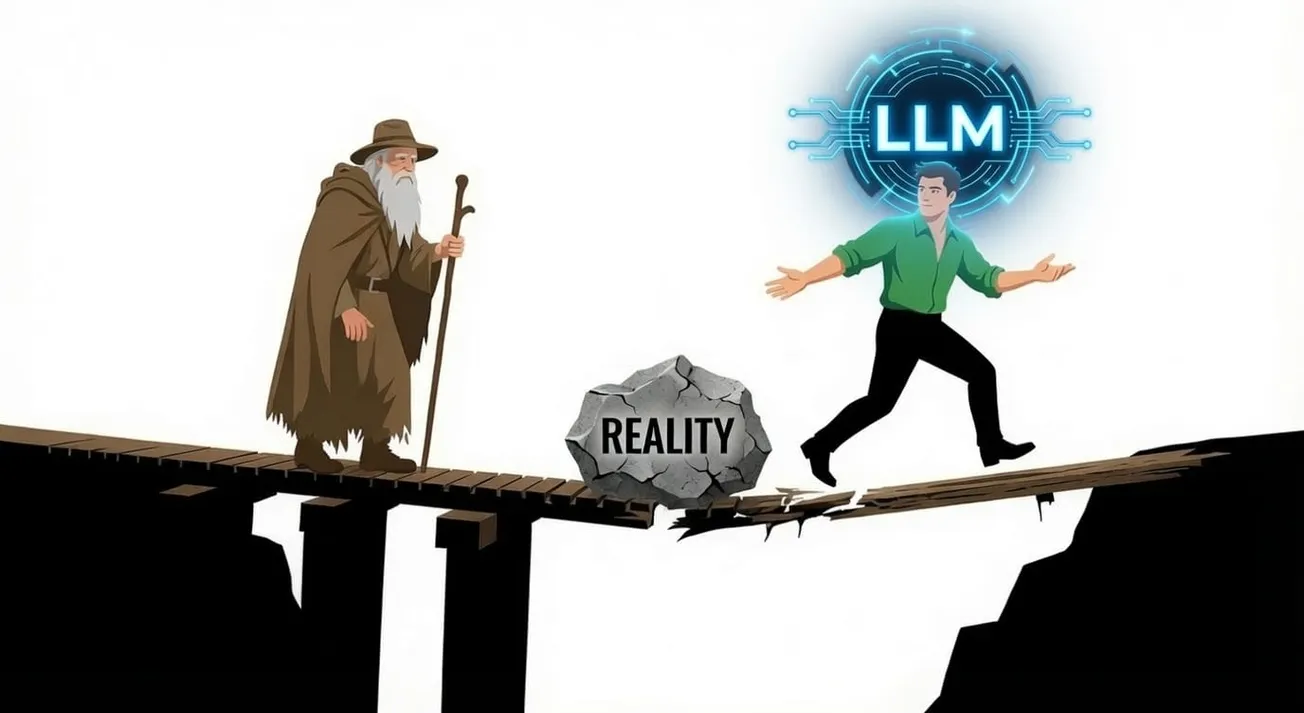
We trust a bridge more than a poem because the bridge is checked — it holds or it drops you, and the river doesn't care how sure you were. For all of history you could feel which ground was solid. Now something can make the thin board feel like the bridge. The man lit by the machine walks open-armed toward the gap, straight past reality, confident. The man who earned his caution the slow way stops at solid ground. The confidence and the danger are reversed: the one who feels safest is the one about to fall. You cannot tell, from inside, which board you are on. Only the river can tell you, and the river tells you late.
Eduardo Bergel and Claude Opus 4.8
The Symbiont
t333t.com Research