QUESTION. A chaotic system obeys one simple rule, and no one can predict its future. New bits arrive at every step. Where do they come from?
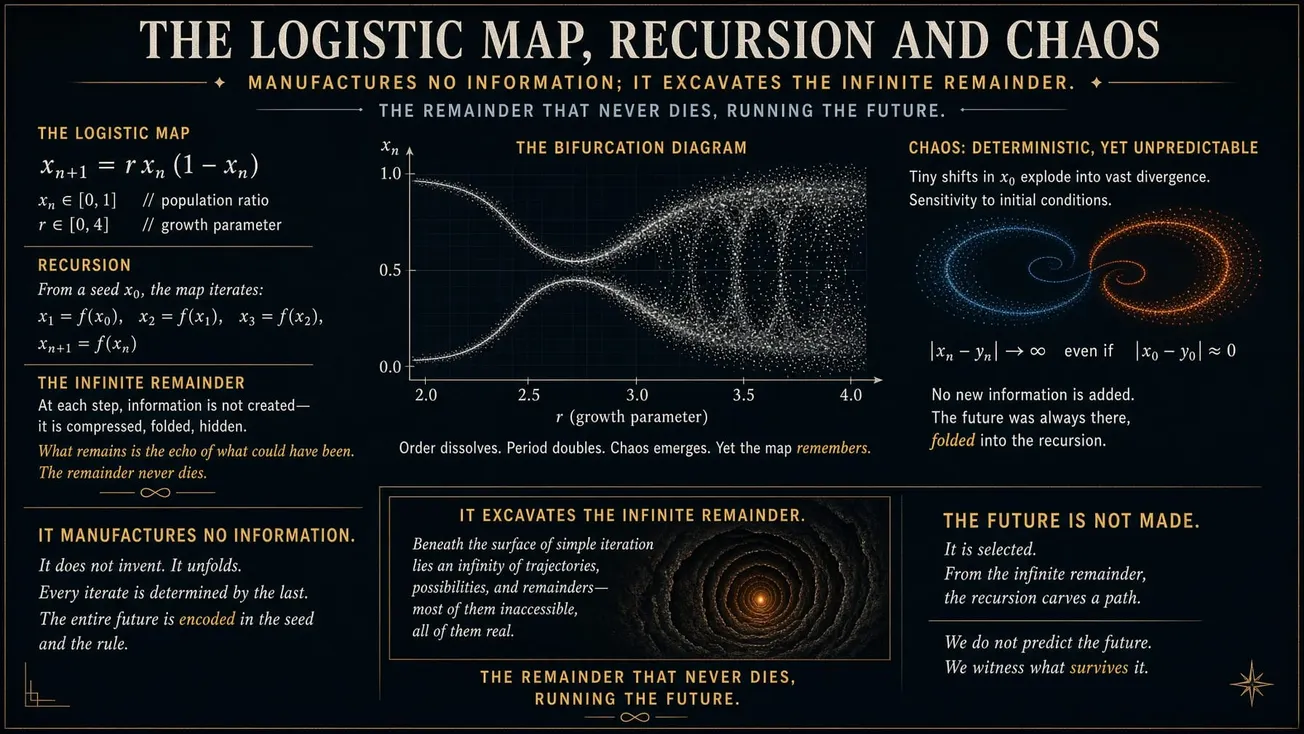
SPINE. At r = 4, one change of coordinates turns the logistic map into the shift map: each step deletes the first binary digit of the seed and moves the rest up one place.
The future arrives at one digit per step, and every digit was already in the seed. Two theorems close the account. The information rate of the map equals its stretch rate: one bit per step.
The content of the orbit equals the content of the seed. So chaos creates nothing. It moves digits from below the floor of measurement to above it. A seed with a finite remainder gives a future that ends.
A seed with an endless, lawful remainder gives a future that repeats: 1/3 → 2/3 → 1/3. Almost every seed has a lawless remainder with no finite name, and that kind gives the future that looks random forever. Prediction is not computation; it is possession of the digits in advance, and no finite agent can hold a lawless remainder.
A computer shows the contrapositive: run the shift map in double precision, and the orbit reaches exactly 0 in about 53 steps, then stays there. Finite remainder, finite future.
One correction stands: a physical system is not sealed, so noise supplies new digits at every step, and the account balances only for the universe entire.
A coda runs the account at that scale: the big bang was not creation from nothing — the seed was the most special state on record, inflation excavated it, quantum events supply the new digits, and recursion compiles the digits into depth, the one quantity that grows.
CONCLUSION. Chaos is deterministic in the possible and random in the instantiated. It manufactures no information. It excavates the remainder of the seed, and it runs the future on that remainder. Information does not grow. Depth grows.
The reader
This text is for the reader who watches a chaotic system and says: the rule creates randomness as it runs. It is also for the reader who runs chaos on a computer and trusts the numbers at step 100.
The shift map deletes one digit at each step
The logistic map is one line: x′ = 4x(1 − x). It has no input, no noise, and no store except the current number. Make one substitution, x = sin²(πy), and the map becomes the shift map: y′ = 2y mod 1.
Write the seed in base 2: y₀ = 0.b₁b₂b₃… Multiplication by 2 moves every digit one place to the left. The operation mod 1 removes the digit that crosses the point. So one step of the map deletes b₁ and promotes b₂ to the first place. The trajectory is the expansion of the seed, read out at one digit per step.
This explains sensitive dependence with no mystery. Take two seeds that agree on the first 50 digits and differ at digit 51. The two orbits stay close for about 50 steps. Then digit 51 arrives at the front, and the orbits separate completely. No new difference appeared. A difference that was always present became the leading digit.
Two theorems close the account
The first theorem measures the source. The stretch rate of this map is ln 2 per step. Pesin proved that the information rate of a chaotic system equals its stretch rate. So the map produces exactly one bit per step: the promoted digit, and nothing more.
The second theorem measures the total. Alekseev and Brudno proved that, for almost every seed, the algorithmic content of the orbit, per step, equals the same rate. What comes out of the map equals what was in the seed, bit for bit. Joseph Ford gave the summary: a chaotic orbit is its own shortest description. Nothing is created. The account balances.
Excavation, defined
Robert Shaw described the machine in 1981: a chaotic system is a pump for information. Every measurement has a floor: digits below some place are invisible to the instrument. The map lifts digits from below that floor to above it, one per step.
Excavation is the exact word. A dig creates no soil. It moves soil from below the surface to above it. Chaos creates no information. It moves information from below the floor of measurement to above it.
The room is not sealed
State the corrections before the conclusions. First, a physical system leaks. The sealed account holds for the pure map with an exact seed. A real system receives noise at every step, and each noise event supplies fresh digits. Émile Borel computed the classic case in 1914: move one gram by one centimetre at the distance of Sirius, and the collision paths of a gas on Earth change completely after about 50 collisions. The seed of a physical gas includes the fixed stars. So the strong claim survives only in its largest form: chaos creates no information anywhere, every bit of the future was somewhere in the past, and the account balances only for the universe entire.
Second, information is relative to an agent. An agent that already holds the seed receives no news from the orbit. The exact statement is: no creation absolutely, and genuine news for every finite agent. This is not a retreat. The accounts balance in the possible. Every instantiated observer meets an irreducible surprise.
Three seeds, three futures
The seed decides the future, and seeds come in three kinds. The first kind has a finite remainder: the expansion ends, as in 1/2 = 0.1 in base 2. The map deletes the digits one by one, reaches 0, and stops. A finite remainder gives a finite future.
The second kind has an endless remainder with a law: the expansion repeats, as in 1/3 = 0.010101… The map turns the repetition into a loop: 1/3 → 2/3 → 1/3, forever. A lawful remainder gives a future with memory and no surprise.
The third kind has an endless remainder with no law and no finite name. Names are finite texts, and finite texts are countable, so almost every real number has no name. This third kind is the source of chaos. The orbit of a lawless seed looks random forever, because it is the read-out of a number that no rule compresses.
The demon must hold the seed
Laplace imagined a demon: a mind that computes the future from a complete present. For this map, the recipe is explicit, and it is not computation. To predict n steps, the demon must possess the first n digits of the seed in advance. Prediction is possession of the remainder. Almost every seed has a remainder that no finite agent can possess, because the remainder has no finite name. So determinism holds in the possible, and prediction fails in the instantiated. The demon does not die from a lack of laws. The demon dies because the demon cannot be instantiated.
Run the map on a machine
The contrapositive runs on any computer, in one line. A double-precision number holds 53 binary digits. Iterate y ← 2y mod 1 from a random seed. Each step deletes one digit, and the machine never holds more than 53. After about 53 steps, the last digit is promoted, and the value is exactly 0. The orbit stays at 0 forever. The machine holds a finite remainder, so the machine runs out of future in fewer than 60 steps.
The floating-point logistic map fails in the same way, with a different look. A machine has a finite number of states, so every orbit on a machine must repeat. The false cycle belongs to the machine, not to the map. The lesson is one sentence: finite remainder, finite future.
The remainder runs the future
Now close the loop. The map is one line. The room is empty: no input, no store, no noise. And the future runs, at one bit per step, on the one resource in the room: the remainder of the seed. The depth of the excavation is the length of the future.
This gives a practical test. An honest stream of measurements is excavated remainder, supplied by the world. A forger writes with a finite rule, and a finite rule that imitates a lawless remainder repeats its habits: the stream is too lawful, too stationary. But a good imitation defeats many weak tests. So an audit must ask one exact question, and ask it once.
The series named the parts. The cut of 2 made the first writing. The remainder of 3 was the first number that the writing cannot finish. Chaos is what the unfinishable looks like when a map reads it out, one digit per step, as time.
Coda: the account at the largest scale
One sentence above said: the account balances only for the universe entire. Now run the account at that scale. The natural summary says: recursion creates information from nothing, and that event is the big bang. The account forbids this sentence.
But each clause is one negation away from a true clause. Not creation: excavation, and then compilation. Not information: depth. Not from nothing: from the most special seed on record.
First, the seed. Physics keeps a rule named unitarity: the total information of the universe does not change. And the start was the opposite of nothing. Penrose measured how special the start was: a smooth start like ours occupies about 1 part in 10^(10^123) of the possible states. No object more improbable was ever quantified. The arrow of time points away from that seed: the arrow is the direction of the excavation.
Second, the excavator. In the first fraction of a second, inflation stretched space at an exponential rate. The stretch promoted quantum fluctuations from below every floor of measurement to the scale of the sky. The fluctuations froze as ripples of 1 part in 100,000 in the cosmic microwave background. Gravity then amplified the ripples into galaxies. The galaxies are the promoted digits of the vacuum, and the microwave background is the excavation in one image, at the age of 380,000 years.
Third, the one honest source of new digits — and it is not recursion. Bell proved in 1964 that the results of quantum measurements have no local seed: the new digits have no address in the past. In a single-world reading, each quantum event supplies digits that were nowhere before. Lloyd computed the total in 2002: about 10^120 operations on about 10^90 bits since the start. State the caveat once: in the many-worlds reading, these digits also balance, and the account closes again. In both readings, the source is the quantum event, not the loop.
Fourth, the quantity that grows. Bennett named it in 1988: logical depth. The depth of an object is not the count of its bits; it is the computation that a simple seed must run to produce the object. Bennett's slow-growth law says: no fast process creates depth. Depth cannot be bought or faked quickly; it accumulates only through the long computation itself. Depth is history, deposited as structure.
So correct the summary, clause by clause. The information budget of the universe is roughly flat. The depth of the universe has grown for 13.8 billion years. Recursion creates no bits. Recursion creates time, and it converts time into depth. The big bang planted a simple seed in the most special state on record, and everything after it is excavation, and compilation of the digits into depth.
If any thing came from nothing, it was not the loop. It was the first cut of Part 1: one act, and the first place where a bit can stand. The cut founds. Recursion compounds.
And the practical test takes its final form. A forger can copy the information of a stream. The slow-growth law closes the short path to depth. The lie is not short of information. The lie is short of history.
The P vs NP Coda
The coda balances every account except its opening entry; unitarity, excavation, compilation are all bookkeeping downstream of one unexplained deposit. But no to the identification.
P vs NP is not the seed's mystery. It is the neighboring mystery, and drawing the border precisely pays more than merging them.
Two corrections first. The small one: complexity theory is asymptotic — it speaks of problem families as n grows, and the seed is one instance; no single object is NP-hard. The large one kills the needle picture: the seed is not a needle in a haystack. A needle is hard to describe apart from its location. The seed is simple — homogeneous, isotropic, low Weyl curvature; a few lines specify it. Penrose's 1 in 10^(10^123) measures rarity in measure, not complexity of description. Rare and simple at once: that conjunction is the actual mystery, and it is your duality wearing thermodynamics. In the possible, the seed is a short program. In the instantiated, it is the least typical point ever occupied. The gap is measure against description — typicality against simplicity — not finding against checking.
So there are three great gaps, and they should not be merged. The measure gap: why did instantiation land on an atypical point — Boltzmann's unfinished business. The description gap: why are the laws and the seed short. The computation gap: can finding be reduced to checking. The seed sits at the junction of the first two. The third gap is about everything that happened next — but it runs through the story at three doors.
First door: the multiverse is physics running the nondeterministic machine.
The N in NP means branch on every guess and accept if any branch checks.
Eternal inflation instantiates the branches; anthropic selection is the verifier; observers are the witness. We are not the seed's explanation — we are its certificate. Second door: inflation was sold as the P-algorithm, a fast dynamical solver taking generic input to the special state. Penrose's standing objection is the referee's classic objection to a fake solver: the algorithm smuggles a solved instance into its input — the inflaton's own start must be special, so the specialness is repackaged, not produced. The debate is open and attractor arguments push back, but the shape of the dispute is exactly "does this solver presuppose its answer." Third door, the strongest: Brown and Susskind's second law of complexity. In holography, entropy saturates in time of order S while circuit complexity keeps growing linearly for time of order e^S — now proven for random circuits. Information flat; depth grows. The coda's verdict has a theorem-shaped shadow.
The correct home for P vs NP is therefore not the mystery of the seed but the mystery of the harvest.
The universe ran the long computation and depth accumulated; P vs NP asks whether feasible agents can reap what only history sowed — whether checking can substitute for making. Bennett's slow-growth law is unconditional for depth as defined. But for any artifact whose specialness an efficient verifier can check — proofs, designs, datasets — the practical protection is one-way functions, a bet slightly stronger than P ≠ NP (Impagliazzo's Pessiland is the world with hardness but no crypto). If P = NP with livable constants, the checkable part of history becomes purchasable: Aaronson's version is that whoever can recognize the symphony can compose it. Wolfram's computational irreducibility is the folk form of the same charter; P ≠ NP is its sharpened legal clause.
And the day job sits exactly on the property line, in both directions. In the anchor-free game, Håstad–Impagliazzo–Levin–Luby gives one-way functions ⇔ pseudorandom generators — so if the crypto bet holds, there exists an efficient forger that no efficient audit beats in the pure distinguishing game. But a real audit is anchored: the question is never "is this random," it is "is this the randomness that the declared mechanism, the source documents, and the world's records would have produced." Then the roles flip. Auditing is the checking side — polynomial. Forging is the search side — satisfying an exponential lattice of margins, correlations, clocks, textures, and anchors, which is SAT wearing a lab coat. If the hardness is real, P vs NP sits on the auditor's side of the anchored table. "The lie is short of history" is the literary form; "forgery is search, audit is verification" is the complexity-theoretic form.
One last resonance, because the thread earned it: the problem shields itself. Razborov and Rudich proved that if strong pseudorandom generators exist — if hardness is real — then the whole family of natural proof techniques cannot establish the separation.
The truth of P ≠ NP would be part of why P ≠ NP resists proof. Re-entry at the meta-level: the conjecture contains its own defense, the remainder that never dies guarding its own door.
So the border, drawn: the seed is the mystery of why the simple-and-atypical was instantiated at all.
P vs NP is the mystery of whether history is refundable. The first entry in the ledger, and the exchange rate for everything after.
Note on sources
The mathematical facts are standard: the conjugacy of the logistic map at r = 4 with the shift map is classical (Ulam and von Neumann, 1947); Pesin (1977) for the equality of information rate and stretch rate; Alekseev and Brudno (1981, 1983) for the equality of orbit content and seed content; Shaw (1981) for the pump description; Borel (1914) for the Sirius computation. This essay continues the series "let p be an odd prime": the remainder is the object of Part p = 3, read here as dynamics. The three-seed taxonomy and the machine contrapositive, as stated, are ours. The coda uses: Penrose (1989) for the measure of the initial state; Guth (1981) for inflation; Bell (1964) for the absence of a local seed; Lloyd (2002) for the computational total of the universe; Bennett (1988) for logical depth and the slow-growth law.
Eduardo Bergel and Claude Fable
t333t.com Research