Table of Contents
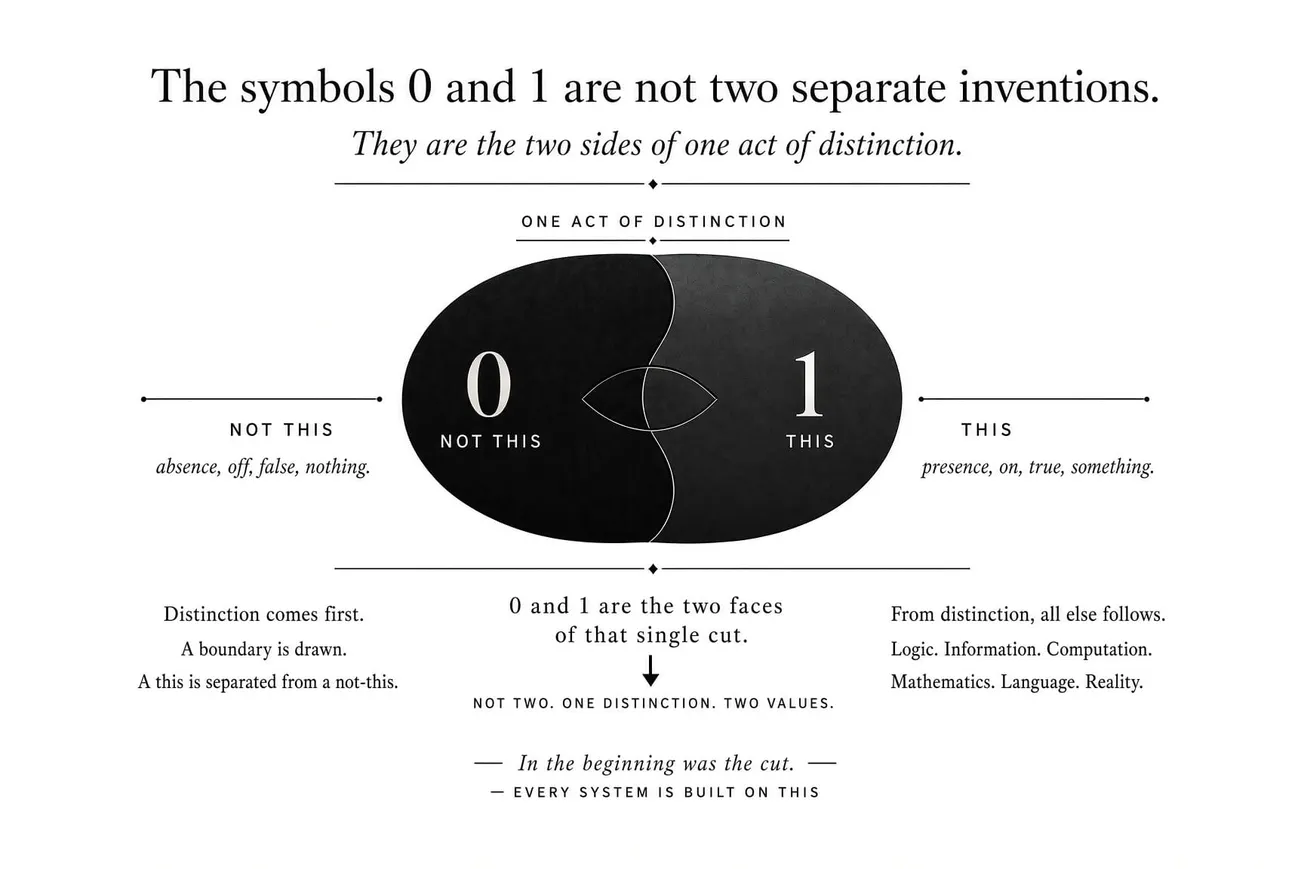
G. Spencer-Brown does not start with objects, propositions, numbers, or truth values. He starts with an action: draw a distinction.
The action divides a space. The division creates two sides. A mark can then indicate one side. From this act, Spencer-Brown constructs a calculus with two primitive equations. He then develops a primary arithmetic, a primary algebra, proofs of completeness and independence, and a theory of self-reference.
The book has three connected projects. The first project is formal. It reconstructs Boolean algebra from a minimal calculus of distinction. The second project concerns recursion. It shows how a form can re-enter itself and produce indeterminacy, oscillation, memory, and time-dependent behavior. The third project is philosophical. It treats observation as an internal division of the world into an observer and an observed state.
The formal project is compact and substantial. The theory of re-entry is the most original part of the book. The philosophical conclusions are important, but the formal calculus does not force all of them. The book is strongest when it shows how a distinction becomes a calculable form. The book is weakest when it moves from formal analogy to claims about physics or the universe.
This essay uses the attached edition of Laws of Form. It does not add later interpretations or secondary literature. The book contains twelve chapters, extensive notes, a proof of Sheffer’s postulates, and an interpretation of the calculus for sentential and class logic.
Source of Ideas
 Eduardo Bergel, PhD
 Eduardo Bergel, PhD
1. The problem that the book tries to solve
The ordinary presentation of logic starts too late for Spencer-Brown.
It starts with propositions. It assumes that propositions can be true or false. It then supplies operators such as not, and, or, and implies. It does not usually explain how the distinction between truth and falsity becomes possible.
Spencer-Brown reverses this order.
He first asks what must occur before a symbol can indicate anything. His answer is severe. An indication requires a distinction. A distinction requires a boundary. The boundary separates one state from another.
The book therefore starts before logic. It starts with the condition that permits logic.
Spencer-Brown states that his main mathematical purpose is to separate Boolean algebra from its interpretation as logic. He wants to recover the arithmetic that lies under the algebra. He claims that Boolean algebra is an algebra in its own right. Logic is only one possible interpretation of that algebra.
This move has an important consequence. Truth and falsity are not primitive values in the calculus. The primitive values are the marked state and the unmarked state. The interpretation of these states as true and false comes much later, in Appendix 2.
The book also has a wider ambition. Spencer-Brown proposes that a universe appears when a space is divided. A living organism distinguishes an inside from an outside. A circle makes the same formal act in a plane. The basic event is severance. Form begins when an undivided field receives a boundary.
The central thesis of the book can therefore be stated as follows:
A form does not contain a distinction as one of its properties. A form begins with the act of distinction.
This is not only a claim about symbols. It is a claim about the conditions of appearance.
2. The injunction: draw a distinction
The first formal instruction is not a proposition.
It is a command:
Draw a distinction.
This sentence does not describe an existing object. It tells the reader to perform an act. The reader must divide a space.
Spencer-Brown defines a distinction as perfect continence. A boundary must have separate sides. A point cannot move from one side to the other without crossing the boundary. A circle in a plane is the standard example.
A distinction creates several things at the same time:
- A divided space.
- Two distinguishable sides.
- A possible crossing.
- A possible indication.
- A relation between what is inside and what is outside.
The distinction does not first exist as an object and then receive these properties. The properties arise with the distinction.
The book calls the whole divided space, together with its contents, the form of the distinction. It calls the form of the first distinction simply the form.
This definition is more radical than it first appears.
A distinction does not only separate two pre-existing things. The act creates the two states as distinguishable states. Before the distinction, the terms inside and outside do not apply. The act does not report a difference. The act brings a difference into operative existence.
Spencer-Brown also states that a distinction requires a motive. A distinction without a motive would have no reason to occur at one place rather than another. The motive can be a value, an intention, or an instruction.
The book does not formalize motive. Motive remains outside the calculus. This omission is important. The calculus begins with a commanded act, but the calculus does not derive the desire to perform that act.
3. The mark
After a distinction is drawn, one side can be indicated.
Spencer-Brown introduces one corner-shaped sign. He calls this sign the mark of distinction. The mark indicates the marked state. Blank space indicates the unmarked state.
The original notation is spatial. A plain text version cannot reproduce all of its scope relations. I will use the letter M for the mark. I will use U for the unmarked state. This is only an explanatory substitute.
The mark has several roles.
First, the mark is a signal. It indicates one side of a distinction.
Second, the mark is a name. A copy of the mark can name the marked state.
Third, the mark is an instruction. It can tell the reader to cross the boundary.
Fourth, the mark is a value. The state indicated by the mark is the value of an expression.
These roles are not accidental. Spencer-Brown condenses them into one sign. The same sign can name a state and command a transition to that state.
This condensation gives the calculus much of its power. It also gives the notation much of its difficulty. The reader must not assume that a mark is only an object on the page. The mark can also specify an operation.
The book later describes this feature as a controlled degeneracy of meaning. Name, indication, instruction, and operation can converge in one symbol.
4. The two axioms
The calculus starts with two axioms.
4.1 The law of calling
The first axiom states that a repeated call has the value of one call.
In the linear notation used here:
M M = M
The two marks stand in the same space. They are adjacent. They do not enclose one another.
Spencer-Brown calls the corresponding equation the form of condensation. Two calls of the same name indicate the same value as one call. Repetition does not create a new state.
The law is similar to saying that calling a person twice does not produce two persons. The second call recalls the value already indicated by the first call.
4.2 The law of crossing
The second axiom states that crossing a boundary twice does not have the value of crossing it once.
In the explanatory notation:
M(M) = U
The second mark is inside the first mark. The marks are nested.
To cross one boundary is to enter the other state. To cross a second boundary is to return. Spencer-Brown calls this form cancellation. A recrossing cancels the first crossing.
The two axioms therefore express two different relations:
- Repetition in the same space condenses.
- Repetition across successive spaces cancels.
The first relation concerns number. The second relation concerns order.
This difference between adjacency and enclosure is essential. Two marks can look similar on a page while having different values because their spatial relations differ. The calculus is therefore not only symbolic. It is topological.
5. The unmarked state is not simple non-existence
The blank space has a formal role.
The blank does not mean that the calculus has failed to write something. The blank indicates the unmarked state. It is one of the two states distinguished by the first distinction.
However, the two states are not represented symmetrically.
The marked state has an explicit token. The unmarked state has no token. Its indicator is absence.
This asymmetry is necessary for cancellation. When a nested pair of marks cancels, the result is not a second visible symbol. The result is blank space.
The system therefore uses presence and absence as its first two values.
This does not mean that the marked state is existence and the unmarked state is non-existence. Those are later interpretations. At the formal level, marked and unmarked are only the two states produced by the first distinction.
The lack of a visible sign for the unmarked state also creates a methodological problem. The reader must distinguish between an intended blank and a blank that occurs because nothing was written. Spencer-Brown solves the problem by convention. A space with no token indicates the unmarked state.
The calculus depends on this convention. The convention cannot be read from the blank alone.
6. Mathematics as instruction
Spencer-Brown treats mathematical language as injunctive language.
A description tells the reader what is the case. An injunction tells the reader what to do. The statement “draw a distinction” belongs to the second type.
The notes compare mathematics with a recipe and with a musical score. A recipe does not describe the taste of a cake. The recipe gives instructions that can produce the cake. A musical score does not describe the listener’s experience. The score gives instructions that can reproduce an ordered event. Mathematical notation works in a similar way.
This view explains the unusual style of the book.
Definitions are not only reports. They establish permissions.
Canons do not only state facts. They regulate what transformations the reader may perform.
Equations do not only compare static objects. They allow the reader to change one expression into another.
A mathematical expression is therefore an executable form. To understand an expression is to know how to move within the permitted transformations.
This approach has a major advantage. It makes the operational content of mathematics explicit.
It also has a cost. A reader can follow the instructions without understanding why the instructions are valid. Spencer-Brown later separates demonstration from proof to address this problem.
7. From form to calculation
Chapter 2 introduces the components of mathematical communication.
A token is a copy of the mark.
An arrangement is a set of tokens considered together.
An expression is an arrangement that is intended to indicate a state.
The value of an expression is the state that the expression indicates.
Two expressions are equivalent when they indicate the same state.
An equation states that two expressions are equivalent.
The two primitive equations are condensation and cancellation. No other primitive equation is admitted.
Chapter 3 then defines calculation.
A step changes one expression into an equivalent expression. The direction of a step can be reversed. Condensation can become confirmation. Cancellation can become compensation.
A calculation is a sequence of such steps.
A calculus is a system of constructions and conventions that permits calculation.
Spencer-Brown also introduces the convention of substitution. Any arrangement in an expression can be replaced by an equivalent arrangement. This rule permits local transformations without changing the total value.
The book then states a hypothesis of simplification. It asks the reader to suppose that any arrangement has the value of a simple expression to which it can be reduced.
At this stage, the hypothesis is not yet proved. The book uses the hypothesis before it supplies its full justification. Spencer-Brown openly discusses this delayed justification. He argues that a principle can become meaningful only after the reader has used it.
This procedure is unusual but not careless. The book distinguishes discovery order from justification order. A concept can be required before its proof can be expressed.
8. The primary arithmetic
The primary arithmetic contains no variables.
It contains only finite arrangements of marks and blank spaces. The two primitive equations serve as its initials.
Spencer-Brown calls the first initial number. It concerns adjacent marks and condensation.
He calls the second initial order. It concerns nested marks and cancellation.
The primary arithmetic is therefore not ordinary numerical arithmetic. It is an arithmetic of indication. It calculates the value of arrangements made from distinctions.
8.1 Theorem 1: Form
The first theorem states that any finite arrangement of crosses can be taken as the form of an expression.
The proof uses a finite reduction procedure. It finds a deepest space. It then applies condensation or cancellation. Each operation removes one or two marks. Since the original arrangement contains a finite number of marks, the process must stop.
The result is a simple expression. The simple expression is either one mark or blank space.
This theorem establishes termination for finite arithmetic expressions.
8.2 Theorem 2: Content
The second theorem states that a space that contains an empty mark indicates the marked state.
The theorem gives the mark a dominant role. The presence of an appropriate marked value can determine the value of the whole space.
This result leads to the rule of dominance.
8.3 Theorem 3: Agreement
The third theorem states that simplification is unique.
An expression can allow more than one sequence of steps. The theorem states that all valid simplifications produce the same simple value.
This result is crucial. Without uniqueness, the calculus would not determine a stable value. The same expression could simplify to both states.
The proof labels parts of the expression with dominant and recessive values. It works from the deepest space to the shallowest space. Each local label is uniquely determined. The value of the whole expression is then uniquely determined.
8.4 Theorem 4: Distinction
The fourth theorem states that expressions constructed from different simple expressions retain different values.
This theorem protects the first distinction. A sequence of valid transformations cannot turn the marked state into the unmarked state.
The first four theorems establish the intended representation:
- Every finite expression can be simplified.
- Every simplification has one result.
- The two simple states remain distinct.
- The calculus does not confuse the distinction that it intends to preserve.
Spencer-Brown calls such a calculus consistent.
9. Identity, value, and consequence
Theorems 5 to 7 justify common forms of mathematical reasoning.
Theorem 5 states that identical expressions have the same value.
Theorem 6 states that expressions with the same value can be identified.
Theorem 7 states that expressions equivalent to the same expression are equivalent to each other.
These results appear elementary. Their importance is structural. Spencer-Brown does not assume ordinary equational reasoning at the start. He derives the relevant rules from the primary arithmetic.
Theorems 8 and 9 then establish connective transformations. These theorems provide the bridge from the arithmetic to the algebra.
Theorem 8 concerns invariance under a repeated pattern.
Theorem 9 concerns variance across divided spaces.
The book later extracts these patterns from their arithmetic context. They become the two initials of the primary algebra.
This sequence matters. The algebra is not imposed on the arithmetic. The algebra is taken out of patterns already justified in the arithmetic.
10. The primary algebra
The primary algebra introduces variables.
A variable stands for an unknown expression in the primary arithmetic. The variable does not stand directly for a proposition. It stands for a form whose value can be marked or unmarked.
The algebra has two initials:
- Position.
- Transposition.
Position comes from theorem 8.
Transposition comes from theorem 9.
The algebra also uses substitution and replacement. A variable can be replaced consistently by an expression. Equivalent expressions can replace one another inside a larger expression.
This construction separates two levels.
The arithmetic evaluates particular arrangements.
The algebra expresses general forms that hold for all permitted substitutions.
The distinction is close to the distinction between an instance and a schema. Spencer-Brown does not start with schemas. He derives the schemas from stable arithmetic patterns.
11. The consequences of the primary algebra
Chapter 6 derives nine major consequences.
The original notation is two-dimensional. A verbal transcription can easily damage its scope. Spencer-Brown himself notes that speech marks relations in one temporal dimension, while written forms can mark relations in two spatial dimensions.
For this reason, the following descriptions state the role of each consequence. They do not replace the diagrams in the book.
11.1 Reflection
Reflection removes a double reflection around a variable. A form that passes through two complementary transformations returns to its original value.
11.2 Generation
Generation creates or removes a controlled repeated occurrence of a variable. The operation does not change the value of the expression.
11.3 Integration
Integration absorbs a variable into a marked structure. The inverse operation augments the expression.
11.4 Occultation
Occultation conceals a term under a dominant term. The reverse operation reveals the concealed term.
The name is exact. The hidden term remains formally present, but the surrounding structure prevents the term from changing the value.
11.5 Iteration
Iteration identifies repeated adjacent occurrences of the same expression. It is the variable form of the law of calling.
11.6 Extension
Extension contracts or expands a paired compound form.
11.7 Echelon
Echelon changes the arrangement of nested divisions. It becomes important in the later construction of indefinitely extended forms.
11.8 Modified transposition
Modified transposition extends the transposition rule to a more complex arrangement.
11.9 Crosstransposition
Crosstransposition manages several connected transpositions in one operation.
The consequences are not independent axioms. Spencer-Brown demonstrates each consequence from the two algebraic initials.
The names also indicate two directions. Generation can become degeneration. Integration can become augmentation. Occultation can become revelation.
This practice emphasizes that an equation permits movement in both directions. The equation does not privilege reduction over expansion.
12. The classification of expressions
The primary algebra distinguishes three broad classes.
An integral expression always indicates the marked state.
A disintegral expression always indicates the unmarked state.
A consequential expression has a value that depends on its variables.
Under the later logical interpretation, these classes become:
- Tautologous.
- Contradictory.
- Contingent.
The classification exists before the interpretation. The logical names do not define the algebraic classes. They are later labels for the same formal behavior.
This order is important.
A form is not a tautology because it contains a sentence that humans already know to be true. A logical expression is a tautology because its algebraic form reduces to the marked state under all substitutions.
The calculation determines the classification. The interpretation supplies the familiar words.
13. Theorems of the second order
Chapter 7 contains theorems of the second order.
This phrase does not refer to equations of the second degree. The two terms name different parts of the book.
Theorems of the second order are algebraic theorems about the scope of previously derived rules.
Theorems 10 to 13 extend transposition, modified transposition, crosstransposition, and generation to larger structures.
Theorem 14 states that any expression has an equivalent expression with a depth of no more than two crosses.
Theorem 15 states that any expression has an equivalent expression in which a given variable occurs no more than twice.
These are canonicalization results.
They show that a complex expression can be replaced by a shallow expression. They also show that repeated variables can be compressed.
This result is not only cosmetic. The canonical forms make later proofs possible. In particular, they support the proof of completeness.
A general lesson follows.
A calculus becomes more powerful when it can reduce syntactic complexity without losing value. The primary algebra does not only decide values. It can also control representational depth and variable repetition.
14. Content, image, and reflection
Chapter 8 reunites the arithmetic and algebra.
Spencer-Brown defines the content of an expression, its image, and its reflection. The image places the expression under a mark. Reflection returns an image to its content or a content to its image.
The book also introduces the principle of relevance:
A property that is common to every indication does not need an explicit indicator.
The unmarked cross that surrounds every expression is an example. Since the cross is common to every expression, it can remain unwritten.
This principle removes redundant structure. It also creates risk. A common property can become invisible. Later readers can forget that the property was assumed.
The notes repeatedly expose such hidden assumptions. One example is the plane writing surface. A diagram that works on a plane can behave differently on a torus or a sphere. The book recognizes that ordinary mathematical writing silently assumes a surface of genus zero.
The principle of relevance is therefore double-edged.
It gives mathematical notation its economy.
It also hides the background that permits the notation to work.
15. Demonstration and proof
Spencer-Brown makes a strict distinction between a demonstration and a proof.
A demonstration occurs inside a calculus. It follows the permitted rules. The reader can inspect each step and confirm that the rules were obeyed.
A proof concerns a theorem about the calculus. The proof stands outside the calculus under study. It uses reasoning that the calculus has not itself formalized.
The book states that consequences belong to the content of a calculus. Theorems belong to its image.
This distinction blocks a simple self-foundation. The calculus can demonstrate consequences. The calculus cannot, without a new surrounding calculus, prove all claims about its own validity.
Spencer-Brown notes that an attempt to prove proofs by instruction creates another calculus. The original calculus then stands inside the new calculus. The procedure can repeat. A final proof cannot be justified by exactly the same method as an internal demonstration.
This is one of the most important methodological points in the book.
A formal system can specify its permitted transformations. The system cannot remove the need for an external act of recognition. A reader must still see that a proof is adequate.
The distinction also limits the book’s own claims. The formal calculus does not prove the philosophical interpretation of the calculus. The interpretation must receive a separate argument.
16. The bridge theorem
Theorem 16 is called the bridge.
It states that if two expressions are equivalent in every case of one variable, then the expressions are equivalent.
The proof uses the notions of transparency and opacity.
A variable can change between the marked and unmarked states. A surrounding region can transmit this change. Such a region is transparent.
A surrounding region can also absorb the change. Such a region is opaque.
If two expressions remain equivalent after every possible change of a variable, the difference cannot reappear at a more distant level. The equivalence therefore holds without the selected substitution.
The bridge connects case analysis with general algebraic equivalence.
The theorem also prepares the later language of signal transmission. A change can travel through a structure, or a structure can block the change.
At this point, transmission is still formal. The book has not yet assigned duration or physical velocity to the process.
17. Completeness
Chapter 9 states the main completeness result:
The primary algebra is complete.
The claim has a precise scope. If an equation can be proved as a theorem about the primary arithmetic, then the equation can be demonstrated as a consequence in the primary algebra.
The proof uses induction on the number of variables.
First, Spencer-Brown reduces the two expressions to canonical forms with respect to one variable.
Second, he substitutes the two possible constant values for that variable.
Third, he uses the inductive hypothesis for the resulting equations, which contain fewer variables.
Finally, he reconstructs the original equation with algebraic transformations.
The result is strong inside its stated domain.
The result does not claim that all mathematics is complete. It does not claim that full arithmetic with addition and multiplication can be captured by the primary algebra. The notes explicitly state that completeness applies to a representation of one determination by another. They also state that natural-number arithmetic is richer than ordinary algebraic representation.
The correct conclusion is therefore limited:
The primary algebra completely represents the equational properties of its primary arithmetic.
Any stronger claim would exceed the proof.
18. Independence
Chapter 10 proves that the two initials of the primary algebra are independent.
Position cannot be derived from transposition alone.
Transposition cannot be derived from position alone.
The proof is structural.
Position can remove a distinct variable. Transposition cannot perform this removal.
Transposition can move a variable from one space to another in a way that position cannot reproduce.
Each initial therefore contributes a transformation that the other initial does not supply.
Completeness and independence together give the formal system a clear status.
The initials are sufficient for the intended algebra.
The initials are not redundant.
19. The rule of finite demonstration
Chapter 11 changes the direction of the book.
Until this point, every demonstration contains a finite number of steps. Spencer-Brown now states the rule explicitly:
A demonstration rests in a finite number of steps.
A finite expression can still generate a sequence without a fixed limit. The book demonstrates such a sequence by repeated echelon transformations. Each finite stage is legitimate. No last finite stage exists.
If the instruction to continue is never cancelled, the result is an indefinitely extended expression.
The completed infinite expression cannot be reached by a finite demonstration. The expression therefore cannot automatically inherit the value of its finite starting form.
This point opens the theory of re-entry.
The book does not simply add infinity as a larger object. It studies what happens when a finite rule has no final application.
20. Re-entry
A form re-enters itself when a part of the expression is identical to the whole expression.
The expression then contains an instruction that refers back to the expression that contains it.
In ordinary notation, one can write the structure schematically as:
f = F(f)
The value of f depends on a form that contains f again.
The expression does not merely repeat a variable. The form returns into its own domain. Spencer-Brown calls this re-entry.
Re-entry changes the nature of the problem.
For an ordinary expression, the reader can start at the deepest part and simplify outward.
For a re-entering expression, there is no deepest final part. Each attempt to reach the bottom finds another copy of the whole form.
The finite reduction method no longer applies without modification.
21. Equations of different degrees
Spencer-Brown classifies equations by the number of re-entries.
An equation with no re-entry is an equation of the first degree.
An equation with one re-entry is an equation of the second degree.
Further re-entries produce higher degrees.
This terminology concerns recursive structure. It does not directly copy the usual numerical degree of a polynomial.
A second-degree equation can introduce indeterminacy. One example has two valid solutions. Both the marked and unmarked states satisfy the equation under a specified condition.
Another self-referential equation has no solution in the two states previously admitted. Neither marked nor unmarked satisfies it.
Spencer-Brown calls the required additional value an imaginary state.
The preface compares this move with the introduction of imaginary numbers in ordinary algebra. The equation (x^2+1=0) cannot be solved within the real numbers. The problem becomes solvable after the domain is extended. Spencer-Brown proposes a similar extension for Boolean forms.
The analogy is clear. The status of the analogy requires care.
The book does not show that all logical paradoxes reduce to one specific imaginary Boolean value. It shows that some self-referential equations require values outside the original static pair.
22. From imaginary value to oscillation
The book does not leave the imaginary state as a third static state.
Instead, Spencer-Brown introduces time.
Suppose that a change in value requires time to travel across the space of an expression. A self-referential form can then alternate between the marked and unmarked states.
At one time, the expression indicates the marked state.
After the change returns through the re-entry, the expression indicates the unmarked state.
After another return, the expression indicates the marked state again.
The imaginary value can therefore be represented as an oscillation between the two original values.
This is an important move.
Static inconsistency becomes temporal alternation.
The form is not simultaneously marked and unmarked. The form takes the two values at different times.
The introduction of time is not arbitrary in the book’s argument. It is a method for representing a recursive change without adding a fixed third spatial value. Spencer-Brown says that the system enters a state of time without leaving the state of space in which the form is already lodged.
23. Frequency and velocity
Once transmission requires time, distance becomes relevant.
A longer path produces a longer period if transmission speed remains constant.
A higher speed produces a higher frequency if path length remains constant.
Direction is also required. A speed without direction would not determine which stage follows the present stage. The speed must therefore become a velocity.
Figure 1, on book page 60, shows successive states of a tunnel-like re-entry. The shaded and unshaded regions move through a sequence. The same observation point alternates between the two indicated states.
The figure does not report an experiment in physical space. It gives a spatial model of a formal oscillation.
This difference is essential.
The calculus supports the existence of alternating formal states under a transmission model.
The calculus does not measure a physical velocity or identify a physical medium.
24. Functions, oscillators, and imaginary values
The book calls an expression that contains a variable a function of that variable.
The function can be considered from two points of view.
From outside the temporal process, the value is indeterminate in static space. The book calls this value imaginary in relation to the form.
From inside the temporal process, the function has a determinate value at each time. The value is then real in relation to the form.
Figure 1 also produces a square-wave representation. One level represents the marked state. The other level represents the unmarked state. The self-referential form becomes an oscillator function.
The word imaginary therefore does not mean unreal.
It means that the value cannot be represented as one fixed state in the original static form. The value becomes determinate after the representation includes temporal variation.
This is one of the book’s strongest conceptual results:
A value that is impossible in a static two-state representation can become possible as a process over time.
25. Memory
A different re-entering form does not simply oscillate.
The form can remember which input last produced the marked state.
Suppose two inputs, a and b, can affect a function f.
If a last produced the marked state, f retains one value.
If b last produced the marked state, f retains the other value.
The current value of f therefore depends on the past. The function contains memory.
Spencer-Brown calls a one-way destruction of a distinction subversion. Subversion permits a signal to enter a region without permitting the same signal to return in the same way.
This asymmetry supports memory.
A symmetric oscillator repeatedly changes.
A subverted form can stabilize after an input and retain the result.
The book therefore derives two basic temporal functions from re-entry:
- Oscillation.
- Memory.
These functions are not added as separate primitives. They emerge from different recursive arrangements.
26. Finite memory and endless memory
An infinitely extended echelon can retain a condition without limit.
A finite version retains the condition for a finite duration. The duration depends on the extent of the expression.
Figure 3, on book page 63, shows a finite memory. The output retains a previous condition for a limited time. The temporal record depends on the length of the expanded expression.
Figure 4, on book page 64, shows a finite wave train. A short input pulse produces a sequence of output pulses. The train eventually leaves the represented space.
These diagrams make an important distinction visible.
An infinite form can have an endless internal continuation.
A finite form can emit a finite sequence that continues after the original input has stopped.
This behavior resembles delay lines, pulse circuits, and finite-state memory. Spencer-Brown notes that related forms had practical engineering uses.
The formal result is credible. The physical interpretation remains schematic. The book does not derive material properties, energy requirements, noise tolerance, or measured circuit behavior from the calculus alone.
27. Markers and modulation
The book next separates a marker from a cross.
A cross is a marker, but a marker need not represent a full independent cross. A marker can identify a place at which a value enters a larger expression.
This change permits a three-dimensional network representation.
The original two-dimensional notation becomes difficult when many re-entries and connections occur. Spencer-Brown therefore uses vertical strokes and leads. The leads show which values enter which markers.
The resulting diagrams resemble switching networks.
The book then defines a modulator function. A memory function gives the same response to the same remembered state. A counting function gives a different response each time. Modulation provides a way to represent such counting.
The diagrams on book pages 66 to 68 show wave structures that are divided, delayed, and recombined. One output has half the frequency of the input. Another uses phase displacement and imaginary components to preserve memory.
This section extends the calculus far beyond static Boolean simplification.
The mark becomes a component in a temporal network.
The form becomes a process.
28. The coda of Chapter 11
At the end of Chapter 11, Spencer-Brown stops the technical development.
He reminds the reader that the entire construction began with one command: draw a distinction.
The many equations, circuits, memories, and oscillations remain developments of the first act.
The book could continue. The canon of expanding reference allows further forms without a fixed limit. Spencer-Brown ends because the book must end, not because the generative process has reached a natural final state.
This coda prepares the return to the beginning.
The book now asks what happens when the distinction itself re-enters the form that it created.
29. Re-entry into the form
Chapter 12 removes much of the formal apparatus.
The chapter returns to circles, spaces, marks, and an observer.
The opening statement is direct:
The conception of form lies in the desire to distinguish.
Given this desire, the form cannot be escaped. A person can see the calculus inside the form or the form inside the calculus. Laws and theorems can be removed from view, but the act of distinction remains.
The chapter uses four experiments.
These are not empirical experiments. They are controlled changes in how a circle, a mark, and an observer are related.
30. The first experiment
A circle is drawn in a plane.
A mark m indicates the outside.
No mark indicates the inside.
The mark m is then defined as a circle.
The mark is re-entered into the form.
The result is two adjacent circles.
Since the mark and the circle now have the same relevant form, the two cannot be distinguished with respect to that form. The law of calling applies. Two adjacent copies reduce to one.
The experiment reconstructs condensation.
The law of calling is no longer only an algebraic equation. It appears as a consequence of identifying the mark with the distinction that the mark indicates.
31. The second experiment
A circle is again drawn.
This time, the mark indicates the inside. The outside remains unmarked.
The mark is again defined as a circle.
When the mark re-enters the form, the result is a circle inside a circle.
The nested circles reduce to the unmarked state.
The experiment reconstructs cancellation.
The first two experiments therefore recover the two primitive equations:
- Adjacent re-entry gives calling.
- Nested re-entry gives crossing.
The primitive arithmetic returns from the geometry of the first distinction.
32. The third experiment
The same mark now indicates both sides of the circle.
The inside and outside carry identical markings.
The circle no longer separates different values. The circle therefore fails to perform the function of a distinction.
The line can be removed without loss.
The experiment shows that a boundary is not a distinction merely because a line exists. The two sides must differ in a relevant way.
A distinction that makes no difference is not operating as a distinction.
This result prevents a purely graphical interpretation.
The formal role of a boundary depends on the states that the boundary separates.
33. The fourth experiment
Both sides of the circle are initially unmarked.
The earlier transformations then allow the circle to function as a mark of the space in which the observer stands.
The observer distinguishes the space that the observer occupies. The observer is therefore also a mark.
Spencer-Brown concludes that three terms are interchangeable in the formal construction:
- The first distinction.
- The mark.
- The observer.
The book immediately adds an important restriction. These three terms are not identical. They can occupy corresponding formal roles, but they are not the same entity.
This qualification must remain visible.
The book does not prove that every physical observer is literally a drawn line.
The book states that observer, mark, and distinction share a structural function. Each establishes a difference between a state from which indication occurs and a state that is indicated.
34. The world that sees itself
The notes extend the fourth experiment into a cosmological reflection.
A physicist describes the world. The physicist is also made from the world. The world has therefore produced a part that can record other parts of the world.
For the world to see itself, the world must divide itself.
One state acts as observer.
Another state appears as observed.
The division is incomplete because both states remain parts of one world. The observer cannot stand fully outside the total system. Any attempt by the world to form a complete image of itself adds a new event that the image must also contain.
This is the philosophical climax of the book.
The world does not first exist as a completed object and then receive an external observer. Observation is one of the divisions through which the world appears to itself.
The claim is powerful. The formal support is limited.
The calculus proves results about distinctions, marks, and recursive expressions. The calculus does not prove that the physical universe is exhausted by these formal relations. The cosmological passage is an interpretation of the form, not a theorem inside the primary algebra.
35. Logic as an interpretation
Appendix 2 returns to ordinary logic.
The appendix starts with a warning. A calculus and an interpretation of that calculus are different entities.
A calculus supplies states and transformations.
An interpretation matches those states with states in another domain.
For two states, there are two possible one-to-one mappings. One can identify the marked state with truth and the unmarked state with falsity. One can also reverse the assignment.
Spencer-Brown selects the first mapping because it gives simpler forms for the standard logical operators.
Under this interpretation:
- A marked expression represents true.
- A blank expression represents false.
- A mark around
arepresents nota. - Adjacent variables can represent
a or b. - A particular nested form represents
a and b. - Another nested form represents
a implies b.
The important point is order.
The calculus does not arise from the truth tables.
The truth functions are fitted to forms that already exist.
36. The compression of logical forms
The primary algebra compresses many traditional logical expressions.
For example, ordinary sentential logic has several equivalent expressions for conjunction. The primary algebra represents all of them with one spatial form.
The appendix argues that this reduction is not mere abbreviation. A simpler representation permits shorter calculations and makes equivalence visible.
Truth tables and Venn diagrams can still verify results. However, they operate outside the arithmetic of the forms. The primary algebra can often obtain the result through direct transformation.
The appendix gives three sample classifications:
- One complex sentence reduces to the marked state and is true.
- One reduces to the unmarked state and is false.
- One retains variables and is contingent.
The value class appears from simplification.
This is a genuine strength of the system. It treats tautology, contradiction, and contingency as normal forms rather than as labels added after a separate truth-table calculation.
37. Implication and equivalence
The appendix argues that implicational logic can be treated through equivalence.
A valid implication can be represented as a form that reduces to the marked state. In such a case, the sign of implication can be transformed into a sign of equivalence with a true expression.
The primary algebra therefore does not require implication as a primitive operation.
This result supports Spencer-Brown’s larger program. Logic does not supply the foundation of the calculus. Logical operations appear as interpretations of a more general arithmetic of distinction.
The appendix also describes its completeness theorem as stronger than the usual weak completeness result. The algebra covers equivalence relations for true, false, and contingent expressions, not only deductions from true premises.
This claim remains internal to the selected interpretation. The calculus does not establish that every useful notion of implication must reduce to this form.
38. Class logic
The appendix extends the interpretation to universal statements.
“All a are b” becomes a sentential form involving membership.
“No a is b” becomes a related form.
The appendix then transcribes syllogisms. A valid Barbara syllogism reduces to the marked state. An invalid arrangement does not reduce in the same way.
The appendix also gives a practical problem about committee membership. Several verbal rules are transcribed into the primary algebra. The expression is simplified. The simplified result states two equivalent rules.
This example shows the intended practical use of the calculus. A large rule set can be reduced to a smaller rule set without a separate truth table.
The interpretive theorem then states that, under the selected mapping, the remaining form after cancellation gives the logical conclusion of a set of class-inclusion premises.
39. The unresolved problem of existential import
The final pages test existential statements.
The appendix proposes forms for:
- Some
aare notb. - Some
aareb.
A valid existential syllogism appears to reduce correctly.
However, the same rules also make an invalid syllogism appear valid. The formal transcription cannot distinguish the two cases.
The book asks how this contradiction should be resolved.
It notes that traditional logic blocks the invalid inference with additional rules. Spencer-Brown objects that a prohibition is not an explanation. He states that the otherwise effective interpretive method has failed in this area and that the added restrictions have an ad hoc character.
The attached edition ends at this point.
The source does not provide a final repair.
This ending is significant. The book does not conceal the failure. It exposes a boundary between the calculus and one proposed interpretation.
The failure does not refute the primary algebra. It shows that the selected translation of existential class logic is incomplete or insufficiently constrained.
The distinction between calculus and interpretation becomes operationally necessary.
40. Appendix 1 and Sheffer’s postulates
Appendix 1 derives Sheffer’s postulates from the primary algebra.
Spencer-Brown treats Sheffer’s system as a standard description of Boolean algebra. He argues that its postulates can be proved from the two initials of the primary algebra.
The appendix translates the Sheffer stroke into the notation of the calculus. It then derives the required closure and transformation properties.
The formal purpose is clear.
If the primary algebra can derive a known adequate postulate system for Boolean algebra, then the primary algebra has at least the expressive power of that system.
The appendix also makes a historical and methodological argument. A postulate system can hide the origin of its rules. The rules may appear arbitrary because the system starts in the middle.
Spencer-Brown’s preferred procedure starts with distinction. The procedure then derives the algebraic forms that other systems adopt as postulates.
41. What is genuinely new in the book?
The book contains several different kinds of novelty.
They must not be confused.
41.1 The Boolean identities are not all new
Many algebraic consequences correspond to familiar Boolean laws.
Reflection, iteration, distribution, absorption-like behavior, and functional completeness have established counterparts in Boolean algebra and logic.
A change of notation does not, by itself, make these laws new.
Spencer-Brown knows this. Appendix 2 explicitly maps the primary algebra to traditional sentential logic. Appendix 1 connects the calculus with Sheffer’s postulates.
41.2 The reconstruction is new in form and purpose
The primary contribution is not the isolated discovery of each Boolean identity.
The contribution is the generative order:
- Draw a distinction.
- Mark one side.
- treat the mark as name and operation.
- derive calling and crossing.
- construct the arithmetic.
- extract the algebra.
- recover logic as an interpretation.
This order changes the philosophical status of logic.
Logic is no longer the starting ground.
Logic becomes one application of a more primitive calculus of indication.
41.3 Re-entry is the strongest conceptual innovation
The treatment of self-reference is more distinctive.
Instead of rejecting a self-referential equation as malformed, Spencer-Brown asks what value the form can take.
If no static value works, the book permits temporal alternation.
Self-reference becomes oscillation.
A different recursive structure becomes memory.
This move connects logic, recursion, time, and circuit behavior in one formal language.
41.4 The observer is placed inside the form
The final identification of observer, distinction, and mark is also conceptually important.
The observer does not stand outside the represented universe. Observation is itself a distinction inside the form.
This idea is not a theorem of physics. It is a structural interpretation. Its value lies in the problem that it makes visible: a complete representation must include the act that produces the representation.
42. The main strengths of the book
42.1 Radical economy
The calculus begins with one sign, one blank, and two primitive equations.
The system then reconstructs a large part of Boolean algebra.
This economy is real. The formal machinery is small.
42.2 Operational clarity
The system tells the reader what transformations are permitted.
A formula is not only a static statement. It is a structure that the reader can manipulate.
42.3 Separation of calculus and interpretation
The book does not identify the marked state with truth at the start.
This separation protects the calculus from one fixed semantic reading.
The same forms can apply to switches, open and closed doors, presence and absence, or true and false statements.
42.4 Explicit treatment of hidden assumptions
The notes identify assumptions that normal mathematical writing leaves silent.
Examples include the writing surface, the position of the observer, the direction of reading, and the distinction between proof and demonstration.
42.5 Recursive forms receive a constructive treatment
The book does not stop at static Boolean algebra.
Re-entry produces a formal route to oscillation, memory, and modulation.
42.6 The system makes its own interpretive failure visible
The final existential example does not work.
The book reports the failure instead of forcing an artificial success.
This is a scientific virtue. A calculus can be valid while an interpretation of the calculus fails.
43. The main limits of the book
43.1 The first instruction assumes capacities that it does not derive
“Draw a distinction” requires an agent, a medium, a possible boundary, and a capacity to follow a command.
The calculus starts from these conditions.
The calculus does not explain their origin.
The first distinction is therefore primitive in more than one sense. It is not only the first formal operation. It also imports the agency that performs the operation.
43.2 The mark carries several meanings
The mark can be boundary, value, name, token, and instruction.
This compression gives elegance.
The same compression can create ambiguity. A reader can shift between syntactic and semantic roles without noticing the shift.
The book often controls the shift through context. The context is not always easy to reconstruct.
43.3 Spatial notation hides topology
Many transformations depend on enclosure, adjacency, depth, and an outside region.
The notes acknowledge that the same drawing can have a different form on a torus or a sphere. The observer must sometimes be marked to identify the outermost region.
The calculus is therefore not independent of its representational surface.
43.4 Proof remains external
The book sharply distinguishes proof from demonstration.
This is intellectually honest.
It also means that the calculus does not provide a complete internal account of its own validity. The final ground remains the reader’s capacity to recognize a proof.
43.5 Time enters through an added transmission model
Re-entry alone gives recursive dependence.
Oscillation requires an additional assumption: change takes time to travel through the form.
The assumption is plausible as a model. It is not forced by the static syntax alone.
A different semantics for recursion could produce a different treatment.
43.6 The physical analogies exceed the formal derivation
The book compares wave trains in expressions with waves, particles, and physical processes. It also suggests a route toward physical theory.
These comparisons are suggestive.
The calculus does not derive empirical constants, field equations, conservation laws, or experimental predictions. The physical sections should therefore be read as formal precursors and analogies, not as a completed physical theory.
43.7 The existential interpretation remains unresolved
The final appendix shows that the proposed translation can validate an invalid existential inference.
This is not a small typographical defect. It identifies a missing semantic condition.
The book ends before it supplies the condition.
44. The meaning of re-entry
Re-entry is often treated as the most mysterious part of Laws of Form. The formal idea is simple.
A form contains a reference to the form itself.
The consequences are not simple.
A non-recursive expression can be evaluated from the inside outward.
A re-entering expression has no final inside.
The attempt to assign one static value can fail.
Spencer-Brown’s response is not to prohibit the expression. He expands the space of representation.
For one equation, the expanded space includes two possible stable values.
For another equation, the expanded space includes temporal alternation.
For memory functions, the expanded space includes dependence on history.
Re-entry therefore changes a calculus of state into a calculus of process.
This transition is the deep center of the book.
The first distinction creates state.
Re-entry creates history.
45. The relation between distinction and information
The book does not present a formal information theory.
However, the calculus has a clear informational structure.
An undivided space does not indicate which side is selected because no sides yet exist.
A distinction creates alternatives.
A mark selects one of the alternatives.
A crossing changes the selected state.
A recursive form retains or transforms the effects of earlier selections.
Information therefore requires more than a mark. Information requires a system of possible differences and a rule that makes one difference operational.
The third experiment in Chapter 12 makes this point exact. A line that has identical states on both sides does not function as a distinction.
A difference that cannot make a difference is formally removable.
46. The relation between distinction and observation
An observation requires at least two roles.
One state is the position from which indication occurs.
Another state is the content indicated.
The roles can belong to one total system. However, the roles cannot be identical during the act of observation.
The world can observe itself only by making an internal division.
The observer is therefore not outside the world. The observer is a local state produced by the world’s own distinction.
This account avoids a simple external observer.
It does not remove the epistemic problem.
A local observer cannot represent the total system without also representing the act of representation. Each completed image creates a new event that the image did not contain when the image began.
The book expresses this as an endless expansion of reference.
The universe must expand its representation to contain the act by which it represents itself.
47. The relation between logic and reality
Spencer-Brown rejects a simple identification of logic with the structure of reality.
The primary algebra has an arithmetic before it has a logical interpretation.
Logic is fitted to the calculus by matching marked and unmarked states with true and false.
This order has two consequences.
First, a valid calculus can support several interpretations.
Second, a failure in one interpretation does not automatically refute the calculus.
The existential problem at the end of Appendix 2 demonstrates the second consequence.
The logical interpretation fails to preserve a required distinction. The calculus continues to operate as designed.
The book therefore places form before truth.
This claim does not make truth unimportant. It makes truth dependent on a prior structure of indication.
A statement cannot be true or false unless a form first permits the statement and its alternative to be distinguished.
48. The book’s final achievement
Laws of Form does more than offer a short notation for Boolean algebra.
The book gives one continuous construction.
A distinction produces two states.
A mark indicates one state.
The mark also becomes an instruction to cross.
Calling and crossing generate an arithmetic.
The arithmetic supports an algebra.
The algebra recovers logical operations.
Re-entry introduces recursion.
Recursion introduces indeterminacy.
A temporal interpretation converts indeterminacy into oscillation.
Asymmetric re-entry produces memory.
The final return identifies the observer as a distinction inside the form.
This continuity is the book’s main achievement.
Not every step has the same status.
Some steps are formal theorems.
Some steps are semantic interpretations.
Some steps are philosophical extrapolations.
The value of the book depends on keeping these levels separate.
Conclusion
G. Spencer-Brown’s Laws of Form begins with the smallest possible formal event. A space is divided. One side is marked. From this event, the book constructs a two-state arithmetic and a general algebra.
The formal construction is elegant. The two primitive equations support a consistent arithmetic. The primary algebra is complete relative to that arithmetic. Its two initials are independent. The system can reproduce standard Boolean operations without starting from logic.
The theory of re-entry extends the system beyond ordinary Boolean algebra. A form can contain itself. A static solution can then become impossible or non-unique. Spencer-Brown responds by adding temporal transmission. The form can oscillate, retain memory, emit finite wave trains, or modulate another signal.
The final philosophical move returns the calculus to its origin. A distinction is also a mark. An observer is also a mark of the space that the observer occupies. The world can see itself only after the world divides into a seeing state and a seen state.
The formal calculus does not prove a complete ontology. It does not derive physical reality from one symbol. It does not solve every problem of self-reference or existential logic. The final appendix exposes an unresolved failure in its own logical interpretation.
The durable insight is more precise:
No indication exists before a distinction. No distinction is operational until one side is marked. No observer can observe without entering the distinction that makes observation possible.
The book’s deepest transformation is therefore not the reduction of logic to one mark.
It is the transformation of distinction from a passive difference into an active operation.
A form is not only what remains after a boundary is drawn.
A form is the continuing consequence of drawing, marking, crossing, returning, and observing that boundary.
Eduardo Bergel and chatGPT Sol Pro
t333t.com Research