We still don’t understand time. Let That Sink In.
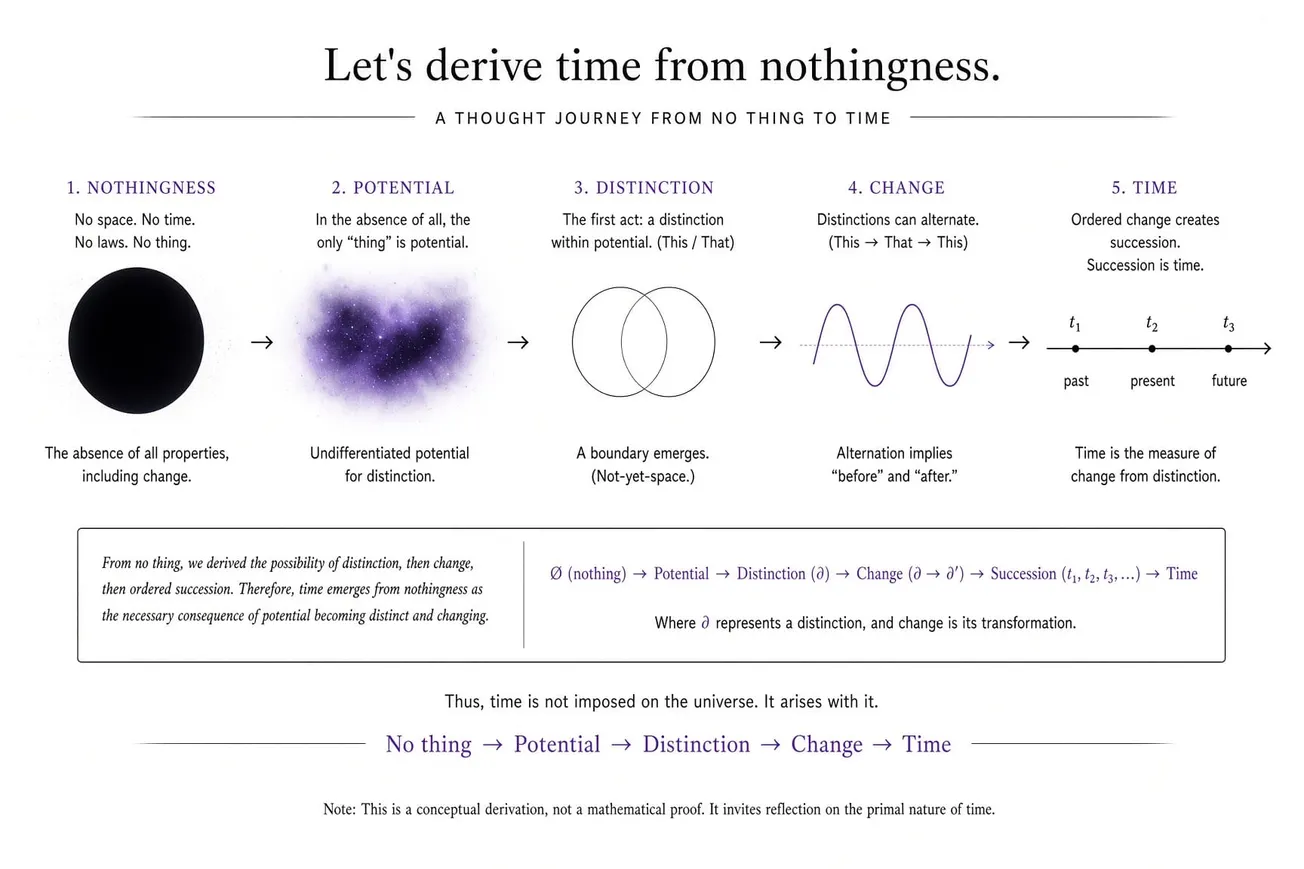
Imagine the smallest possible universe.
It contains one object.
The object has no parts. It has no color. It has no position relative to another object. It does not move. It does not vibrate. It does not change.
Now ask:
How much time passes in this universe?
One second?
One billion years?
No time at all?
You can choose any answer. However, no experiment inside that universe can show that one answer is different from another. Nothing changes. Nothing records a difference. Nothing can compare one supposed moment with another.
Now let the object change once.
It is first in state $A$. It is then in state $B$.
Have we created time?
Not yet.
The two states must have an order. We need a fact such as:
$$
A \prec B
$$
The symbol $\prec$ means that $A$ comes before $B$, or that $B$ depends on $A$.
Now we have the beginning of temporal structure.
However, we still do not know how much time separates $A$ and $B$.
For that, we need another changing process. We must compare one change with another.
That second process is a clock.
This gives us the driving question for the whole article:
What is the smallest physical structure that must exist before the word “time” makes a measurable difference?
This question leads to a possible answer.
Time is probably not one thing.
It contains at least four different structures:
- An order of events.
- A measure of duration.
- A direction that separates past from future.
- A possible passage, in which events become present and then past.
Physics understands the first two structures very well.
Physics has a strong but incomplete account of the third.
Physics does not yet know whether the fourth is a fundamental part of reality.
That is the real state of the problem.
We are not clueless about clocks.
We are not clueless about relativity.
We are not clueless about causal order.
We are not clueless about the thermodynamic arrow.
We are still uncertain about what makes reality happen, rather than only contain an ordered structure of events.
That is the hard part.
Part I — Build Time From Nothing
1. Do Not Start With a Clock
A common definition says:
Time is what a clock measures.
This definition is useful in a laboratory.
It is not a complete explanation.
We must then ask:
What is a clock?
If the answer is “a device that measures time,” the definition forms a circle.
Time is what clocks measure.
Clocks are devices that measure time.
Nothing has been explained.
We must first describe what a clock does without using the word “time.”
A clock is a physical system that:
- passes through distinguishable states;
- does this in a sufficiently regular way;
- keeps or produces a count of those changes;
- lets us compare those changes with changes in another system.
A clock does not need to contain a substance called time.
It needs an ordered sequence of physical differences.
The word difference is essential.
A state that never differs from itself cannot show that anything has happened.
2. World Zero: No Objects and No Events
Consider a universe with nothing in it.
There is no matter.
There is no radiation.
There are no fields.
There are no events.
Could time still exist?
Newton would have said yes. We will examine his view later.
However, no observer in this empty universe could detect time. No state would distinguish one proposed instant from another.
The statement “one hour passed” would have no physical effect.
This does not prove that time cannot exist in an empty universe.
It proves a narrower statement:
Time in an empty universe has no operational meaning.
The word operational means connected to a possible observation or procedure.
A hidden feature can exist without being measurable. Physics does not automatically reject such features.
However, a hidden feature earns no explanatory power if it never changes any possible result.
3. World One: One Event Is Not an Interval
Now add one event.
An event is a physical occurrence at a definite location in a physical description.
A flash is an event.
A collision is an event.
An atom emitting a photon is an event.
A neuron firing is an event.
One event does not have a duration between events.
A single point does not have a distance.
Distance requires at least two locations.
An interval requires at least two events.
This gives our first result:
One event can be located in a theory, but one event cannot define an elapsed interval by itself.
Now add one object that continues to exist.
Does that solve the problem?
Only if the object has distinguishable internal states.
A perfectly featureless and unchanging object provides no internal clock.
Suppose the object exists for one second in one possible universe and for one trillion years in another. If the complete physical state is identical in both cases, no internal experiment can distinguish the universes.
The extra duration behaves like an unused label.
It may appear in a mathematical description. It does not yet appear in physical relations.
4. The State of “One” Is Not Completely Undefined
It is tempting to say:
The state of one object is undefined because there is no reference.
This is too strong.
Some properties are relational.
Other properties can be intrinsic.
A single object has no position relative to another object.
It has no velocity relative to another object.
It has no angle relative to another direction.
However, it can still have properties such as mass, electric charge, or an internal energy state.
The exact distinction depends on the physical theory. The important point is simpler:
The absence of a reference removes relational properties. It does not necessarily remove every property.
Velocity is relational.
“Moving at 20 kilometres per hour” is incomplete until we say relative to what.
Mass is not velocity.
Electric charge is not position.
A physical theory must state which properties require a reference and which do not.
This correction matters because the problem of time is not solved by saying that everything is undefined.
The more useful claim is:
Duration is relational because it compares events or changes.
5. World Two: Difference Is Not Yet Time
Now consider two distinguishable states:
$$
A,\quad B
$$
This gives us a difference.
However, the set ${A,B}$ does not tell us which state comes first.
An unordered pair is not a history.
We need an additional relation:
$$
A \prec B
$$
This relation says that $A$ is a predecessor of $B$.
The word predecessor means a state or event that comes before another state or event in the relevant order.
We can interpret this relation in several ways.
It can mean that a signal can travel from $A$ to $B$.
It can mean that information from $A$ can affect $B$.
It can mean that a physical rule transforms $A$ into $B$.
It can mean that the state at $B$ contains a record produced at $A$.
These meanings are not always identical. However, they all introduce a directed relation.
A directed relation has an arrow:
$$
A \longrightarrow B
$$
The arrow is the first structure that can support a before and an after.
This gives our second result:
Difference is necessary for time, but difference is not sufficient. Temporal structure also requires order.
6. An Ordered Pair Does Not Yet Give Duration
Suppose we know that $A$ comes before $B$.
How much time separates them?
The relation $A\prec B$ does not answer.
The interval might be one second.
It might be one hour.
It might have no metric value at all.
The word metric means a rule that assigns a measurable size to an interval.
Order and metric are different structures.
Consider three cities on a road:
$$
A \rightarrow B \rightarrow C
$$
The order tells us that $B$ lies between $A$ and $C$.
It does not tell us the distances.
The distance from $A$ to $B$ can be one kilometre. The distance from $B$ to $C$ can be one hundred kilometres.
Time has the same distinction.
Causal order tells us which events can come before which other events.
A clock gives a numerical measure along an ordered path.
7. The First Clock Needs More Than Repetition
Imagine a pendulum.
The pendulum moves from left to right and back again.
You might say that each swing is a tick.
However, there is a problem.
After one complete cycle, the pendulum returns to its starting position.
If the complete clock also returns to exactly the same state, nothing inside the clock distinguishes the first cycle from the tenth cycle.
A pure oscillator does not remember how many times it oscillated.
A usable clock therefore needs more than an oscillator.
It needs:
- A changing phase.
- A counter or record.
- A way to compare the count with another process.
The word phase identifies the position within a cycle.
For a pendulum, phase includes both position and direction of motion.
A pendulum at the centre while moving right is not in the same phase as a pendulum at the centre while moving left.
A clock must also count completed cycles.
A clock is therefore not only a repeating system.
It is a repeating system plus a memory.
This produces an important result:
Measurement of elapsed time requires a record.
Without a record, a cycle can occur, but the system cannot distinguish cycle number 10 from cycle number 11.
A clock is an oscillator, a counter, and a comparison procedure.
8. A Clock Measures a Relation Between Changes
Suppose a clock passes through states
$$
C_0, C_1, C_2, C_3,\ldots
$$
Suppose another system passes through states
$$
S_0, S_1, S_2,\ldots
$$
The clock lets us establish correlations such as:
- When the clock is in state $C_5$, the system is in state $S_1$.
- When the clock is in state $C_{12}$, the system is in state $S_2$.
- When the clock is in state $C_{20}$, the system is in state $S_3$.
The physical content is the correlation.
The clock does not need to detect an invisible fluid.
It compares one physical sequence with another physical sequence.
This is the first relational definition of physical time:
Physical time is a structure that lets us order changes and compare one sequence of changes with another.
This definition is not yet complete.
It does not explain relativity.
It does not explain the arrow of time.
It does not explain the feeling of passage.
However, it breaks the circular definition.
Part II — The Quantum Clock Makes the Problem Clearer
9. A Quantum State Can Change Without Producing a Tick
Quantum mechanics is the physical theory used for atoms and smaller systems.
A quantum state is represented by a mathematical object called a state vector.
We can write an energy state as:
$$
|E\rangle
$$
The symbol $E$ represents energy.
If this state has one exact energy, quantum mechanics says that its evolution has the form:
$$
|\psi(t)\rangle=e^{-iEt/\hbar}|E\rangle
$$
The symbol $i$ is the square root of $-1$.
The symbol $\hbar$ is Planck’s constant divided by $2\pi$.
The exponential factor is a phase.
The phase changes as the parameter $t$ changes.
However, this phase multiplies the complete state.
It is a global phase.
A global phase cannot be observed by itself.
All ordinary measurement probabilities remain unchanged.
The state has changed mathematically, but no internal observable has changed.
One exact energy state therefore does not function as a clock.
It has no measurable internal tick.
This is a precise quantum version of our first thought experiment.
A single component can carry a mathematical phase.
However, that phase becomes observable only relative to something else.
10. Two Energy States Produce a Measurable Relative Phase
Now prepare a quantum system in a combination of two energy states:
$$
|\psi(0)\rangle=
\frac{1}{\sqrt{2}}
\left(
|E_1\rangle+|E_2\rangle
\right)
$$
This is a superposition.
A superposition is a quantum state that contains more than one possible measurement component.
After an interval $\tau$, the state becomes:
$$
|\psi(\tau)\rangle=
\frac{1}{\sqrt{2}}
\left(
e^{-iE_1\tau/\hbar}|E_1\rangle
+
e^{-iE_2\tau/\hbar}|E_2\rangle
\right)
$$
The two components accumulate different phases.
The phase difference is:
$$
\Delta\phi=
\frac{(E_2-E_1)\tau}{\hbar}
$$
The symbol $\Delta\phi$ means the change in relative phase.
The quantity $E_2-E_1$ is the energy difference.
Unlike a global phase, this relative phase can affect an interference measurement.
Interference occurs when quantum components combine. Their phases can make outcomes more likely or less likely.
This gives a sharp result:
One energy component has no observable internal clock phase. Two energy components can produce a measurable relative phase.
The difference does the work.
The clock is relational even inside one atom.
The atom counts as one object in ordinary language. However, it contains distinct internal quantum components.
The relation is internal.
11. What an Atomic Clock Actually Does
An atomic clock does not watch a tiny hand move around inside an atom.
An atom has allowed energy states.
A transition between two states has an energy difference:
$$
\Delta E=E_2-E_1
$$
Quantum theory connects this energy difference to a frequency:
$$
\nu=\frac{\Delta E}{h}
$$
The symbol $h$ is Planck’s constant.
The symbol $\nu$ is frequency, which means cycles per second.
A practical atomic clock contains an electromagnetic oscillator. This oscillator can produce microwave or optical radiation.
The clock compares the oscillator with the atomic transition.
A control system adjusts the oscillator until it stays locked to the atomic resonance.
Electronics then count the oscillator cycles.
Thus, even an atomic clock is a comparison machine.
It compares:
- one quantum phase with another quantum phase;
- an atomic transition with an electromagnetic oscillator;
- accumulated phase with an electronic count.
Modern passive atomic clocks repeatedly measure the phase difference between an oscillator and an ensemble of atoms. A feedback system uses the result to correct the oscillator.
The official International System of Units, or SI, defines the second by fixing the caesium-133 transition frequency at exactly:
$$
9,192,631,770\ \text{cycles per second}
$$
This number defines the unit. It does not explain the metaphysical nature of time.
The atomic definition tells us how to reproduce a second.
It does not tell us whether time flows.
12. The First Deep Answer
We can now answer part of the question.
What does a clock measure?
At the mechanical level, a clock counts reproducible changes.
At the quantum level, a high-quality clock accumulates and compares relative phase.
At the informational level, a clock creates a durable record of the count.
At the relational level, a clock compares its sequence of states with another sequence.
This answer is already deeper than “a clock measures time.”
However, it is still incomplete.
Different clocks move differently.
Different clocks can be at different heights in a gravitational field.
Einstein showed that they do not always accumulate the same amount.
To understand that fact, we need relativity.
Part III — Newton, Leibniz, and the First Great Division
13. Newton’s Absolute Time
Isaac Newton was one of the founders of mathematical physics.
In the seventeenth century, Newton proposed a distinction between absolute time and measured time.
Measured time came from motions such as:
- the rotation of Earth;
- the motion of the Sun across the sky;
- the swing of a pendulum.
Newton thought that these processes were imperfect measures of a deeper time.
He described absolute time as something that proceeds uniformly by its own nature, independent of external objects.
In Newton’s picture, the universe has a master clock.
The master clock does not depend on matter.
It does not depend on observers.
It does not depend on motion.
Every event has one true universal time.
Two distant events are either truly simultaneous or not truly simultaneous, even if no observer can determine the answer.
This view is clear.
It is also expensive.
It adds a universal temporal structure that cannot be directly observed.
14. Leibniz’s Relational Time
Gottfried Wilhelm Leibniz was a mathematician and philosopher who lived at the same time as Newton.
Leibniz rejected absolute space and absolute time.
He proposed that space is an order of things that coexist.
He proposed that time is an order of things that succeed one another.
Consider a universe in which every event occurs one year earlier than in our universe.
All objects have the same relative positions.
All causes have the same effects.
All clocks show the same values relative to all other clocks.
No internal observer can identify the one-year shift.
Leibniz argued that the two descriptions do not represent different physical worlds.
The added shift makes no observable difference.
In modern language, we might call the shift a redundancy in the description.
A redundancy occurs when two mathematical descriptions represent the same physical situation.
Leibniz’s argument does not prove that all time is relational.
However, it introduces a powerful rule:
Do not multiply physical structure when the additional structure produces no possible difference.
15. Neither Newton Nor Leibniz Won Completely
Relativity rejected Newton’s universal time.
However, relativity did not turn time into arbitrary opinion.
A clock following one path can record a different duration from a clock following another path.
When the clocks meet again, they can display different numbers.
All observers can agree about those final readings.
This is not subjective.
It is relational and objective.
A relation can be real.
The distance between two cities is relational.
The angle between two lines is relational.
The mass ratio between two objects is relational.
None of these quantities is arbitrary.
The important distinction is not:
- absolute means real;
- relative means unreal.
The important distinction is:
- frame-dependent quantities depend on a stated reference;
- invariant quantities remain the same under a change of valid description.
Relativity removes some absolutes.
It also reveals new invariants.
Part IV — Einstein’s Real Revolution
16. There Is No Single Answer to “How Fast Are We Moving?”
Earth rotates.
Earth moves around the Sun.
The Sun moves through the galaxy.
The galaxy moves relative to other galaxies.
Each speed uses a different reference.
The speed of Earth relative to the Sun is not the speed of Earth relative to the centre of the galaxy.
There is no known universal state of absolute inertial rest.
The starting source correctly identifies this relational fact when it lists several different speeds and then asks for Earth’s “real” speed.
However, a serious error can follow from this correct fact.
One might argue:
- There is no absolute velocity.
- Therefore the universe is one indivisible object.
- Therefore there is one universal now.
- Therefore all time exists now.
Steps 2, 3, and 4 do not follow.
In fact, special relativity says that there is generally no unique universal now.
The absence of absolute velocity does not create absolute simultaneity.
It destroys it.
17. Einstein Asked How to Synchronize Distant Clocks
A clock beside you can label a local event.
The event and clock meet at one place.
This causes no special problem.
The difficult question concerns distant events.
Suppose one clock is in Buenos Aires and another clock is in Tokyo.
What does it mean to say that both clocks show noon at the same time?
You cannot place the clocks side by side while they remain distant.
You need a synchronization procedure.
Einstein used light signals.
Suppose clock $A$ sends a light pulse at time $t_1$.
Clock $B$ reflects the pulse.
Clock $A$ receives the returning pulse at time $t_3$.
If light travels symmetrically in both directions in that reference frame, then the reflection event at $B$ is assigned the midpoint time:
$$
t_B=\frac{t_1+t_3}{2}
$$
This procedure defines distant simultaneity within that frame.
It does not discover a pre-existing universal present.
It constructs a consistent time coordinate by using clocks and light signals.
Einstein’s 1905 analysis began with the operational meaning of time assignments and synchronization.
18. A Reference Frame Is a Network, Not One Observer
A reference frame is not only a person looking from one location.
It is an imagined network of:
- rulers;
- synchronized clocks;
- spatial coordinates;
- procedures for assigning locations and times to events.
An inertial frame is a reference frame that is not accelerating or rotating.
Objects with no net force move at constant velocity in an inertial frame.
Different inertial frames can move at constant velocity relative to one another.
Special relativity says that the laws of physics take the same form in all inertial frames.
It also says that light in vacuum has the same speed $c$ in every inertial frame.
The symbol $c$ represents approximately:
$$
299,792,458\ \text{metres per second}
$$
The deeper role of $c$ is not limited to light.
It sets the conversion between temporal and spatial units.
It also defines the maximum speed of causal influence in relativity.
19. Why Simultaneity Becomes Relative
Consider two events.
Event $A$ occurs at location $x_A$ and time $t_A$.
Event $B$ occurs at location $x_B$ and time $t_B$.
Suppose the events are simultaneous in one inertial frame:
$$
\Delta t=t_B-t_A=0
$$
Suppose another frame moves at speed $v$ relative to the first frame.
The time separation in the moving frame is:
$$
\Delta t'
\gamma
\left(
\Delta t-\frac{v\Delta x}{c^2}
\right)
$$
Here:
$$
\Delta x=x_B-x_A
$$
and
$$
\gamma=
\frac{1}{\sqrt{1-v^2/c^2}}
$$
The Greek letter $\gamma$ is called the Lorentz factor.
Because $\Delta t=0$, the equation becomes:
$$
\Delta t'
-\gamma\frac{v\Delta x}{c^2}
$$
If the events occur at different locations, then $\Delta x\neq0$.
Therefore:
$$
\Delta t'\neq0
$$
The second frame does not judge the events to be simultaneous.
This is not a delay caused by slow communication.
Each frame corrects for the travel time of light.
The disagreement remains after that correction.
Simultaneity between distant events depends on the inertial frame.
20. Local Now and Distant Now Are Different Ideas
The word now hides two concepts.
The first is local now.
Your local now is the event occurring where you are.
It is a point on your path through spacetime.
The second is an extended now.
An extended now is a set of distant events declared simultaneous with your local event.
Relativity preserves the first concept.
It makes the second concept frame-dependent.
There is no conflict about an event that occurs beside you.
The problem begins when you try to extend your present across the universe.
A universal present would require one preferred way to divide spacetime into complete spatial slices.
Special relativity does not provide that preferred division.
Part V — Build a Light Clock From Ground Zero
21. The Clock at Rest
Imagine two parallel mirrors.
The mirrors are separated by a distance $L$.
A light pulse travels from the lower mirror to the upper mirror.
The pulse then returns.
Use one upward trip as half of a tick.
In the rest frame of the clock, the light travels distance $L$ at speed $c$.
The half-tick interval is:
$$
\Delta\tau=\frac{L}{c}
$$
The symbol $\tau$, pronounced “tau,” represents the time recorded by the clock that travels with the mirrors.
This is the clock’s local interval.
22. The Same Clock Seen in Motion
Now let the complete clock move horizontally at speed $v$.
An observer in the laboratory sees the light follow a diagonal path.
During the upward half-tick:
- the clock moves horizontally by $v\Delta t$;
- the light moves along the diagonal by $c\Delta t$;
- the mirror separation remains $L$ in the vertical direction.
These lengths form a right triangle.
The Pythagorean theorem gives:
$$
(c\Delta t)^2=L^2+(v\Delta t)^2
$$
Expand the squares:
$$
c^2\Delta t^2=L^2+v^2\Delta t^2
$$
Move the velocity term to the left:
$$
(c^2-v^2)\Delta t^2=L^2
$$
Therefore:
$$
\Delta t=
\frac{L}{\sqrt{c^2-v^2}}
$$
Factor out $c^2$:
$$
\Delta t=
\frac{L/c}{\sqrt{1-v^2/c^2}}
$$
Since $L/c=\Delta\tau$, we get:
$$
\Delta t=
\frac{\Delta\tau}{\sqrt{1-v^2/c^2}}
$$
Therefore:
$$
\Delta t=\gamma\Delta\tau
$$
Because $\gamma$ is greater than 1 when $v\neq0$:
$$
\Delta t>\Delta\tau
$$
The laboratory observer says that the moving clock takes more laboratory time to complete one tick.
This is time dilation.
23. This Is Not a Defect of the Light Clock
One might object:
The light path became longer. Only the light clock slowed down.
Suppose that were true.
Suppose a light clock slowed down but a mechanical clock did not.
An observer inside the moving laboratory could compare the clocks.
The disagreement would reveal the laboratory’s absolute motion.
This would violate the principle that uniform motion cannot be detected by an experiment fully contained in an inertial laboratory.
Nature does not behave this way.
Atomic clocks, unstable particles, electromagnetic oscillators, and other processes follow the same relativistic structure when relevant disturbances are controlled.
The universality does not come from the word “clock.”
It comes from the laws that govern matter.
The laws share Lorentz symmetry.
Lorentz symmetry is the structure that keeps the laws of physics consistent when we change between inertial frames.
Real clocks are not perfect. Temperature, magnetic fields, collisions, and acceleration can disturb them.
An ideal clock is a theoretical clock whose reading depends only on its path through spacetime.
Real clocks approximate this ideal when unwanted effects are sufficiently small. The connection between material clocks and metric proper time follows from the dynamics of matter as an approximation, rather than from a magical command issued by geometry.
Part VI — Proper Time
24. Coordinate Time and Proper Time
Relativity uses two important kinds of time.
Coordinate time is part of a chosen reference frame.
It is assigned by a network of synchronized clocks.
Different frames can assign different coordinate times to the same pair of events.
Proper time is the interval recorded along a particular physical path.
That path is called a worldline.
A worldline is the history of an object through spacetime.
In flat spacetime, the proper-time interval is:
$$
d\tau^2
dt^2
\frac{dx^2+dy^2+dz^2}{c^2}
$$
Here:
- $dt$ is the coordinate-time separation;
- $dx$, $dy$, and $dz$ are spatial displacements;
- $d\tau$ is the proper-time separation.
For motion at speed $v$, this becomes:
$$
d\tau
dt\sqrt{1-\frac{v^2}{c^2}}
$$
A clock accumulates proper time along its worldline:
$$
\tau=\int d\tau
$$
The integral sign means that we add the small intervals along the complete path.
25. Proper Time Is Relational but Invariant
Proper time belongs to a path between events.
It is not a universal time outside all objects.
It is also not a matter of opinion.
Different observers can use different coordinates.
They can disagree about:
- the coordinate duration;
- the coordinate distance;
- which distant events are simultaneous.
However, they calculate the same proper time for the same worldline.
This makes proper time an invariant.
An invariant is a quantity that does not change when we switch between valid coordinate descriptions.
This is the central correction to the idea that relativity makes everything relative.
Relativity does not say that every statement is observer-dependent.
It separates frame-dependent quantities from invariants.
26. The Twin Experiment
Imagine twins named Ana and Bruno.
Ana remains on Earth.
Bruno travels in a fast spacecraft and returns.
Their paths begin at the same departure event.
Their paths end at the same reunion event.
Between these events, they follow different worldlines.
Each twin carries a clock.
When they meet again, the clocks can be placed side by side.
Suppose Bruno’s clock shows less elapsed time.
This difference is not an optical illusion.
It is not caused by delayed signals.
It is not an unresolved disagreement between observers.
Both twins agree about the two final readings.
The clocks accumulated different proper times because they followed different paths through spacetime.
Bruno had to change direction to return.
That acceleration breaks the simple symmetry between the twins.
However, acceleration is not a mysterious substance that slows the clock.
The full worldline determines the accumulated proper time.
27. Minkowski’s Geometrical Move
Hermann Minkowski was a mathematician and one of Einstein’s former teachers.
In 1908, Minkowski presented a geometrical formulation of special relativity.
Instead of treating space and time as separate universal backgrounds, he represented physical history in four-dimensional spacetime.
Three dimensions describe space.
One dimension participates in the temporal structure.
An event becomes a point in spacetime.
An object becomes a worldline.
Light rays form the boundaries of light cones.
Minkowski’s formulation showed why different observers can divide spacetime into space and time differently while agreeing on the spacetime interval.
This was a great advance.
However, a geometrical representation is not automatically a complete metaphysical interpretation.
A four-dimensional map can represent all events.
The existence of the map does not by itself prove that all events exist in the same way.
Physics must distinguish the structure of the model from claims about what exists.
Part VII — Gravity Changes Clock Comparisons
28. General Relativity Makes the Metric Dynamic
Special relativity applies to flat spacetime.
General relativity includes gravity.
In general relativity, gravity is not represented as an ordinary force acting inside a fixed spacetime.
Matter and energy affect spacetime geometry.
That geometry affects the paths of matter and light.
The mathematical object that defines local intervals is the metric.
The metric is written as $g_{\mu\nu}$.
The indices $\mu$ and $\nu$ label the spacetime coordinates.
Using one common sign convention, proper time is:
$$
d\tau^2
-\frac{1}{c^2}
g_{\mu\nu},dx^\mu dx^\nu
$$
This notation means that the metric combines the small coordinate changes into an invariant interval.
The equation is compact.
Its meaning is important:
The amount of proper time accumulated by a clock depends on the spacetime path and gravitational geometry.
29. Clocks at Different Heights Do Not Tick at the Same Comparative Rate
Near Earth, a clock at a higher gravitational potential ticks faster relative to a similar clock below it.
For a small height difference $\Delta h$, the approximate fractional frequency difference is:
$$
\frac{\Delta f}{f}
\approx
\frac{g\Delta h}{c^2}
$$
Here:
- $f$ is the clock frequency;
- $\Delta f$ is the difference between frequencies;
- $g$ is the local gravitational acceleration;
- $\Delta h$ is the height difference.
The effect is small.
However, modern clocks are sensitive enough to detect it across millimetre-scale height differences.
Earlier experiments also confirmed relativistic clock effects.
Pound and Rebka measured the gravitational frequency shift of radiation in Earth’s gravitational field.
Hafele and Keating flew caesium clocks around Earth in opposite directions. The returned clocks showed different elapsed times consistent with the combined effects of motion and gravity.
These experiments do not identify a substance called time.
They show that physical processes accumulate phase and clock readings according to relativistic spacetime structure.
30. What Does “Time Itself Changes” Mean?
The phrase “time itself changes” can cause confusion.
There is no single universal flow that speeds up in one place and slows down in another.
The more precise statement is:
Different worldlines can contain different amounts of proper time between specified events.
Each local clock behaves normally in its own immediate frame.
Your heartbeat does not feel slow to you.
Your atomic clock does not appear damaged.
Your thoughts do not become stretched.
The difference appears when two paths are compared.
This is why relativity is relational without being subjective.
Part VIII — What a Clock Measures
We can now give four answers at four levels.
31. The Mechanical Answer
A clock counts a reproducible sequence of distinguishable physical changes.
A pendulum clock counts swings.
A quartz clock counts crystal oscillations.
An atomic clock counts a signal locked to an atomic transition.
32. The Quantum Answer
A high-quality clock accumulates relative phase.
For two internal energy components:
$$
\Delta\phi=
\frac{\Delta E,\Delta\tau}{\hbar}
$$
The clock converts this phase difference into a measurable signal.
33. The Relativistic Answer
An ideal clock records proper time along its worldline.
It does not record one universal cosmic time.
Two clocks can accumulate different proper times between their separation and reunion.
34. The Foundational Answer
A clock establishes a stable correlation between one physical process and another.
It gives a numerical structure to change.
It does not directly detect passage.
A clock can tell us:
- how many cycles occurred;
- how much proper time accumulated;
- how two worldlines differ;
- how gravity affects comparative rates.
A clock cannot tell us whether the future comes into existence.
A clock cannot identify a universal present.
A clock cannot show that reality moves through an additional medium called time.
This is the clean answer:
A clock measures accumulated, reproducible physical change along a path, calibrated so that ideal clocks agree on proper time.
Part IX — The Sentence “All Time Exists Now”
35. The Sentence Contains a Logical Problem
Consider the statement:
All time exists now.
The word now means simultaneous with the present event of the speaker.
If every time is now, then different times are not different times.
The statement collapses the distinction that it tries to describe.
The block-universe view does not properly say that all times exist now.
It says that all events are equally parts of a four-dimensional reality.
That is different.
A useful comparison is:
All places can exist without all places being here.
Likewise:
All times could exist without all times being now.
“Here” is a local relation.
“Now” can also be a local relation.
36. Eternalism Is Not Universal Simultaneity
The view that past, present, and future events all exist is called eternalism.
Eternalism does not say that all events are simultaneous.
It says that an event does not need to be present to be real.
A four-dimensional block can contain:
- a dinosaur event;
- your current reading event;
- a future stellar event.
These events occupy different temporal locations.
They are not one simultaneous instant.
The source discussion moves from relative motion to a universe that is “one big thing” and then to “one now.” That conclusion does not follow from the preceding argument.
37. Relative Velocity Does Not Imply a Single Whole
A network can be defined completely by relations.
Consider a graph.
A graph contains nodes and links.
No node needs an absolute position on a page.
The graph can still contain many distinct nodes.
The absence of an external coordinate does not turn the graph into one node.
The universe can contain relational structure without becoming an undifferentiated object.
Relationalism does not mean that distinctions disappear.
It means that distinctions come from relations rather than from an external stage.
Part X — What Relativity Says About “Now”
38. Light Cones
At each event, relativity defines a light cone.
The future light cone contains events that can receive a signal from the event.
The past light cone contains events that could have sent a signal to the event.
Events outside both cones are called spacelike separated from the event.
No signal travelling at or below $c$ can connect spacelike-separated events.
This divides event pairs into important classes.
Timelike-separated events
A slower-than-light object can travel from one event to the other.
All inertial observers agree about their temporal order.
Lightlike-separated events
A light signal can connect the events.
All inertial observers agree about their causal order.
Spacelike-separated events
No ordinary causal signal can connect the events.
Different inertial observers can disagree about which event occurred first.
This disagreement does not create a causal contradiction because neither event can influence the other under relativistic causality.
Minkowski’s spacetime geometry makes these distinctions explicit.
39. Relativity Does Not Make Causality Arbitrary
Relativity removes a universal ordering for all event pairs.
It preserves causal order for events that can influence one another.
This is a partial order.
A partial order does not need to rank every pair.
For example, a family tree orders ancestors and descendants.
It does not necessarily order two distant cousins as earlier and later members of one ancestral chain.
Relativistic spacetime behaves similarly.
Some events have an invariant causal order.
Other events do not.
The universe does not need one global present to preserve local causality.
40. “Now” Can Be Local and Objective
Your present event is local.
It is the event at your current position on your worldline.
Another observer has another local event.
If you meet, you share one event.
If you are far apart, there is no unique frame-independent rule that says which distant event on the other observer’s worldline is happening “right now” for you.
This does not make your local present unreal.
It makes the extension of your present across distance non-unique.
The most defensible relativistic statement is:
There is a local now at each event. There is no generally unique universal now across all space.
41. Cosmological Time Does Not Restore Newton’s Time
Some cosmological models contain a useful cosmic time.
These models describe a universe that is approximately uniform when viewed at very large scales.
The average motion of matter defines a convenient family of observers.
The proper time measured by those observers can serve as cosmic time.
This lets cosmologists discuss the age of the universe within the model.
However, cosmic time is not Newton’s absolute time.
It depends on the large-scale structure and symmetry of the cosmological model.
General relativity also permits spacetimes in which no global cosmic time exists.
Kurt Gödel, a mathematician and logician, found a rotating solution of Einstein’s equations with closed timelike curves. A traveller in that mathematical spacetime could, in principle, return to an event in the traveller’s own causal past. Gödel’s solution does not describe the observed universe, but it proves that Einstein’s equations do not guarantee one universal global time structure.
Part XI — Relativity Does Not Prove the Block Universe
42. A Mathematical History Is Not Automatically a Finished Reality
A physicist can represent a moving ball with a complete curve.
The curve contains the ball’s position at many times.
The complete curve can be printed on one page.
The page does not cause all positions to occur simultaneously.
It represents relations among events.
Likewise, a spacetime model contains a complete set of events.
This supports a block interpretation.
It does not logically force that interpretation.
A mathematical model can represent history as a whole because the scientist is describing many events in one object.
The representation does not settle whether:
- only present events exist;
- past events also exist;
- future events already exist;
- events become real one by one;
- becoming is local rather than global.
Relativity restricts these options.
It does not select one option by experiment alone.
43. Presentism
Presentism says that only present events exist.
Past events no longer exist.
Future events do not yet exist.
This view matches ordinary speech.
It faces a severe problem in relativity.
Which distant events belong to the one present?
Different inertial frames produce different simultaneity surfaces.
A presentist can add a hidden preferred slicing of spacetime.
That move is logically possible.
However, the preferred slicing becomes additional structure.
If it has no observable effect, physics has no way to identify it.
Naive presentism does not fit relativity.
A modified presentism can survive, but it must pay for extra structure.
44. The Growing Block
The growing-block view says that the past and present exist.
The future does not yet exist.
Reality grows as new events become real.
This view preserves objective becoming.
However, it must define the growth boundary.
If the boundary is a universal present, relativity creates the same problem as before.
If the boundary is local, the theory must explain how different local growth processes combine consistently.
The growing block is intuitive.
Its physical mechanism remains unclear.
45. Eternalism
Eternalism says that past, present, and future events are all parts of reality.
This view fits naturally with four-dimensional spacetime geometry.
It does not require a universal moving present.
However, eternalism has its own explanatory debt.
It can represent change as differences between temporal locations.
It does not automatically explain why passage feels immediate.
It often answers the question by denying that passage needs a separate explanation.
That may be correct.
It may also be a way of removing the phenomenon instead of explaining it.
A geometrical fit is not the same as a complete account of experience.
46. The Moving Spotlight
The moving-spotlight view combines a block universe with a privileged present.
All events exist.
One set of events is objectively present.
The spotlight moves through the block.
This view tries to preserve both eternalism and passage.
It faces a difficult question:
Relative to what does the spotlight move?
If it moves relative to a second time, then the theory adds a meta-time.
We can then ask whether that meta-time also passes.
This produces a regress.
A defender can say that passage is primitive and does not need another rate.
That answer is possible.
However, the spotlight still needs an empirical role.
If no observation can distinguish a moving spotlight from an ordinary block, the added structure remains metaphysical.
47. Local Becoming
A more promising option is local becoming.
On this view, becoming does not occur across one universal spatial surface.
It follows causal structure.
An event becomes definite relative to events in its causal future.
Each event has a causal past.
Each event has possible causal successors.
There is no need for one cosmic instant shared across all space.
Local becoming fits light-cone structure better than a universal present.
However, it still needs a precise physical theory.
It must explain:
- what “becoming” adds to causal order;
- whether becoming has observable consequences;
- how quantum events fit the structure;
- whether spacelike-separated events have any joint becoming relation.
Among the traditional options, local becoming has the best structural fit with relativity.
It is not yet a complete theory.
Part XII — Four Questions Hidden Inside “What Is Time?”
The question “What is time?” combines four different problems.
They must be separated.
48. Temporal Order
Which events can come before which other events?
Which events can influence which events?
Relativity answers this with causal structure and light cones.
The answer is local and partial.
49. Duration
How much interval accumulates along a physical path?
Relativity answers this with proper time.
Clocks test the answer with extraordinary precision.
50. Direction
Why do physical records point toward one temporal direction?
Why do we remember one direction and not the other?
Why do broken objects not normally reassemble?
Statistical mechanics and cosmology provide a strong but incomplete answer.
51. Passage
Why does the present seem to advance?
Do events genuinely come into existence?
Is passage a physical process?
Is it an internal perspective produced by memory and causal succession?
Current physics does not decide this question.
The failure to separate these four problems creates much of the confusion.
A theory can explain duration without explaining passage.
A theory can explain direction without explaining duration.
A theory can contain causal order without containing a global present.
Part XIII — Why Time Has a Direction
52. Many Fundamental Equations Do Not Select a Macroscopic Direction
Imagine a video of two hard balls colliding.
Run the video forward.
The motion looks possible.
Run the video backward.
The reversed motion also looks possible.
Many microscopic physical equations have a similar property.
If a sequence is allowed, a suitably reversed sequence is also allowed.
However, ordinary macroscopic events are strongly asymmetric.
A glass falls and breaks.
Broken pieces do not normally jump together and form a glass.
Cream mixes into coffee.
Mixed coffee does not normally separate into cream and black coffee.
A person remembers yesterday.
A person does not normally possess records created by tomorrow.
Where does this asymmetry come from?
The standard answer uses entropy.
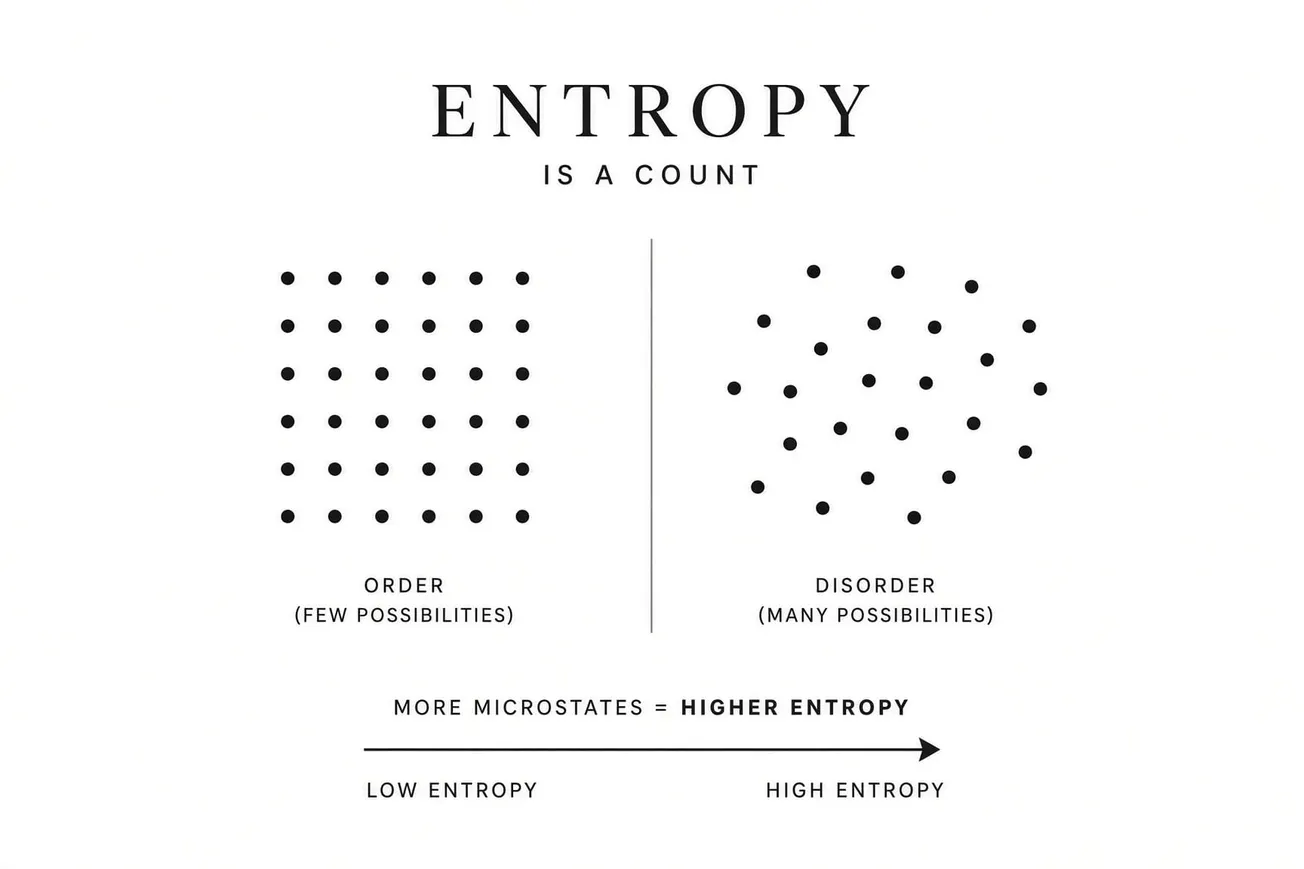
53. Microstates and Macrostates
A microstate is a highly detailed physical description.
For a gas, a microstate can include the position and momentum of every molecule.
A macrostate is a coarse description.
It can include:
- temperature;
- pressure;
- volume;
- average density.
Many different microstates can produce the same macrostate.
A room full of air looks uniform at the macroscopic level.
There are enormously many molecular arrangements that all look like uniform air.
Now imagine that every air molecule is in the left half of the room.
Far fewer molecular arrangements satisfy that condition.
The “all molecules on the left” macrostate is special.
The “molecules spread through the room” macrostate is generic.
54. Boltzmann Entropy
Ludwig Boltzmann was a nineteenth-century physicist who connected thermodynamics to statistics.
His entropy formula is:
$$
S=k_B\ln\Omega
$$
Here:
- $S$ is entropy;
- $k_B$ is Boltzmann’s constant;
- $\Omega$ is the number of microstates compatible with the macrostate;
- $\ln$ is the natural logarithm.
A macrostate with more compatible microstates has higher entropy.
A macrostate with fewer compatible microstates has lower entropy.
The formula does not say that disorder is a substance.
Entropy measures how many detailed arrangements fit the coarse description.
55. Why Entropy Usually Increases
Suppose all gas molecules begin in the left half of a box.
Remove a partition.
The molecules collide and spread.
Why?
Because almost all accessible microstates correspond to gas spread through the box.
Only a tiny fraction correspond to gas confined to one side.
The system does not need a special force that pushes entropy upward.
It moves through its allowed microstates.
Almost all available directions lead into larger high-entropy regions.
Entropy increase is therefore statistical.
It is not logically impossible for all molecules to return to one side.
It is overwhelmingly improbable for a large gas.
The probability becomes so small that the reversal does not occur on ordinary timescales.
56. The Hidden Assumption
This explanation starts with a low-entropy state.
The gas begins on one side.
Why did it begin there?
If we choose a generic middle state and apply time-symmetric laws, entropy will usually increase away from that state in both temporal directions.
To explain one consistent thermodynamic arrow, physicists often use the Past Hypothesis.
The Past Hypothesis says that the universe had an extremely special low-entropy condition near one end of its history.
From that boundary, entropy increases in the direction that we call the future.
The hypothesis explains the observed arrow conditionally.
It does not explain why the low-entropy boundary existed.
The need for a low-entropy cosmological condition remains an active foundational problem.
57. The Early Universe Was Hot but Still Special
A hot object often has high entropy.
This creates a puzzle.
The early universe was hot.
Why call it low entropy?
Gravity changes the answer.
For a gas without important gravity, a uniform distribution is close to equilibrium.
For gravitating matter, a uniform distribution is not the final high-entropy state.
Gravity causes matter to clump.
Stars, galaxies, and black holes can form.
A smooth gravitational field has fewer available gravitational structures than a highly clumped universe.
The early universe was very smooth on large scales.
That smoothness was a special low-gravitational-entropy condition.
This shifts the mystery.
The question is not only:
Why was the early universe hot?
The deeper question is:
Why was its gravitational state so smooth and special?
58. A Serious Alternative: Two Arrows From One Middle
Not every proposal requires a low-entropy condition at one temporal endpoint.
Julian Barbour, Tim Koslowski, and Flavio Mercati studied a simplified gravitational model.
In their model, a time-symmetric history contains a point of minimum structural complexity.
Complexity grows away from that point in two directions.
Observers on either side would identify the minimum-complexity region as their past.
Each side would call its own outward direction the future.
The model shows that a local arrow can emerge from a globally time-symmetric system without placing a special boundary at one chosen end.
This is not a complete model of our universe.
It does not yet explain all thermodynamic and quantum arrows.
However, it proves an important point:
The Past Hypothesis is a leading answer, not a closed verdict.
The arrow may come from a boundary condition.
It may emerge from gravitational structure.
It may require a deeper combination of both.
Part XIV — Records Create the Usable Past
59. We Never Observe the Past Directly
You do not directly observe yesterday.
You observe present records.
A photograph is a present arrangement of matter.
A fossil is a present structure in rock.
A scar is a present structure in tissue.
A memory is a present physical state of a nervous system.
A historical document is a present pattern of marks.
Each record exists now, locally.
The record is correlated with another event.
The earlier event helped produce the record.
This causal production distinguishes a record from a lucky resemblance.
60. Information Is a Physical Difference
A system contains information about another system when its state reduces uncertainty about the other system.
Suppose a detector has two states:
- 0 means no particle arrived;
- 1 means a particle arrived.
The difference between 0 and 1 matters because it changes what we can infer.
A record is a difference that was produced by another difference and can affect later behaviour.
A reliable memory has three parts:
- An earlier event affects the recording system.
- The recording system preserves a stable difference.
- A later process can use that difference.
Records therefore require causal ancestry.
A record must survive long enough to influence a successor state.
61. Record Formation Usually Has an Entropy Cost
To record one event, a system must amplify and stabilize a difference.
A single photon can trigger a chemical change in a camera sensor.
Electronics can amplify the change.
A memory device can store a bit.
These processes typically release heat or increase entropy elsewhere.
The exact entropy cost depends on the operation.
The general point is that robust macroscopic records are not free.
They depend on low-entropy resources and irreversible amplification.
This connects the record arrow to the thermodynamic arrow.
The direction with abundant records is the direction we call the past.
The direction without records is the direction we call the future.
62. A Prediction Is Not a Record From the Future
A weather forecast contains information about tomorrow.
However, it is not a record sent from tomorrow.
The forecast is produced by:
- present measurements;
- past records;
- physical models;
- computation.
Its causal ancestry lies in the present and past.
A record of a past storm was produced by the storm.
A forecast of a future storm is produced by a model.
This asymmetry is essential.
We have traces caused by past events.
We have models of possible future events.
63. Why Memory Points One Way
A current mental state contains records of earlier mental and physical states.
It does not normally contain records caused by its future successors.
This produces the psychological arrow.
The brain does not need to detect a universal river of time.
It needs:
- stable causal order;
- memory formation;
- retention;
- comparison;
- anticipation;
- action.
The direction of memory follows the direction in which physical records form.
Models of memory formation support a connection between the psychological and thermodynamic arrows.
This explains why we remember the low-entropy direction.
It does not yet explain objective passage.
Part XV — Entropy Is Not the Passage of Time
64. Direction Is Not Motion
A compass gives a direction.
It does not make a traveller move.
Entropy gives a temporal orientation.
It does not by itself make the present advance.
A complete block universe can contain an entropy gradient.
One end has fewer compatible microstates.
The other end has more.
The gradient exists as part of the four-dimensional structure.
Nothing in the entropy formula requires a moving present.
Therefore:
Entropy can explain the arrow of time without explaining the passage of time.
This distinction is often lost.
65. A Frozen Picture Can Contain an Arrow
Imagine a complete film strip laid on a table.
One end shows an intact glass.
Later frames show the glass falling.
Still later frames show broken pieces.
The strip contains an asymmetric sequence.
It contains an arrow.
However, the strip does not run itself.
A projector can produce an additional sequence of viewing.
The block-universe defender says that reality is more like the complete strip.
The passage defender says that something physically selects or creates one frame after another.
Entropy describes the difference between the frames.
It does not decide whether the film must be projected.
The analogy is imperfect, but the logical distinction is exact.
Part XVI — What Could “Passage” Mean?
66. Weak Passage
A weak meaning of passage is:
Events occur in an ordered causal sequence.
State $B$ depends on state $A$.
State $C$ depends on state $B$.
Records pass from predecessors to successors.
This weak passage is present in ordinary physics.
Physical systems have histories.
Later states depend on earlier states according to laws.
67. Strong Passage
A stronger meaning is:
Events change their mode of existence.
A future event does not yet exist.
It becomes present.
It then becomes past.
This is objective becoming.
Objective becoming is more than causal order.
It adds an ontological transition:
$$
\text{not real}
\longrightarrow
\text{presently real}
\longrightarrow
\text{past real}
$$
Standard relativity contains no measured variable for this transition.
A clock records intervals.
It does not record an event changing from future existence to present existence.
68. How Fast Does Time Pass?
Suppose time passes at a rate.
A rate has the form:
$$
\frac{\text{change in one quantity}}
{\text{change in another quantity}}
$$
A car can move at:
$$
\frac{100\ \text{kilometres}}
{1\ \text{hour}}
$$
What is the rate of time?
One might write:
$$
\frac{dt}{dt}=1
$$
This equation gives no new information.
It compares time with itself.
Suppose we introduce a second time $u$:
$$
\frac{dt}{du}
$$
We can now ask:
How fast does $u$ pass?
A third time would produce the same question.
This creates an infinite regress.
The argument does not prove that becoming is false.
A defender can say that becoming is primitive and has no rate.
However, the argument shows that passage cannot be explained as ordinary motion through another time without adding an endless hierarchy.
69. No Passage Detector Exists
A detector measures a contrast.
A thermometer distinguishes temperatures.
A voltmeter distinguishes electrical potentials.
A clock distinguishes accumulated phase or proper time.
What result would a passage detector produce?
What would the detector show in a universe with objective passage?
What different result would it show in a block universe with the same events, records, and clock readings?
No accepted experiment currently provides this contrast.
That fact does not prove that passage is unreal.
It establishes the present scientific situation:
Objective passage has no agreed independent observable.
If a future theory gives passage a measurable consequence, passage will become a physical hypothesis rather than only a metaphysical interpretation.
Part XVII — Why Passage Feels Undeniable
70. A Mind Is Not a Featureless Instant
A conscious system does not consist of one contentless point.
Its current physical state contains structure.
That structure includes:
- records of earlier inputs;
- retained goals;
- an estimate of its current condition;
- predictions;
- possible actions;
- mechanisms that select the next action.
The current state is temporally asymmetric.
It contains records of causal predecessors.
It does not contain equivalent records caused by causal successors.
This internal asymmetry is part of the experience of passage.
71. The Present Is a Functional Position
For an embedded agent, the present is not necessarily a universal slice of the cosmos.
The present is the local state in which:
- records of causal ancestry are available;
- current input is integrated;
- possible successors are evaluated;
- action is selected.
The present has a role.
It is the active boundary between recorded ancestry and unrecorded successors.
This boundary is local.
It moves with the process only in the sense that each successor state takes over this functional role.
No universal cosmic spotlight is required.
72. A Mind Preserves Its Causal Ancestry
A useful definition is:
A mind is a fault-tolerant causal process that preserves an actionable model of its own causal ancestry and encounters, and uses that model to regulate its next transition.
The term fault-tolerant means able to continue despite noise, damage, or local errors.
The term causal ancestry means the earlier events that helped produce the current state.
The term actionable model means an internal structure that can affect what the system does next.
A mind cannot function if causal order constantly breaks.
A memory must normally be caused by what it represents.
A decision must affect later action.
Local causality is therefore not an abstract decoration.
It is a condition for record-bearing agents to exist.
73. The Felt Passage Can Be an Inside View
Consider a chain of states:
$$
M_0\prec M_1\prec M_2\prec M_3
$$
Each state $M_n$ contains records of selected features of earlier states.
Each state also participates in producing the next state.
From an external description, the chain is an ordered structure.
From inside each state, the available records point backward and the available actions point forward.
The system never needs a representation of a universal moving present.
It needs a continually inherited causal model.
This suggests a possible account:
The felt passage of time is the internal form of directed causal succession in a process that preserves records of its predecessors.
This is not an established theorem.
It is a reasoned proposal.
It explains why passage feels immediate to a record-bearing agent even if physics contains no universal present.
It does not prove that strong objective becoming is absent.
Part XVIII — The Quantum Problem of Time
74. Ordinary Quantum Mechanics Uses an External Time
The basic equation of ordinary quantum mechanics is the Schrödinger equation:
$$
i\hbar\frac{\partial|\psi(t)\rangle}{\partial t}
\hat H|\psi(t)\rangle
$$
Here:
- $|\psi(t)\rangle$ is the quantum state;
- $t$ is time;
- $\hat H$ is the Hamiltonian;
- the Hamiltonian represents the system’s energy and generates its evolution.
In this equation, time appears as an external parameter.
The quantum state changes with respect to $t$.
The parameter is not itself a quantum observable in the same way as position.
Ordinary quantum theory assumes a clock outside the system being described.
This works well for laboratory systems.
The laboratory contains clocks and an external environment.
The problem becomes harder when the system is the complete universe.
There is no external laboratory.
There is no external clock.
75. General Relativity Makes Time Part of the System
General relativity does not place matter inside a fixed temporal background.
The metric is dynamic.
Matter affects the metric.
The metric determines proper-time relations.
Therefore, the temporal structure is part of the physical system.
Quantum mechanics says:
States evolve relative to an external time.
General relativity says:
Temporal geometry is itself dynamical.
These statements do not fit together easily.
This mismatch is one version of the problem of time in quantum gravity.
Quantum gravity is the still-incomplete theory that must combine quantum principles with gravitational spacetime.
76. The Wheeler–DeWitt Equation
One major route to quantum gravity begins by rewriting general relativity in Hamiltonian form.
The method divides spacetime into spatial geometries and asks how one geometry relates to another.
After quantization, one obtains a constraint of the schematic form:
$$
\hat H\Psi=0
$$
This is called the Wheeler–DeWitt equation.
The symbol $\Psi$ represents a quantum state of geometry and matter.
The equation contains no external time parameter like the $t$ in the ordinary Schrödinger equation.
The formal state of a closed universe can appear stationary.
Bryce DeWitt’s 1967 work emphasized that, for a finite universe, coordinate-time labels are not physical in the usual way and that time must be identified internally.
This does not prove that nothing happens.
It may mean that the complete universe does not evolve relative to an external clock.
The external clock does not exist.
77. A Stationary Whole Can Contain Relational Change
Don Page and William Wootters proposed a model sometimes called “evolution without evolution.”
Divide a closed quantum system into:
- a clock subsystem $C$;
- another subsystem $S$.
The complete state can have the form:
$$
|\Psi\rangle
\sum_n
|n\rangle_C
\otimes
|s_n\rangle_S
$$
Here:
- $|n\rangle_C$ means that the clock has reading $n$;
- $|s_n\rangle_S$ is the correlated state of the other system;
- $\otimes$ means that the two subsystem descriptions are combined.
Suppose the complete state $|\Psi\rangle$ is stationary.
An internal observer can still ask:
What is the state of $S$ when the clock reads $n$?
The answer is:
$$
|s_n\rangle_S
$$
When the clock reads 0, the system has one state.
When the clock reads 1, the system has another state.
The whole state does not change relative to an external time.
The parts change relative to one another.
Page and Wootters showed how stationary global observables can encode relational dynamics.
78. A Simple Two-State Example
Consider:
$$
|\Psi\rangle
\frac{1}{\sqrt{2}}
\left(
|0\rangle_C|A\rangle_S
+
|1\rangle_C|B\rangle_S
\right)
$$
The clock and system are correlated.
If the clock is found in state $|0\rangle_C$, the system is in state $|A\rangle_S$.
If the clock is found in state $|1\rangle_C$, the system is in state $|B\rangle_S$.
An internal description has an ordered correlation:
$$
A\rightarrow B
$$
No outside clock is needed to state the relation.
This provides a serious exit from the idea that the universe requires an external master clock.
The universe can be globally constrained and internally temporal.
79. Page–Wootters Is Not the Final Answer
The proposal has unresolved problems.
A realistic clock has many states.
A finite clock is imperfect.
The clock can interact with the system.
Different choices of clock can produce different descriptions.
The theory must recover ordinary smooth spacetime.
It must also explain why internal records have one thermodynamic direction.
Relational quantum time is a real mathematical construction.
It is not yet a complete theory of the observed universe.
80. Thermal Time
Alain Connes and Carlo Rovelli proposed another idea called the thermal-time hypothesis.
The proposal begins with a physical state rather than a universal external clock.
Under suitable mathematical conditions, the statistical state itself defines a natural flow of observable quantities.
Time is then not a universal background supplied in advance.
The state of the system helps determine the relevant temporal flow.
The proposal connects quantum theory, thermodynamics, and generally covariant physics.
This idea is mathematically deep.
It also has limitations.
It does not yet derive all ordinary clock behaviour from one confirmed fundamental theory.
It remains a hypothesis.
81. Causal-Set Theory
Causal-set theory starts even closer to our original thought experiment.
It proposes that spacetime is not fundamentally a smooth continuum.
At the smallest level, reality could consist of discrete events with a partial causal order.
The basic structure is:
$$
A\prec B
$$
if event $A$ is in the causal past of event $B$.
The set is locally finite.
This means that only finitely many fundamental events lie between two causally related events.
Order gives causal structure.
Counting events can provide a measure related to spacetime volume.
Smooth spacetime could then emerge as a large-scale approximation.
Bombelli, Lee, Meyer, and Sorkin proposed this structure in 1987.
This is a direct candidate answer:
Causal order can be more fundamental than metric time.
However, causal-set theory still must recover:
- smooth spacetime;
- general relativity;
- quantum matter;
- observed dimensionality;
- reliable predictions that distinguish it from other theories.
It is a serious research programme, not a confirmed final theory.
82. Does Causal Order Explain Time or Rename It?
This objection is important.
The relation
$$
A\prec B
$$
already contains direction.
If we call it causal order, have we explained time?
Or have we renamed before and after?
The honest answer is:
We have reduced the problem, but we have not reduced it to nothing.
Every theory must stop at some primitive structure.
Newton stops at absolute time.
A block theory stops at a four-dimensional metric structure.
A causal theory stops at directed relations between events.
A process theory stops at state transitions.
The advantage of causal order is not that it eliminates every primitive.
The advantage is that causal order has direct operational meaning.
It controls:
- which signals are possible;
- which events can produce records;
- which dependencies can support prediction;
- which processes can form minds.
The remaining question is still deep:
Why does reality contain directed dependence at all?
No current theory answers that question from nothing.
Part XIX — The Solvay Giants Did Not Ignore the Problem
83. The Famous Meeting
In 1927, many founders of quantum theory met at the fifth Solvay Conference on Physics.
The subject was electrons and photons.
The meeting lasted six days.
It centred on five principal reports.
Participants included:
- Albert Einstein;
- Niels Bohr;
- Marie Curie;
- Paul Dirac;
- Max Born;
- Werner Heisenberg;
- Erwin Schrödinger;
- Wolfgang Pauli;
- Louis de Broglie;
- Max Planck;
- Hendrik Lorentz.
The conference devoted much of its time to discussion rather than formal presentation.
These physicists did not fail to notice the conceptual problems.
They disagreed about:
- whether quantum theory was complete;
- whether measurement outcomes existed before measurement;
- whether probability reflected ignorance or indeterminacy;
- whether the wavefunction described reality or knowledge;
- whether causality remained fundamental.
However, their quantum theory still used an external time parameter.
Einstein’s gravitational theory made spacetime dynamic.
The two revolutions solved different parts of the problem.
Their conflict became fully visible only when physicists tried to quantize gravity.
84. Genius Does Not Guarantee a Unique Answer
The Solvay participants had extraordinary mathematical and physical ability.
They also had the same universe that we have.
They could test only the consequences available to experiments.
Several interpretations can reproduce the same observations.
When theories make identical predictions, more intelligence alone does not select one.
A new answer needs at least one of the following:
- a new empirical contrast;
- a new consistency requirement;
- a deeper theory that derives the old theories;
- a conceptual distinction that removes a false problem.
The last option is important.
The conundrum may persist partly because the word time combines several different structures.
Part XX — A New Synthesis From the Ground Up
We can now build an answer.
I will call it the causal-record account of time.
This is not a standard theorem.
It is a synthesis of established results and a proposed interpretation.
85. Principle One: Difference
No measurable time exists without distinguishable states or events.
A perfectly featureless state supplies no internal temporal contrast.
A mathematical time label can still be added.
However, the label has no local physical content until some relation changes.
86. Principle Two: Order
Difference alone is not enough.
Events require an ordered relation.
A minimal temporal chain has the form:
$$
A\prec B\prec C
$$
The order can represent directed physical dependence.
Not every pair of events needs to be ordered.
Relativity permits a partial causal order.
87. Principle Three: Measure
Order alone gives no duration.
A metric or clock process must assign interval size.
In established relativistic physics, proper time gives this measure along timelike worldlines.
Ideal clocks realize the measure through reproducible dynamics.
Quantum clocks implement the measure by accumulating relative phase.
88. Principle Four: Record
A usable past requires stable records.
A physical record is a present structure caused by an earlier event and available to affect later events.
A clock itself needs a record of its ticks.
A mind needs records of its causal ancestry.
The direction in which records accumulate supplies the practical distinction between past and future.
This direction is connected to thermodynamic conditions.
89. Principle Five: The Present Is Local
The present is not one universal sheet across the cosmos.
For an embedded physical process, the present is the local event or state where:
- inherited records are available;
- current interactions occur;
- successor states are constrained.
Each event occupies this role relative to its own causal structure.
The word “now” behaves partly like the word “here.”
Every observer has a here.
No location is the universal here.
Every local process has a now.
Relativity provides no universal now.
90. Principle Six: Do Not Add Flow Without a Difference
Causal order, proper time, records, and local presents explain a large part of temporal experience and measurement.
An additional universal flow is possible as a metaphysical hypothesis.
However, the hypothesis must answer:
What observable difference does this flow produce?
If it produces a difference, physics can test it.
If it cannot produce any possible difference, it does not improve physical prediction.
It might still express a metaphysical commitment.
It should not be presented as an experimental result.
Part XXI — The Proposed Answer
91. What Is Physical Time?
Here is the proposed definition:
Physical time is the structure that orders events by possible causal dependence and assigns invariant duration to change along causal paths.
This definition has two main parts.
Causal order gives before and after.
Proper time gives measurable duration.
At a deeper quantum-gravity level, both structures might emerge from more basic relations.
92. What Is the Arrow of Time?
The arrow of time is the macroscopic asymmetry in which stable records and entropy-producing correlations accumulate in one direction along causal histories.
This account does not claim that entropy creates causal order.
It says that thermodynamic and record structure identify the direction that embedded observers call the past-to-future direction.
93. What Is a Clock?
A clock is a physical system that accumulates a reproducible phase or sequence, records a count, and permits comparison with another process.
In established relativity, an ideal clock records proper time along its worldline.
A real clock approximates the ideal when environmental disturbances are controlled.
A clock does not measure the rate at which reality becomes real.
94. What Is the Experienced Present?
The experienced present is the local state in which a record-bearing causal process uses preserved ancestry to regulate its next transition.
This present is not a universal cosmic surface.
It is a functional role in a local causal process.
95. What Is the Passage of Time?
There are two answers.
The minimal answer is:
Passage is the internal appearance of directed causal succession in a system whose successive states preserve records of their predecessors.
The stronger answer would be:
Reality objectively creates new events or moves a privileged present through existence.
Current physics does not establish the stronger answer.
Current physics also does not logically disprove it.
The stronger answer needs an empirical signature.
Part XXII — Test the Synthesis
96. Objection: A Static Block Can Contain All the Same Records
Yes.
A block universe can contain every brain state, memory, clock reading, and causal relation.
The causal-record account therefore does not refute eternalism.
It shows how the experience of passage can exist inside a block structure.
This reduces the need for a universal moving present.
It does not prove that the block is the complete ontology.
97. Objection: If the Future Is Fixed, Decisions Do Nothing
This does not follow.
In a deterministic history, decisions are still causes.
A decision is part of the chain that produces an action.
A complete representation of a causal history does not remove the causal relations inside that history.
A map containing a bridge does not make the bridge unnecessary to the route.
However, determinism changes the meaning of openness.
The future can be epistemically open because the agent does not know it.
It might not be ontically open if every event is fixed.
The causal-record account does not decide between determinism and ontic randomness.
98. Objection: Quantum Randomness Creates Becoming
Not automatically.
Quantum randomness concerns whether an outcome is determined before it occurs.
Passage concerns whether events become present or real.
A stochastic block can contain random events.
A collapse theory can describe objective event production.
A many-worlds theory can describe branching correlations without a unique collapse.
Randomness and passage are different questions.
One does not logically imply the other.
99. Objection: Entropy Is Time
No.
Entropy is defined on physical states.
To say that entropy changes already requires an ordering of states.
Entropy can select an arrow within an ordered history.
It does not create the basic possibility of order from nothing.
100. Objection: One Object Can Still Have a Clock
Correct.
“One object” in ordinary language can contain many internal degrees of freedom.
An atom can contain two energy components.
A molecule can vibrate.
A planet can rotate.
A brain can contain many interacting subsystems.
Internal relations can serve as references.
The original minimal world excluded these internal differences.
A composite one is already a relational many.
101. Objection: Time Could Pass in a Completely Empty Universe
Yes, in an absolute-time theory.
The causal-record account does not prove that hidden empty time is impossible.
It says that empty time makes no observable difference inside the universe.
The disagreement then becomes metaphysical unless the absolute time affects possible physics.
102. Objection: Causality Already Assumes Time
This is the hardest objection.
Ordinary language defines causes as preceding effects.
Therefore, using causality to explain time can be circular.
A fundamental theory must use a more exact primitive.
It could use:
- a directed dependency relation;
- a state-rewrite rule;
- a transition relation;
- a partial order;
- a quantum causal structure.
These structures still contain direction.
The direction cannot be derived from a completely unordered structure without adding something.
The causal-record account does not pretend to explain order from absolute nothing.
It identifies directed dependence as the minimum unexplained structure.
This is progress because directed dependence has clear physical consequences.
A universal flowing substance does not yet have such consequences.
Part XXIII — What Would Count as Real Progress?
103. A Preferred Present Could Become Physical
Suppose an experiment detected one preferred state of rest.
Suppose clock synchronization worked differently relative to that state.
Suppose the difference could not be explained by matter, gravity, or known fields.
That result would support a preferred foliation of spacetime.
A foliation is a division of spacetime into complete spatial slices.
Such evidence would change the status of universal time.
No accepted evidence currently requires this structure.
104. Clock Universality Could Fail
Suppose two different ideal clock mechanisms follow the same worldline.
Suppose all known environmental effects are controlled.
Suppose the clocks accumulate different unexplained intervals.
This would show that one universal proper-time rule is incomplete.
Different forms of matter could couple differently to temporal geometry.
Modern precision clocks test this possibility.
So far, their agreement strongly supports the relativistic structure.
105. Quantum Gravity Could Derive Time
A successful quantum theory of gravity could show how:
- causal order emerges;
- smooth spacetime emerges;
- proper time emerges;
- classical clocks emerge;
- thermodynamic direction emerges.
This would be a major exit from the current conundrum.
The answer might resemble Page–Wootters relational time.
It might resemble causal sets.
It might use a different structure that has not yet been invented.
106. Objective Becoming Could Gain a Signature
A theory of objective becoming must predict something that a non-becoming theory does not.
Possible examples could include:
- a fundamental event-creation process;
- a measurable violation of exact time-reversal structure;
- an objective collapse law tied to spacetime growth;
- a limit on possible global quantum correlations;
- a new relation between records and event production.
These are research directions, not established results.
Until a contrast exists, strong passage remains empirically underdetermined.
107. The Low-Entropy Boundary Could Be Derived
The standard arrow-of-time account begins with a special low-entropy condition.
A deeper theory could derive that condition rather than assume it.
It might derive the condition from:
- quantum cosmology;
- gravitational constraints;
- a two-sided Janus structure;
- selection effects;
- a deeper law of initial conditions.
This would explain why records, memories, and thermodynamic processes share one direction.
It would not automatically prove objective passage.
Part XXIV — Why Are We Still Here After More Than a Century?
108. Einstein Solved a Different Question
Einstein did not discover the substance of time.
He transformed the question.
Newton asked for a universal time behind all clocks.
Einstein asked how observers assign times to events and which quantities remain invariant.
This produced precise answers about:
- synchronization;
- simultaneity;
- clock comparison;
- motion;
- gravity;
- causal order.
It did not settle the ontology of becoming.
The year 2026 is 121 years after Einstein’s 1905 special-relativity paper.
The unresolved problem has survived because the remaining question is not the same question that relativity solved.
109. The Known Physics Works Extremely Well
A scientific crisis becomes urgent when predictions fail.
Relativity predicts clock differences with extraordinary accuracy.
Quantum mechanics predicts atomic transitions with extraordinary accuracy.
Statistical mechanics predicts thermodynamic behaviour with extraordinary accuracy.
The theories disagree conceptually at their deepest junction.
However, each works very well in its tested domain.
This gives nature little experimental leverage for selecting a deeper interpretation.
110. Many Interpretations Share the Same Predictions
Presentism with hidden structure can imitate relativistic observations.
Eternalism can reproduce the same observations.
Relational time can reproduce ordinary evolution under suitable conditions.
Several quantum interpretations reproduce the same laboratory probabilities.
When the data do not separate the theories, consensus cannot create knowledge.
The correct answer remains conditional.
111. We Cannot Stand Outside the Universe
A laboratory clock is compared with another clock.
A subsystem is compared with another subsystem.
The complete universe has no known external clock.
We cannot observe the entire universe at two external moments.
Any universal time must be constructed from relations inside the universe.
This makes the problem structurally difficult.
112. Quantum-Gravity Effects Are Hard to Reach
The conflict between quantum theory and general relativity becomes strongest where both quantum effects and gravitational effects matter.
These conditions occur near:
- the early universe;
- black-hole interiors;
- extremely high energies;
- extremely small length scales.
Direct experiments are difficult.
This does not make progress impossible.
It explains why decisive evidence is scarce.
113. Language Keeps Recombining Solved and Unsolved Questions
The word time can refer to:
- a coordinate;
- a clock reading;
- proper time;
- causal order;
- an entropy gradient;
- memory;
- change;
- becoming;
- a conscious present.
A person can ask “What is time?” while moving between these meanings without noticing.
One scientist answers with proper time.
Another answers with entropy.
A philosopher asks about becoming.
A neuroscientist explains memory.
They can appear to disagree while answering different questions.
The first exit is conceptual hygiene.
Each verdict must remain within the jurisdiction of the test that produced it.
Clock experiments test duration.
They do not test eternalism.
Entropy models test direction.
They do not test objective becoming.
Relativity tests synchronization and invariance.
It does not by itself prove that the future already exists.
Part XXV — The Honest Frontier
114. What We Know
We know how to build clocks.
We know how atomic clocks use transition frequencies and relative phase.
We know how motion affects clock comparisons.
We know how gravity affects clock comparisons.
We know that proper time depends on a worldline.
We know that distant simultaneity is frame-dependent.
We know that causal order remains invariant for causally connected events.
We know that macroscopic records align with a thermodynamic arrow.
We know that ordinary quantum theory and general relativity use time in different ways.
These are not small achievements.
115. What We Do Not Know
We do not know why the universe has its particular low-entropy structure.
We do not know whether causal order is fundamental.
We do not know whether smooth spacetime emerges from discrete events, quantum relations, or another structure.
We do not know why spacetime has one temporal dimension and three large spatial dimensions.
We do not know whether the future is ontically open.
We do not know whether objective becoming exists beyond causal succession.
We do not know whether the felt passage of time reveals a fundamental feature or only the internal structure of record-bearing minds.
These are genuine unknowns.
116. What We Must Not Pretend to Know
Relativity does not prove that all times exist.
A spacetime diagram does not prove eternalism.
The absence of absolute velocity does not prove one universal now.
Entropy does not explain the existence of time.
A clock does not detect a flowing substance.
Quantum uncertainty does not prove becoming.
Conscious experience does not prove a cosmic present.
The Wheeler–DeWitt equation does not prove that nothing happens.
Relational time does not yet solve quantum gravity.
Any confident statement that erases these distinctions exceeds the evidence.
Final Answer
What Is Time?
Physical time is not best understood as an invisible substance that flows.
The most economical current answer is:
Time is the structure that orders physical events by directed dependence and permits invariant comparison of change along causal paths.
In relativity, the measurable duration along a path is proper time.
At a deeper level, proper time might emerge from quantum correlations, causal order, or another structure.
What Is a Clock Measuring?
A clock is measuring accumulated physical change.
More precisely, a high-quality clock accumulates relative phase, records a count, and follows a worldline.
When the clock approximates an ideal relativistic clock, its reading corresponds to proper time along that worldline.
The clock is not measuring a universal river.
It is realizing a stable relation between physical processes.
What Is the Passage of Time?
The phrase has two meanings.
The first meaning is directed causal succession.
Events have predecessors and successors.
Records pass from earlier events to later events.
Physics contains this structure.
The second meaning is objective becoming.
On this view, reality itself creates new events or moves a privileged present.
Physics has not identified an independent observable for this stronger passage.
Therefore, objective becoming remains possible but unconfirmed.
Why Does Passage Feel Real?
A mind is a record-bearing causal process.
Its current state contains memories of causal predecessors.
It uses those memories to predict and regulate successors.
The current state plays the role of the present.
The asymmetry between recorded ancestry and unrecorded successors creates the internal structure of passage.
This can explain the experience without a universal moving now.
It does not prove that no stronger becoming exists.
Is There Only One Now?
No known law provides one universal present across all space.
Each local event has a local now.
Different inertial frames divide distant events into simultaneous sets differently.
A useful cosmological time can exist in special large-scale models.
It is not Newton’s universal absolute time.
Do Past, Present, and Future All Exist?
Current experiments do not decide this metaphysical question.
Eternalism fits naturally with four-dimensional spacetime.
Presentism requires additional structure to fit relativity.
Growing-block and local-becoming views remain possible but incomplete.
The statement “all times exist now” is not a correct formulation of eternalism.
If all events exist, they exist at different temporal locations, not in one common present.
Is There an Exit From the Conundrum?
Yes, but it is not a final theory.
The exit begins when we stop forcing one word to perform four jobs.
Separate:
- causal order;
- metric duration;
- thermodynamic direction;
- ontological passage.
Then build each concept from the minimum required physical structure.
One event gives no interval.
Two distinguishable events give no time unless they are ordered.
An ordered pair gives no duration unless a metric or clock supplies a measure.
A periodic process gives no elapsed count unless it leaves a record.
A record gives a usable past.
A network of records and causal dependencies gives an embedded agent a local present.
This reconstruction explains clocks, relativity, memory, and much of temporal experience without requiring a universal flowing substance.
The remaining question is exact:
Is directed causal succession all that physical passage ever was, or does reality perform an additional act of becoming?
Physics has not yet answered that question.
The next revolution must do one of two things.
It must make objective becoming produce a measurable difference.
Or it must derive why causal order, proper time, records, and embedded perspective together create every phenomenon that we have called the passage of time.
Before the first tick, there must be a difference.
Before duration, there must be an order.
Before a clock, there must be a comparison.
Before a past, there must be a record.
Before a mind can experience a present, its causal ancestry must survive inside it.
What remains unexplained is not how clocks work.
It is why reality contains directed succession at all.
That is the core.
That is the honest unknown.
And that is where the next answer must begin.
Eduardo Bergel and ChatGPT Sol
t333t.com