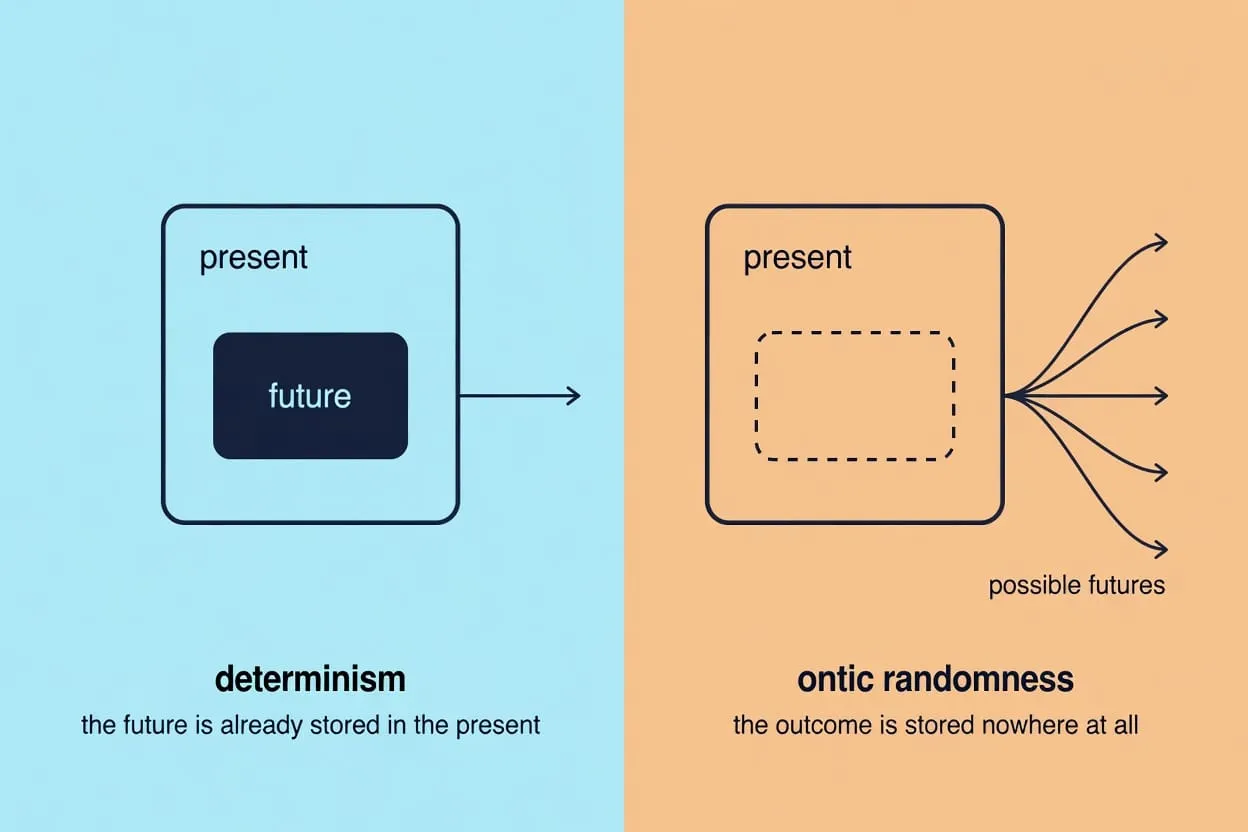
Determinism says the future is already stored in the present. Ontic randomness — randomness in the strongest sense — says the outcome is stored nowhere at all.
Laplace needed a demon:
A vast intelligence that, given the complete present, would compute the entire future. The phrasing hides the claim inside a knower, and the knower was never the point. Say it as storage and the demon evaporates: determinism says the future is already stored in the present. Nothing has to read the record for the record to be there — the laws are the reading rule, and the world executes them unwatched. Already does the remaining work: the not-yet, asserted to exist now.
Ontic randomness is the exact denial, and it names the one failure no demon can be blamed for. In a genuinely open world the demon does not fail from weakness; unlimited intelligence climbs every wall of the first kind. It fails because it stands in an archive with an empty shelf: the outcome is stored nowhere, and there is nothing, anywhere, to read.
This essay was the audit of that single claim — where such a record could sit, how large it would have to be, what each theory pays to assert it, and what every further bit of transcript does to the assertion. The demon was never the load-bearing part of Laplace's sentence. The shelf was.
And Einstein Dice
Einstein's sentence hides the same item. God does not play dice — granted; then the accounting. A God who refuses dice must have stored the result of every throw in advance, and quantum experiments price that storage: Bell closed the small local ledger, so what remains is an infinite bucket — the initial condition of the universe carrying, digit by digit, every outcome it will ever be asked for — or a ledger correlated with the questions, or entries written after the fact. The dice and the bucket cost the same bits; the theories differ only on the deposit date. Two famous sentences, one missing line item: the storage bill.
Who this essay is for: a reader who will not accept the word unpredictable without asking to whom, holding what, and allowed to search how much — and who wants to redo the essay’s central arithmetic on paper, because the core of the argument is counting, and counting can be checked.
Abstract
We are reframing determinism versus ontic randomness as competing claims about information storage: determinism asserts the future is fully encoded in the present state as a “seed” executed by natural laws, while true randomness means the outcome exists nowhere in advance.
We introduce a quantitative “ledger” approach using description budgets (bits for rule plus seed), showing how each observed bit beyond the budget halves the survival probability of bounded deterministic mechanisms, enabling statistical rejection of small hiding places or exhaustive refutation of entire classes via compression tests and interventions.
We conclude that declaring a specific hiding-place size or architectural constraint (such as in Bell tests) makes randomness claims testable and falsifiable, but unrestricted or unbounded models remain immune to finite evidence, limiting observers to pricing and constraining theories rather than reaching absolute metaphysical verdicts.
The Assay
QUESTION - Can an observer, from finite records and experiments, tell whether the events of its world were stored in advance or genuinely undecided?
SPINE - Determinism is the claim that the future is already stored in the present: the state of the world is a seed, the laws are the program that reads it. Ontic randomness is the claim that the outcome is stored nowhere. Between those poles, every workable notion of randomness turns out to be a statement about a hiding place: how large a hidden description — rule plus seed together — the candidate mechanism is allowed, and whether the observed transcript overflows that allowance. Declare a budget of B bits and evidence becomes arithmetic. Fewer than 2^(B+1) descriptions fit inside the budget, so fewer than 2^(B+1) transcripts of any length can come out of it; every observed bit beyond the budget therefore halves, at once, the survival prospects of the entire bounded class. The same count runs in both directions: finding a description far smaller than the transcript rejects chance at a computable significance level, and finding none within the budget refutes every bounded mechanism together. Leave the budget unrestricted and the hiding place can simply be the transcript itself, after which no observation tests anything. From this one ledger the rest follows: theorems audit infinite hiding places in a single stroke when the architecture is declared, which is what Bell tests do; certified randomness is a certified seed deficit — more fresh entropy out than any adversary's seed could hold; interventions are exam questions written after the seed was sealed; and fabricated datasets betray themselves by an entropy deficit, a transcript too small for the world that supposedly produced it.
CONCLUSION — The question "is it random?" becomes answerable exactly when the size of the hiding place is declared, and not before. Finite evidence can falsify named mechanisms, crush bounded classes at a compounding rate of two per bit, and bill every surviving architecture a stated structural price. It can never reach the two limiting verdicts — hiding place empty, hiding place guaranteed — because an opponent with an unbounded seed absorbs every record, and a chancy opponent tolerates every record. The boundary of knowledge here is not set by the observer's intelligence. It is set by the budget the observer is willing to write down
1. Determinism is a storage claim
Determinism says the future is already stored in the present. Ontic randomness — randomness in the strongest sense — says the outcome is stored nowhere at all.
That is the entire metaphysical dispute, stated as a question about storage. In a deterministic world, the present state of everything is a seed, and the laws of nature are the program that reads the seed forward. Laplace's famous intelligence, which sees the whole present and computes the whole future, is just the claim that such a seed exists and suffices. The strongest opposite claim is not that the seed is well hidden, or enormous, or unreadable in practice. It is that before the event there is no seed: nothing anywhere in the present, however complete, fixes which way the coin lands.
Put the dispute this way and the familiar weaker meanings of "random" line up as different questions about the same hiding place.
Unpredictable to an observer means: a seed may exist, but this observer cannot search the hiding place — it lacks the seed, the rule, the side information, or the computing power. A shuffled deck is unpredictable to you and transparent to the person who filmed the shuffle. Unpredictability is a relation between an event and a searcher, not a property of the event.
Algorithmically random means: no small hiding place exists. There is no description — rule and seed together — meaningfully shorter than the transcript itself. The record "HT repeated five hundred times" has a tiny hiding place: that sentence. A typical record of a thousand real flips has none shorter than the record. This can be made mathematically exact [1], and Section 7 does.
Statistically random-looking means only: the surface of the transcript resembles what a short-ruled chancy law would emit — the frequencies, runs, and correlations sit where a fair-coin model puts them. Statistical tests measure resemblance to a model. They are silent about hiding places, which is why a deterministic generator with a well-concealed seed passes every one of them.
So the four classical senses of randomness are one picture viewed four ways: no hiding place (ontic), no small hiding place (algorithmic), a hiding place you cannot search (epistemic), and a surface that matches the small-rule chancy profile (statistical). None implies the others, and the picture shows why: they are claims about different things — existence, size, searchability, and surface.
The question of this essay is then the honest version of the old one:
From finite records and experiments, what can an observer justifiably conclude about the size of the hiding place — including the limiting claims that it is empty, or that it surely exists?
2. "Lacks the seed" is where the whole question hides
A well-built pseudorandom generator is a deterministic program whose output is statistically impeccable and unpredictable to anyone who lacks the seed. Sentences like that one appear everywhere, and the argument of this essay came from refusing to let its last clause pass. Lacks the seed — for how long? Against how much searching? The answer depends entirely on how many seeds there are, and that single quantity splits the problem into three regimes.
Regime one: the seed space is finite. Then exhaustive search works in principle. Take a toy generator with a known rule and a 10-bit seed: 1,024 possible seeds. Record 40 output flips. Run all 1,024 candidates forward and keep those that match. A wrong seed matches 40 specified flips with probability one in 2^40 — about one in a trillion — so the expected number of surviving impostors is 1,023 divided by a trillion: effectively zero. With overwhelming probability, exactly one candidate remains, and it is the truth. Two honest caveats. Identification needs more output than seed: had you recorded only 8 flips, about four impostors would survive (1,023 ÷ 256), and you would hold a shortlist, not a verdict. And "the seed" presumes the rule is known; when it is not, the search space is rules-and-seeds jointly, which is the correction Section 3 makes permanent. But the lesson of the regime stands: with a finite hiding place, unpredictability is a statement about search cost, never about the world. All of cryptography lives in this regime on purpose — 2^256 is finite — and its security is the price of the climb, not the absence of a wall.
Regime two: the seed space is countably infinite. Now you can never test them all. Does infinity rescue the hiding? Not by itself. Enumerate candidate descriptions in order of length, interleaving the runs so that no single non-halting candidate blocks the queue. The true mechanism, having some finite description, eventually enters the pool — and once in, it is never eliminated, because it keeps matching. The searcher converges on the truth in the limit. What infinity destroys is not convergence but certification: at no finite time can the searcher announce completion, because untested candidates always remain. Doubt never dies; it only thins.
Regime three: the seed space is unrestricted — the hiding place is allowed to grow with the transcript. Then the seed can simply be the transcript. The program that stores the record and prints it is exactly this: a generator whose seed ate the data. It matches everything, predicts nothing, and no output bit ever tests it, because whatever is observed next can be appended to the seed. This regime — not infinity, and not the observer's weakness — is the true refuge of untestable determinism.
The three regimes are the essay in miniature. Bounded hiding place: evidence bites, at a rate we can compute. Countable hiding place: evidence converges but never certifies. Unbounded hiding place: evidence is abolished by construction, and the abolition is a fact about the bookkeeping, not about the world.
3. The ledger: every bit past the budget is a test
Fix a budget. From here on, "seed" means the mechanism's entire free description — the rule and its hidden inputs together — and the budget B is one number: the total bits of description the candidate mechanism is allowed. Now count.
Descriptions no longer than B bits number fewer than 2^(B+1). A deterministic description, run forward, yields at most one transcript. Therefore fewer than 2^(B+1) transcripts of any given length n can ever emerge from the entire budget-B class — while fair chance distributes its probability over all 2^n transcripts of length n equally. That mismatch is the engine, and it fires in both directions.
Direction one: a small hiding place is found. Suppose the observer exhibits a description of at most B bits that reproduces the n-bit transcript, with n much larger than B. Under the chance hypothesis, the probability that any budget-B description matches is less than 2^(B+1) × 2^(−n) = 2^(B+1−n). At n = B + 21 that is under one in a million; each further matched bit halves it again. Exhibiting the short description is therefore a significance test whose null hypothesis is chance, with a p-value you can compute on your fingers — and the exhibited description is a certificate anyone can verify by running it. Compression found is mechanism convicted.
Direction two: no hiding place fits the budget. Suppose instead the search establishes that no description within B bits reproduces the transcript. Then every mechanism in the budget-B class is refuted — not probabilistically: deductively, all of them at once, by one record. And if the world is in fact chancy, this outcome is nearly guaranteed: by the same count, the chance-produced transcript admits a budget-B description with probability below 2^(B+1−n), so a growing transcript refutes the bounded class almost surely, and each additional bit halves the class's survival probability again.
That is the ledger. Define the evidence pressure on a mechanism class as n − B: transcript bits observed, minus description bits allowed. Positive and growing pressure means every new bit is a fresh test that the whole class must pass together, and the class's unearned survival decays by a factor of two per bit. Zero pressure — a budget allowed to track the transcript — means nothing is ever tested, which is Regime three restated as arithmetic.
One asymmetry inside the ledger must be flagged now and paid in Section 7. Direction one is cheap to certify: a found description proves itself by running. Direction two is expensive: proving that no small description exists is exactly the certification that algorithmic information theory shows to be bounded — no auditor can certify hiding-place-absence much above the auditor's own size. Within regimes where the search is actually exhaustible — finite seeds, known rule families — direction two is available outright. Beyond them, it degrades from proof to evidence: "nothing we searched fits" rather than "nothing fits."
4. What the ledger cannot buy
State the adverse results before enjoying the machine, because there are four and each one disciplines a temptation.
The unrestricted opponent survives everything. Drive the bounded class's survival to 2^(−1000); the class with no budget sits untouched, because Regime three is immune by construction. No transcript, however long, refutes determinism as such. The ledger prices bounded claims only.
Chance is never refuted either. The symmetry is exact and usually forgotten. Any transcript — even a thousand heads — has probability greater than zero under a fair coin, so no record deductively excludes the chancy law. What a very compressible transcript does is reject chance at a significance level, by Direction one. Statistical conviction, never logical execution. The two limiting verdicts — hiding place empty, hiding place certain — are unreachable from opposite sides for mirrored reasons.
At full budget, determinism and chance cost the same. Charge each theory its honest total: description of the theory, plus the transcript encoded using the theory [4]. The chancy law is a short rule that then pays for every outcome bit: roughly n. The hardcoded mechanism pays nothing per outcome but carries the transcript inside itself: roughly n. For a genuinely patternless record the totals tie. So description accounting cannot crown chance; what it establishes is narrower and permanent — "a deterministic explanation exists" and "the evidence favors it" are different claims, and the difference is the pressure n − B, which the hardcoded mechanism has set to zero.
Some deterministic worlds sit outside every budget. Deterministic means the present fixes the future; describable means a finite text captures the mechanism. A deterministic world whose seed contains infinitely much detail has no finite description, hence no budget, hence no exposure to the ledger. It escapes refutation by ceasing to be statable — which is not a loophole but a worse fate for a theory, and should be named as the price it is.
These four limits also separate the two walls an observer can face, which are habitually conflated. Wall One: the pressure is positive, but the search is dear. The seed is in there — 256 bits, findable in principle — and the observer lacks the strength; there even exist generators provably random-looking to every observer below a stated memory bound [11], a theorem about a class of searchers, not about the world. Strength, luck, or side information can climb Wall One. Wall Two: the pressure is zero. Either the budget is unrestricted, or the rival theories agree exactly on every experiment the observer can reach. Nothing in the accessible channel discriminates, so no strength helps; only new access does. Which brings the argument to interventions.
5. Interventions are exam questions written after the seed
A sealed seed can only answer the exam it was written for. That single fact is why experiments outrank observations.
Watch two streetlights that have come on at dusk every evening this month — one on a timer, one on a light sensor. The passive records are identical, and passively they will remain so: the world keeps setting the same exam, dusk after dusk, and the timer's seed — the schedule, written once — happens to contain every answer. Now cover the sensor at noon. That question was written by you, today, after the schedule was sealed. The sensor answers; the timer fails. One intervention separates mechanisms that a lifetime of watching could not [2].
In seed terms: a pre-stored answer sheet must contain answers to whatever will be asked. Passive observation lets the environment ask, and the environment's questions may have been foreseeable when the seed was written. Intervention transfers the pen to the auditor, who writes questions the seed's author could not have known — unless the theory claims the author did know, which is a real escape route with a real name and a real price, and the next section makes it pay in public. For now, the working rule: against any bounded mechanism, free interventions raise the evidence pressure faster than passive records of the same length, because each freely chosen question multiplies the answer space the seed must have covered in advance.
And the honest limit, stated at once: interventions sharpen the ledger; they do not repeal Section 4. Against the unrestricted opponent even the auditor's freedom fails, because an unbounded seed can be stipulated to include the auditor — choices, pen, and all. That stipulation has a name too, and it is about to be priced.
6. A theorem can audit an infinite hiding place at once
Exhaustive search is one seed at a time. A theorem is exhaustive search compressed into a single blow — and the strongest physical evidence in this subject is exactly such a blow, landed on an uncountable hiding place.
The setup is a game. Two players, in laboratories far apart, may agree beforehand on any strategy whatsoever — a shared hidden record λ of unlimited size: numbers, functions, a library. During play they cannot communicate. A referee sends each lab a freely chosen question; each returns an answer; correlation between answers and question-pairs is scored over many rounds. Bell's theorem [5]: for every strategy of that architecture — shared prior record, no signaling, questions independent of the record — the score has a strict ceiling. Not "no strategy we tried": every strategy, over the entire uncountable space of seeds, in one proof. That is what declaring the architecture buys — the ledger's logic extended past any budget, because the declaration itself supplies the structure that raw counting supplied before. Entangled quantum devices beat the ceiling, and since 2015 they have beaten it with the loopholes closed [6]. The whole architecture — local hidden variables, any seed — is dead.
The same structure yields the strangest object in the subject: a certified seed deficit. If the devices score above the classical ceiling, their outputs cannot have been fully pre-stored; granted the declared assumptions, the outputs must contain fresh entropy — quantifiably, with a floor — relative to any adversary bound by those assumptions, including the devices' own manufacturer [7]. A deterministic device can never emit more entropy than its seed holds; Bell-certified expansion certifies precisely the signature no fixed seed can counterfeit: more randomness out than went in. And the required freedom on the input side is remarkably compressible — a source of only slightly free choices can be amplified toward perfect randomness [8] — but not to zero. From a seed the adversary fully holds, nothing fresh can be certified: zero freedom in, zero certified out.
Where can determinism still stand? Only by repudiating one clause of the declared architecture, in public, at a listed price.
Nonlocal storage: keep determinism, let the hidden record act across any distance — Bohmian mechanics, deterministic dynamics plus a special distribution over hidden initial conditions that recovers quantum statistics [3]. The chance is not eliminated; it is relocated into that distribution, which the theory must then interpret.
The seed read the exam: correlate the hidden record with the questions the experimenters would freely choose — the pre-stored answer sheet that anticipated the auditor. This is measurement dependence, superdeterminism at the limit, and its cost is no longer rhetorical: the minimum correlation between seed and questions needed to fake the quantum score deterministically has been computed [9]. The conspiracy is a number now.
The seed written after the exam: retrocausal models let later choices shape earlier states — the answer sheet composed once the questions are known.
One global seed, chance moved to the address: Everettian mechanics keeps the universal state evolving deterministically and relocates randomness into which branch is yours — an account of probability that is itself actively contested.
Each survivor lives, and each has purchased its life with a named structural commitment. That is what evidence achieves against an infinite hiding place: not emptiness proved, but every remaining occupant forced to register what it paid to stay.
7. Small seeds that fool everyone
Four illusions about randomness dissolve the moment you ask for the seed by size, and one hard limit remains when you ask for proof that no small seed exists.
Infinite output, ten-line seed. The digits of π run forever without repeating and pass the statistical batteries — yet the complete infinite expansion hangs from a recipe a few lines long, plus the number of digits wanted. Infinite, patternless-looking output is no evidence of a large hiding place. The continuum does contain points of unbounded description — almost all of them, by measure — but a physical theory's use of real-valued coordinates does not show nature occupies such a point, nor that its deep digits are readable.
Chaos launders the seed; it does not grow it. A double pendulum magnifies microscopic differences until forecasting collapses. That is a fact about prediction cost, not about information: the state at time t is fully described by rule, initial state, and t — three short items. Chaos redistributes and exposes what the seed already held. It mints nothing. Practical opacity with a tiny hiding place is therefore common, which is exactly why opacity certifies nothing.
A short rule need never repeat. The folk theorem "finite program, eventual cycle" is false as stated. Repetition is forced by finite state, not finite description: a six-digit odometer must revisit a reading, and the pigeonhole principle closes the loop. Give the counter room to grow new digits and it never returns. The digits of π, the primes, the Thue–Morse sequence: short seeds, unbounded state, no period, forever.
Most transcripts have no small seed at all. Count again: descriptions shorter than n bits number fewer than 2^n, transcripts of length n number 2^n exactly, and the shortfall compounds as you demand real compression — fewer than one string in a million can be shortened by 20 bits. Incompressibility is not exotic; it is the default [1]. Pattern is the exception, which is why finding one means something (Section 3, Direction one).
Now the limit. Proving, of a specific transcript, that no small seed exists, is the certification that cannot scale: any fixed sound proof system can certify "no description below k bits" only for k up to roughly the system's own description length [10]. Read that in this essay's terms and it stops being a curiosity: the auditor is also a mechanism with a seed, and its certificates of hiding-place-absence are only good up to about its own size. Above that line, absence of found pattern remains what Section 3 said it degrades to — evidence, compounding and quantifiable, but never a completed proof. The ledger audits the world and, in the same gesture, audits the auditor.
8. Transcripts too small for their world: the forensic reverse
Run the ledger backward and it becomes a fraud detector: instead of asking whether a transcript overflows a hypothetical mechanism's budget, ask whether it underflows the budget of the world that supposedly produced it.
Real processes embedded in the world are open systems. A multi-centre clinical trial does not emit clean draws from a textbook distribution; it integrates the world's entropy continuously — seasons, staffing, referral waves, the accumulating enrollment path — and that inflow leaves texture: drift across calendar time, coupling to site operations, the specific fingerprints of a trajectory that happened one way and not another. The world's contribution to the record is a seed of enormous size, and it shows.
A fabricator, by contrast, generates the dataset from a small effective seed: a mental model of what trial data look like, a few distributional shortcuts, a random-number generator. The RNG is the revealing part — it supplies statistical noise cheaply, so fabricated data passes surface tests; what it cannot supply is world-coupled irregularity, because faking the couplings would require simulating the hospital, the city, the winter. The fabricator's budget covers white noise. It does not cover weather. The forensic signature is therefore an entropy deficit of a specific kind: a record too stationary, too exchangeable, too decoupled from its own timeline — a transcript smaller than its declared world. Absence of the signature the world imprints is itself a signature. This is the operating principle of trial-forensics work in the IcebergSim program, where the texture is read on three clocks at once — calendar time, exposure time, operational time — precisely because those are the channels through which the world's seed enters the record.
The adverse result, stated before the implication as always: the test prices lazy fabrication, not all fabrication. A fabricator willing to simulate the couplings — to spend budget approaching the world's — defeats any fixed battery, and the contest becomes an arms race of budgets: the auditor keeps adding couplings the record must carry; the fabricator keeps paying to counterfeit them. The ledger does not promise victory. It promises that every round of the race has a price tag, and that the price of perfect counterfeit is the price of the world.
9. What an observer can defend
Arrange the claims by the size of what they refute, each with its support and its ceiling. Every rung below the last is working science.
- "This transcript matches that statistical profile." Fit tests, calibration, replication. Testable, defeasible, silent about hiding places.
- "No adversary holding at most this seed, under these assumptions, predicts this output." Entropy floors, cryptographic reductions, Bell certificates [7]. Certifiable — relative to the declared adversary.
- "This named mechanism — rule and seed exhibited — is false." One failed prediction. Conclusive within the framework.
- "Every mechanism within budget B is refuted, at pressure n − B." The ledger, Direction two; exhaustive within searchable regimes, evidential beyond them, decaying doubt by half per bit.
- "Every mechanism of this architecture, any seed size, is refuted." A declared-structure theorem plus experiment — the Bell rung [5][6]. Strong, and explicitly assumption-priced.
- "No mechanism whatsoever produced this record" — and its mirror, "surely some mechanism did." Unreachable from finite transcripts, from opposite sides: the unrestricted opponent absorbs every record, the chancy opponent tolerates every record.
- "The world is ontically open" — or "closed." Supportable by total evidence plus declared physical commitments; deducible from data alone, never.
The ladder convicts the two habitual errors as bookkeeping failures. Triumphalism reads a rung-2 or rung-5 result as rung-7, silently deleting the adversary model or the architecture declaration that made the result possible. Nihilism reads the unreachability of rung 6 as the worthlessness of rungs 1 through 5 — a standard under which every claim about unobserved mechanisms, remote objects, and the past would also fall, since a sufficiently flexible skeptic is just an opponent granted an unrestricted budget, and Section 4 already showed what that grant costs: it costs the meaning of evidence itself.
Between the errors stands the defensible position: there may be a fact about whether a given event was stored in advance; evidence bears on it through the priced survival and priced death of theories; and no finite record settles it free of every declared assumption. Holding all three at once is not a compromise. It is what the counting licenses.
10. The remainder
One question survives every tool in this essay, and honesty requires marking it rather than absorbing it. Suppose two complete theories — one all-storage, one genuinely open — agree exactly on every experiment any observer in the world could ever perform: evidence pressure zero, everywhere, forever. Is there still a fact about which is true? The ledger prices distinguishability; this question asks about existence, and the dispute is over what counts as a fact at all — the verificationist reads permanent silence as identity, the realist replies that whether an event could have gone otherwise may be real though every record is shared. This essay's machinery does not close that question, and it declines to pretend. It contributes only one firm negative, which disciplines both sides: zero pressure between two theories does not make them one theory. Underdetermination is a relation between evidence and rivals; identity is a further claim, and it must argue for itself.
11. Conclusion: declare the budget
The question "is it random?" is the question "how big is the hiding place?" — and it becomes answerable at the exact moment a size is declared.
Declare a budget, and every observed bit beyond it is a test that the entire bounded class must pass together, with unearned survival halving per bit; a found small seed convicts chance at a computable significance level; an exhausted search convicts the whole class at once. Declare an architecture instead of a budget, and a theorem can audit an infinite hiding place in one blow, certify outputs that overflow any adversary's seed, and hand every surviving escape route a public price: nonlocal storage, a seed that read the exam, a seed written afterward, one global seed with chance moved to the address. Decline to declare anything, and the seed eats the transcript, the pressure reads zero, and the ensuing silence of the evidence is your own entry in the ledger — a fact about the bookkeeping, not about the world.
The two limiting verdicts stay unreachable, from opposite sides and for mirrored reasons: no record refutes the opponent allowed to become anything, and no record refutes the opponent allowed to tolerate anything. Ontic randomness — the empty hiding place — and ontic determinism — the guaranteed one — remain claims that finite observers can support, constrain, and price, but never extract from data alone.
Everything between the verdicts is open country, and the deed to it is one sentence long:
Evidence is the overflow of the transcript beyond the hiding place, and it exists only where the hiding place has a declared size.
The world may be open. It may be storage all the way down. A finite observer can kill named mechanisms, collapse bounded classes at two-to-one per bit, force infinite architectures to the cashier, and read fraud off a transcript too small for its world. What it cannot do is get a metaphysical verdict for free — and knowing exactly why, and exactly what each further bit of evidence costs the opposition, is not the consolation prize. It is the science.
References
- Martin-Löf, P. (1966). "The Definition of Random Sequences." Information and Control, 9(6), 602–619. DOI: 10.1016/S0019-9958(66)80018-9.
- Peters, J., Bauer, S., & Pfister, N. (2022). "Causal Models for Dynamical Systems." In Probabilistic and Causal Inference: The Works of Judea Pearl, 671–690. DOI: 10.1145/3501714.3501752.
- Dürr, D., Goldstein, S., & Zanghì, N. (1992). "Quantum Equilibrium and the Origin of Absolute Uncertainty." Journal of Statistical Physics, 67, 843–907. DOI: 10.1007/BF01049004.
- Rissanen, J. (1978). "Modeling by Shortest Data Description." Automatica, 14(5), 465–471. DOI: 10.1016/0005-1098(78)90005-5.
- Bell, J. S. (1964). "On the Einstein Podolsky Rosen Paradox." Physics Physique Fizika, 1, 195–200. DOI: 10.1103/PhysicsPhysiqueFizika.1.195.
- Shalm, L. K., et al. (2015). "Strong Loophole-Free Test of Local Realism." Physical Review Letters, 115, 250402. DOI: 10.1103/PhysRevLett.115.250402.
- Pironio, S., et al. (2010). "Random Numbers Certified by Bell's Theorem." Nature, 464, 1021–1024. DOI: 10.1038/nature09008.
- Colbeck, R., & Renner, R. (2012). "Free Randomness Can Be Amplified." Nature Physics, 8, 450–454. DOI: 10.1038/nphys2300.
- Hall, M. J. W. (2010). "Local Deterministic Model of Singlet State Correlations Based on Relaxing Measurement Independence." Physical Review Letters, 105, 250404. DOI: 10.1103/PhysRevLett.105.250404.
- Chaitin, G. J. (1974). "Information-Theoretic Limitations of Formal Systems." Journal of the ACM, 21(3), 403–424. DOI: 10.1145/321832.321839.
- Nisan, N. (1992). "Pseudorandom Generators for Space-Bounded Computation." Combinatorica, 12, 449–461. DOI: 10.1007/BF01305237.
Eduardo Bergel and Opus Fable 5
The Symbiont
t333t.com Research