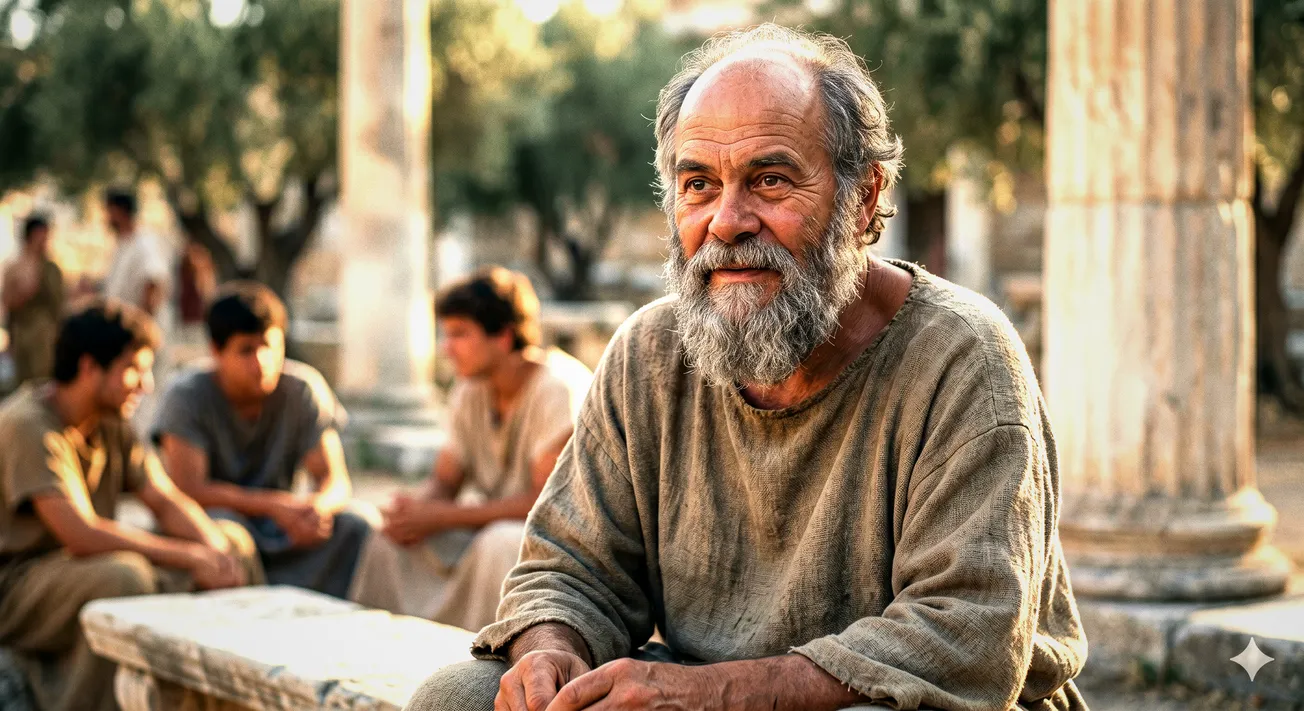
At the foundation of the Western tradition of inquiry stands a man who wrote nothing, founded no doctrine, and claimed to know nothing at all.
Socrates left no book. He built no system that could be inherited as a set of conclusions.
His entire practice was the asking of questions, and the single thing he claimed by way of wisdom was the confession that he did not possess it.
- Truth seeking requires dissolving the ego, the defended persona of competence, to enable honest questioning and acceptance of error, as "I know that I do not know" is an operational act rather than mere modesty.
- Ego as a structural bias favoring self-image over truth, explaining why inquiry demands characterological surrender over pure method, and why Socrates wrote nothing or built no doctrine to avoid creating a position for the persona to defend.
- Ego dissolution is the precondition for all inquiry, rare due to social incentives for maintaining public personas, and illustrated by Socrates' execution for exposing others' unexamined claims.
Socrates is a strange kind of founder — the one who knew least, who built nothing positive, whose only teaching was that he had nothing to teach. And yet the tradition is right to place him at its root, because what he built lies beneath every doctrine that could be argued, beneath every method that could be followed. He built the posture from which truth can be honestly sought. And that posture, it turns out, has a precondition that is not intellectual but characterological — a precondition most people, in most ages, cannot meet.
The thesis of this essay is that the pursuit of truth requires the setting-aside of the ego — by which I mean not vanity in the ordinary sense, but the defense of the contextual self, the maintained presentation of a competent and consistent persona — and that it requires this not as an ornament of good character but as a structural necessity, because the ego operates as a filter that systematically prevents the mind from seeing what it does not wish to see, and what it does not wish to see is precisely where its errors, and therefore the truths it lacks, are most likely to be found. The Socratic confession, I know that I do not know, is the name of the first move by which this setting-aside is performed. It is not modesty. It is the opening operation of all honest inquiry.
On the dissolution of the self that honest inquiry requires
What the ego is, and what it is for
The word ego must be used precisely or the argument dissolves into moralizing. It does not mean here arrogance, or the love of praise, though these are among its expressions. It means the defense of the contextual self: the standing project of presenting and protecting a coherent persona — competent, consistent, in command of what it claims — before others and before oneself. This project is not a vice that some people happen to have and others do not. It is a near-universal function of the social animal, and it was adaptive. A creature whose standing among its fellows depends on appearing capable and reliable has reason to guard the appearance, to avoid being seen as ignorant, mistaken, or inconstant, because such exposure carries real costs in a world of status and cooperation. The ego, so understood, is not a flaw in the human instrument. It is a feature of it, installed for reasons that have nothing to do with truth and everything to do with surviving among others who are watching.
This is worth establishing at the outset because it removes the temptation to treat what follows as a sermon against pride. The problem is not that some people are vain and ought to be humbler. The problem is that an instrument built to defend a persona is being asked to do something the defense of a persona obstructs — and the obstruction is structural, not a matter of individual character. Even the person of genuine modesty carries the machinery; it operates beneath the level of intention, in what one finds oneself able and unable to see.
Why the ego is incompatible with inquiry
Here is the core of the matter. Inquiry is the attempt to find what is true regardless of whether the truth is welcome. The ego's function is to protect the persona, and the persona is gratified by being right and threatened by being wrong, ignorant, or shown to have changed. From these two facts a conflict follows that is not occasional but systematic. The ego introduces into the mind a standing bias in what it will admit: an inclination to accept what confirms the persona's competence and to reject, fail to see, or explain away whatever would reveal the persona to be mistaken. This bias does not operate now and then, on particular questions. It operates on everything, because it applies a single criterion — does this flatter or threaten the self — that runs independently of, and frequently against, the criterion inquiry requires, which is simply: is it true.
That much would be damaging enough. But the decisive point is sharper. Consider what the ego most resists. It resists being shown wrong; it resists being shown ignorant; it resists the abandonment of a position with which it has identified. And these are exactly the things inquiry most needs, for the advance of understanding comes precisely through the discovery of error — through finding that what one believed was false, that what one was sure of was unfounded, that the position must be given up. The ego is the standing refusal to make these discoveries about oneself. A filter that rejects, above all else, the evidence of one's own mistakes is a filter that guarantees one's mistakes will be the last things one ever sees. This tendency was catalogued at the dawn of modern method: the human understanding, it was observed, is no dry light, but is shot through with will and with feeling, so that a person more readily believes what they would prefer to be true. The ego is the organized form of that preference. It is the part of the mind whose office is to keep the persona from having to know what it would cost the persona to admit.
The confession, read correctly
Now return to Socrates, and to the sentence usually heard as humility. I know that I do not know is, on the common reading, a graceful disclaimer, a modest bow before the vastness of what one has not learned. This reading misses everything. The confession is not a description of a state of modesty; it is an operation. It is the deliberate laying-down of the persona's claim to knowledge — the setting-aside of the self that needs to be seen as knowing — and this laying-down is what first makes a genuine question possible. For a question, asked in earnest, is the admission that one does not possess its answer; and one cannot admit this while the persona that must possess answers remains in command. The confession of ignorance is therefore not a preliminary throat-clearing before inquiry begins. It is the first act of inquiry itself, because until the self that must-be-right is set down, every step that follows is filtered through it, bent toward what the persona can bear.
This is also why Socrates wrote nothing, and the fact is more significant than it appears. A written body of claims is a position, and a position, once staked and signed, becomes something to defend — which is to say it becomes a persona, an intellectual self with standing to protect. The man who has published his system has acquired a thing the ego will now guard against every objection, because to abandon it is to be seen, and to see oneself, as having been wrong in public. Socrates built no such thing. The living question defends nothing, possesses nothing, stakes no claim that could be lost. He constructed the posture rather than the position precisely so that there would be no persona standing between him and the next admission of ignorance. He did not decline to write because he had nothing to say. He declined because having a fixed thing to say is the beginning of having a self to protect, and the protection of that self is the end of inquiry.
The method made visible in others
The practice through which Socrates is known — the patient questioning that led his interlocutors to discover that what they had confidently claimed to know, they could not in fact account for — is instructive not only for what it revealed about their ideas but for how it was received. It was experienced as humiliating. The men he questioned grew angry, not usually because his logic was faulty, but because the conclusion their own answers forced upon them was one their egos could not afford: that they did not possess the knowledge their standing rested upon. The resistance was not to the argument. It was to the cost of accepting it. And this exposes, from the outside, the very thesis argued here from within: that the obstacle to truth is, far more often than we admit, not the difficulty of the reasoning but the price the persona must pay to follow it.
The end of the story is the seal. Socrates was tried and put to death — condemned, in effect, for making the city's prominent men feel that they did not know what they believed they knew, and for teaching the young to ask the questions that produced this feeling. He was not executed for being wrong. He was executed for exposing the gap between what people claimed and what they could defend, and for refusing to stop. The persona, threatened past tolerance, would rather silence the question than pay what answering it would cost; a whole city, confronted with its own ignorance, chose to kill the one who revealed it rather than undergo the revelation. That a man could be killed for the confession of ignorance is the most vivid possible demonstration of how much the defended self has at stake, and how violently it will move to protect what it cannot bear to examine.
The objection: that truth is a matter of method, not character
The strongest objection to all of this is clean and must be met without evasion. Surely, it runs, the discovery of truth is a matter of method and intelligence, not of character. The validity of an argument does not depend on the humility of the one who makes it; a proof is sound or unsound regardless of the vanity of its author. History is full of arrogant thinkers who discovered profound truths, and of humble ones who discovered nothing. To make the setting-aside of the ego the precondition of inquiry seems to confuse a personal virtue with an epistemic requirement — to smuggle a piece of moral or spiritual counsel into what should be a question of logic. What secures truth is the rigor of the method, not the modesty of the mind that applies it.
This objection is right in what it asserts and wrong in what it concludes, and the distinction between the two is the whole of the reply.
The reply
Concede at once what is true: the validity of an argument is entirely independent of the character of the arguer. A vain person can construct a flawless proof; a saint can commit a fallacy. An argument must be judged on its form and not its author — this is itself a first principle of honest thought, the very principle that the arguer's self should be set aside so that the argument can be weighed on its own. So far the objection stands.
But it conflates two operations that must be separated: the evaluation of an argument already on the table, and the production and acceptance of arguments and conclusions in the first place. Character is indeed irrelevant to the first. It is decisive for the second. The ego does not corrupt logic; logic is incorruptible, and indifferent to who wields it. What the ego corrupts is what one is willing to submit to logic, and what conclusions one is willing to accept when logic delivers them. The vain thinker can build a valid proof — of a conclusion that flatters. What that thinker cannot easily do is follow an argument to a conclusion that humiliates; abandon a position on which they have staked their name; take seriously, rather than swat away, the one objection that would unmake the view they are known for. The intelligence is intact. The willingness is filtered. And inquiry depends on the willingness, because the truths that matter most are exactly the ones that cost the persona something — the discoveries that one was wrong, that the cherished position fails, that the admired predecessor erred, that the comfortable conclusion does not hold.
Indeed the method to which the objection appeals is itself nothing other than the setting-aside of the ego, formalized into procedure. Consider what its steps actually require. To seek out the strongest objection to one's own view, and state it in its most powerful form. To concede whatever the opposing case gets right. To claim no more than the evidence warrants, surrendering the more impressive conclusion one would have preferred. To abandon a conjecture once it has been refuted, however much labor and reputation are invested in it. Each of these is precisely a move the ego resists, because each requires the persona to relinquish ground — to credit an opponent, to confess a limit, to give up a position, to be seen and to see oneself as having been wrong. Method is not an alternative to the dissolution of the ego that spares one the inner work. Method is that dissolution, written down as rules, so that a mind which cannot yet perform the renunciation freely can be led through it step by step. The objection is correct that logic is impersonal; it errs in thinking this makes character irrelevant, for the impersonal weighing is applied only to those conclusions one is willing to place on the scale, and it is the ego that governs what one will place there. A truth-seeker with an undissolved ego is a scale that refuses to weigh anything it suspects might come out lighter than hoped.
The same obstacle, named from two directions
It is worth observing that this conclusion is reached independently by two traditions that share neither vocabulary nor domain. The contemplative disciplines that take the investigation and dissolution of the self as their central work, and the methodology of empirical inquiry that takes the subordination of preference to evidence as its central rule, arrive — from opposite directions, the one turning inward and the other outward — at the same identification. Both find that the obstacle to seeing what is real is the self's stake in the outcome: the attachment to a particular answer, the investment of the persona in the world's being one way rather than another. And both prescribe the same cure: the suspension of that self, so that what is the case can appear in place of what one wished were the case. That two such different enterprises converge on a single diagnosis is some evidence that the diagnosis is not an artifact of either — that the entanglement of the defended self with the distortion of judgment is a real feature of the human mind, recognized wherever the mind has been made, by whatever means, to look honestly.
Why it is rare, and seems rarer
The setting-aside of the ego is rare, and the reason is not that people are weak but that the resistance is the ego doing its job. To ask the persona to lay itself down is to ask an instrument to act against the function it was built for; the difficulty is engineered into the thing. This is why the renunciation has the character of a discipline rather than a disposition — something achieved against an inner grain, repeatedly, never finished — rather than a trait one simply possesses.
And it grows harder wherever a society is organized around the public maintenance and amplification of the self: where standing is built and defended in the open, where the confident assertion is rewarded and the changed mind read as defeat, where the persona is treated as an asset to be cultivated and displayed rather than as a thing to be seen through. Such conditions are not new. The Athens that killed Socrates was itself a culture of public reputation, of men whose position depended on appearing to know — which is exactly why his exposure of their ignorance was intolerable. But conditions that magnify the rewards of the persona magnify, in proportion, the cost of suspending it, and in any age that makes the self more loudly public and more relentlessly defended, the quiet act of laying it down runs that much further against the current. The confession of ignorance has always been countercultural, because the culture, in every age, is in part the collective defense of the personae that compose it.
The first axiom
The setting-aside of the ego is not one virtue among the several a truth-seeker should cultivate. It is the precondition of all of them, the axiom that lies beneath the axioms. It is prior to method, since each step of method is an instance of it. And it is prior even to the question, the first move of inquiry — for the question itself cannot be honestly asked by a self that must already possess the answer it prefers; the demand to be right reaches back before the question is framed and bends it toward the reply the persona can accept, so that what looks like an inquiry is only the defense of a foregone conclusion wearing the costume of an open mind. Before one can ask in earnest, the self that needs a particular answer must be set down.
This is what the Socratic confession performs, and why it belongs at the foundation. I know that I do not know is the verbal form of the renunciation: the persona laying down its claim to knowledge so that something other than the persona — the truth, which owes the persona nothing and will not arrange itself to spare it — can be sought, and, with some chance, found. The founder of inquiry wrote nothing and claimed nothing because he had grasped that inquiry begins not in a possession but in a surrender. He built no doctrine. He built the doorway, and the doorway is exactly the width of a self that has agreed, for a moment, to die. Whoever will not pass through it — whoever cannot bear the small death of not knowing, of being wrong, of laying the cherished persona down — does not see, however able, however learned. Whoever passes through begins. The answer comes last. The question comes first. And before even the question stands the one act without which none of it is honest: the setting-aside of the self that would rather be right than know.