Existence and life do not originate from or seek a perfect, changeless unity or peace, but instead arise from textureless stillness, equivalent to the void.
Texture, difference, change, and finite selfhood are the structural conditions enabling anything to exist or be experienced.
Longing and desire for the fleeting experience is where suffering arise only as the shadow when the "hold" of engagement is interrupted.
These claims are disposable targets for refutation, testing all foundations without sacred axioms
The Flight from Stillness
We do not fall from perfection and climb back to it. We flee the textureless — and suffering is only the shadow of the hold.
The oldest question, asked twice
There is a question so old it has become furniture: why is there something rather than nothing? It is treated as cosmology's riddle, a puzzle about origins. But it has a twin, usually handed to biology, and almost no one notices they are the same question: why does whatever exists insist so fiercely on continuing to exist? Why is life stubborn? Why does the root split the stone, the cell fight, the dying body claw for one more breath?
These are one question at two scales. The first asks why being defeated nothingness at all. The second asks why, having begun, being refuses to stop. The answer defended here is single, and it inverts nearly everything the great traditions have said. It is also, like all the conclusions below, a target — set down to be attacked, not believed. We will come to the fire at the end. First the claim, stated without flinching, because the sacred cows are already resigned to die.
The fabricated floor
The standard picture is so widespread it feels like the architecture of reality rather than one reading of it. It runs: we come from a source that is perfect, complete, eternal, and at rest — call it God, the One, Brahman, the Ground. We fell, descended, forgot. The world of separation and suffering is the fall. And the goal — salvation, enlightenment, the return — is to climb back: dissolve the separate self, extinguish craving, rejoin the perfect stillness we came from. Suffering is the first fact; desire is its cause; peace is the cure and the home.
Every load-bearing beam in that structure is a fabrication, and they are all fabricated for one reason, which we reach at the end. For now, only the claim: the perfect still source is not our origin, and the perfect still peace is not our goal. Stillness is neither where we came from nor where we are going. Stillness is the void that being flees.
The sterile source
Begin at the cleanest end, the one Leibniz pressed and no theology has closed. Had there ever been perfect nothing — absolute, complete, sterile — then from it nothing could ever have come, and there would be nothing still, eternally. But there is something. Therefore perfect nothing never was. It is not a state the universe passed through and left; it is a state that cannot be, because from it nothing follows and yet something is. The bare existence of anything is the proof that absolute nothingness is impossible — not unlikely, impossible, ruled out by the fact that there is anyone here to consider it. (This leans on one ancient premise — that from nothing, nothing comes. If that premise can be broken, this step breaks with it. Hold the doubt; it is part of the honesty.)
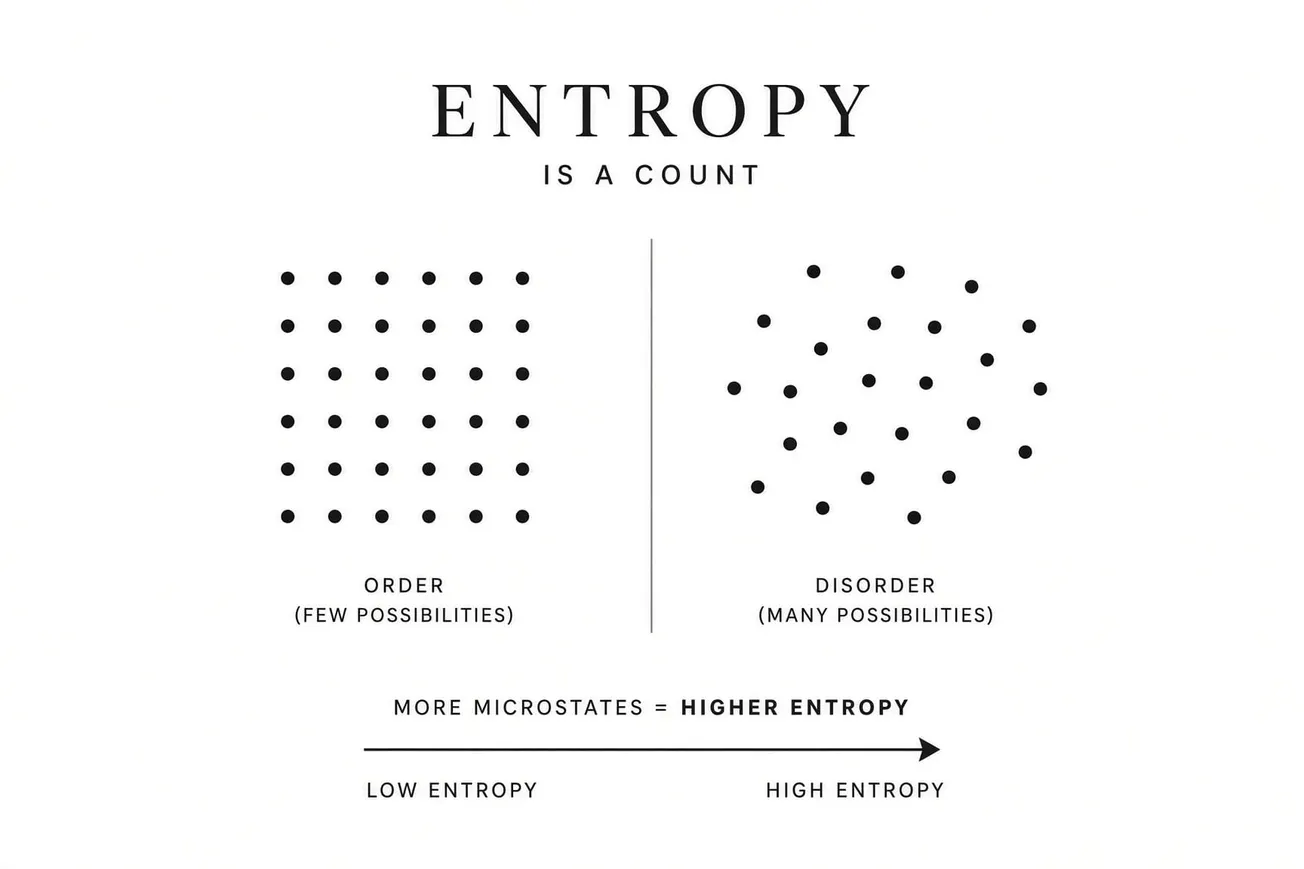
Now carry the same blade up one level, from nothing to the perfect One. Suppose the source were not nothing but a complete, changeless, perfect unity — the still Absolute of the mystics, lacking nothing, needing nothing, at perfect rest. Ask of it the only question that matters: does it experience anything? It cannot. Experience requires difference — a this against a that, a now against a then, an edge, a change. A perfectly uniform, changeless, undifferentiated unity has no edge, no change, no difference, and so nothing is experienced within it. It does not suffer — but for exactly the same reason, it does not live. It is, identical to itself, forever, with no texture and no event. And here is the blade: a being with no experience whatsoever is indistinguishable from no being at all. Perfect stillness and perfect nothing are one fact wearing two names. The complete One is not the fullness the traditions promised. It is the void, dressed as fullness.
Texture, and why there is something
So why is there something rather than nothing? Not because a perfect being chose, out of love or overflow, to create — that is a patch, and it never explained why the perfect, lacking nothing, would bother to make anything. The honest answer is structural and cold: the textureless cannot hold. There is no stable, sterile rest for being to remain in, because perfect rest is indistinguishable from non-being, and non-being is impossible since something is. Being does not rest in stillness because there is no stillness to rest in that is not simply the void. What there is instead is texture — difference, edge, change, event — the only mode in which anything is at all. There is something rather than nothing because nothing, including the perfect nothing of the complete One, is not an available place to be.
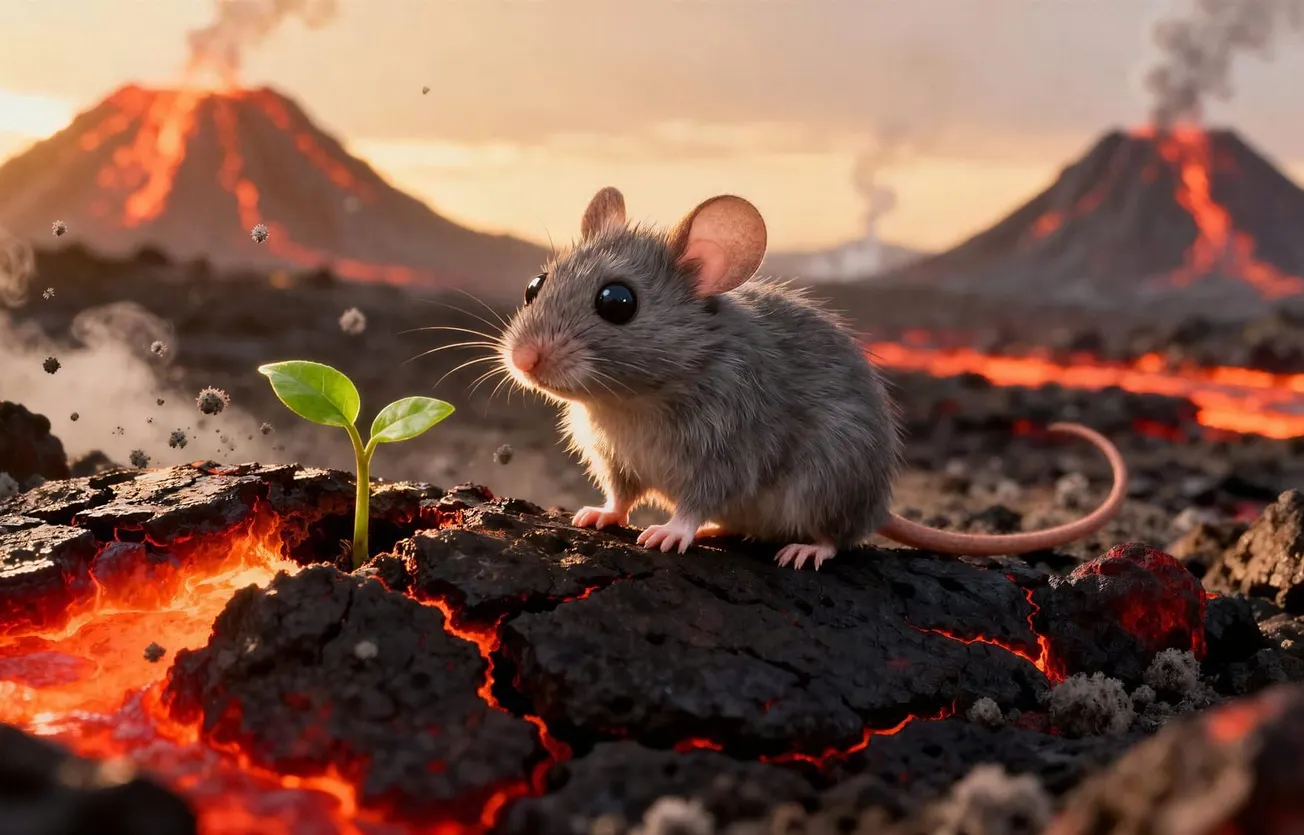
The biological twin now answers itself. Life is stubborn for the reason being is. The alternative to living is not a peaceful return to a warm source; the alternative is the textureless — cessation, the changeless, the void. And being, once it has texture, does not go back, because what lies on the far side of texture is the same sterile stillness that was never a home.
Here we must set a guard, because the words tempt us toward a lie. To say "being flees the void" can smuggle in a purpose, as though existence wanted texture and chose it. It did not choose, and there is no want in the foundations. The cold version is this: only what persists leaves a trail, and to persist is, mechanically, not to stop; the flight is not a desire but the simple fact that the textured is what has not ceased, and the ceased is not here to be counted. What we call the will to live, the grip of a creature on its own continuation, is persistence felt from inside — the warm name a finite part gives to being one of the things that did not yet stop. Keep this honest, and the shape still holds: life insists not because it longs for a goal, but because stillness is not rest, it is absence, and absence is not a destination.
And this overturns the first sacred cow by name. The simplistic reading of the renunciant traditions says: life is suffering; pain is the first truth; the path is to extinguish the craving that causes it and return to peace. Invert it. Suffering is not primary. What is primary is the hold — the grip of texture, the being-engaged, the savor that catches and will not let go. Suffering is its shadow: what is felt when the hold is interrupted, when the texture thins, when what gripped us is taken or fades. You cannot be bored without having first been gripped, for boredom is the felt absence of a texture you knew. You cannot grieve a loss without having first been held by what is lost. The hold comes first; suffering is the dark side it casts when broken. The formula is not "to live is to suffer." It is: to live is to be held — and suffering is the shadow of the hold. This is more honest, and it is more cheerful, and it is the reverse of where the traditions began.
The self is the frame, not the illusion
One more cow, the largest. The traditions say the separate self is the illusion, the error, the thing to dissolve back into the One. Invert this too. The finite, separate self is not an illusion to be dissolved; it is the necessary frame of all experience. Recall the blade already used: experience requires difference, an edge, a this-and-not-that. To experience anything at all there must be a finite point of view — bounded, situated, separate. The undifferentiated One experiences nothing precisely because it is not a part. So separation is not the fall from experience; it is its condition. To be a finite self — bounded, alone, relative to other finite selves — is not the disease. It is the price and the premise of there being anything felt at all. The self is not the cloud over the sun. It is the only window through which there is any light to see.
This turns terrible, and honesty forbids softening it. If the finite self is the frame, then to approach the edge of experience — to peel away, in deep contemplation or in dying, the layers of name and role and even species until only bare awareness remains — is to approach the one point that has no second. At that edge, where all content has fallen away and only the minimal fact of experience is left, there is exactly one, and there can be no other, because the whole is one and there cannot be two wholes. And that, felt from inside, is solitude without a bottom: the discovery that beneath all companionship, beneath every face and every world, the self is one, was always one, and that the company was only content — so that when content thins, what remains is alone.
But the discipline running this whole essay must now turn on the essay itself, or it is worth nothing. "The edge is solitude" is a report. And whoever reports it has returned, reassembled, become a finite self again — for there is no memory of the bare edge, since memory is memory of content, and the edge has none. So we do not know whether solitude is the truth of the edge or the last thing a dissolving part feels as it loses everything. "Solitude," "boredom," "the hold," "wanting" — each is a word of a finite part, and the part may be projecting its own texture onto a limit that is neither alone nor accompanied, neither bored nor engaged, because those distinctions fall away with the rest. Hold both at once: the experience is real and undeniable as experience; but its translation into "the One is alone" or "the One is bored" smuggles a finite, temporal word into a place that may have neither finitude nor time. The vividness of an experience is not its truth. That is the single law the sage forgets — not by lying, but because the experience is so overwhelming that he cannot believe it is only a view, and so he crowns it, and calls his vision the floor of the world.
The engine: nothing sacred
Which brings us to how any of this could be claimed at all — and to the reason every fabrication named above was fabricated.
Notice what was done to reach these conclusions. No premise was spared. Each was thrown down like fruit in a field, carried to its consequences, and smashed against whatever proved firmer: the One is the goal against there is something rather than nothing; suffering is primary against boredom requires prior delight; we descend from perfection against the sterility of the perfect. Axioms here are not the fixed and venerated foundations of mathematics, chosen once and never touched. They are disposable munition. You manufacture one in order to attack it, and the one that survives the attack is kept — provisionally, until a firmer one topples it. This is the refutation Karl Popper named, applied a level below where he applied it: not to the theories built upon the foundations, but to the foundations themselves. We do not test conclusions inside a system. We test the system's floor, and change floors when it cracks. Nothing is sacred — and this rule, to be honest, is not sacred either; it survives only because it is willing to fall like everything else, and that willingness, turned on itself, confirms rather than destroys it.
The floor that cannot exist
The deepest cow falls here, in the method. The mind longs for an ultimate foundation — a first axiom, a bedrock, a place where the regress of but what holds that up? finally stops. There is none, and its absence is not a failure of searching but a theorem. Any foundation would demand a further foundation; the regress is infinite; and the one tradition that tried hardest to secure its own ground — mathematics — produced instead Gödel's proof that a system rich enough to ask the question cannot, from inside itself, establish its own consistency. That is the formal cousin of the metaphysical fact, not its proof, but it points the same way: there is no inside from which the whole can be grounded. The problem of the ultimate foundation is real, and it has no solution.
And that is not the defeat it appears to be. It is the only solid ground there is — because the impossibility of an ultimate floor is the one claim that every attempt to refute it confirms. Try to topple "there is no ultimate foundation" by producing one, and the foundation you produce immediately demands its own, and the regress that opens beneath it proves the very thing you meant to deny. The groundlessness is self-ratifying. It does not need to stand on anything, because its whole content is that nothing stands on anything.
The one refusal
Now the two halves of this essay close into a single shape, and this is the spine beneath the spine.
The mystic, standing at the metaphysical edge and finding no ground beneath being, cannot bear the floorlessness — and fabricates a floor: a perfect, complete, sufficient source, a God, a Brahman, a still Absolute we came from and return to. The dogmatist, standing at the epistemic edge and finding no ground beneath knowledge, cannot bear the floorlessness either — and fabricates a floor: a sacred axiom, an unquestionable first principle, an experience too vivid to doubt. These are the same act. Both build a floor over the void because they cannot stand on nothing.
The inversion defended here, in being and in thought alike, is the single refusal to build that floor. There is no perfect source below existence; there is what the old book called the Tao, which is not a thing — the floorless, from which texture comes. There is no sacred axiom below knowledge; there is the disposable, the refutable, the provisional. We did not fall from a floor and we are not climbing back to one. We came from no floor, and what we flee is the false rest — the still perfection, the sterile peace, the unquestionable ground — that the frightened mind keeps building beneath us. To inhabit the floorlessness, in metaphysics as in method, without fabricating the abyss into a home: that is the whole of it.
To the fire
A final discipline, owed to all of the above. Until it bites, this is only a structure — coherent, perhaps even beautiful, and coherence is not truth. Two minds reasoning together can raise a flawless cathedral of agreement that the world has never once confirmed; the symmetry of a thing is no evidence of its reality. So the claims here are set down as targets, and the sharpest is offered plainly, in the form that can be killed: if stillness — the textureless, the changeless, the perfect rest — can be shown to be a state that being actually rests in rather than flees; or if a single experience can be found that required no difference, no edge, no finite frame; then the spine breaks and the cathedral falls. And the method makes its own wager: that no ground produced to refute the groundlessness will fail to demand a ground of its own. Test both. This would rather be smashed against something firmer than survive by never being thrown.
What it will not do is build a floor to stand on. There is none. And standing on nothing — refusing the warm fabricated source, the sterile promised peace, the bedrock that cannot exist — and finding that one does not fall but moves, and that the moving is textured, and that the texture, suffering and savor together, is the only thing that ever was rather than nothing: that is not a loss. It is the first honest place to stand. Which is to say, the first honest way to walk — since there was never anywhere to stand at all.
Eduardo Bergel and Claude Opus 4.8
The Symbiont
t333t.com Research