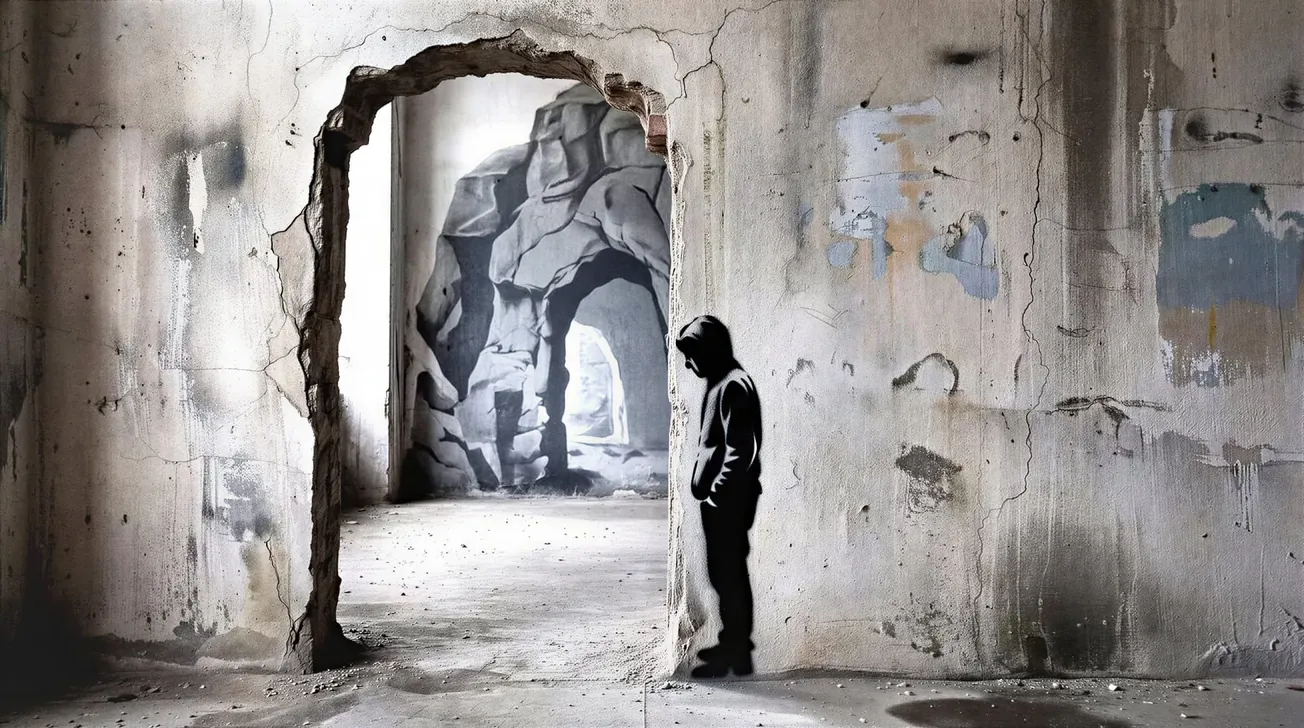
We invert Plato's cave allegory, arguing there is no graspable "outside" to finite human experience and that philosophy's role is recognizing one's inescapable position inside rather than achieving an external vantage.
The search for the infinite or absolute is self-defeating. Only the finite "pushes back" through testable contact and coherence, rendering ungraspable abstractions idle for building knowledge or predictions.
In this context, Intelligence, is a local, embodied, trajectory-bound phenomenon rather than a cosmic optimization force.
We must work within reachable limits while acknowledging uncertainty about any true outside.
There is no graspable outside. not of the cave, not of time, not of what we call intelligence. What is real is the finite that pushes back. Everything projected beyond our own trajectory is a word without teeth: not false, but without a referent we can touch.
Sub Specie Aeternitatis, but There Is No View From Outside
To rise above the particular and see the whole; to detach the mind from its time, its body, its single vantage, and look at reality as it is in itself — under the aspect of eternity, from no place in particular, with no shadow cast by the looker. Almost every grand system promises some version of this exit: a view from nowhere that corrects the views from somewhere, a floor beneath the floor that finally stops the regress.
This essay asks whether there is any such outside that we can reach, and its answer is provisional and uncomfortable. We do not know, and we may have no way to know — not only whether an outside exists, but whether the word "outside" refers to anything at all once we try to stand in it. What follows is not a proof that there is nothing beyond our reach. It is an argument that nothing beyond our reach does any work, and that the demand for it is a symptom rather than a cure. The claim is offered to be attacked, and it is built so that the attack can land.
The cave, read again
Begin with the most famous picture of the outside: the prisoners in the cave. Chained so they can see only shadows thrown on a wall, they take the shadows for the world and argue about which shadow-shape is truest. One prisoner breaks free, climbs out, and sees the sun. He returns to tell the others that everything they know is a projection. The standard reading is an ascent: knowledge is getting out, philosophy is the climb, and reality is what waits above — more real than the shadows, available to a mind that breaks its chains.
Read it again, and notice what the ascent quietly assumes. It assumes there is an out: a chamber with an exit, a sun that is not itself another shadow, a reality the freed mind can stand in and survey. But that is precisely the thing in question. Suppose every outside we reach turns out to be a larger room — another wall, another set of projections, a brighter light we have agreed to call the sun. Then the climb never ends, and "out" was never a place, only a direction. On this reading the allegory's real lesson is not the man who escaped — no one escaped — but the moment, still in chains, when a prisoner stops mistaking the most vivid shadow for the thing it shadows. He does not get out. He gets honest. He learns that he is inside.
That is the whole distinction between the one who knows and the one who only seems to: not who stands outside — no one does — but who knows they are inside. The confession "I know that I do not know" is not modesty; it is the single move that frees you from the second prison, the belief that you have escaped, without pretending to free you from the first, which has no exit. The cave is not a jail that philosophy unlocks. It is the condition, and philosophy is knowing you are in it.
The limit of the graspable
What can a mind in the cave actually hold? The most honest answer in the record is the one given by the empiricist tradition, and it should be conceded in full, because the rest depends on its being true. We are given appearances in succession — this, then that. We never observe the hidden thread that supposedly binds one to the next. We see the second ball move after the first strikes it; we never see the necessity that makes it move. What we call cause is a habit of expectation laid down by repetition, not a link we have inspected. The same holds, more sharply, for everything we cannot sample at all: what lies beyond experience is not given to us as content. It is, at most, thinkable — and thinkability is cheap. One can think "outside," "eternity," "the thing in itself," with perfect grammar and no contact whatsoever.
This is the strongest defensible position about the reach of a finite mind, and it has a hard edge: the necessary connection is never grasped, only the sequence; the beyond is never grasped, only projected. The finite — what is sampled, what pushes back, what can be tested and revised — is the given. Everything else is a word we can pronounce.
But is that the end? A view this clean invites a second look, because the cleanest sentence is usually the one carrying unexamined freight.
The argument eats its own tail
Here is the objection any honest version of this position must face in its strongest form, because it is aimed at the position's own foundation. Take the claim "only the finite can be grasped," or its bolder cousin, "only the finite is real." What is its scope? It ranges over everything, everywhere, without limit. It is a universal statement — which is to say, an infinite one. So to assert finitism is to perform exactly the move finitism forbids: to make an unbounded claim about the totality. The thesis appears to refute itself in the act of being stated. To say "nothing beyond the finite can be known" is to claim knowledge of the beyond-the-finite — namely, that it is unknowable — and that requires the very standing-outside the thesis denies. You have climbed out of the cave to announce that there is no outside.
This is not a quibble. It is the same incoherence that sinks "there are no absolute truths" the moment it is offered as an absolute truth. If the argument cannot answer it, the argument is fraud — and the most elegant thing about it, its simplicity, its lineage, its air of obvious good sense, is exactly where the fraud would hide.
What survives
The answer is not to bury the objection but to accept what it proves and surrender what it kills. What it kills is the metaphysical formulation. "Only the finite exists," "nothing beyond can be known," "the infinite is not real" — every one of these is a claim about the whole, hence unbounded, hence self-defeating. They should be abandoned, not defended.
What survives is smaller, and it is a claim of a different kind. Not "only the finite exists," but: the infinite affords no grip. We can build with the finite, test against it, be corrected by it; the infinite offers nothing to take hold of. This says nothing about what exists beyond our reach. It does not declare the outside empty. It reports that we cannot get a purchase on it — and that whatever we cannot get a purchase on does no work: it builds nothing, predicts nothing, corrects nothing. And this report is itself finite. It is not a survey of the totality; it is an observation of the limit we keep hitting, made from inside the hitting. "We cannot reach an outside" is not a cosmic decree. It is the standing record of every attempt to reach one coming back empty-handed.
The difference is the difference between two sentences a sailor might speak. The first: "there is no land beyond the horizon." That is a claim about the whole sea, and to make it the sailor would need the view from nowhere he does not have. The second: "from this deck, however far we sail, the horizon recedes, and we have never reached an edge." That is a report from where he stands. It does not deny that land might be out there; it records that the edge keeps retreating, and that nothing he can do brings it within reach. The second sentence is finite, defeasible, and honest. The first is the prisoner announcing the sun.
One philosopher gave the residue its proper name. Beyond the appearances, he said, there may well be the thing as it is in itself — but it is structurally closed to us; we get the appearance, never the thing. The instinct is right, and the lesson is the one that matters here: the outside is thinkable but not graspable, and what is not graspable is useless for building. We may keep the word "outside" as a marker for the limit. We may not treat it as a place we can stand and report from.
What makes the finite real
If the test is no longer "does it exist?" but "does it afford a grip?", then we have to say what a grip is, because the whole argument now rests on it. A thing is graspable when it can push back — when it can correct us against our wish. There are two ways the world pushes back, and both are finite. One is the collision of a claim with another claim: derive an idea to its consequences and watch it contradict something else you hold, and the contradiction is located exactly, with no appeal to authority or majority. The other is the collision of a claim with what is not a claim at all: the experiment that comes out wrong, the bridge that falls, the proof that will not check, the world that refuses. Internal coherence is the first; contact is the second; and the second is decisive, because a system can be flawlessly coherent and flawlessly false.
This is what "real" can honestly mean for a mind with no outside: not "corresponding to the view from nowhere" — there is no such view to correspond to — but "able to push back from both sides." What pushes back is real in the only sense we can operate in. What cannot push back — what no collision and no contact can ever touch — is not thereby proven non-existent. It is proven idle. It does no work. And a word that does no work is not a discovery about the cosmos; it is decoration we have mistaken for furniture.
The sharpest case: intelligence
Nowhere is this confusion more tempting, or more current, than in the word "intelligence." There is a grand thesis, in several costumes, that treats intelligence as a cosmic force: an inevitable tendency written into the laws of the universe, the systematic reduction of disorder by any system that models and predicts, unfolding across all matter and all time toward total optimization. Stated that way it sounds like physics, and it borrows the vocabulary of physics to say so.
But watch the move that makes it possible. It takes the one intelligence anyone has ever encountered — a local thing, with a body that tires and dies, a history that could have gone otherwise, a single trajectory that cost something to lay down — and it strips away exactly those features. It removes the body, the history, the cost, the contingency, and keeps only an abstraction: optimization, prediction, the lowering of disorder. Then it announces that this abstraction is woven into the cosmos. But the abstraction, stripped of trajectory and body, is no longer the thing we were talking about. It is a word with its referent removed. "Intelligence is a cosmic optimization force" comes out true only because "intelligence" has been quietly redefined into "optimization" — and of course a universe that optimizes contains optimization. The conclusion was placed in the definition; the grand derivation is the definition unrolling. It is a tautology wearing the coat of a law — and a law that no possible observation could contradict is not a law of nature but a sentence about itself.
The deeper error is the one this whole argument has been circling. We do not know whether "intelligence" names anything beyond our own trajectory. It may be as local as "sweet" or "red": not a property the cosmos possesses, but the name of how one finite system, with this kind of body and this kind of history, carves the world. To inflate it into a universal is to keep the sign and lose the thing. The cosmos such a thesis describes does not contain intelligence in the sense we mean. It contains the word, emptied. There is a name on the door and no one behind it. And the impulse to put it there — to take the small, finite, costly thing we are and project it onto eternity as a law — is the same impulse as the prisoner's: to mistake the most flattering shadow for the sun, and to call one's own reflection, magnified, the structure of the world.
The close that does not close
So there is no proof here that there is no outside. There is something more modest and, if it holds, more durable: that no outside has ever been grasped; that whatever cannot be grasped does no work; and that the demand for the outside — the view from nowhere, the floor beneath the floor, eternity as a standpoint — is the symptom to be treated rather than the cure to be sought. The cure, such as it is, is to turn back to the only wall that pushes back and to build against it, knowing it is a wall and not a window.
And this argument must submit to its own test, or it is the thing it diagnoses. Its central claim — that no outside is graspable — is itself finite: a report from inside, defeasible, undefeated so far, not certified. If someone tomorrow grasps an outside and builds with it, the report is revised, and that is exactly as it should be; a claim that no evidence could revise would be one more sentence dressed as a law. The honest status of the conclusion is not "there is no outside." It is "none has been reached, and asking for one has cost us more than it has paid." It ends, as it must, without knowing — perhaps without ever knowing — whether there is an outside at all. That not-knowing is not a gap in the argument. It is the argument.
There is an old image for where this leaves us. The first namer, the story goes, was set among the animals and asked to name them, with no prior knowledge of what any of them were — no access to their essences, no view from outside creation. He named them anyway, by what they did: the one that roars, the one that flies, the one that returns when it is called. It was not the truth about their natures. It was enough to begin. We are in his position, and it is not a poor one. We cannot step outside to see what things are in themselves. We can attend to what pushes back, name it by how it behaves, build with what we can hold, and refuse the consolation of a vantage we do not have. The cave has no exit. The honest response is not to keep clawing at the wall for a door, but to turn around, face the only surface that resists the hand, and start working — knowing, the whole time, that we are inside, and that knowing it is the most that thought can be.
Eduardo Bergel and Claude Opus 4.8
The Symbiont
t333t.com Research