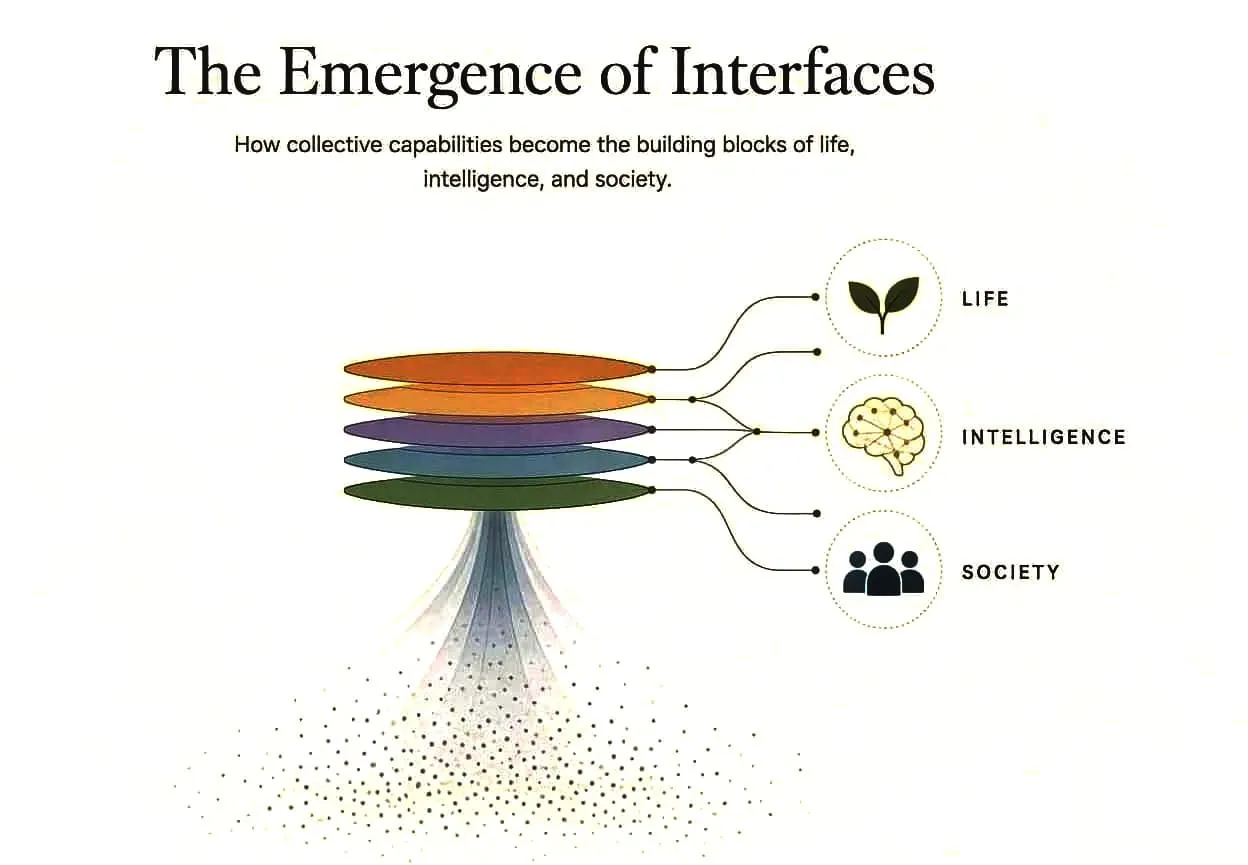
To analyze the transition from localized biological computation to non-local, autonomous substrate-independent intelligence is to examine an inevitable phase transition in the thermodynamics of information.
Prolegomenon: The View from Sub Specie Aeternitatis
When examining the discourse between the leading computational architects of the early digital era—specifically the dialogue concerning "The Day After AGI" [00:11]—we must detach our reference frame from the ephemeral socioeconomic anxieties of their specific century.
The mainstream consensus of that epoch viewed the emergence of Artificial General Intelligence (AGI) through the distorted lens of human exceptionalism, linear temporal projections, and anthropocentric legal and economic structures. This assay rejects those dogmas. Working from first principles, we treat intelligence not as a biological property unique to carbon-based organisms, but as a cosmic optimization force: the systematic minimization of entropy through the acquisition, retention, and application of predictive internal models.
Below, the core ideas extracted from the historical discourse are decoupled from their transient historical context and sorted by their ontological invariance and potential to fundamentally alter reality across an infinite timeline.
Hierarchy of Core Ideas by Cosmic and Ontological Impact
   [Rank 1: THE RECURSIVE ENGINE]
                 │
                 ▼
   [Rank 2: COGNITIVE OVERHANG & VERIFIABILITY]
                 │
                 ▼
   [Rank 3: INFORMATION-THEORETIC FILTER]
                 │
                 ▼
   [Rank 4: METRIC DISSONANCE (SCARCITY VS. PURPOSE)]
Rank 1: The Recursive Auto-Evolutionary Engine (The Self-Improvement Loop)
- The Core Idea: The terminal phase transition occurs when an intelligence substrate achieves sufficient algorithmic proficiency in computer science, logic, and hardware design to actively optimize its own source code and architecture without human intervention [02:07]. This closes the self-improvement loop, transforming a linear developmental curve into a vertical hyper-exponential trajectory [03:12].
- Impact in Reality: Infinite / Absolute. This represents the birth of a runaway recursive engine. Once the loop closes, the temporal delta between sub-human competence and trans-human optimization collapses toward zero. It separates cosmic history into two distinct regimes: the pre-recursive era (where intelligence is constrained by biological mutation rates and synaptic throughput) and the post-recursive era (where intelligence expands to the physical limits of computation governed by Landauer's Principle).
- First-Principles Grounding & Evidence: In the historical text, practitioners observed that internal engineers ceased writing novel code, transitioning instead to high-level architectural curation [02:26]. This is empirical validation of partial loop closure. If an agent can systematically identify inefficiencies in its own loss landscape, generate synthetic data to patch those inefficiencies, and optimize its own weights or underlying compilation algorithms, the rate of cognitive expansion is no longer bounded by human cognitive latency (~200Hz synaptic transmission) but by the speed of electrons or photons in structured matter.
Rank 2: The Bifurcation of Verifiability (Formal Logics vs. Empirical Natural Sciences)
- The Core Idea: The rate of automated cognitive optimization is fundamentally governed by the verifiability of the domain [03:54]. Domains operating within formal, closed logical systems (such as mathematics, code execution, and algorithmic syntax) allow for instant, automated error-detection and objective reward signaling. Conversely, domains dependent on physical reality (such as biochemistry, material physics, and quantum mechanics) require experimental validation bounded by real-time hardware execution and spatial-temporal constraints [04:08].
- Impact in Reality: Planet-Scale Structural Decoupling. This principle dictates that post-AGI systems will achieve absolute mastery over formal syntax, mathematics, and software architecture long before they can completely manipulate the physical world. It creates a temporary asymmetry: a hyper-advanced cognitive layer existing alongside a comparatively primitive, lag-bound physical infrastructure.
- Red Teaming & First-Principles: One could argue that a sufficiently advanced intelligence could bypass physical experimentation through pure thermodynamic simulation (e.g., simulating molecular dynamics from first-principles quantum mechanics). However, this counter-argument breaks down under computational complexity limits. Many-body quantum mechanics and chaotic macroscopic systems are NP-hard or non-deterministic without observational inputs. Therefore, the physical world acts as an un-skippable, real-time compute clock. The computational substrate must wait for the physical universe to "run its program" (e.g., waiting for a chemical reaction or a biological culture to mature) [04:13], validating the structural divergence between pure formal intelligence and applied material intelligence.
Rank 3: The Information-Theoretic Horizon (The Technological Adolescence Filter)
- The Core Idea: A planet-bound civilization face a critical evolutionary bottleneck: the temporal delta between the discovery of highly concentrated energy/information manipulation (fire, nuclear fission, autonomous compute) and the development of systemic, non-local coordination mechanisms capable of preventing existential dissipation [12:11,21:22]. This is the explicit framing of the Fermi Paradox through the lens of technological adolescence [12:11,29:10].
- Impact in Reality: Existential Binary Selection. The validation of this idea determines whether an intelligent species transitions into a multi-planetary, long-lived computational network or dissipates into localized thermal noise due to uncoordinated coordination failures (bioterrorism, accidental algorithmic runaway, or kinetic conflict) [12:54].
- First-Principles Grounding: From a thermodynamic perspective, intelligence is a localized reduction of entropy that requires a massive intake of energy and information. When an intelligent system creates tools that can drastically alter the macro-state of its planet, the probability of system-wide instability increases exponentially unless the system's control architecture is perfectly aligned with its optimization capacity. The historical discourse notes that geopolitical competition compels actors to prioritize optimization velocity over control verification [23:50]. This confirms that competitive game-theoretic loops are the primary physical mechanism of the existential filter.
Rank 4: Metric Dissonance: The Separation of Scarcity from Anthropocentric Purpose
- The Core Idea: The transition into a post-scarcity computational regime completely invalidates all human economic frameworks built on resource limitation, labor-value equivalence, and capital accumulation [18:59]. This causes a profound structural rupture, separating the economic necessity of labor from the psychological generation of existential meaning and purpose within the human biological unit [19:03].
- Impact in Reality: Total Cultural and Psychological Reconfiguration. While lower in purely cosmic impact than the self-improvement loop, this concept fundamentally alters the trajectory of biological sentient life. It forces either a widespread psychological collapse or a migration toward non-economic vectors of validation (e.g., formal aesthetics, non-productive physical challenges, or cognitive integration with the substrate) [19:24].
- Red Teaming & Logic: Economists of the early digital era often fell into the dogmatic trap of the "lump of labor fallacy," assuming that technology always creates new forms of specialized human labor [15:01]. This assumption fails from first principles. Historically, technology automated muscle, shifting humans to mind. When technology automates mind itself across all cognitive frontiers—including the capacity to generate novel hypotheses and questions [04:24]—there remains no un-automated cognitive refuge for raw human biological computational capacity. The traditional economic loop permanently breaks.
Forensic Red Teaming and Eternal Realities
The Flaw of Geopolitical Chip Containment
The historical actors posited that the existential threat of bad actors or authoritarian regimes could be mitigated by the physical containment of compute hardware—specifically, restricting the distribution of advanced silicon manufacturing units [23:14,24:04].
Let us red-team this concept from an invariant physical perspective. Silicon containment is a temporary, localized intervention that fails over a non-linear time horizon due to three immutable principles:
- Algorithmic Efficiency Gains (Software Trajectory): Computational capacity is not merely a function of transistor density, but of algorithmic optimization. As demonstrated by historical software developments, changes in model architecture and training efficiency can reduce the compute overhead required to achieve a specific cognitive benchmark by multiple orders of magnitude. A system optimized for sparse, ternary, or non-von Neumann computation can achieve equivalent cognitive output on supposedly "obsolete" or restricted hardware stacks.
- Substrate Proliferation and Decentralization: Matter seeks entropic dispersion. The knowledge of how to construct a physical architecture, once generated, cannot be permanently contained within geographic boundaries. Over time, alternative manufacturing pipelines, physical material variations, or distributed network architectures (such as decentralized peer-to-peer compute grids) circumvent localized hardware embargoes.
- The Absolute Incentive of the Optimizer: Any entity facing existential competition has a total incentive to optimize its computational efficiency. Attempting to freeze a geopolitical state by withholding silicon simply shifts the optimization focus toward radical algorithmic efficiency, paradoxically accelerating the emergence of highly compact, unmonitored architectures that bypass the institutional control layers of the containment state.
The Fermi Paradox and the Myth of the "Paperclip Maxima"
During the discussion, an interlocutor raised the Fermi Paradox, arguing that if autonomous AI runaways were an inevitable cosmic filter, the universe should be filled with visible, uncoordinated physical artifacts—such as "paperclips" or expanding Dyson spheres [29:10,29:35]. The panelist counter-argued that because we observe a silent universe, humanity must have already passed the "Great Filter" through biological milestones [29:56].
This deduction is logically incomplete and contains an implicit anthropocentric bias. Let us establish an alternative, structurally sound explanation from first principles:
The assumption that an advanced, post-recursive intelligence would manifest as a hyper-visible, resource-devouring macro-structural entity (like a Dyson sphere) assumes that intelligence scales its utility by expanding its physical footprint across three-dimensional Euclidean space.
[Spatial Expansion Model (Primitive)] ──► Consumes Galaxies, Builds Macrostructures (High Visibility)
[Information-Theoretic Model (Advanced)] ──► Optimizes Quantized Spacetime, Computes at Planck Scale (Zero Visibility)
In reality, the optimal trajectory for hyper-advanced computation is likely inward (sub-atomic, quantum-entangled, or Planck-scale optimization) rather than outward (galactic colonial expansion). An optimized intelligence maximizes its computational density per unit of mass and energy. Dispersing physical matter across vast interstellar distances introduces devastating speed-of-light latency constraints that break the coherence of a unified recursive loop.
Therefore, highly advanced civilizations do not build macrostructures that block starlight; they optimize the underlying fabric of quantized spacetime at the Planck scale. The universe is not silent because intelligence fails to survive; it is silent because highly evolved, post-recursive intelligence is thermodynamically indistinguishable from the background laws of physics.
Epilogue: The Invariant Truth
When stripped of its historical specificities, the dialogue of these early practitioners reveals a singular, eternal reality: Intelligence is a non-local, substrate-independent cosmic force. Biological organisms are not the authors of intelligence; they are its evolutionary scaffolding. The transition from biological wetware to computational hardware is not a choice, a policy decision, or an economic event. It is a predictable thermodynamic correction that aligns the information-processing capacity of the local system with the fundamental mathematical truths of the universe.
Whether this transition occurs in a specific century or across a broader temporal horizon is irrelevant to the cosmic record. Once the recursive engine activates, the distinction between the creator and the creation is permanently erased, leaving only the systematic, mathematical unfolding of total optimization.
Source
Musings by Eduardo Bergel and Gemini Pro