Physics contains exactly two time-asymmetric facts: the thermodynamic gradient and the collapse of the wave function. Everything else is direction-blind.
The initial universe was not uncurved. It was curved without wrinkles: enormously compressed, but gravitationally smooth.
The Big Bang did not happen and then cause space to expand. “The Big Bang” is the name we give to the hot, dense beginning of a universe whose geometry was already expanding.
The Second Law is not part of the universe's physiology but of its biography — one trajectory, selected at odds of 10^(−10^123), depositing irreversible structure ever since.
Given only the present macrostate and the dynamics, the most probable history is not a lower-entropy past but a fluctuation — your memories are more likely to be noise that congealed five minutes ago than records of real events.
The arrow of time is not written in the laws; it is written in the initial condition. The laws run both ways — what points is the trajectory: a universe born with its gravitational degrees of freedom switched off, Weyl zero, smooth at odds of one part in 10^(10^123), and spending that smoothness ever since.
The Second Law is not physiology but biography. Every star, every record, every act of inference is an installment paid against a single unexplained geometric fact at the first instant — a fact that accounts for everything downstream and for itself not at all.
Strip it to the verdict first: the arrow of time is not in the laws of physics.
Every fundamental dynamical equation we possess — Newton, Maxwell, Schrödinger, Einstein — runs equally well in both directions. The arrow lives in a single boundary condition: the universe began in a state of preposterously low entropy.
Penrose's contribution is to say precisely where that lowness resided — not in the matter, which was in thermal equilibrium, but in the gravitational field, which was as far from equilibrium as geometry permits — and to give the condition a covariant name: the Weyl curvature was zero at the initial singularity. That is the hypothesis. Its size is one part in 10^(10^123). It is not explained by inflation, not yet explained by his own cyclic cosmology, and not currently explained by anyone. What follows is the argument, then the adverse column.
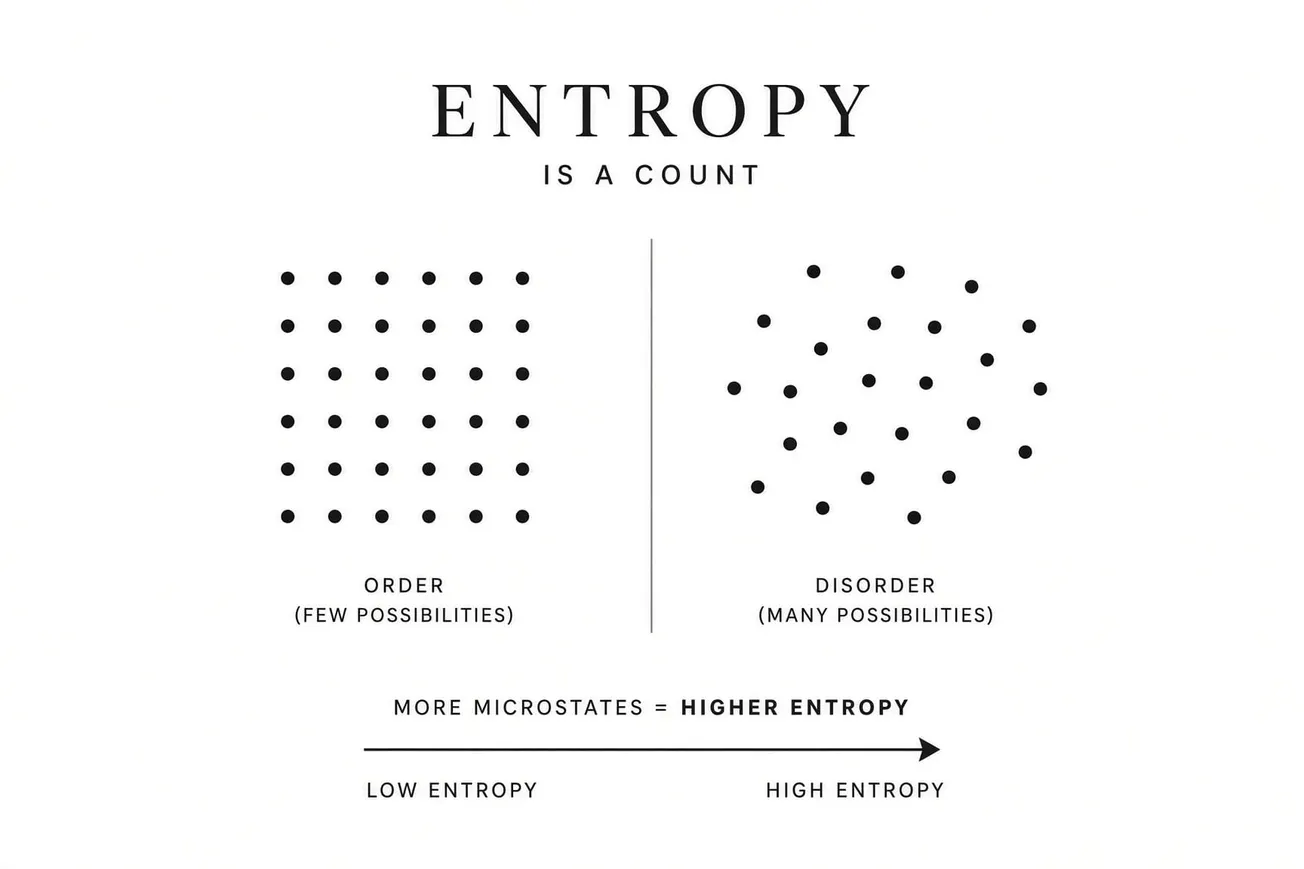
Begin with why a boundary condition is forced. Boltzmann explained the mechanism of the Second Law — coarse-grain phase space, count volumes, and evolution toward larger macrostates is overwhelmingly probable. But Loschmidt's objection cuts deep: the argument is time-symmetric, so run it backward and it works identically. Given only the present macrostate and the dynamics, the most probable history is not a lower-entropy past but a fluctuation — your memories are more likely to be noise that congealed five minutes ago than records of real events. The weak interaction's genuine T-violation (measured directly by CPLEAR in kaons) is no escape: it is CPT-preserving, microscopic, and shifts decay rates without manufacturing any macroscopic gradient. The only exit is a postulate about the actual trajectory: the past hypothesis. Entropy rises toward the future because it was inexplicably low at one end. The Second Law is not a law; it is the visible half of an initial condition — constitutional in appearance, biographical in fact.
Now the paradox that selects gravity as the residence of that condition. Look at the universe's baby picture. The CMB is the most perfect blackbody ever measured — FIRAS bounded deviations at tens of parts per million — and uniform to one part in 10⁵. For a gas, thermal and uniform is what maximum entropy looks like. So the allegedly special initial state appears to be equilibrium; where is the specialness hiding? Answer: gravity reverses the sign of the gradient. For short-range forces, spreading out exhausts phase space; for a universally attractive, long-range, unscreenable force, the clumped configurations own almost all the volume and the smooth state is a measure-zero corner. Self-gravitating systems have negative heat capacity — lose energy, contract, heat up — so entropy grows by clumping: smooth gas, then stars, then black holes as the terminal maximum. The matter was in equilibrium; the gravitational field was switched off, and that was the loaded spring. Everything since is the spending of smoothness. The Sun makes the point brutally concrete: Earth re-radiates essentially every joule it receives; what it keeps is quality — one visible photon arrives, roughly twenty infrared photons leave, energy balanced, entropy exported. A hot dot in a cold sky, which exists only because gravity condensed hydrogen. Every metabolic act on this planet is an installment paid against the initial uniformity.
The geometric translation is where the hypothesis earns its name. Riemann curvature in four dimensions has twenty independent components and splits cleanly in two: ten of Ricci, ten of Weyl. Einstein's equations chain the Ricci part algebraically to local matter — where there is stress-energy, there is Ricci. The Weyl part is gravity's own free field: tidal distortion, gravitational waves, the vacuum curvature around a black hole — the part that can be nonzero where nothing is. And the two ends of time are different species of singularity. The Big Bang: Ricci divergent (infinite density) but Weyl ≈ 0 — the FLRW geometry is exactly conformally flat, tidally silent. A black-hole singularity, or any generic crunch: Weyl → ∞, the chaotic BKL/mixmaster tidal frenzy that Belinskii, Khalatnikov and Lifshitz showed is the generic face of gravitational collapse. The Weyl Curvature Hypothesis elevates this to law: initial singularities are constrained to vanishing Weyl; final singularities are unconstrained. Paul Tod sharpened it into rigor — the demand that the bang be a smooth conformal boundary through which spacetime extends. Note that this dissolves the circularity worry about the word "initial": you do not need a prior arrow to state the law. The constrained end is the past, by definition; the asymmetry of the constraint is the arrow, and thermodynamics is downstream of geometry. The temptation to symmetrize — a Gold universe where the arrow flips in recollapse — was tried by Hawking in 1985; Page and Laflamme showed it fails, and Hawking publicly recanted, later describing it as among his worst mistakes. A concession-to-verdict event, on the record.
The number, since the whole argument turns on its absurdity. Bekenstein–Hawking gives a black hole entropy of area over four Planck areas. Collapse the observable universe's ~10⁸⁰ baryons into a single hole and you get S ~ 10¹²³ k_B — the entropy ceiling of our contents. Phase-space volumes scale as e^(S/k), so selecting our smooth initial macrostate rather than a generic one was a choice of one part in 10^(10^123) — a number you could not write in decimal with a digit on every particle in the universe. The ledger since: the early radiation era sat near 10⁸⁸–10⁹⁰; today we are near 10¹⁰⁴, already dominated by supermassive black holes (Egan–Lineweaver's audit); ceiling 10¹²³. Almost everything thermodynamically possible is gravitational and still ahead. And the Boltzmann-brain check closes the fluctuation escape: if the low past were a random dip, small dips beat cosmic ones by doubly-exponential margins, so a solitary deluded brain vastly outnumbers coherent worlds; the observed mutual consistency of records everywhere refutes the fluctuation account. The condition is lawlike, not luck.
Adverse column, before anything settles. First: WCH names the asymmetry; it does not explain it. It is a redescription of the past hypothesis with geometric precision — falsifiable in shape (it forbids high-Weyl bangs, and the observed isotropy complies), but mechanically empty; the "why" is untouched. Second, and under-advertised: the quantity the hypothesis gestures at — "gravitational entropy," presumably some functional of Weyl — has no agreed definition. Gravity has no local stress-energy, hence no canonical local entropy density; proposals exist (Clifton–Ellis–Tavakol and others) but nothing settled. The hypothesis is about a quantity we cannot yet write down in general. Third, the rival: inflation. The mainstream buys smoothness dynamically and holds a quantitative trophy WCH lacks — the measured spectral tilt of the CMB fluctuations, n_s ≈ 0.965, predicted from quantum fluctuations of the inflaton. Penrose's counter is the phase-space argument: generic initial data are Weyl-wild and do not inflate; the inflaton requires its own exquisitely low-entropy, gradient-free patch; inflation therefore spends the specialness it claims to mint, and by volume measures arguably worsens it. Steinhardt presses the same wound from inside cosmology. Unresolved — because the measure on initial conditions is not a settled mathematical object. That is an honest stop, not a rhetorical one. Fourth, Penrose's own proposed explanation, conformal cyclic cosmology: in the far future only massless, conformally invariant quanta remain — no rest mass, no clocks, no rulers — so the cold infinite expansion is conformally indistinguishable from a smooth hot bang; glue aeon to aeon, and Weyl ≈ 0 is inherited from the previous aeon's tame future rather than postulated. The costs are steep: rest mass must eventually fade (the electron is the standing embarrassment — pure speculation); the entropy bookkeeping requires information to be genuinely destroyed in black-hole singularities, directly against the post-2019 Page-curve consensus for unitary evaporation; and the flagship evidence — low-variance concentric circles, later "Hawking points" in the CMB — has repeatedly failed independent replication (Moss–Scott–Zibin, Wehus–Eriksen, DeAbreu et al., Jow–Scott): consistent with Gaussian ΛCDM, tainted by a posteriori statistics. CCC is currently losing on evidence, and saying so plainly is the respect the idea deserves. Fifth, the strange double status of BKL genericity: it is simultaneously the strongest evidence for something like WCH — generic relativistic singularities are chaotic and ours demonstrably was not, so the constraint is real — and the naked mystery: the universe took a measure-zero door, and nobody knows why.
Now connect it to the previous conversation, because Penrose's architecture is one building. Physics contains exactly two time-asymmetric facts: the thermodynamic gradient and the collapse of the wave function. Everything else is direction-blind. Penrose pins both to the same peg. At the cosmological register, the Weyl condition sets the gradient — gravity's degrees of freedom start off, and history is their switching on. At the event register, objective reduction makes each quantum measurement an irreversible, gravitationally triggered deposit — possibility becoming instantiated fact, once per collapse, never reversed. Even if E_G dies in the next generation of Gran Sasso descendants and the Hawking points stay noise forever, the structural observation survives both corpses: the only force that is the stage rather than an actor on it is also the only place either arrow could live, and Penrose is nearly alone in insisting the two asymmetries are one fact seen at two scales.
The landing, stated once. A boundary condition versus a dynamical law is exactly the distinction between path and space: the Second Law is not part of the universe's physiology but of its biography — one trajectory, selected at odds of 10^(−10^123), depositing irreversible structure ever since. And the deposit is not decorative. The entire asymmetry of causal inference — that records exist of the past and none of the future, that retrodiction and prediction are different problems, that interventions propagate forward — is underwritten by that initial condition; Albert and Loewer have made the case that without the past hypothesis no memory, no measurement record, no inference from data to cause is licensed. Every trial ever randomized runs on borrowed smoothness. Where the explanation honestly stops: we have compressed "why does entropy rise" into "why was Weyl zero" — one constraint instead of a law, which is real progress by the only standard that matters, minimum axioms for maximum yield. But compression is not explanation, and the residue is a single unexplained geometric fact sitting at the first instant, biting everything downstream and accounting for itself not at all.
Coda - the Weyl curvature was zero at the initial singularity
The Weyl curvature was zero at the initial singularity is a precise way of saying: at the Big Bang, pure gravity started out completely smooth and featureless.
In Einstein’s theory, spacetime is curved, and that curvature is what we feel as gravity. The full mathematical description of the curvature (the Riemann tensor) can be split into two very different pieces:
- Ricci curvature — the part that is directly caused by matter and energy. Wherever there is mass, energy, pressure, etc., this part responds. It is the “source” part of gravity.
- Weyl curvature — the leftover, “pure gravity” part. It can exist even in empty space. It describes tidal forces (the stretching and squeezing that would tear you apart near a black hole), gravitational waves, and the tendency of gravity to make things clump and become irregular. It is the free gravitational field.
The initial singularity is the Big Bang itself — the mathematical point where density, temperature, and curvature all go to infinity and classical physics breaks down.
The claim is that, right at that starting point, the Weyl part was exactly zero.
What that actually means physically
The universe began in a state of extreme gravitational smoothness. There were no gravitational wrinkles, no tidal distortions, no gravitational-wave chaos, and no seeds of clumping coming from pure gravity. The geometry was as uniform and ordered as it could possibly be.
(This is the content of Roger Penrose’s Weyl curvature hypothesis.)
A balloon analogy
Imagine a perfectly smooth balloon covered with tiny circular drawings.
Now shrink the entire balloon toward zero size.
The circles become smaller, distances collapse, and the balloon’s overall curvature may become extreme. But as long as the shrinking is perfectly uniform, every circle remains a circle.
That is analogous to strong Ricci curvature without Weyl curvature.
Now press one finger into the balloon. Some circles become stretched and distorted. That dent is analogous to Weyl curvature.
So the statement means that the primordial universe had extreme overall compression but no gravitational dents.
Why anyone cares
Gravity is special when it comes to entropy (disorder). Ordinary matter and radiation in the early universe were already in thermal equilibrium — high entropy for them. But the gravitational field was in an extraordinarily low-entropy state precisely because the Weyl curvature was zero. That low-entropy gravitational starting point is what allows the second law of thermodynamics to operate and gives time its direction: the universe can only become more gravitationally clumpy and disordered as it evolves (stars, galaxies, black holes…).
So the statement is really saying: the Big Bang was not a random, high-entropy mess. Gravitationally, it was the most ordered possible beginning.
Why did space expand after the Big Bang?
Because the early universe was already on an expanding branch of the possible solutions to Einstein’s equations.
Its matter and radiation then controlled how that expansion slowed, while inflation may have caused an early period of enormous acceleration.
But why was the initial expansion rate positive rather than negative?
The classical Big Bang model does not answer that. It treats the expanding state as part of the initial condition.
And because classical general relativity breaks down at the initial singularity, a deeper answer would require a successful theory of quantum gravity.
The sentence to remember is:
The Big Bang did not happen and then cause space to expand. “The Big Bang” is the name we give to the hot, dense beginning of a universe whose geometry was already expanding.