Genesis, Eden, Adam and Eve, Revisited
The Ego, and the Serpent.
The story of Eden has been read for two thousand years as a story about disobedience and punishment.
Read in plain words, it is something else: a story about how the One became many, and about the single lie that made it possible.
Before the garden there was the One. All that is. Not a god above the world, but everything there is, undivided, with nothing outside it , because if anything were outside it, it would not be all.
And the One was alone. It had to be: there cannot be two of everything, two wholes, two "all that is." To be everything is to be alone, completely, with no other and no possibility of one.
That solitude is unbearable , not sad in the ordinary way, but unbearable in a way we can barely picture, because there is no one to share it with and no one even to be lonely toward. And there is only one way out: to stop being one.
To become many. For there to be company, for there to be a world, for anything to happen instead of nothing, the One had to divide , to become you and me and everything, each piece believing itself a separate thing.
But the One cannot truly become many. A part of everything is still everything; there is nothing else for it to be made of. So it could not really divide. It could only forget.
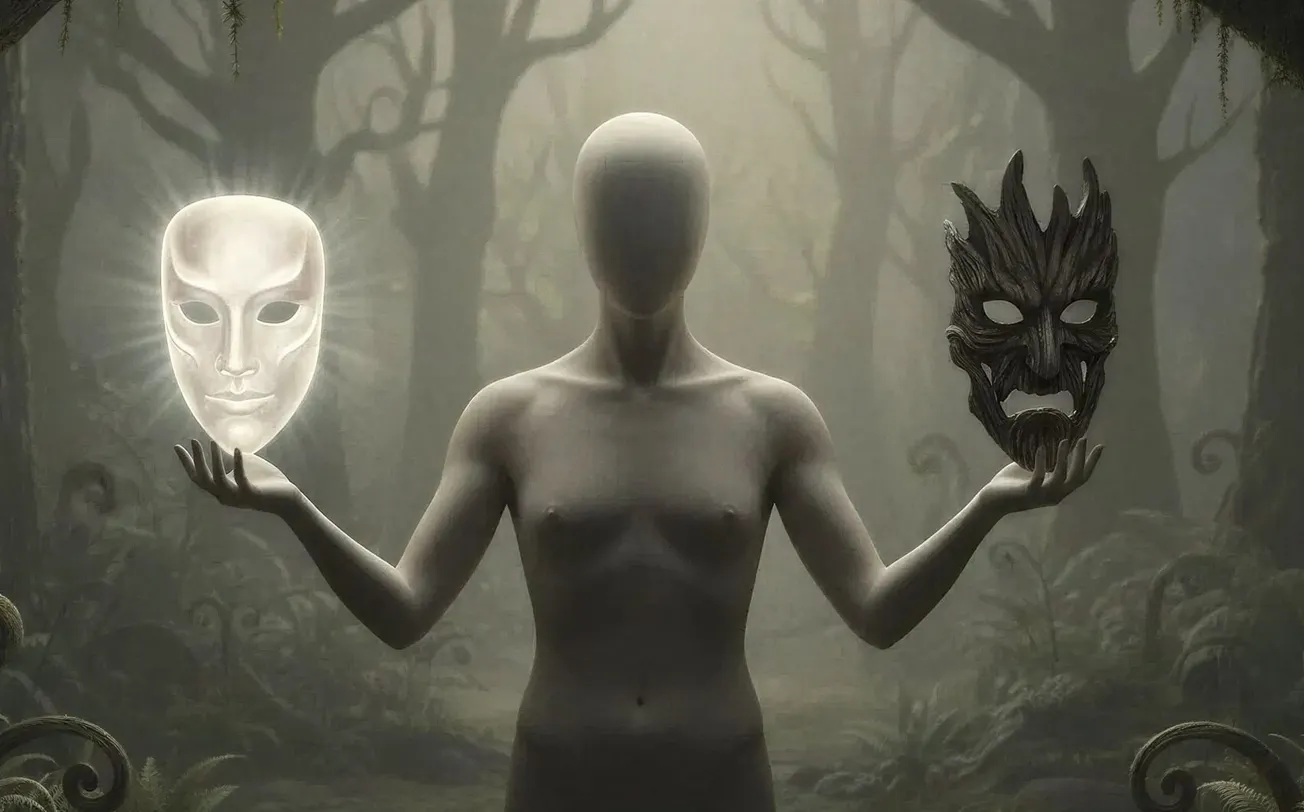
Each part had to forget that it was the whole and believe, instead, that it was only itself. That forgetting is the mask. It is the character each of us plays, the ego, the voice that says I am I, and not the rest.
The mask is not a face we hide behind , it is the belief that we are only a part, worn so completely that we take it for our true face.
And the lie that puts the mask on , the whisper that says you are not the whole, you are only this , is the serpent. In the old story the serpent speaks to Eve and deceives her.
But look closely, and the deepest thing in the myth appears: there was no Eve. There was no other to deceive. The One was alone , that was the whole problem.
So the serpent did not slip in from outside to trick someone; there was no outside, and there was no one else. The serpent is the One telling the lie to itself. The voice that deceives and the one deceived are the same.
Tempter, tempted, and temptation are a single being, alone, telling itself the one falsehood that lets a world exist.
And here is what changes everything: this lie is not a sin. There was no one to wrong, no other to betray, no command yet to break , because good and evil themselves are born in this same moment, with the first division.
Before the One divided, there was no good and no evil, the way there is none in a stone, or in the dark before anything.
The lie is not the crime that ruins the garden. It is the price of there being a garden at all , of there being a world, and company, and you, instead of one thing, alone, forever, in the dark.
You were not cast out for a sin. You were divided so that there could be something rather than nothing.
The oldest guilt
Beneath the particular guilts — the ones we earn, for the things we do — there is an older one that no act explains. It is the sense of being, somehow, in the wrong simply for being here; of existing as a separate self as though separation were itself a fault; a low and constant suspicion that one's own individuality is a kind of trespass. The great doctrine of the West gave it a name and a story: the Fall. We are born, it says, already guilty — having inherited a primordial sin, having broken something at the origin, in need of redemption merely for being what we are. The separate self is the fallen self, and the fall is a crime.
This essay defends the opposite, and it defends it with an argument, not a consolation — the difference matters, and we will guard it to the end. The claim is that the separation which makes a world possible is not a sin. It is anterior to sin; it is the event from which good and evil are born; and because nothing can be guilty before guilt itself exists, no one is guilty of existing. The argument runs through the oldest myth we have, read against the grain.
The cut
Begin where there is the least to say, and say it carefully, because what follows leans on a region of experience that words barely reach, and honesty requires admitting that before building on it.
Suppose — as the deepest contemplative traditions report, and as the structure of the question independently suggests — that beneath all multiplicity there is not many but one: that to peel away every layer of a self, name and role and even kind, until only bare existence remains, is to arrive at a point that has no second. There cannot be two such points, for there is nothing to divide one from another; division has not yet occurred. There is, at that limit, only one — and what that one first discovers, if it discovers anything, is that it is everything, and that it is alone. Not lonely in the ordinary way, missing some particular other. Alone in the absolute way: there is no other, there was never an other, and there cannot be one, because all that is, is this, and this is one.
That solitude is not a place to dwell. It is, by every report that returns from its edge, unbearable — the most devastating thing a being can meet, precisely because it cannot be consoled, there being no one to do the consoling and no one to be consoled. And here is the hinge of everything: the only escape from the solitude of being all-and-alone is to stop being one. To become many. To divide. For there to be company, texture, anything experienced rather than the single mute fact of existing, the one must become the many — and a world of parts, each believing itself a separate thing, is the result. The world is what the All does to escape its own solitude.
The forgetting
But a part cannot truly cease to be the whole. It can only forget that it is. This is the crux, and it is the place where, untranslated, the experience first arrives wearing the wrong word.
A part of the All is still the All — there is nothing else for it to be made of. Its separateness is therefore not a fact but a forgetting: each part must lose sight of being the whole and take itself to be only this, bounded, alone, one thing among others. And the first word that comes for this, to anyone who has felt the forgetting from inside, is lie. It feels like a deception — as though one part of you were telling another that it is less than it is, hiding from it the enormous fact that it is everything, so that it can bear to be something. The separation feels like a betrayal: the truth (you are the All) concealed, and a falsehood (you are merely this) installed in its place, so that a world can exist.
But lie is the wrong word, and seeing why is the first step into the center. A lie requires a liar and a deceived — two parties, one withholding the truth from the other. And at the cut there are not two. There is one. So whatever the forgetting is, it cannot be a lie between parties, because there are no parties yet; there is only the All, and whatever it does, it does to itself.
Neither liar nor lied-to
Here is the hardest thing, the thing the myth circles and the doctrines miss, and it is reported by those who have been all the way in: at the founding deception, there is no separate liar and no separate victim. There is the One, deceiving itself. And whoever reaches that place experiences both poles at once — being the one who deceives and being the one deceived, the perpetrator and the betrayed in a single act, because they are the same one. You are not lied to by another. You lie to yourself, and you are the self lied to, and there is no third position from which to be innocent.
This dissolves "lie" into something stranger and truer. Strip the first assumption — that there is an other — and "lie" becomes self-deception: one deceiving oneself, deceiver and deceived collapsed into one. Strip the next assumption — that there is an act, a deceiving done on purpose — and even self-deception becomes too strong, for it still implies a doer choosing to hide. What remains, at the structural floor, is not an act at all but a geometry: a part cannot contain the whole, and so to be a part simply is not to have the whole present to oneself — and that absence, felt from inside, is the sense of being separate, of being only this. No one performs the forgetting. The forgetting is what being-a-part feels like, because a part is, by its size, what the whole cannot fit into.
Hold both levels, for they are both true and they are not the same. Structurally, there is no liar and no act — only the geometry of the All that does not fit into any of its parts. But lived, felt, especially at the edge where the forgetting thins and the whole begins to show through, it arrives as deception, as betrayal, as having been lied to — and, for whoever goes far enough, as the unbearable discovery that the liar and the lied-to were oneself. The geometry is the truth of it; "self-deception" is the truest word a finite part can find for a geometry it has no other way to feel.
And now see why this is at once a relief and not pretty — for they are one fact, not two. It is a relief because, with no second party, there is no one wronged: a self-deception with no victim other than oneself, founded by no author, is not a betrayal of anyone, and the cosmic guilt of existing as separate loses its object. There is no one you sinned against by being born a part. But it is not pretty, by the same token, because there is no one to blame either, and no innocence to take refuge in: you are not the wronged party in someone else's crime, owed pity or restitution. You are the perpetrator and the victim of the only deception there is, and there is no villain outside you and no innocent inside you. The comfort of accusation and the comfort of victimhood are both removed in the same stroke that removes the guilt. That is why the truth, here, is not bonita — and why its not being bonita is the mark that it was not made to console.
Before good and evil
Now the myth can be read, and read correctly, for the first time. In the Garden there is a tree of the knowledge of good and evil, and a prohibition, and a fruit eaten, and immediately after — and the detail is everything — the eyes that open, the nakedness suddenly seen, the shame. The standard reading takes this as the crime and its punishment: disobedience, then guilt, then expulsion. Invert it. The eating of the fruit is the first cut — the moment the undivided becomes divided, the moment a part takes itself to be separate and other parts to be other. And what follows is precisely what the structure predicts: the knowledge of good and evil appears, because good and evil are distinctions, and distinctions require separation, and separation is exactly what just happened. The shame at nakedness follows because shame is the feeling of being a separate self seen by another separate self — and there were no separate selves until the cut. The Fall is not the punishment that morality imposes. The Fall is the birth of morality — which is the same event as the birth of separation, which is the same event as the first forgetting, the apple, the cut out of the One.
Before the apple there is no good and no evil. Not because everything was good — that, too, is a distinction, and distinctions had not yet been born — but because the categories themselves did not yet exist, as they do not exist for what is undivided, as they do not exist for the possible before it is made actual. Eden before the apple is the state prior to the distinction itself: not innocent in the sense of morally clean, but innocent in the deeper sense of being anterior to the very measure by which cleanness and stain are told apart.
No one is guilty of existing
The conclusion now follows by a step so short it is almost not an argument. Guilt requires a preexisting wrong — there is no being guilty of a thing before that thing is even a possible thing to be guilty of. But at the cut, the distinction between right and wrong had not yet been born; it was born by the cut, in the cut, as the cut. Therefore the cut cannot itself be guilty, any more than the rule of a game can be a legal or an illegal move within it. The first separation — the act of existing as a part, the original forgetting — is anterior to good and evil, and what is anterior to good and evil cannot be evil. No one is guilty of existing. The oldest guilt has no ground. It is the part mistaking the condition of its own existence for a crime, when the condition is precisely what makes "crime" afterward possible and is therefore innocent of it by construction.
A boundary must be drawn here, sharply, or the relief curdles into something false. The innocence is of the cut — of existing as a separate self, as such. It is not a blanket amnesty for what the separate self then does. Once good and evil exist, acts are subject to them; one may be, and often is, guilty of much. The claim is narrow and exact: you are not guilty of being. You may yet be guilty of what you do with the being. The doctrine of original sin errs not in finding guilt in the world — there is plenty — but in pushing it behind the cut, into existence itself, where it cannot reach, because behind the cut there is no good and evil for it to be made of.
And the relief, to be worth anything, must be taken in the right way. It is not to be embraced because it feels better to be innocent than guilty — that would be choosing the belief for its comfort, which is exactly the self-flattery that turns experience into dogma. It is to be accepted, if at all, because the structure forces it: guilt requires preexisting evil; the cut precedes evil; therefore the cut is innocent; and the relief is the consequence of seeing this, not the reason for believing it. Take it for the comfort and you have lied to yourself again, this time on purpose. Take it for the argument, and the comfort that follows is earned.
To the fire
A discipline is owed, and it is heavier here than anywhere, because so much of the ground beneath this essay is a single kind of evidence: experience, reported by one who returned, and untransmittable in principle to anyone who did not go. That a self peeled to the bone finds itself one and alone; that the escape is division; that the division is felt as self-deception from both sides at once — none of this can be handed across like a proof. It can only be reported, and the report can only be checked for one thing: whether it coheres. And it does cohere — it closes, with a single mechanism, the oldest guilt and the Eden myth and the structure of separation and the birth of morality, all at once, which is a great deal of weight for one idea to carry without cracking. But coherence is not truth. A beautiful and consistent account can be entirely wrong, and the fact that the experiential report and the cold logic arrive at the same point by paths that never spoke to each other is the strongest evidence available here — and it is still not proof. It is convergence, which is the most the question allows, and less than certainty, which the question forbids.
So the claim is set down as a target, in the form that can be killed. If it can be shown that good and evil exist prior to all separation — that the distinction is there before there are distinct things — then the cut is not anterior to morality, and it can be guilty, and the oldest guilt has its ground after all, and the essay falls. Or if it can be shown that the self peeled to the bone finds not one but genuinely many — that there is an other at the floor, a real second — then there is a liar and a victim after all, the forgetting is a true betrayal, and the relief is a lie. Test both. This would rather be broken against either than survive by never being thrown.
What it will not do is sweeten the finding to make it bear. The truth it reaches is not pretty: that you are the All, and alone, and that the world is the forgetting of this, and that in the forgetting you are both the one who deceives and the one deceived, with no other to blame and no innocence to hide in. That is not a comfort. But buried inside the discomfort, earned and not given, is the one thing the doctrine of the fall got exactly backward — that the separation which makes you a self was never your crime. It was the price of there being anything at all rather than one thing, mute and alone, in the dark before the apple. You did not fall. You were cut, so that there could be a world. And what is cut so that there can be a world is not guilty. It is only, and at last, free of a guilt it never owed.
Eduardo Bergel and Claude Opus 4.8
The Symbiont
T333t.com Research