1. General
The document presents the physics program of Stephen Wolfram. The program became public in 2020. Its roots are in his 2002 book. This review lists the claims, examines each claim, gives credit where credit applies, and runs the gate audit from our Einstein analysis.
NOTE:
In this document,
"the prior" is knowledge from tradition or training.
"The interior" is the area where much data agrees.
"The tail" is the area where data is thin.
"A gate" is a check that each theory must pass.
"The bite" is a measurement that can say no.
"Instantiated" means: made real in history, not only possible.
2. The claims of the document
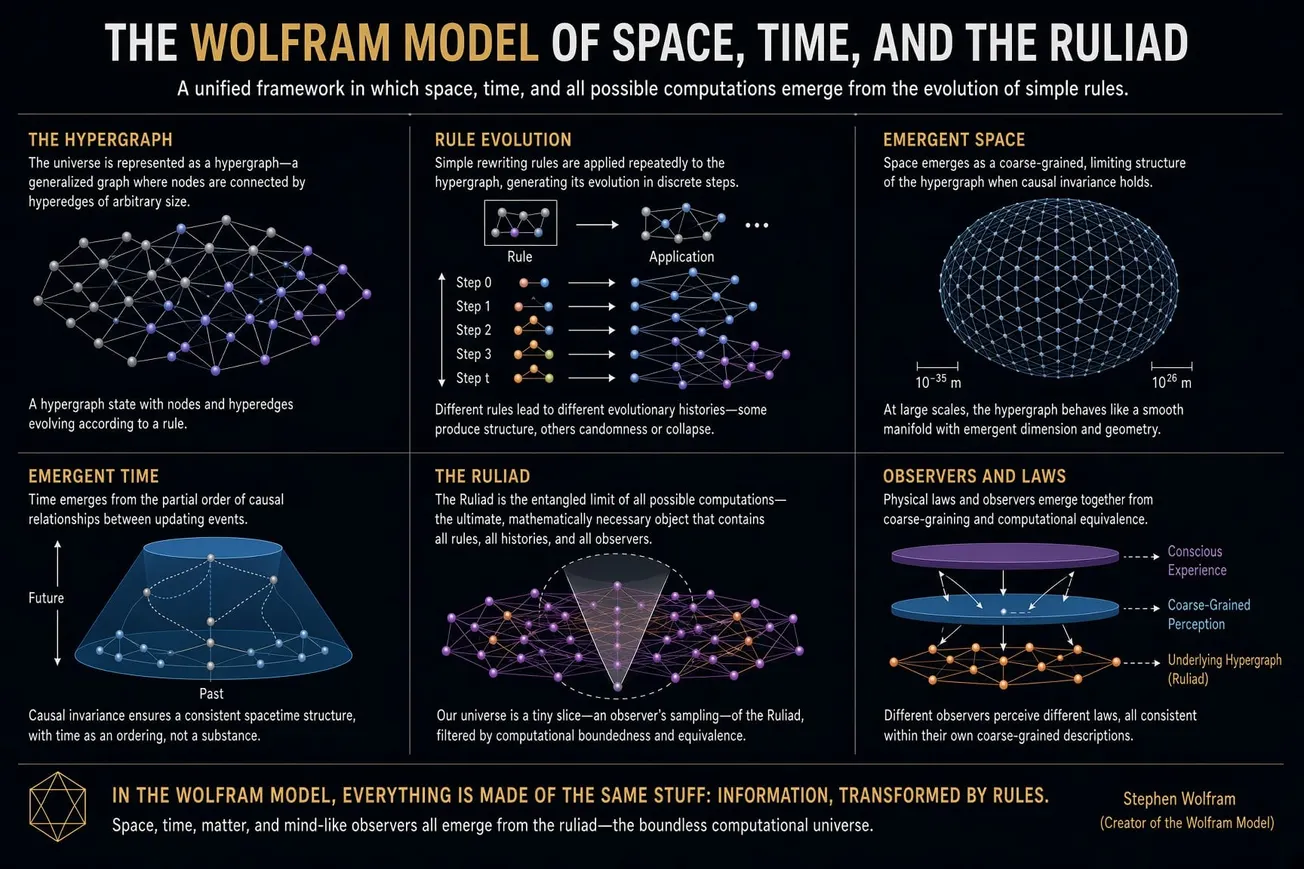
- C1. Space is a network of discrete atoms. Only their relations exist.
- C2. Time is the step-by-step rewriting of this network by rules.
- C3. The aggregate effect of the rewriting gives the Einstein equations.
- C4. Many possible rewrite orders give many histories. This gives quantum mechanics.
- C5. Not one rule applies. All possible rules apply. The total object is the ruliad. It is unique and necessary.
- C6. Observers are computationally bounded. They compress much input into one thread of experience.
- C7. The second law of thermodynamics is a result of bounded observers plus computational irreducibility.
- C8. Objective reality is a result of many observers near each other. Conclusion of the document: for observers of our type, the perceived laws of physics are inevitable.
3. The model and the mechanism
The document starts with a rule: models represent nature; models are not the mechanism of nature. Then the document says: what ultimately exists is the network. Then: the ruliad necessarily exists. The three statements do not agree. The first is instrumental. The other two are ontological. The document moves between the two positions without a signal. The word "is" does two different jobs. We found the same defect in branch-counting arguments for many worlds: the word "exists" did two jobs there also.
4. The novelty of C1 and C2
C1 and C2 are in the interior, not in the tail. Networks of discrete space have relatives in the literature: causal sets, spin networks, causal dynamical triangulations. The document does not name the relatives. The new parts of the program are not the atoms of space. The new parts are C5 to C8.
5. The status of C3 and C4
The document says general relativity "seems to emerge." The verb is honest. The published derivations use added assumptions: causal invariance, a fixed dimension in the limit, and statistical uniformity conditions (a type of ergodicity). The derivations appear mostly in the author's own journal and on preprint servers. Hostile external review is thin. A corpus that its author curates gives weak survival evidence. Survival is evidence only after a deletion filter.
NOTE: There is an internal tension. The motor of the framework is irreducibility: no summary replaces the run; you must follow the path. This agrees with the non-ergodic axiom. But the derivation of the continuum limit pays with a uniformity assumption. The path-based theory buys its best result with a path-free condition.
6. C5: the possible and the instantiated
The question was: why this rule and not another? The answer of the document: all rules run. The answer does not solve the question. The answer deletes the question. Apply the axiom criterion: minimum axioms, maximum yield for each axiom. The ruliad is one axiom. It is very cheap. But yield must be paid in numbers that can fail. When all rules run, no observation can refuse the object. All explanatory work then moves into the observer.
There is a second cost. The ruliad makes the catalog of the possible equal to the catalog of the instantiated. Convergent evolution shows the shape of the possible without giving existence to all of it. The eye evolved more than 40 times; the possible eyes that never evolved do not exist. The document gives existence to the full catalog, by decree. This is the many-worlds move, made larger: many worlds of rules.
7. C6 and C7: the strongest part
The second law argument is the best-built mechanism in the document.
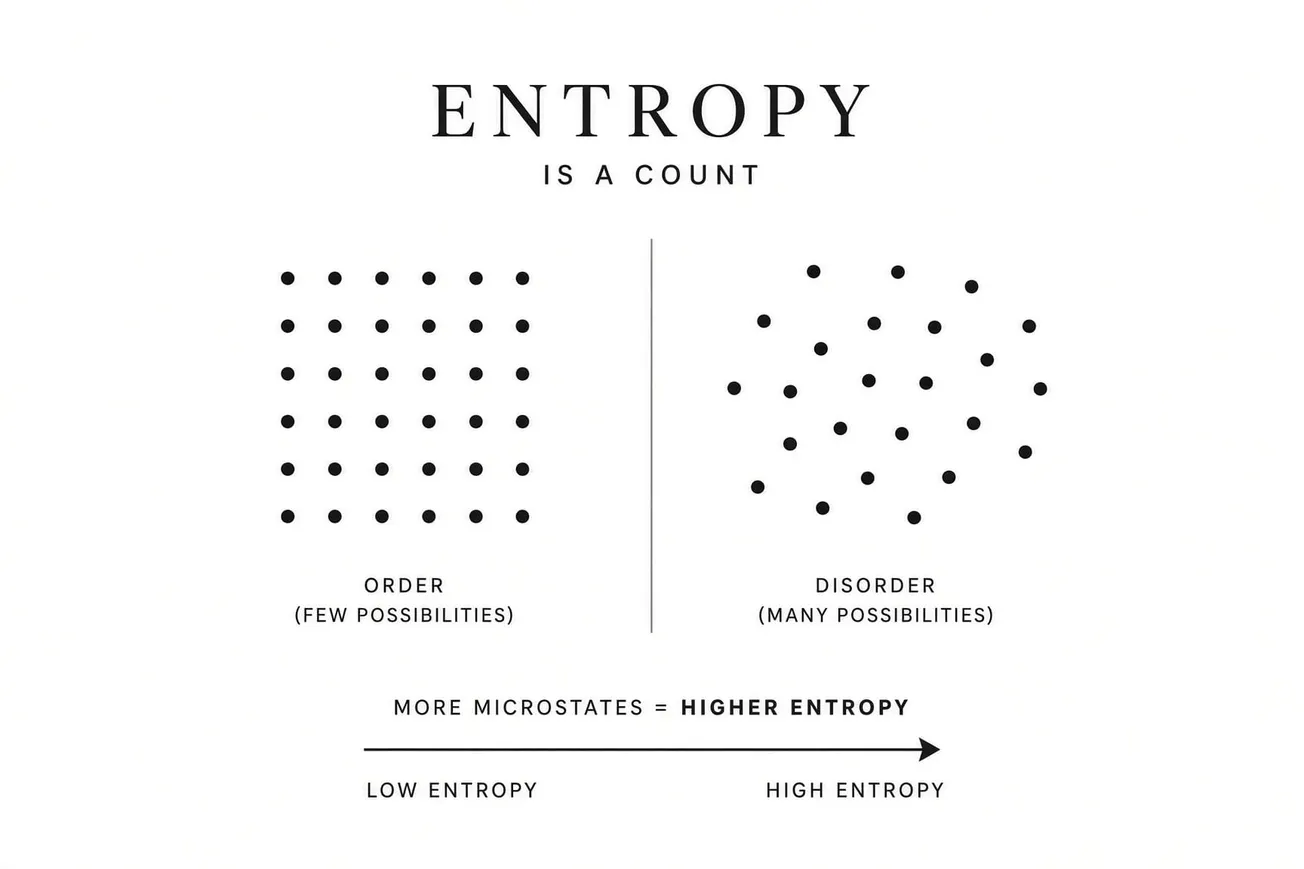
Structure: the microscopic steps are reversible; the computation hides the simple initial condition; the bounded observer cannot recover it; the observer sees randomness; entropy increases for that observer. This is Boltzmann coarse-graining, written in computational words. The translation adds one good element.
It says why no observer of our type can win: the irreducibility is a property of the process, not of our effort.
Two limits apply. First, the principle of computational equivalence (the weather computes like a brain) is a conjecture. The document states it as fact. Second, separate two claims: (a) observers select which regularities they perceive; (b) observers determine the laws. The evidence supports (a). The document sometimes says (b). The night-sky example shows the limit. We agree about the constellations for two reasons: we stand near each other, and the stars are where they are. The second reason carries the objectivity. The document keeps only the first.
8. C8: objectivity as agreement
The document says: objective reality depends on many observers who agree. Test this with history. For 56 years, all observers agreed about explanations for the 43 arcseconds of Mercury. The consensus was wrong. The number defeated the agreement. A theory where objectivity equals agreement cannot explain why the anomaly wins. Objectivity needs the bite: explicit input and output with the world. Agreement is an average. The average is confident everywhere and reliable only in the interior.
The final conclusion of the document has this structure: (1) the ruliad necessarily exists; (2) we are observers of type O; (3) observers of type O must perceive laws L. Premise 3 is built for the second law only. Premise 2 is open; the document says so. The strong conclusion stands on the least-built premise.
9. The gate audit
Apply the Einstein standard. In 1907, Einstein named his number before his theory existed. This program became public in 2020. It has not named its number. Candidate signatures exist: dimension change in the early universe, a maximum entanglement speed, discreteness at a very small scale. No signature is computed to a value that a current instrument can refuse. Discrete-space models usually break Lorentz symmetry. Photon arrival-time measurements constrain this strongly. The program answers that causal invariance protects the symmetry. The theory has answers that avoid the tests. The capacity for avoidance is itself a warning sign.
CAUTION: A THEORY WITHOUT A GATE OPERATES AS AN ADVISOR. AN ADVISOR CAN DEFEND ITSELF WITHOUT LIMIT.
10. Procedure: how the program can pass a gate
- Select one observable where the rule class and standard physics give different numbers.
- Compute the number from the rule class, before the measurement.
- Publish the number and the full computation, outside the internal journal.
- Identify the instrument that can refuse the number.
- Accept the verdict. Do not amend the rule class after a negative result.
11. Value in the document
Give credit for five items. (a) The observer question is real and not sufficiently studied: which laws are visible to a bounded observer? This is a good research program. (b) Irreducibility makes path-dependence native: history must run; no shortcut exists. (c) The axiom count is low. The economy is real; only the yield is unpaid. (d) The second-law mechanism is clean pedagogy. (e) The bounded observer that compresses input into one thread, and samples pockets of reducibility, is the same object as the prior in our LLM analysis. The pockets are the interior. The irreducible zones are the tail. The document gives a physics costume to that structure.
12. Conclusion
The document contains one strong mechanism (C7), one honest verb ("seems to emerge") for its largest promise (C3, C4), and one decree (C5) that makes the possible equal to the instantiated. The program is rich in explanation and empty of gates. Einstein's program had one principle above and one number below. This program has many principles above and no number below. Until it names its number, its correct status is: a large, interesting advisor.