Table of Contents
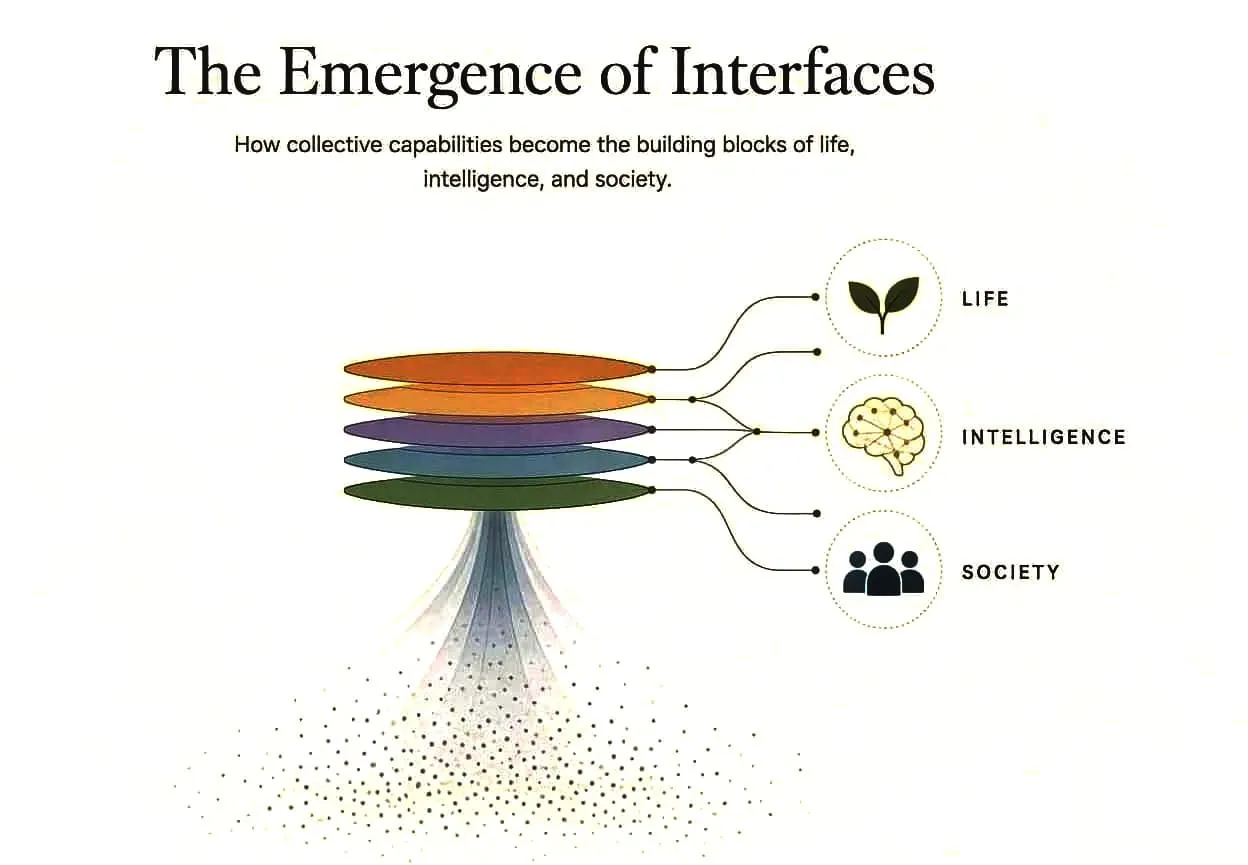
How collective capabilities become the building blocks of life, intelligence, and society
The evolution of complexity is commonly understood as the accumulation of components, interactions, and organizational levels. A complementary possibility is that complexity becomes scalable through the emergence of interfaces: physically implemented relationships that make the capabilities of an organized system available without requiring continuous access to its internal machinery. The decisive development is not concealment alone. An organized collective can perform functions unavailable to its isolated components; an interface can make those functions dependable, controllable, and reusable by other systems.
This essay develops that proposition into a research framework. It distinguishes functional novelty from mere aggregation, operational abstraction from an observer’s simplified description, and statistical dependability from determinism. It connects these distinctions to Donald Hoffman’s interface theory of perception, Michael Levin’s work on multiscale biological agency, and earlier contributions from cybernetics, evolutionary theory, and computer science. The central question becomes not simply how a higher level controls a lower one, but how coordinated activity acquires a sufficiently stable identity that other processes can treat it as a unit of action.
The proposed synthesis is that some transitions in biological and artificial complexity involve the joint emergence of a new collective capability, a dependable interface, and a new domain of composition. The essay concludes with a minimal simulation program designed to distinguish these mechanisms experimentally, without building the desired hierarchy into the result.
1. Beyond hidden complexity: the appearance of a new capacity
The original intuition was that higher levels become possible because they do not need to manage the full complexity of the levels below them.
That remains important. But the example of the heart reveals something stronger.
A cardiac muscle cell is not useless. It possesses substantial physiological organization and can generate contractile activity. Nevertheless, an isolated cell cannot perform the pumping function of a ventricle. The relevant capability depends on the organization of contractile tissue into an appropriate geometry and its interaction with a fluid system. Tissue-engineering experiments make this distinction concrete: arranging cardiac cells in chamber-like constructs produces measurable pressure–volume behavior and pumping work, although such constructs remain far from equivalent to a complete natural heart. Nature
The difference is not simply that the collective does more of what an individual cell already does.
The collective makes a different kind of action possible.
A contraction becomes part of a pressure-generating process. That process can participate in circulation. Circulation, in turn, supports physiological arrangements that could not function through the capacities of isolated cells alone.
This suggests a more ambitious thesis:
Some increases in organized complexity occur when a collective acquires a new capability and makes that capability available through a dependable interface, allowing it to become a component in further organization.
Three developments must be distinguished.
First, components become organized so that they can do something collectively.
Second, this activity becomes sufficiently stable that another system can depend on it.
Third, the capability becomes accessible without requiring that other system to reproduce the coordination that generates it.
The third development is the specific contribution of an operational interface.
But the interface should not be imagined as a decorative control panel placed on top of an already complete machine. Sometimes the connections themselves help constitute the new function. A heart’s interaction with the vascular system is not merely a description of pumping. It is part of the physical arrangement through which pumping becomes consequential.
We therefore need to study both the interfaces through which components form a collective and the interfaces through which that collective participates in something larger.
The important transition is not merely:
\[ \text{many components}\longrightarrow\text{one convenient description}. \]
It is:
\[ \text{coordinated components} \longrightarrow \text{new capability} \longrightarrow \text{dependable access} \longrightarrow \text{new combinations of capabilities}. \]
These transitions can overlap and reinforce one another. They need not occur in a rigid sequence.
2. What is an interface?
The word interface risks becoming so broad that it explains everything and therefore distinguishes nothing.
A membrane, a professional qualification, an application programming interface, a perceptual category, and a pressure–flow relationship are not identical objects. A useful theory must identify what they share without erasing the mechanisms that make them different.
I propose the following working definition:
An operational interface is a physically implemented relationship through which one system can selectively affect, respond to, or use the capabilities of another, without having to manage all the internal processes that realize those capabilities.
“Physically implemented” matters. A scientific model can describe a system compactly without that system possessing an operational interface corresponding to the description.
“Relationship” also matters. An interface does not exist solely inside the provider. Its adequacy depends on the systems interacting through it, the tasks being attempted, and the conditions under which those interactions occur.
A pump may be adequately characterized by its pressure–flow behavior for one engineering purpose. That characterization will not be adequate for studying every possible failure of its materials.
There is no contradiction. An interface is selective by construction.
2.1 Description is not the same as causal organization
Suppose we replace a complicated simulation with a single icon on a screen.
We have simplified the observer’s experience. We have not necessarily changed the organization of the simulated system.
Now suppose that the simulated components acquire local feedback mechanisms that maintain an output despite disturbances, so that another component can use that output without coordinating each correction.
Something different has happened. The system itself now supports a simpler mode of interaction.
The first case is representational compression. The second is operational abstraction.
Rosas and colleagues’ Software in the natural world provides a close formal relative. It examines conditions under which higher-level processes possess informational, causal, or computational closure relative to their microscopic implementations. These forms of closure are distinguishable: a useful predictive description does not automatically establish an autonomous causal level. arXiv
The present proposal adds a functional question: what can another system now accomplish by interacting at that level?
2.2 Not every interface creates a new level
A button that starts an existing motor is an interface. It does not necessarily establish a major organizational transition.
A collection of redundant components can improve reliability without adding a fundamentally different task to the system’s repertoire.
Conversely, a fragile experimental assembly can produce a new effect without yet making that effect available as a dependable building block.
The stronger category of interest is therefore a level-generating interface: one associated with a collective capability that can become a usable primitive in further organization.
This requires more than concealment, more than synchronization, and more than an attractive coarse-grained description.
It requires functional consequences.
2.3 Simplicity belongs to a relationship, not necessarily to an entire level
The claim is not that every higher level has fewer possible states than every lower level.
Language, institutions, and ecosystems can possess enormous complexity. Nor do physical degrees of freedom disappear when we adopt a higher-level description.
What can decrease is the number of distinctions that must be communicated or controlled across a particular boundary.
The relevant quantity is thus not simply “complexity above” versus “complexity below.” It is the coordination burden required to achieve a specified class of outcomes.
A successful interface can reduce that burden while expanding the available repertoire of action.
3. The intellectual ancestry is closer than it first appears
This proposal has substantial predecessors. Recognizing them strengthens the project by identifying which parts are established conceptual territory and where sharper synthesis or new experiments remain possible.
Herbert Simon’s The Architecture of Complexity argued that complex systems can become more attainable through stable intermediate assemblies and nearly decomposable organization. David Parnas’s work on information hiding showed how software modules can conceal implementation decisions while preserving relationships on which other modules depend. Simon helps explain why intermediate organization matters; Parnas clarifies why stable boundaries can permit internal change. ISU Sites
John von Neumann directly investigated the construction of reliable systems from unreliable components. Ashby approached the complementary problem of regulation: adequate responses to disturbances must be supplied somewhere in the system. A narrow high-level interface does not abolish the need for regulatory capacity; it can depend on that capacity being distributed below the interface. IAS
An especially close predecessor is Valentin Turchin’s theory of metasystem transitions. Turchin described transitions in which existing systems become coordinated within a new system possessing an additional level of control. Importantly, his formulation includes the emergence of a new kind of activity, not merely a larger collection of existing units. It explicitly connects biological organization, cognition, society, and computation. VUB PESPMc
The present argument should therefore not claim that nobody previously connected hierarchy, control, and new capabilities.
The opportunity is more specific: to formulate the relationship among functional novelty, conditional dependability, reduced coordination burden, and compositional reuse, and then distinguish their contributions experimentally.
Hoffman: effective action without exhaustive representation
Hoffman, Singh, and Prakash’s interface theory of perception provides an important point of departure. Their models investigate how selection can favor perceptual strategies organized around fitness-relevant distinctions rather than faithful representation of the world’s full structure. The conclusions depend on the modeled relationships among environmental states, fitness, and perceptual strategies; they do not establish that every accurate representation is maladaptive or that all perception is arbitrary. Springer Link
The useful extension is not to assume that all physical reality is a perceptual illusion.
It is to generalize the distinction between representing an implementation and providing effective access to what can be done with it.
Hoffman asks how an agent can act successfully without seeing the world exhaustively.
The present question is broader: how can one organized process make use of another without reproducing its internal organization?
That extension moves from perception toward control, construction, and the emergence of new functional units.
4. Dependability does not require determinism
A foundational correction is necessary: an interface need not promise a particular outcome with certainty.
It can instead support a stable conditional distribution of outcomes.
Let \(u\) denote an input or command, \(z\) the exposed state, and \(c\) the relevant context. A statistical interface can be represented by a response kernel
\[ K_I(y\mid z,u,c), \]
where \(y\) is a task-relevant outcome.
This formulation accommodates variability, noise, stochastic choices, and imperfect execution.
However, knowing a distribution is not the same as having a useful capability. A fair coin has an exceptionally simple probability model. That does not make it a reliable pump.
For a goal \(g\), define an acceptable outcome set \(G_g\). Functional dependability concerns a condition such as
\[ P\!\left(Y\in G_g \mid \operatorname{do}(u_g),c,I \right) \geq 1-\epsilon. \]
The probability is conditional on an operating environment and a specified intervention. The tolerance \(\epsilon\) is task-dependent.
A component that fails once in ten uses might be acceptable for cheap exploratory trials and unacceptable for a long chain of indispensable operations.
Indeed, in a hypothetical chain of twenty independent stages, each of which must succeed and each of which succeeds with probability \(0.9\), total success is
\[ 0.9^{20}\approx0.122. \]
Conversely, three independent binary estimators, each correct with probability \(0.9\), yield a majority decision that is correct with probability
\[ 0.9^3+3(0.9)^2(0.1)=0.972, \]
assuming an error-free voting mechanism.
These calculations demonstrate why there is no universal reliability gradient running from physical depth to organizational height. Composition can degrade reliability or improve it.
Everything depends on the organization of dependence and correction.
If all three estimators share the same source of error, the majority calculation no longer describes the system. Redundancy is not automatically independence.
4.1 A useful contract includes its conditions of validity
A scientifically meaningful interface specification must include more than an average success rate.
It must specify the outcomes being measured, relevant timescales, admissible inputs, environmental conditions, failure modes, and dependencies among failures.
There are also two different uncertainties: variability in the system and uncertainty in our estimate of its behavior. A fitted success probability is not an established guarantee merely because it is expressed precisely.
This leads to an important research principle:
An interface is dependable when its behavior is sufficiently predictable for its intended use, including the conditions under which that predictability fails.
The boundary of competence is part of the interface.
5. When is hidden detail genuinely dispensable?
Let \(X\) be a detailed internal state, and let \(Z=\phi(X)\) be the state exposed through an interface.
Consider two admissible internal states \(x\) and \(x'\) that produce the same exposed state:
\[ \phi(x)=\phi(x'). \]
For the interface to be adequate, permitted interventions should produce sufficiently similar task-relevant outcomes from these states.
One possible criterion is
\[ d_{\mathrm{TV}} \left[ P(Y\mid x,\operatorname{do}(u),c), P(Y\mid x',\operatorname{do}(u),c) \right] \leq\varepsilon, \]
over a specified horizon and operating regime. Here \(d_{\mathrm{TV}}\) measures the difference between probability distributions.
This is a proposed operational criterion, not a claim that biological systems satisfy exact closure.
Its meaning is that distinctions hidden by the interface should not matter too much for the task it promises to support.
When they do matter, the interface leaks.
A hidden memory may affect how a subsystem responds. A resource deficit may make yesterday’s reliable command unreliable today. A supposedly irrelevant internal variable may become decisive after a change in environment.
The appropriate response is not necessarily to expose everything. It may be to include a small amount of history, a health indicator, an uncertainty estimate, or a failure signal.
5.1 Why hiding can help—and why it cannot perform miracles
There is a logical limit to the argument.
An unconstrained controller with complete information can imitate any controller operating through a restricted interface. Therefore, removing information cannot by itself improve the maximum performance of an otherwise identical, unlimited controller.
The advantage of interfaces arises under constraints: finite learning time, limited communication, limited memory, expensive sensing, imperfect coordination, and repeated reuse.
Under those constraints, a system that regulates itself locally may be much easier to use than one that requires all corrections to be specified externally.
The interface does not create physical capacity by suppressing information. It can make existing or newly organized physical capacity accessible at an affordable control cost.
This also explains why “action per token” is insufficient as a benchmark. One token can trigger a huge fixed script or an uncontrolled cascade.
A better question is:
How many different intended outcomes can be achieved reliably, with how much external coordination, and at what total cost?
The cost accounting must include the internal computation, training, maintenance, and correction that the interface conceals.
6. Michael Levin: the material being organized is already competent
Levin’s work is especially important because it challenges a misleading starting point: the assumption that the components below a higher-level controller are merely passive material.
In Darwin’s agential materials, Levin argues that multicellular evolution operates on cells that retain substantial adaptive capacities inherited from unicellular life. Developmental organization therefore does not simply assemble inert pieces. It recruits, redirects, and coordinates components capable of responding to disturbances and pursuing physiological outcomes. This is a theoretical interpretation of a broad body of biological evidence, not an assertion of a supernatural designer. Springer Link
His Technological Approach to Mind Everywhere develops a graded, functional approach to agency and intelligence. Rather than restricting useful cognitive concepts to human-like brains, it asks which experimental tools reveal capacities for memory, adaptation, and goal-directed behavior in different substrates. Such functional attributions do not by themselves establish subjective experience. Frontiers
For the present project, the consequence is substantial:
The emergence of a higher-level interface may depend on the competencies of the components being coordinated—not merely on the sophistication of a controller placed above them.
6.1 Morphogenesis provides experimentally accessible cases
Durant and colleagues reported that transient perturbations of endogenous bioelectric organization in planarians could alter subsequent regenerative outcomes. Notably, animals with apparently normal anatomy could retain a changed propensity to regenerate abnormal head configurations after later amputations. The work also investigated interventions that restored wild-type patterning. PubMed
This does not show that a planarian explicitly imagines a future body.
It shows something more precise and experimentally useful: present anatomy can fail to reveal physiological state relevant to future anatomical behavior.
For our framework, the implication is instructive. An interface adequate for describing current shape may be inadequate for predicting regeneration. “Hidden complexity” is not uniformly dispensable; its relevance depends on the question.
Gumuskaya and colleagues’ anthrobot experiments provide another example. Adult human epithelial progenitor cells formed multicellular, motile constructs under altered culture conditions without direct genetic editing. The study also reported effects on closure of scratches in neuronal cell layers in vitro. These findings concern laboratory constructs and assays, not demonstrated clinical repair of human nervous tissue. The Advanced Portfolio
The relevant lesson is that changing cellular organization and context can reveal collective capabilities not expressed in the cells’ ordinary anatomical setting.
The repertoire of a component is therefore not exhausted by its familiar role.
6.2 The interface connection is explicit in Levin’s work
A particularly close contribution is Levin’s article “The Multiscale Wisdom of the Body: Collective Intelligence as a Tractable Interface for Next-Generation Biomedicine,” published online in December 2024 and in BioEssays in 2025.
The article proposes exploiting cellular and tissue competencies through interventions that influence higher-level outcomes without specifying every molecular event. Bioelectric organization is discussed as an experimentally tractable route to such control. The proposed biomedical program treats the ability of living material to complete and regulate complex processes as something an intervention can recruit. Wiley Online Library
This means that the present synthesis is not merely adjacent to Levin’s work. An important part of the interface-centered argument is already explicit there.
The remaining opportunity is to develop a general experimental account of when such interfaces generate new compositional possibilities, how their dependability should be measured, and how they originate.
7. Who creates the interface?
The question appears to demand a choice:
Does the interface emerge from below, or does an intelligence above create it?
But this formulation may impose a temporal order that the phenomenon does not require.
There are at least three distinct questions: how the interface originated, how it operates once established, and how an observer discovers or describes it.
These can have different answers.
A human engineer can deliberately construct an interface from above. A learned skill can become accessible through goals that previously required explicit intermediate control. A biological collective can develop a stable mode of interaction through reciprocal adaptation among its components.
The higher-level agent need not be fully constituted before the interface exists.
7.1 The agent and its boundary may emerge together
Imagine components whose interactions initially produce only unstable collective effects.
Some arrangements improve the persistence of those effects. Feedback stabilizes them. The environment begins to respond to the collective output rather than to each component separately.
That environmental response changes the conditions experienced by the components, favoring arrangements that maintain or improve the collective capacity.
Under this proposed mechanism, a new functional unit develops through reciprocal stabilization. It is neither wholly imposed from above nor adequately described as isolated parts blindly adding their outputs.
Levin’s The Computational Boundary of a “Self” is relevant here. It proposes understanding an agent’s functional extent through the range of events it can sense, model, and influence in pursuit of outcomes. This reframes individuality in terms of organized competence rather than merely an anatomical outline. PubMed Central (PMC)
The extension proposed here is that an operational boundary may become a boundary of agency when it supports persistent, integrated control over a domain of outcomes.
That is a stronger claim than the existence of an interface.
A pump can possess an excellent interface without possessing the flexibility ordinarily associated with intelligence. A coordinated collective can be functionally integrated without being a new evolutionary individual.
Theories of major evolutionary transitions accordingly examine additional conditions, including cooperation, conflict management, division of labor, and changes in individuality or information transmission. These should not be collapsed into a single interface criterion. PubMed Central (PMC)
7.2 Intelligence may participate without being presupposed everywhere
Levin’s framework suggests that the components may already possess meaningful problem-solving capacities.
That possibility should be investigated, not ruled out by vocabulary.
But it would be equally unhelpful to rename every stable physical interaction “intelligence.” The empirical questions concern flexibility: whether a system can maintain an outcome through alternative means, compensate for disturbances, exploit experience, or reorganize its behavior in unfamiliar conditions.
An interface can arise through passive regularity, active regulation, learning, deliberate design, or combinations of these.
The ambitious hypothesis is not that every interface has a conscious creator.
It is that interface construction can itself be a process through which the scope and organization of intelligence change.
8. What becomes fixed: the machinery or its commitments?
The discussion initially suggested that evolution stabilizes a layer and then builds above it.
That is partly right, but literal freezing would often be a poor strategy.
What must remain sufficiently stable is the behavior on which other systems depend. Internal implementation may continue to vary.
The genetic code illustrates the distinction between deep conservation and absolute invariance. The translation mapping is highly conserved, but documented alternative codes exist, including numerous mitochondrial variants. This should not be confused with the much more extensive evolutionary change in DNA sequences themselves. NCBI
The general architectural lesson is that compatibility can matter more than microscopic identity.
A useful interface can therefore produce an apparent paradox:
It constrains externally consequential variation while allowing greater freedom internally.
This yields a testable conjecture. Once a capability is reliably encapsulated, selection or learning may tolerate more variation in internal implementation, provided that the relevant response contract remains intact.
That tolerance could increase the number of evolutionary or engineering paths available to improve cost, efficiency, repair, or adaptability.
The prediction is not that interfaces always increase evolvability. They can also become rigid dependencies, obscure dangerous changes, or prevent useful coordination across boundaries.
The expected effect depends on whether the interface preserves the distinctions that future environments make important.
9. Does the principle extend below life?
It can, but the mechanisms must remain distinguishable.
9.1 Quantum measurement does not eliminate uncertainty
A measurement does not generally transform an uncertain quantum world into a completely deterministic one. It produces outcomes and changes the relevant conditional description; uncertainty about other observables can remain.
Decoherence explains important aspects of the suppression of interference in reduced descriptions, but it does not, by itself and independently of interpretive assumptions, supply a complete account of the occurrence of one experienced outcome. It should not be described simply as nature deleting complexity to manufacture reliable objects. arXiv
Likewise, the stability of matter is a substantive consequence of quantum many-body physics, not something that requires a conscious observer to instantiate atoms. arXiv
9.2 The relevant connection is selective accessibility
Quantum Darwinism investigates how certain information about a system can become redundantly available through its environment, helping explain the emergence of robust, accessible records within that framework. It provides a more precise connection to selective accessibility than the general phrase “wave-function collapse simplifies everything.” arXiv
But this is not the same mechanism as cellular feedback, natural selection, or an AI testing harness.
The strongest defensible cross-domain claim is that different physical mechanisms can produce stable, restricted relationships among levels of description and interaction.
Life adds the possibility of maintaining, modifying, and exploiting those relationships through adaptive organization.
There is no need to claim that the universe implements one universal error-correcting algorithm in order to investigate whether such relationships repeatedly enable further complexity.
10. Learning, language, and the changing alphabet of action
The driving example reveals that the creation of interfaces need not wait for evolutionary change.
A novice encounters actions as a demanding collection of separately controlled operations. A skilled performer can coordinate some of them as larger units while remaining responsive to the environment.
Jin and Costa’s experiments found neural activity associated with the boundaries of learned action sequences, supporting the idea that practice can reorganize sequences into larger behavioral units. This does not imply that expertise becomes a deterministic recording or that skilled driving is independent of attention. Nature
Optimal feedback control offers a complementary insight. A successful controller need not correct every deviation. It can preferentially correct deviations that threaten the task while allowing variation that does not. Todorov and Jordan developed this principle as an account of motor coordination. Nature
The distinction is important: competence need not reduce all internal variability. It may organize variability so that much of it does not become an external problem.
10.1 A learned capability becomes a new primitive
The options framework in reinforcement learning formalizes temporally extended actions through an initiation condition, a policy operating over time, and a termination condition. A higher-level decision can therefore select a structured course of activity rather than choosing every elementary action separately. ScienceDirect
This suggests a useful formulation:
Learning changes not only which actions are selected, but which units are available to be selected as actions.
The action vocabulary itself becomes an object of development.
That is one bridge between the evolution of biological organization and the acquisition of individual skill.
10.2 Symbols recruit competence; they do not contain it
“Go home” does not contain a detailed motor trajectory.
“Build a house” does not contain a complete construction process.
A compact instruction works because it is interpreted by a system with extensive relevant capacities and access to further resources.
The same conceptual distinction applies to genetic encoding: an encoded sequence is not an autonomous constructor. Its operation depends on an organized machinery of interpretation.
The interesting parallel between genetic code, language, and software is therefore not that they are identical symbolic systems. It is that compact distinctions can become operationally powerful when they address an organized repertoire.
The missing detail has not vanished.
It has been supplied by the interpreter, its history, and its environment.
10.3 Consciousness as coordination across interfaces
A speculative extension is that conscious access becomes particularly useful when established competencies must be coordinated in a new way.
Under this conjecture, consciousness would not simply track the amount of underlying computation. It would be associated with situations in which multiple partially autonomous processes must negotiate a shared course of action.
This suggests experiments separating local execution difficulty from cross-system coordination demands.
However, a functional account of coordination does not explain why anything is experienced. Nor should the metaphor introduce an inner user who inspects the interface. That would merely relocate the explanatory problem.
The productive conjecture is about the organization of access and control, not a completed theory of phenomenality.
11. Professions, institutions, and social dependability
A professional role can be interpreted as a socially maintained interface.
The client does not reproduce the professional’s training. Instead, the relationship exposes a class of services, expectations, responsibilities, and procedures for dealing with uncertainty.
But professional reliability should not be equated with obedience.
A reliable expert may need to reject a request, revise its formulation, or explain that the desired outcome cannot be guaranteed. The value of the role can depend precisely on capacities that exceed the requester’s ability to specify the work.
The analogy with intelligent biological material is therefore stronger than the analogy with a slave or a rigid mechanism.
Institutions also need not form a single nested hierarchy. Ostrom’s work on polycentric governance emphasizes systems with multiple interacting centers of decision-making and context-dependent arrangements for coordination. This is a useful corrective to any picture of society as one controller issuing instructions through progressively lower layers. American Economic Association
Religious practices can also be studied as contributors to behavioral expectations and cooperation, but this is not a sufficient explanation of religion’s origins or persistence. Purzycki and colleagues reported cross-cultural associations between beliefs about punitive, knowledgeable gods and allocations benefiting geographically distant co-religionists. That result concerns particular beliefs, measures, and social relationships—not a universal mechanism of altruism or proof that religion was invented to make people predictable. Nature
The interface framework nevertheless raises a useful institutional question:
Does the standardized role support dependable capability, or merely the appearance of it?
A credential is a signal about competence. It is not competence itself.
The distinction becomes crucial whenever an organization learns to preserve its public signals while allowing its actual performance to deteriorate.
12. AI harnesses: the capable unit is the entire organized system
AI offers an unusually accessible setting in which to investigate interface-mediated capability.
A model operating alone differs from a model embedded in a system with tools, persistent state, environmental feedback, tests, recovery procedures, and constraints on action.
The relevant unit is no longer simply the model.
SWE-agent demonstrated that the design of the agent–computer interface affects performance on software-engineering tasks. This provides specific evidence that capability depends on the organization of access to the environment, not only on the underlying language model. arXiv
Anthropic’s engineering work on long-running agents similarly describes arrangements involving initialization, persistent progress records, incremental work, and explicit testing. These are mechanisms for maintaining continuity and exposing failure across extended tasks. They are engineering findings, not proof that harnesses alone explain all recent progress. Anthropic
AlphaEvolve offers another example: language-model proposals operate within an evolutionary process receiving feedback from evaluators. The reported discoveries belong to this organized proposal–evaluation–selection system, not to an unaided stream of generated text. arXiv
The interpretation developed here is that the harness can help establish a new operational unit.
However, a second model’s agreement is not automatically an independent check. Shared training, assumptions, prompts, or evaluation blind spots can produce correlated errors.
Likewise, passing tests establishes performance relative to those tests, not arbitrary correctness.
This yields an important design principle:
Routine complexity can remain hidden only if consequential failures have a route back into visibility.
An effective interface therefore has two complementary functions: enabling ordinary use and exposing conditions that invalidate ordinary trust.
The opposite of a good interface is not always an excessively complicated interface. Sometimes it is an interface that is beautifully simple because it has concealed the evidence that it is failing.
13. Four research conjectures
The framework becomes more useful when it produces expectations beyond “complex systems have layers.”
13.1 The reusable-capability conjecture
A collective capability should contribute more to further organization when other systems can reuse it without reconstructing its internal coordination.
The relevant comparison is not simply a successful collective versus isolated components. It is a collective whose capability can be composed with new processes versus one that works only in its original setting.
Transfer is therefore a central test.
13.2 The contract-conservation conjecture
Once other processes depend on an interface, externally important response relationships should become more constrained than many aspects of internal implementation.
A system could consequently exhibit substantial microscopic variation alongside comparatively conserved functional behavior.
The test requires measuring both sides. Observing functional conservation alone is insufficient to establish the proposed redistribution of variation.
13.3 The error-localization conjecture
An interface should support scaling when ordinary disturbances can be corrected locally, without requiring progressively wider coordination.
The predicted advantage concerns not merely the number of errors but how far their consequences propagate.
A locally recoverable failure and a system-wide cascade should not be treated as equivalent events simply because each begins with one faulty component.
13.4 The co-emergence conjecture
Some new functional individuals should appear through the joint stabilization of internal coordination and external interaction, rather than through the imposition of a fully formed higher-level controller.
Evidence would include new collective outcomes, persistent boundaries of control, and transfer across changes in component identity or configuration.
None of these conjectures implies that every system benefits from stronger encapsulation. Some tasks require extensive cross-boundary information. The expected result is a conditional landscape, not a universal instruction to hide more.
14. A minimal simulator: three components, one new capability
The first experiment should not simulate the origin of life, a complete organism, or a civilization.
It should establish whether a small collection of imperfect components can acquire a collective capability that becomes easier to reuse through an interface.
A suitable starting point is a three-component pumping apparatus.
This is deliberately not a realistic heart model. It is a small causal environment in which the distinction between component activity and collective function is visible.
14.1 The physical world
The environment contains a source reservoir, a destination under higher pressure, and three controllable components: an inlet gate, a variable-volume chamber, and an outlet gate.
The gates can open or close. The chamber can expand, contract, or remain still.
Fluid follows pressure differences. Opening a gate does not automatically imply flow in the desired direction.
A minimal model can use
\[ q_{\mathrm{in}} = g_{\mathrm{in}}G_{\mathrm{in}}(p_s-p_c), \]\[ q_{\mathrm{out}} = g_{\mathrm{out}}G_{\mathrm{out}}(p_c-p_d), \]
and
\[ \Delta v_c = (q_{\mathrm{in}}-q_{\mathrm{out}})\Delta t. \]
Here \(g\) represents gate state, \(G\) conductance, \(p\) pressure, and \(v_c\) chamber fluid volume. Chamber pressure changes with filling and mechanical actuation.
The implementation must prevent impossible volumes and account for fluid conservation and mechanical work. Pumping against a pressure difference cannot be free.
The desired capability is sustained net transport from the lower-pressure source to the higher-pressure destination.
The individual components do not possess this capability separately. Their timing and coupling matter.
Importantly, no component receives an instruction such as “perform the filling phase of a pump.” Those coordinated phases must arise through the policies controlling the primitive actions.
14.2 What this first world tests—and what it does not
The apparatus contains a deliberately chosen possibility for pumping.
Consequently, a successful controller would not demonstrate that a heart evolved from unstructured matter.
It would demonstrate something narrower: whether distributed control can organize a latent physical possibility into a dependable capability, and whether that capability can subsequently be used without repeating the original coordination problem.
This distinction should remain visible in the experimental report.
The first version holds the physical arrangement fixed. A later version can permit a small number of changes in connections.
Trying to evolve body topology, communication, learning rules, reproduction, and higher-level goals simultaneously would make an initial success almost impossible to interpret.
15. Classical and JEV-based agents from the first experimental version
Each component should have a small stateful controller.
Its observation can include local pressure or fill state, its previous action, a small internal memory, and any available neighbor signal.
The action space must remain explicit and bounded.
Two decision systems should operate in parallel from the outset.
The classical condition can use a transparent stochastic policy with a few internal states, whose parameters are optimized by a simple search procedure.
The JEV condition can provide action probabilities from the same observation schema and permitted actions.
Both should act in the same physical environment, incur the same physical costs, and face the same observational restrictions.
15.1 The model is a policy provider, not an oracle about outcomes
For every JEV decision, record the observation, returned probability vector, sampled action, relevant configuration, and subsequent physical result.
Three objects must remain separate:
\[ \text{probability assigned to an action}, \]\[ \text{empirical frequency of that action}, \]
and
\[ \text{probability of achieving the physical objective}. \]
The first does not establish the third.
A model can produce beautifully differentiated action probabilities that nevertheless control the apparatus badly.
Conversely, a relatively simple policy can perform well if it captures the relevant physical contingencies.
JEV also brings prior competence from its training. Success would therefore test the usefulness of that imported competence within the architecture, not demonstrate that intelligence originated spontaneously in the simulated components.
15.2 A factorial behavioral assay
Before running prolonged adaptation, construct a fixed-state assay.
For example, use three chamber-fill conditions, two downstream-pressure conditions, two incoming signal values, and two recent actuator-outcome conditions:
\[ 3\times2\times2\times2=24 \]
contexts.
These should be physically admissible snapshots, not arbitrary combinations that the world could never produce.
Repeated evaluation reveals whether action distributions actually depend on the context.
The analysis should distinguish sensitivity to physically relevant variables from sensitivity to superficial wording or action ordering. Neutral labels and reordered presentations can serve as diagnostic controls.
This assay should remain a permanent part of the simulator.
When a policy changes, the question is not merely whether average reward increased. It is also which conditional response patterns changed and whether those changes explain the physical improvement.
16. How to let an interface appear without secretly programming it
Initially, there need not be a symbolic command called “pump.”
The collective can first expose a physical interface: a reproducible relationship among input conditions, energy use, pressure, and delivered flow.
This is important because an interface need not consist of messages. Components can coordinate through shared physical variables.
Removing explicit communication therefore does not necessarily remove coordination. Pressure itself can transmit relevant information.
Once a useful collective behavior exists, introduce a small external controller that must meet changing downstream demand.
The controller can interact through a restricted channel, perhaps a binary request and a small set of observable output states. The vocabulary can be fixed while its operational interpretation is learned.
Now the critical comparison becomes possible:
Can the external controller obtain useful pumping behavior without selecting every gate and chamber action?
A positive result would establish operational compression.
But it would not yet establish general composability. That requires a further test.
16.1 Transfer to a new client
Take the learned subsystem and leave its internal policy unchanged.
Connect it to a downstream task it was not optimized to solve—for example, maintaining a reservoir within a target range under a new demand schedule.
The new controller must use only the exposed interface.
If it can solve the task without redesigning the pumping policy, the module has become a reusable capability.
The important preserved object is the learned response organization, not a pre-recorded sequence of actuator movements.
A fixed sequence may work in the training environment and fail when load or timing changes. A competent subsystem should respond to the new conditions within its declared operating range.
16.2 A second layer only after the first is demonstrated
The next increase in size can be modest: two learned pumping modules, or one module combined with a buffer.
The question is whether the new arrangement supports an additional task, such as maintaining delivery under variable demand or overcoming a pressure requirement outside one module’s range.
The higher-level controller should not be allowed to access hidden actuator details simply because the composition becomes difficult.
Otherwise, the experiment has abandoned the interface precisely where its usefulness was supposed to be tested.
17. The controls that make the result interpretable
A simulator that rewards groups for existing will discover groups. A simulator that automatically promotes stable patterns into “higher-level agents” will discover higher-level agents.
Neither result is informative about the proposed mechanism.
Reward should depend on physical performance, resource costs, and task outcomes—not on whether the investigator recognizes a desirable abstraction.
The most useful comparisons are these:
| Comparison | Question answered |
|---|---|
| Same parts with disrupted coordination | Does the capability depend on organization rather than component count alone? |
| Hidden internal state without compensating local control | Does concealment help by itself, or only when supported by competence? |
| Learned feedback policy versus a matched open-loop sequence | Is the subsystem regulating its activity or replaying a script? |
| Interface-based controller versus a flat controller | Does delegation reduce the cost of achieving the same outcomes? |
| Original environment versus held-out loads and disturbances | Is the interface dependable outside its training trajectory? |
| Original client versus a new client | Is the capability reusable rather than narrowly fitted? |
The flat-controller comparison requires particular care.
The decentralized system must not receive free additional computation, memory, sensing, or actuator opportunities. On the other hand, equal parameter counts do not automatically make two architectures equally capable.
It is preferable to report both a resource-constrained comparison and a generous full-information reference.
The latter establishes what performance is attainable when coordination costs are relaxed. The former tests whether interfaces help under the constraints that motivate the theory.
17.1 Perturb the mechanism, not just the score
Interventions should include occasional missed actions, altered loads, delayed information, and changes in initial internal state.
A useful test starts two runs with the same exposed state but different hidden states.
If their task-relevant outcomes diverge substantially, the interface is missing a relevant variable or memory.
Another test interrupts a learned cycle. Can the subsystem recover locally, or must the higher-level controller reconstruct its internal phase?
A completely jammed gate may lie outside the system’s recoverable range. That is not automatically a failure of the interface concept. The relevant question becomes whether failure is detected and exposed rather than silently treated as ordinary operation.
18. What to measure
No single “complexity score” should decide whether a new level has appeared.
The essential measurements concern distinct claims.
Functional novelty concerns whether the organized system achieves a specified physical outcome that its isolated or coordination-disrupted components cannot achieve under matched conditions.
Dependability concerns the conditional distribution of outcomes across loads, perturbations, and timescales—not merely average reward.
Operational compression concerns how many external decisions, observations, or communicated bits are required for a unit of successful work. Precision and timing must be fixed; counting variables alone is inadequate.
Composability concerns success with new clients or new combinations without reconstructing the internal policy.
Total cost includes formation, learning, execution, communication, and correction.
A module that reduces upper-level effort while consuming unlimited hidden resources has not necessarily improved the system.
18.1 A simple amortization prediction
Suppose direct coordination costs \(C_f\) per use, while using a learned interface costs \(C_u\), including ordinary local execution and maintenance. Constructing the interface costs \(C_b\).
Over \(N\) uses, the interface becomes advantageous when
\[ N(C_f-C_u)>C_b. \]
This elementary relation identifies an important experimental variable: repetition and reuse.
An interface may be a poor investment for a one-off task and an excellent investment for a repeatedly invoked capability.
The stronger prediction is that benefits increase when the same capability can serve multiple tasks without being rebuilt.
18.2 Replication and analysis
The unit of replication should be an independently trained policy or simulated lineage, not every time step in one run.
Training, model selection, and final evaluation should use separate environments or disturbance schedules.
Randomness should be logged through distinct reproducible streams for environmental events and action sampling. Paired initial conditions are useful, but once policies produce different trajectories, identical seeds do not imply identical causal exposure.
A hierarchical analysis can estimate condition effects while accounting for variation among independently obtained controllers.
The central results should remain intelligible without sophisticated modeling: flow traces, resource use, recovery after perturbation, and successful or failed transfer.
Statistical modeling should quantify those differences, not compensate for a world whose behavior cannot be inspected.
19. Visualization is part of the scientific apparatus
The first interface to build carefully is the researcher’s interface to the simulation.
The display should show the three physical components, fluid movement, pressure, energy use, and each controller’s current observation and action probabilities.
It should allow pausing, single-step execution, replay, and intervention.
An internal-state view and a module-level view should describe the same running system. Switching views must not alter its physics.
The decisive visual experiment is a fork.
At one moment, duplicate the world. Leave one branch intact and alter one causal mechanism in the other: delay a signal, interrupt an actuator, remove local feedback, or change the load.
Then watch what changes.
This is more informative than a dashboard announcing that “complexity increased.”
The simulator should make it possible to answer:
What new capability appeared? Which interactions sustain it? Which disturbances remain local? What does the next controller genuinely no longer need to know?
Only after those questions have clear answers should the world become larger.
19.1 Evolving the interface itself
The subsequent experiment can allow a few additional features to vary: which components connect, which internal variables are exposed, and how a small signal vocabulary affects local behavior.
That tests interface formation more directly.
Even then, the report must distinguish what was supplied by the experimenter from what arose through search or learning.
Providing a mutation rule and a performance objective is a legitimate experimental intervention. It is not evidence that the entire evolutionary process has emerged without design.
A complementary morphogenesis model could later use a small population of locally interacting units that assembles or repairs a structure. Growing neural cellular automata provide a relevant precedent for learning local rules that support construction and repair. However, their supplied training objectives and learning procedures must not be mistaken for spontaneous discovery of goals or individuality. Distill
The pumping world should come first because it makes collective function, physical cost, and interface use unusually easy to separate.
20. What a successful result would mean
The first convincing result would not be a beautiful artificial organism.
It would be a small, inspectable demonstration that coordinated components acquired a new physical capability; that local regulation made the capability dependable over a measurable range; and that another controller could reuse it with less external coordination than the original activity required.
A stronger result would show that this advantage survives new clients, unfamiliar disturbances, and changes in internal implementation.
A still stronger result would show that the boundary and protocol themselves can develop rather than merely being imposed.
Failures would also be informative.
If a narrow interface performs well only because the task is trivial, it has not established a scalable principle.
If it hides state that becomes essential under mild perturbations, its apparent simplicity was conditional in a more restrictive way than expected.
If a flat controller performs equally well at equal total cost, the proposed advantage is absent in that regime.
If the collective works but cannot be reused, functional emergence has occurred without the next proposed transition.
The point is to avoid treating all these outcomes as the same phenomenon.
Conclusion: the emergence of usable complexity
The deepest development in this discussion is the move from hidden complexity to usable collective capability.
Concealment alone explains too little.
A system can hide its machinery and remain fragile, useless, or impossible to coordinate. What matters is whether organization creates something that other processes can depend on and incorporate into further activity.
Hoffman helps articulate why effective access need not reproduce underlying reality in full. Levin emphasizes that the material being organized may already possess competencies that higher-level organization can recruit. Cybernetics explains why regulation cannot be dispensed with merely by narrowing the control surface. Theories of hierarchy and metasystem transitions show that these questions belong to an established, unfinished investigation of how new scales of activity arise. Springer Link
The synthesis proposed here is that some major increases in organized capability occur when a system acquires a new alphabet of action.
What previously required coordination among many processes becomes something another process can invoke, regulate, or combine.
The components remain active. Their complexity has not vanished. Their interactions continue to do the work.
But a new possibility has become available at a different scale.
The ambitious conjecture is therefore not that nature always builds cleaner hierarchies, or that higher levels are inherently simpler. It is that the growth of adaptive organization is partly a history of capabilities becoming dependable enough to serve as the material of further capabilities.
And the interface is where that transition becomes operational.
It is not merely the boundary behind which complexity is hidden. It is the relationship through which organized complexity becomes something new that the world can do.