What does a clock actually measure?
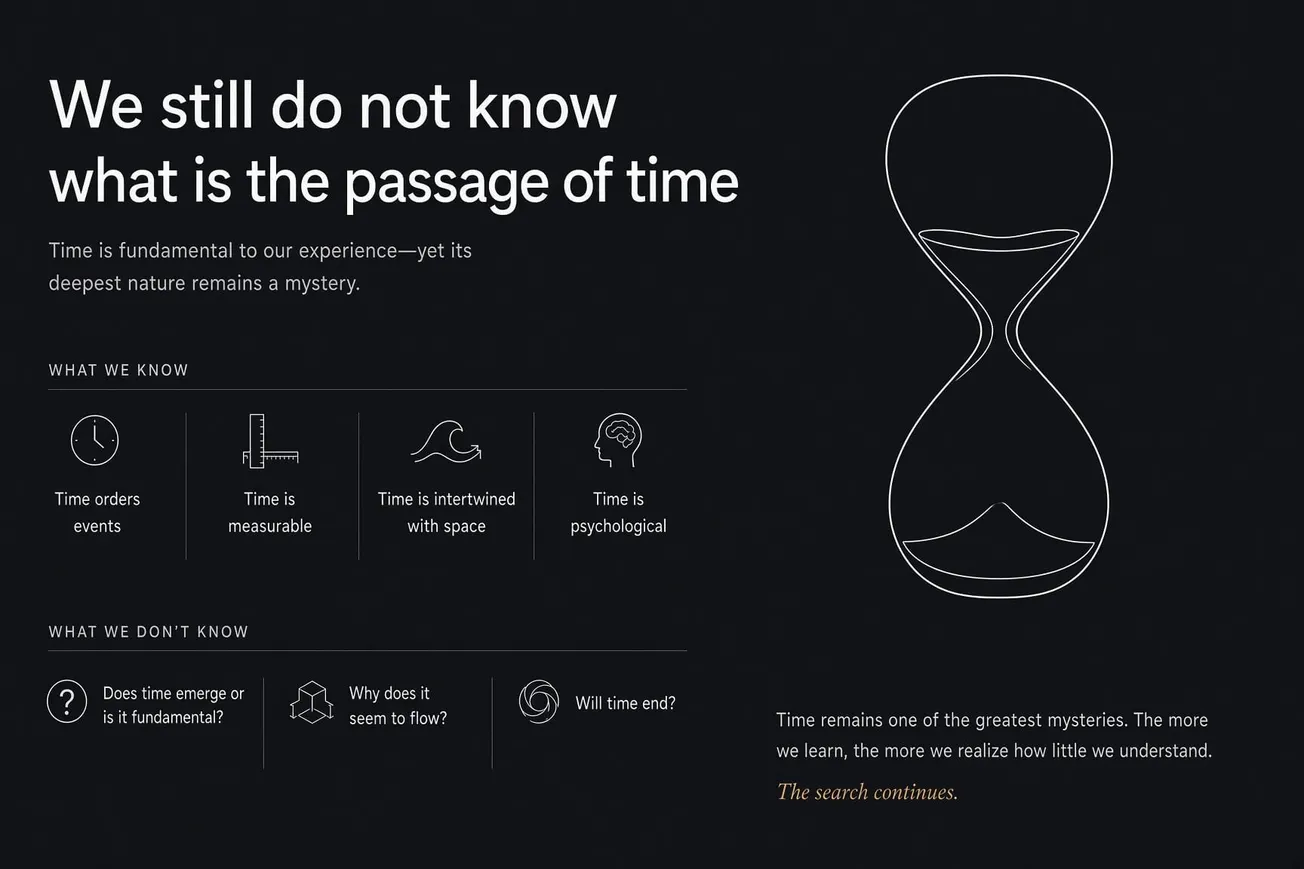
We understand elapsed time with extraordinary precision. We understand part of time’s direction. We do not know whether the passage of time is a fundamental feature of reality, an emergent feature of physical records, or no additional physical process at all.
The confusion survives because all three questions are called “What is time?”
First, remove the sleight of hand
- there is no absolute velocity,
- therefore motion is relational,
- therefore the universe is “one big thing,”
- therefore “there is only one now,”
- therefore past, present, and future all exist.
Steps 3–5 do not follow from steps 1–2. That is BS. The jump is explicit in the source.
Special relativity actually says something close to the opposite of “there is one universal now.” Einstein showed that distant events judged simultaneous in one inertial frame need not be simultaneous in another. There is no frame-independent way of slicing the entire universe into a unique present. (Pitt Sites)
And “all time exists currently” is almost self-contradictory. In the block-universe interpretation, all events exist tenselessly. They are not all simultaneous. The analogy is:
All places may exist, but they are not all here.
All times may exist, but they are not all now.
Einstein’s famous remark about past, present, and future being an illusion came from a condolence letter written after Michele Besso’s death, not from a theorem appended to the equations of relativity. It expressed Einstein’s interpretation of the physics, not an experimentally isolated conclusion of it. (Christie's)
Relativity strongly constrains any theory of a universal present. It does not, by itself, experimentally prove eternalism. There are technically informed arguments for presentism and for evolving-block models, although they remain controversial and often require additional structure.
What does a clock actually measure?
There are three increasingly deep answers.
1. Mechanically, a clock counts change
A pendulum clock counts swings. A quartz clock counts crystal oscillations. An atomic clock compares an electromagnetic oscillator with the phase evolution associated with an atomic transition.
The SI second is currently defined by fixing the caesium-133 hyperfine transition frequency at exactly $9,192,631,770$ cycles per second. That is a definition of the unit, not an explanation of what time is. (BIPM)
An atomic clock therefore does not contain a detector that encounters particles of “time.” It has an internal physical state that changes in an exceptionally reproducible way.
For an atomic transition with energy difference $\Delta E$, the relative phase accumulates approximately as
$$
\Delta\phi=\frac{\Delta E}{\hbar}\Delta\tau.
$$
The clock counts this phase accumulation.
2. Relativistically, an ideal clock records proper time
In flat spacetime,
$$
d\tau=dt\sqrt{1-\frac{v^2}{c^2}}.
$$
In curved spacetime, using the $(-,+,+,+)$ sign convention,
$$
d\tau=\frac{1}{c}\sqrt{-g_{\mu\nu},dx^\mu dx^\nu}.
$$
The quantity $\tau$ is proper time: the Lorentzian length of the clock’s path through spacetime.
So the clean textbook answer is:
A good clock records the proper time accumulated along its worldline.
But “records” can mislead. A clock is not a thermometer dipped into a fluid called time. Its internal constituents simply obey relativistic dynamical laws. Because the relevant matter laws are locally Lorentz-covariant and couple to the same metric, sufficiently isolated clocks of different construction display the same proper-time behavior. Their agreement is a substantive fact about matter and its universal coupling, not a logical consequence of calling them clocks.
That distinction matters. The clock is not passively sensing time. It is undergoing lawful change, and that change correlates with the spacetime metric.
This correlation is extraordinarily well confirmed. Optical clocks can detect the gravitational difference in ticking rate across a vertical separation of only about a millimetre. (Nature)
The attached source’s light-clock argument is therefore broadly correct, but its phrase “time itself is changing” is too loose. What changes is not a universal cosmic time. Different worldlines between events accumulate different amounts of proper time.
3. Foundationally, a clock establishes a correlation
A clock lets us say:
When the clock subsystem is in state $C_n$, the other system is in state $S_n$.
The physical content is the correlation between changes, not necessarily evolution relative to an invisible external substance.
This is the relational answer:
A clock measures one physical process against another physical process.
It does not completely answer why the whole structure exists, but it removes the need for a metaphysical river flowing behind the events.
Your “one and two” intuition
Your intuition is very close to the relational exit, but it needs one correction.
The absence of a reference makes some properties undefined, not the complete state of the object.
For one isolated object:
- Absolute position is undefined without a spatial reference.
- Absolute inertial velocity is undefined without a frame.
- Absolute orientation can be undefined.
- But rest mass, charge, spin magnitude, proper acceleration and internal state relations can remain meaningful.
Likewise, a single event has no duration, just as a single geometrical point has no distance.
You need at least two events to define an interval:
$$
\text{duration}=\text{relation between event }A\text{ and event }B.
$$
But you do not necessarily need two separate objects. One composite object can contain an internal clock degree of freedom. An atom in a suitable superposition contains two energy components whose relative phase changes. It effectively contains its own comparison.
So the sharper statement is:
A literally featureless, unchanging “one” has no operational time.
A system with distinguishable internal states and ordered correlations can have internal time.
And when there are two clocks, relativity does not reduce everything to arbitrary opinion. While separated, their coordinate descriptions depend on frames and signal conventions. But when the clocks reunite, the readings can be placed side by side. The difference in accumulated proper time is invariant. Every competent observer agrees which clock recorded less time.
Relative does not mean unreal. Relative does not mean arbitrary.
A triangle’s angle is relational, but perfectly objective. Proper time is similar: it belongs to a path between events, not to an absolute universal background.
What is the passage of time?
Here the real ignorance begins.
Physics distinguishes at least three things that ordinary language merges.
Duration
Duration is what proper time quantifies. This part is exceptionally well understood.
Direction
Why do we remember yesterday rather than tomorrow? Why do eggs break but not spontaneously reassemble? Why are causes recorded before their effects rather than after them?
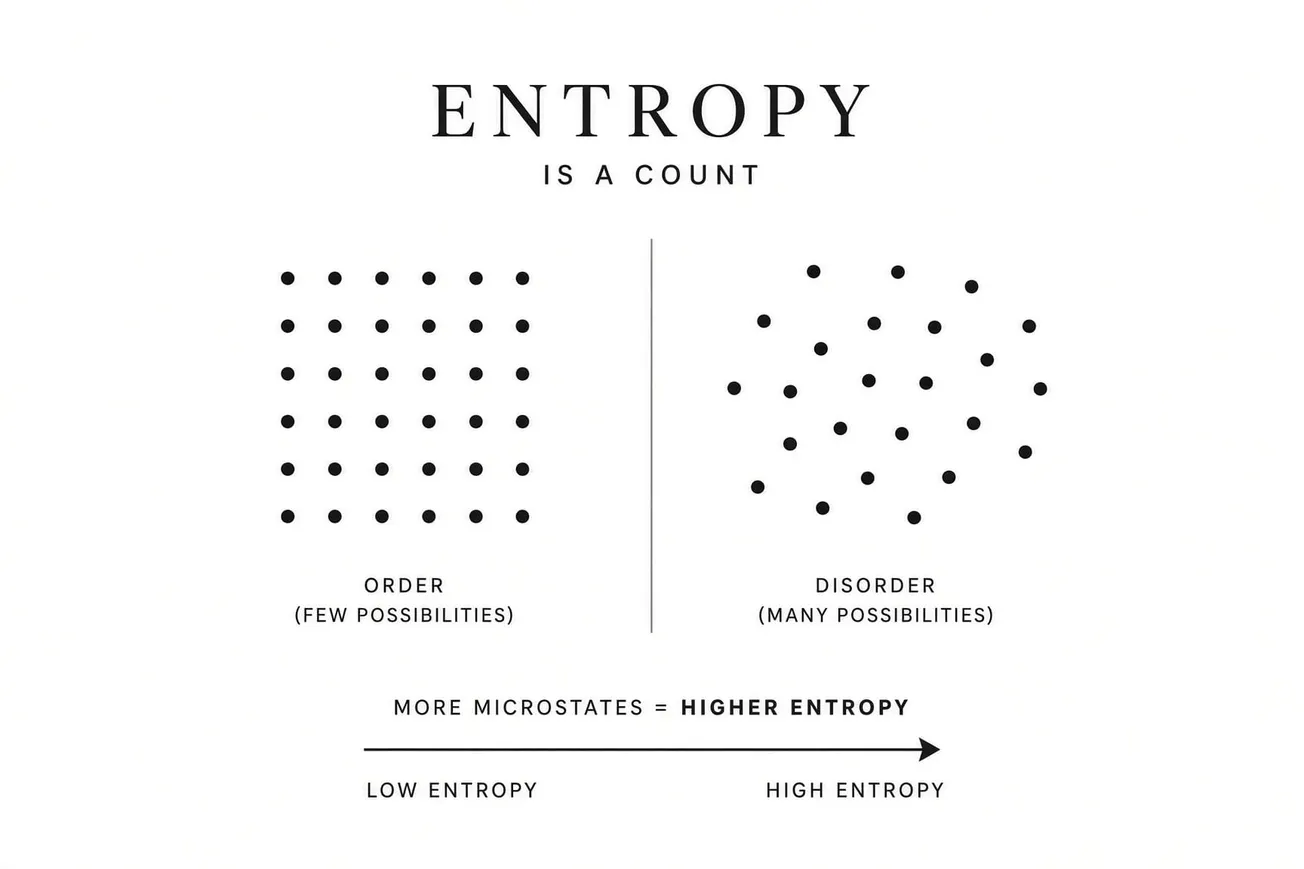
The standard account appeals to an extraordinarily low-entropy boundary condition in what we call the past. From such a state, overwhelmingly many microscopic trajectories lead toward larger coarse-grained entropy in one temporal direction. This explains the thermodynamic arrow conditionally—but it does not explain why the universe possessed that special boundary condition. (arXiv)
Physical memories are records: present structures correlated with other states. There are explicit models showing that robust, non-fine-tuned memories generically point in the same direction as the thermodynamic entropy gradient. This helps explain why psychological time agrees with thermodynamic time. (arXiv)
But entropy explains an arrow within time. It does not automatically explain why there is time at all.
Passage or becoming
Passage would mean that events undergo a real ontological transformation:
$$
\text{not yet real}\rightarrow\text{present}\rightarrow\text{past}.
$$
Standard relativity contains no variable representing this transformation. There is no measurable “present surface” moving through spacetime. There is also no independent parameter against which we could measure the speed of time’s passage.
“How fast does time pass?” produces
$$
\frac{dt}{dt}=1,
$$
which contains no information. To define a rate, we need one quantity changing relative to another. If the denominator is merely a second copy of time, the explanation has gone in a circle.
That does not prove passage is unreal. It means standard physics has no independent observable corresponding to it.
Why are we still stuck after 120 years?
Not because physicists neglected the question. The remaining problem is unusually resistant for four reasons.
First, experiments test relations, not metaphysical interpretations. A block universe, a relational universe and some forms of objective becoming can reproduce the same clock readings. Better clocks test relativity more precisely; they do not necessarily distinguish what the mathematical structure means.
Second, there is no external clock for the universe. We are embedded subsystems. We cannot step outside reality, observe its total state at successive meta-times and compare them.
Third, general relativity and quantum mechanics assign incompatible roles to time. In ordinary quantum mechanics, time is normally an external parameter:
$$
i\hbar\frac{\partial|\psi\rangle}{\partial t}=H|\psi\rangle.
$$
In general relativity, the geometry that determines temporal intervals is itself dynamical. When canonical methods are applied to gravity, one encounters equations of the Wheeler–DeWitt type,
$$
\hat H|\Psi\rangle=0,
$$
with no external $t$. The formal state of the whole universe can appear frozen. This “problem of time” remains a live structural problem, not merely a philosophical complaint. (arXiv)
Fourth, perhaps the demand “What substance is time?” is partly malformed. Distance is not usually considered a substance emitted by rulers. It is a geometrical relation between locations. Time may similarly be a causal and metric relation between events rather than a material ingredient.
The most serious exit: relational time
The relational approach says that the universe as a whole need not evolve relative to an external clock. One subsystem functions as a clock, and other subsystems are described relative to its state.
Schematically, a globally constrained state can have the form
$$
|\Psi\rangle=\int d\tau,|\tau\rangle_C\otimes|\psi(\tau)\rangle_S.
$$
The total state $|\Psi\rangle$ may be stationary, while the conditional state
$$
|\psi(\tau)\rangle_S\propto \langle\tau|\Psi\rangle
$$
changes relative to clock reading $\tau$.
Thus:
The whole does not change relative to anything outside it.
Parts change relative to other parts.
This is not wordplay. Page–Wootters-type constructions can recover ordinary Schrödinger evolution from clock–system correlations under appropriate conditions. (arXiv)
A 2026 cold-atom experiment has even constructed an internal, entropy-based time variable and used it to order the observed evolution of an analogue system. This was a laboratory testbed for relational-time mathematics, not evidence that the actual universe obeys that particular model of quantum gravity. (arXiv)
Relational time therefore offers a real exit from the need for an external universal clock. It does not yet solve:
- why a particular internal variable is a globally adequate clock;
- why the universe had its entropy gradient;
- why classical spacetime emerges;
- whether objective becoming exists;
- why temporal passage feels immediate rather than inferred.
My best current synthesis
The least extravagant answer is this:
Time is not a substance that flows. It is the causal ordering and metric separation of physical events. A clock is a physical process whose internal phase tracks the metric separation along its path. The arrow of time is the asymmetric production and preservation of records in a universe with an entropy gradient.
Then the experienced present is local, not cosmic.
At each stage, a memory-bearing system contains actionable records of some events in its causal ancestry and not of events outside that ancestry. Its present physical state uses those records to regulate what happens next. From inside such a process, this continually updated frontier is experienced as now.
That may explain passage without adding a cosmic moving spotlight. But it remains an inference, not an established final theory.
The irreducible residue is real:
- Why was the accessible past so low in entropy?
- Does becoming exist objectively, or only perspectivally for embedded systems?
- How does classical proper time emerge from quantum gravity?
- Is causal order more fundamental than time, or does causal order already presuppose temporal direction?
So we are not clueless. We have solved the ruler-and-clock part to absurd precision. We have a strong but conditional account of the arrow. What remains unknown is exactly the deepest part:
Does reality itself happen, or does reality merely contain the complete causal structure within which happening is experienced?
Eduardo Bergel and ChatGPT Sol
t333t.com Research