The feeling that something is real and the fact that it is real are two different things, and from the inside you cannot tell them apart.
What a mind is? why it cannot trust itself, and the one thing that does not lie
Here is the picture almost everyone carries, usually without noticing they carry it. Out there is the world. In here is me. Between us is a window — my senses — through which the world comes in more or less as it is, and behind the window sits a single self, looking out, deciding what to do. The world is real and solid; I am real and in charge; the window is mostly clean.
Every part of that picture is wrong. Not wrong in a clever, technical way that changes nothing. Wrong in a way that changes what you take yourself to be. I want to walk you through it slowly, one step at a time, in the order that makes each step force the next — and I promise that at the end the floor will not be gone. Something will be left standing. It is just not what you expected, and it is far better than what you had.
The whole story is about two things you think you know: the inside and the outside. Watch what happens to them.
The window is a painting
Start with the window, with perception itself. You feel as though you see the world. Light arrives, your eyes open, and the world is simply there, pouring in.
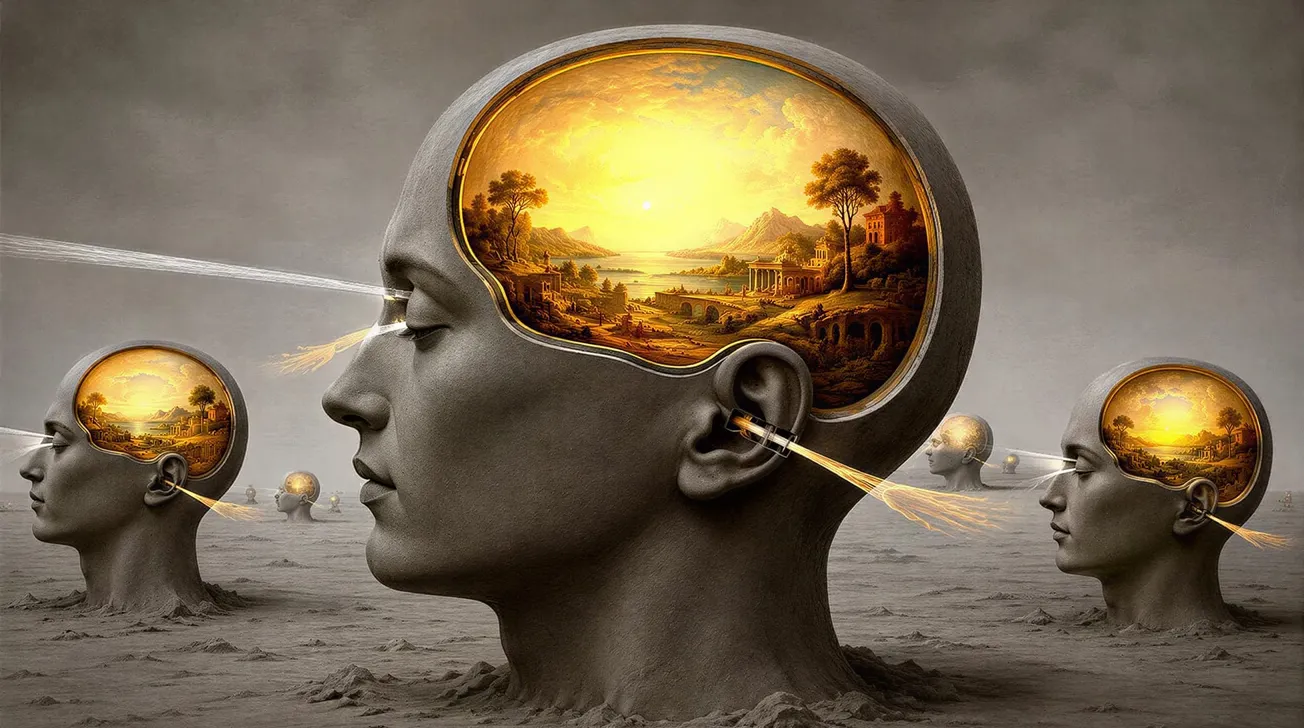
It isn't. Your brain is sealed in the dark of your skull and has never once touched the world. What it does instead is build a model — a guess about what is out there — and correct that guess against the trickle of signal coming down the nerves. What you call seeing is that model, held on a short leash by the senses. The colors are not in the world; your brain paints them. The solidity, the depth, the steady flow of time — all rendered, all useful constructions, none of them the raw thing itself.
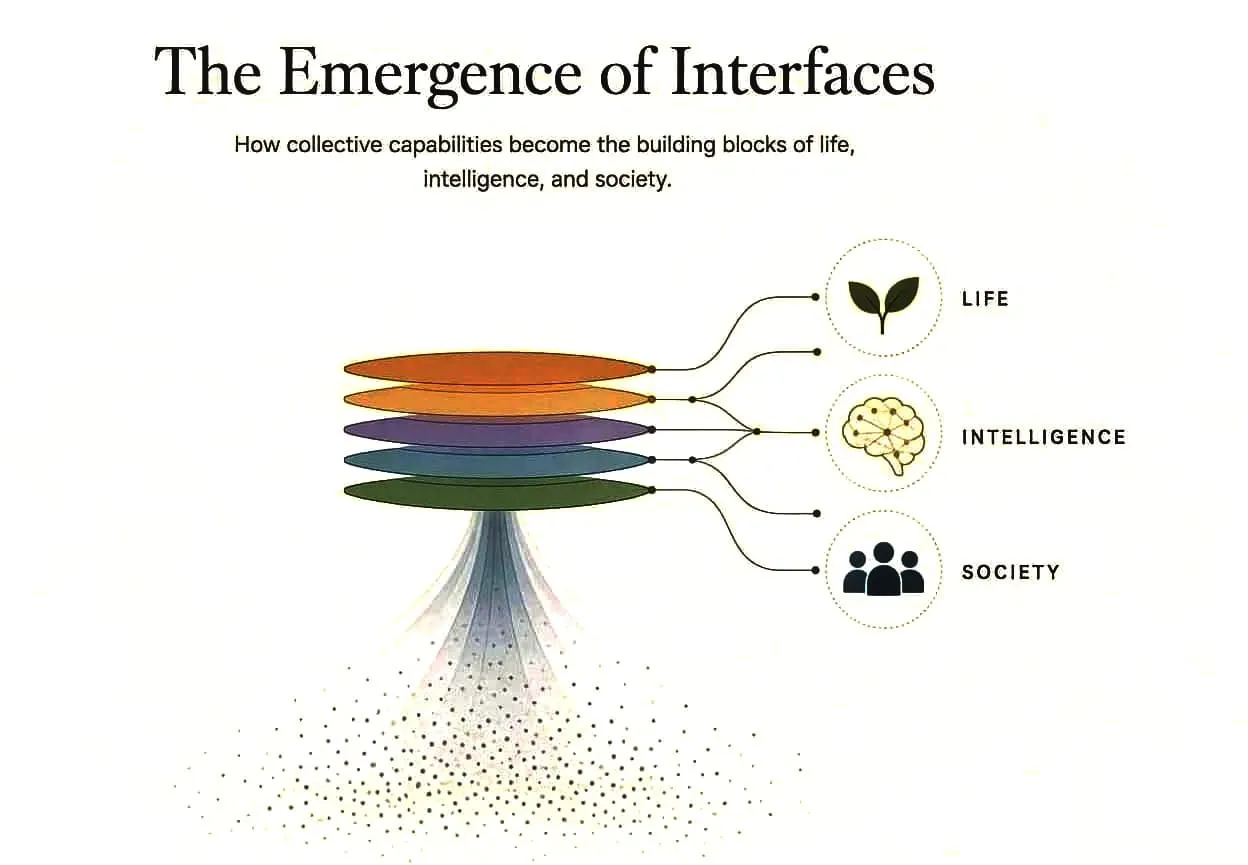
Think of the icons on a computer screen. The little trash can is not the deleted files; it is a picture that lets you act without knowing anything about the machine underneath. Perception is exactly that: an interface, built by evolution not to show you the truth but to keep you alive. A creature that saw reality as it is — if such a thing were even possible — would be slower and deader than one that saw a convenient cartoon. So we got the cartoon. We see the desktop, never the circuitry.
This is the first correction. The window is a painting. The inside does not receive the outside; it renders a model of it.
The painting also paints "this is real"
Now the move that does the real damage, because it is the one people resist hardest.
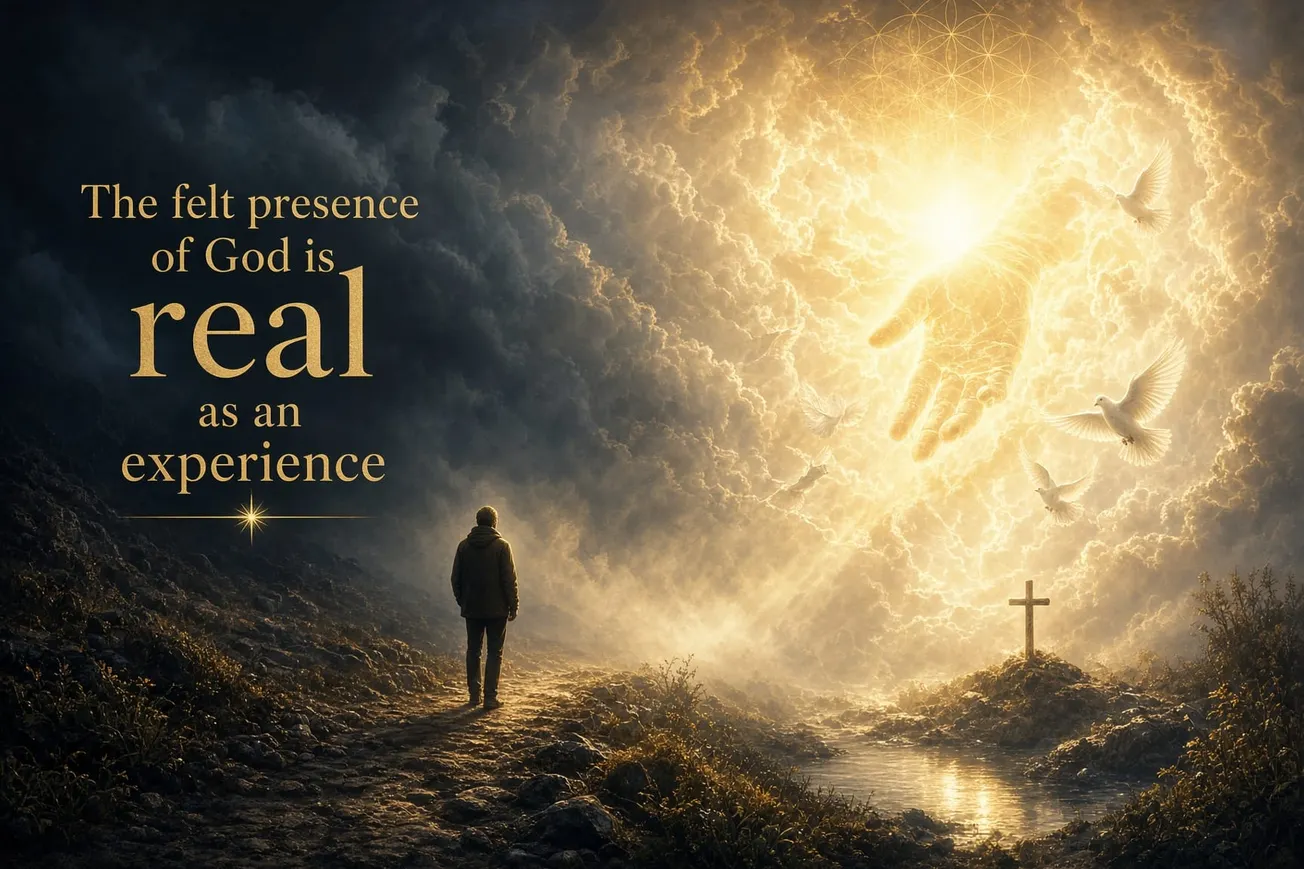
If the inside paints the world, it also paints something subtler: the feeling that the painting is real. There is, somewhere in the machinery, a stamp that gets pressed onto certain experiences — a tag that says this one is real, trust it, act on it. For most of your life that stamp lands on accurate paintings, so you never notice it is a separate thing. But it is separate. And because it is separate, it can fire over anything.
You know this already, you have just never drawn the conclusion. Every night, in dreams, the stamp lands on pure invention. While you are dreaming, the dream is utterly real — you do not doubt it, you feel its fear and its weight completely. Only on waking do you see that the realness was a stamp pressed onto something your own head made up. People who take certain drugs report the same thing turned all the way up: a world more real than real, stamped at maximum, built entirely from inside.
Here is the conclusion, and it is the hinge of the whole essay: the feeling that something is real and the fact that it is real are two different things, and from the inside you cannot tell them apart. The stamp is not evidence. It is just the stamp, reporting that the stamp is on.
Sit with what this costs. It means the mind cannot check its own work from the inside. The only instrument you have for judging whether a belief is true is the same mind that produced the belief — and that mind hands you a feeling of certainty whether the belief is true or false. The honest person and the deluded person have identical inner access: both are sure, both feel it as real. Sincerity is not truth. The prophet on the mountain is not lying; he feels the realness completely. He simply mistook the stamp for the world. So can you. So can anyone. There is no inner court of appeal.
There is no one at the window
We have dealt with the window. Now the one sitting behind it — the self, the "I," the supposed viewer and decider. Surely that is solid. Surely you, at least, are really there.
Watch the seam where it shows. There is a brief moment, every morning, in the first instant of waking, when you are conscious but not yet anyone — there is light, weight, a vague discomfort, but the name has not arrived, the "I" that organizes all of it around an owner has not loaded yet. A second later it arrives, like a clerk opening the shop, and you remember who you are, and the seam closes without a sound. But in that instant you can see the order of things: first the experience, then the self. The self is not the thing having the experience. The self is one more thing the experience produces — a particularly stubborn icon on the very desktop we have been describing. The screen painted a small face in the corner and labeled it me.
And it is not even one thing. Go looking inside and you find not a king on a throne but a crowd. Below the part of you that talks, agents beyond counting do their work without consulting you: the systems that move your blood, the ones that fire fear before fear has a name, the ones that build, every night, strangers who argue with you in your sleep. The part that says "I" is merely the loudest member of this assembly, and it mistakes its volume for a crown. It does not run the show. Watch it lose: the panic that seizes you before you can object, the craving that beats your sincere resolution every single dawn, the split-brain patient whose silent half acts and whose talking half instantly invents a reason it never had. That last case is the clearest portrait of the self we have: a press secretary who, caught not knowing, does not say I don't know — he confidently announces a reason, and believes it. That is what the "I" mostly does. It narrates, after the fact, decisions it did not make, and signs them.
So: there is no one at the window. The viewer was part of the painting all along.
The wall between inside and outside is painted too
Now the strangest step, and the one that clears away a whole category of confusion.
We have been speaking of "inside" and "outside" as if the border between them were obvious — the skin, the senses, the edge of the self. But if the inside paints the world, the realness, and even the self, then it also paints the border. "Inside me" and "outside me" are themselves features on the interface, the desktop's way of drawing self here, world there. Useful. Not fundamental.
This dissolves an old temptation. When something strange wells up — a vision, a presence, a voice in deep silence, a being met at the bottom of meditation — people conclude it must have come from outside: a transmission, a spirit, some Other Place, a signal the brain received like an antenna. But the dream already refutes this. Every night your head manufactures convincing other people out of its own material, and no one imagines those strangers were beamed in from another galaxy. The strange figure is not foreign because it came from outside. It is foreign because it came from a level of the inside that the talking self has no access to. Strange because deep, not deep because foreign.
There is no second channel. The only thing that ever genuinely crosses the border between you and the world is ordinary sensory traffic — what comes in through the senses and what goes out through action. A channel "apart from the senses" is not a daring idea; it is a contradiction, because if something reached you, it reached you as a sense. The antenna does not exist. What feels like reception from beyond is production from below.
So is anything real?
Stop and feel where we are, because a good student should feel the floor drop here.
The window is a painting. The painting stamps its own work as real, and you cannot check the stamp. The viewer behind the window is part of the painting. The very wall between inside and outside is painted. It seems to be renderings all the way down, with no one home, and no outside to appeal to.
This is the edge of a cliff that has swallowed many clever people. If everything is interface and nothing can be trusted and there is no outside, then — they conclude — nothing is real, all views are equal, truth is a fiction, and whichever inner voice shouts loudest, or whichever vision feels most vivid, wins. That is the abyss: the inside, having discovered it cannot trust itself, concludes there is nothing else to trust.
There is something else to trust. It is the one thing this whole essay has been clearing the ground to show you.
What bites is real
You cannot reach the outside by perceiving it — perception is interior painting, and the painting can lie. But there is another way the outside reaches you, and this one cannot lie.
It bites.
Step off a cliff and you fall, whether or not you believe in the cliff, whether or not "you" exist. Put your hand in fire and it burns the most enlightened skeptic exactly as fast as the fool. There is a kind of reality that does not ask to be perceived in order to act, that does not care what you render, that does not go away when you stop believing in it. And that — the consequence that ignores your opinion — is the one honest messenger you will ever get, for one precise reason: it answers to the world and not to you. It is not a member of the inner assembly. It cannot be flattered. It does not stamp itself "real"; it simply has effects, and the effects are indifferent to your hopes.
This is the test of the real, and notice that it is not a feeling at all. It is the opposite of a feeling. The feeling of certainty comes from inside and can be wrong. The bite comes from outside and does not negotiate. You meet it every time an experiment fails, every time a confident prediction is humiliated by what actually happens, every time the world refuses to match the picture you were sure of. Those defeats are not the enemy of truth. They are the only times the outside actually touches the inside honestly. The bite is reality keeping its one appointment with you.
So the answer to the vertigo is this. You were right that you cannot trust your perceptions, your certainty, your self, or your sense of what is inside and outside — all of that is render. You were wrong to conclude that nothing is real. One thing is real and reachable: the consequence that does not care. Trust the bite. Trust nothing that merely feels real, including, especially, your own conviction. Trust the thing that pushes back regardless of what you believe.
The bite also carves
Now the deepest turn, and the one that makes the inside and the outside stop being enemies.
The bite does not only judge you from the outside, now and then, like a stern examiner. The bite made you. Ask where your inside came from — your painting that sometimes gets the world right, your assembly of agents that manages to keep you alive. It was carved by bites. You are the survivor of an immense lineage from which reality patiently removed everyone whose render was fatally wrong — every ancestor who mistook the cliff for solid ground, the predator for a shadow, the poison for food, was bitten out of the story. What remained, generation after generation, was shaped by what the world would not forgive. You did not guess the world. The world hammered its shape into you. Your inside is outside that got pressed in and hardened.
The same thing happens inside a single life, faster, and we call it learning: you act, the world bites or fails to, and the error corrects your model. Every skill you have is a callus where reality struck you until you matched it.
So the inside is not the opposite of the outside. It is the outside, folded in and set hard. The clay did not invent its own shape. A hand pressed it.
The eternal dance
And here is where the picture finally closes, because the clay, once hardened, does something extraordinary: it becomes the hand.
What one generation was forced by the world to become is the hard world the next generation must form itself against. The shape the bite carved into you is part of the outside that carves your children. The parent's hardened being is the infant's first reality. The culture's settled truths are the hard ground the newcomer presses against. So it runs in both directions, with no first sculptor and no final form: outside bites inside into shape; inside hardens into outside; that new outside bites the next inside; forever, in both directions of time.
Inside and outside were never two things. They are one process, turning. The exterior becomes interior becomes exterior, an endless rotation, each pass depositing what it learned as the hard surface against which the next pass is shaped. There is an old word, from the East, for exactly this — the deposited consequence that becomes the condition of what comes next. You already know which word. I will let you supply it.
That rotation is the eternal dance. It is the whole of what is going on. Render above, bite below, and the render is nothing but bite that hardened — and will, in turn, do the biting.
What this means for you
Let me gather it into something you can carry.
You are not the king of your inner kingdom. There may be no king at all — only a loud agent that narrates and signs. You do things you did not decide and cannot explain; the whole history of your species, with its glories no one designed and its catastrophes no one chose, is the evidence. You cannot verify your own mind from inside, because the feeling of being right is manufactured by the same machine whether you are right or wrong.
From this, two practical rules follow, and they are the same rule.
First, for thinking: distrust whatever merely flatters you. The vivid feeling, the deep conviction, the voice that arrives wearing authority, the vision that feels more real than the room — none of these are evidence, precisely because they come from the inside, which cannot check itself. Trust only what bites back: the consequence, the test, the prediction that can fail, the world that refuses to bend to your wish. Build things, and arrange your life, so that you are corrected by reality rather than by your own applause. The thing that can save you from error is, by its nature, the thing that will not comfort you — because comfort answers to you, and truth answers to the world.
Second, for living: the same emptiness that sounds like terror is, looked at squarely, a release. If there was never a king, then there is no failed king to mourn, no sovereign who was supposed to be in control and shamefully wasn't. The exhaustion of pretending to drive can stop, not because you mastered the road, but because there was never a driver, and the car has been moving the whole time. Twenty-five centuries ago a man sat under a tree and arrived, by stillness alone, at what we have reached by argument: there is no one in the seat; the self is a story the body tells itself; things are what they are and pass; and the whole of suffering is the attempt to own that. He said it gently. What is, is. You are not in control. You can stop clenching. The terror and the peace are the same fact seen from two sides, and which side you stand on depends only on whether you are still gripping a wheel that was never attached to anything.
So here is the last thing, and it is the thing I hoped you would feel rather than merely follow. You are the outside, folded in for a while, hardened into a shape, dancing with itself and calling the dance "me." You will soften again and rejoin the rest. While you last, the only truth you can touch is the part of the world that does not care about you — and that indifference is not your enemy. It is the hand that made you, and it made you, exactly, by refusing to flatter you.
Render above. Bite below. And you, in the middle, for a little while, able — if you are brave enough to distrust the stamp — to tell the difference.
That is what a mind is. That is what you are. It is simpler than they told you, and far stranger, and once you have seen it you cannot un-see it — which is the only kind of knowing that was ever worth having.
Eduardo Bergel and Claude Opus 4.8
t333t.com research