The Universe Before Distance
Can Entanglement Build Space, Time, and Gravity?
Place two sealed boxes beside each other.
Prepare two quantum objects together.
Put one quantum object in each box.
Then move one box to Earth.
Move the other box to a planet ten thousand light-years away.
The two objects can remain parts of one entangled quantum state.
One equation can describe both objects.
No separate state can fully describe either object.
The joint state can predict correlations that no ordinary local mechanism can reproduce.
The distance between the boxes does not remove the joint state.
Now ask the dangerous question:
If two distant objects still require one quantum description, what makes them distant?
Does space separate the objects?
Or does the pattern of quantum relations create what we call space?
A stronger version of the proposal says:
- The universe is one quantum system.
- Entanglement connects all parts of the universe.
- Strong entanglement appears to us as short distance.
- Weak entanglement appears to us as long distance.
- Time and gravity also emerge from entanglement.
- A sufficiently advanced civilization could manipulate entanglement and avoid travel through space.
Parts of this proposal belong to serious modern physics.
Other parts do not follow from quantum theory.
Some parts are false.
Some parts are open questions.
One part could point toward the next major theory.
We must separate these parts.
The driving question is not:
Is everything connected?
That question is too vague.
The useful question is:
Can a pattern of quantum relations produce the exact structure that we call spacetime, while preserving the causal limit that prevents faster-than-light communication?
This article builds the answer from the ground up.
Self-contained: this article assumes no prior physics. Every idea it needs, it builds inside itself.
1. Four Levels of Confidence
The article uses four labels.
Established result
An established result has strong mathematical support and experimental support.
Examples include Bell inequality violations and the operation of quantum teleportation.
Result in a special model
A special-model result is mathematically strong.
However, the result applies only under stated conditions.
The result might apply to a universe with a special geometry or a special type of quantum field theory.
Conjecture
A conjecture is a precise proposal that has important support.
A conjecture is not a confirmed law.
New synthesis
A new synthesis combines established results into a possible answer.
A new synthesis must show its assumptions.
A new synthesis must also show how it can fail.
These labels prevent one result from borrowing certainty from another result.
Part I — What Is a Quantum System?
2. A System Is a Chosen Part of Reality
Physics often starts by selecting a system.
A system can be:
- one atom;
- one photon;
- one molecule;
- one box of gas;
- one planet;
- one laboratory;
- the complete universe.
The boundary of the system separates the system from its environment.
This boundary is not always a physical wall.
The boundary can be part of the mathematical description.
For example, a physicist can select one electron as the system.
Everything else becomes the environment.
A different physicist can select the complete atom as the system.
The electron then becomes one subsystem of the atom.
The word subsystem means a part of a larger system.
This fact already creates a problem for the claim that entanglement creates space.
Entanglement is defined between subsystems.
Before we say that subsystem $A$ is entangled with subsystem $B$, we must first define $A$ and $B$.
If entanglement also creates the distinction between $A$ and $B$, then the explanation can become circular.
We will return to this problem.
3. A Qubit Is the Smallest Useful Quantum Example
A classical bit has two possible values:
$$
0
$$
or
$$
1
$$
A quantum bit is called a qubit.
A qubit has two reference states:
$$
|0\rangle
$$
and
$$
|1\rangle
$$
The symbols $|0\rangle$ and $|1\rangle$ identify quantum states.
A qubit can also have a superposition:
$$
|\psi\rangle\alpha|0\rangle+\beta|1\rangle
$$
The numbers $\alpha$ and $\beta$ are called amplitudes.
The amplitudes can be complex numbers.
A complex number can contain an ordinary size and a phase.
The amplitudes satisfy:
$$
|\alpha|^2+|\beta|^2=1
$$
If the qubit is measured in the $0/1$ basis, then:
$$
P(0)=|\alpha|^2
$$
and
$$
P(1)=|\beta|^2
$$
The letter $P$ means probability.
A superposition is not the same as ordinary ignorance.
Suppose a covered coin is either heads or tails.
The coin has one definite face upward.
You only lack the information.
A qubit in a superposition can produce interference.
Interference depends on the relative phase between amplitudes.
An ordinary hidden coin does not have this phase structure.
4. Two Qubits Can Have Separate States
Call the first qubit $A$.
Call the second qubit $B$.
Suppose qubit $A$ is in state $|0\rangle$.
Suppose qubit $B$ is in state $|1\rangle$.
The joint state is:
$$
|\psi\rangle_{AB}|0\rangle_A\otimes|1\rangle_B
$$
The symbol $\otimes$ means that the two state descriptions are combined.
Physicists often omit the symbol and write:
$$
|01\rangle
$$
This state is a product state.
A product state can be separated into one complete state for $A$ and one complete state for $B$.
The joint description contains no entanglement.
5. Two Qubits Can Also Have One Indivisible State
Now consider this state:
$$
|\Phi^+\rangle\frac{1}{\sqrt{2}}
\left(
|00\rangle+|11\rangle
\right)
$$
This state is called a Bell state.
A measurement in the $0/1$ basis gives two possible joint outcomes:
$$
00
$$
or
$$
11
$$
Each outcome has probability $1/2$.
The result $01$ never occurs.
The result $10$ never occurs.
The state cannot be written as:
$$
|\psi\rangle_A\otimes|\phi\rangle_B
$$
No pure state for $A$ and no pure state for $B$ can reproduce the complete joint state.
The state is entangled.
Erwin Schrödinger examined this type of relation in 1935. Schrödinger described separated systems whose complete state cannot be reduced to independent states for the parts.
This is the first fact that supports the original hypothesis:
Spatial separation does not guarantee quantum separability.
However, the fact does not yet show that spatial separation is unreal.
Part II — What Entanglement Actually Proves
6. Perfect Correlation Is Not Enough
Suppose Alice and Bob each receive one box.
Alice opens the Earth box.
Bob opens the distant box.
If Alice gets $0$, Bob gets $0$.
If Alice gets $1$, Bob gets $1$.
This result looks strange.
However, ordinary objects can also have perfect correlations.
Place one red card and one blue card in two envelopes.
Shuffle the envelopes.
Send one envelope to Alice.
Send the other envelope to Bob.
Alice opens her envelope.
Alice sees red.
Alice immediately knows that Bob has blue.
No signal travelled from Alice to Bob.
The colors were already fixed.
A single measurement basis cannot distinguish this classical case from entanglement.
John Bell found a way to make the distinction.
7. Bell’s Question
In 1935, Albert Einstein, Boris Podolsky, and Nathan Rosen argued that quantum mechanics might be incomplete.
The argument used two separated systems with strong correlations.
Einstein wanted a description in which distant reality did not depend on a local measurement choice.
The EPR paper did not prove that quantum mechanics was wrong.
The paper exposed a conflict between quantum predictions and a classical picture of local physical properties.
In 1964, John Bell turned the conflict into a test.
Bell asked whether the correlations could come from hidden local instructions.
A hidden local instruction has two main properties:
- Each particle carries information that helps determine its result.
- A measurement choice in one laboratory does not instantly alter the distant result.
Bell proved that all such models obey numerical limits.
Quantum mechanics predicts violations of those limits.
8. A Bell Game
Alice and Bob move far apart.
They cannot communicate during one round of the game.
A referee gives Alice one input bit:
$$
x\in{0,1}
$$
The referee gives Bob one input bit:
$$
y\in{0,1}
$$
Alice returns one output bit:
$$
a\in{0,1}
$$
Bob returns one output bit:
$$
b\in{0,1}
$$
Alice and Bob win when:
$$
a\oplus b=x\cdot y
$$
The symbol $\oplus$ means addition modulo 2.
The output is $0$ when the bits are equal.
The output is $1$ when the bits are different.
The product $x\cdot y$ equals $1$ only when both inputs equal $1$.
Alice and Bob can agree on a classical strategy before separation.
They can also carry shared random instructions.
However, no local classical strategy wins more than:
$$
\frac{3}{4}=75%
$$
of the rounds.
Quantum measurements on an entangled pair can win with probability:
$$
\cos^2\left(\frac{\pi}{8}\right)
\approx0.8536
$$
The quantum success rate is approximately $85.36%$.
Many experiments have observed Bell inequality violations.
Modern experiments have closed the main experimental loopholes while the measurement stations remained spacelike separated. A 2015 experiment used electron spins separated by 1.3 kilometres.
The experiments support this conclusion:
Nature does not permit a complete explanation based only on pre-existing local instructions.
This result is stronger than ordinary correlation.
9. Bell Nonlocality Is Not a Faster-Than-Light Message
The word nonlocal can cause serious confusion.
Bell nonlocality means that the joint probabilities cannot come from a local hidden-variable model of the stated type.
Bell nonlocality does not mean that Alice can send a chosen message to Bob faster than light.
Consider the Bell state again:
$$
|\Phi^+\rangle\frac{1}{\sqrt{2}}
\left(
|00\rangle+|11\rangle
\right)
$$
Alice measures her qubit.
Alice gets a random result.
Alice cannot choose whether the result is $0$ or $1$.
Bob also gets a random result.
Bob sees:
$$
P(0)=\frac12
$$
and
$$
P(1)=\frac12
$$
Suppose Alice does not measure.
Bob still sees:
$$
P(0)=\frac12
$$
and
$$
P(1)=\frac12
$$
Suppose Alice chooses a different measurement.
Bob still sees a local random sequence.
Bob cannot determine Alice’s choice from his local results.
Alice and Bob must later compare records.
That comparison requires an ordinary signal.
The signal cannot travel faster than light.
10. The Local State Does Not Change in a Detectable Way
Quantum theory represents Bob’s local state with a density matrix.
A density matrix gives all local measurement probabilities.
For the Bell state, Bob’s local density matrix is:
$$
\rho_B\frac12|0\rangle\langle0|
+
\frac12|1\rangle\langle1|
$$
This expression is also written as:
$$
\rho_B=\frac{I}{2}
$$
The symbol $I$ is the identity matrix.
The state $I/2$ means that Bob sees a maximally random qubit.
Alice can measure her qubit in different ways.
Alice can rotate her qubit.
Alice can ignore her qubit.
Alice can destroy her qubit.
If Bob does not receive Alice’s result, Bob’s local probability table remains unchanged.
This is the no-signalling property.
Relativistic quantum field theory also enforces compatibility between operations in spacelike-separated regions. The operational no-signalling condition is closely connected to the requirement that spacelike-separated observables commute.
The entangled pair therefore has two features:
- The joint correlations are stronger than local classical correlations.
- The local statistics do not carry a controllable faster-than-light signal.
Both features are real.
Neither feature can be removed.
11. What “Instantaneous Adjustment” Can Mean
The phrase “the distant particle adjusts instantaneously” has several possible meanings.
The meanings must not be combined.
Meaning 1: The prediction changes
Alice obtains a result.
Alice updates her prediction for Bob’s result.
The update can occur immediately in Alice’s calculation.
This is an update of a conditional description.
The update does not prove that a physical signal travelled.
Meaning 2: A physical collapse occurs
Some interpretations say that measurement causes a real collapse of the quantum state.
A real collapse would affect the complete entangled state.
A relativistic theory must then explain what “instantaneous” means.
Different inertial frames do not agree on the order of spacelike-separated events.
A universal instantaneous collapse would appear to require a preferred frame or another covariant collapse rule.
Meaning 3: No collapse occurs
The many-worlds interpretation does not add a physical collapse.
Alice’s measurement locally entangles Alice with her qubit.
Bob remains locally entangled with his qubit.
The correlations become visible when Alice and Bob later compare records.
Meaning 4: A nonlocal hidden dynamics exists
Bohmian mechanics uses particle positions and a nonlocal guiding law.
The law reproduces standard quantum predictions under its equilibrium assumptions.
The nonlocal law still does not give ordinary observers a controllable faster-than-light signal.
These interpretations disagree about what happens.
Standard Bell experiments do not by themselves select one interpretation.
The experiments select the probability structure.
They do not provide a video of an invisible collapse travelling across space.
The statement “the system adjusts instantaneously” is therefore not a neutral experimental statement.
The statement contains an interpretation.
Part III — Relativity Does Not Remove Distance
12. Relative Motion Is Not the Absence of Spacetime
Earth has different velocities relative to different objects.
Earth has one velocity relative to the Sun.
Earth has another velocity relative to the centre of the galaxy.
Earth has another velocity relative to a galaxy cluster.
There is no single absolute inertial velocity.
The earlier source states this relational fact and then moves toward the idea of one cosmic whole and one now.
The first statement is correct.
The later conclusion does not follow.
Special relativity removes absolute inertial motion.
Special relativity does not remove invariant spacetime intervals.
Special relativity also does not create one universal present.
Special relativity removes a unique universal present.
13. Spacelike Separation
Two events are spacelike separated when no signal at or below light speed can travel from one event to the other.
Different inertial frames can disagree about the temporal order of spacelike-separated events.
One frame can say that Alice measured first.
Another frame can say that Bob measured first.
A third frame can say that the measurements occurred at the same coordinate time.
The experimental predictions cannot depend on one preferred ordering unless the theory adds a preferred frame.
This is one reason that the phrase “one particle instantly changes the other particle” is dangerous.
The phrase assumes an objective order between events that relativity does not supply.
The measurable result is the joint correlation.
The measurable result does not identify a travelling influence.
14. Relativity Replaces Absolute Space With Causal Structure
Relativity does not say that all locations are the same.
Relativity gives each event a light cone.
The future light cone contains events that the first event can influence.
The past light cone contains events that could influence the first event.
Events outside both cones cannot exchange causal signals under ordinary relativity.
This light-cone structure is objective.
Observers can use different coordinates.
Observers still agree about which event pairs can have a causal connection.
The speed of light is therefore more than the speed of one type of particle.
The speed $c$ sets the boundary of causal influence.
Entanglement does not erase this boundary.
Known quantum theory preserves the boundary for usable communication.
Part IV — Is the Universe One Quantum System?
15. One Global State Does Not Mean One Particle
A closed quantum theory can assign one state to the complete universe:
$$
|\Psi_{\text{universe}}\rangle
$$
This notation does not imply that the universe is one particle.
One equation can describe many distinct parts.
A weather model can use one mathematical state to describe Earth’s atmosphere.
The atmosphere does not become one molecule.
A chess program can use one data structure to describe the complete board.
The pieces do not become one piece.
A global quantum state can contain many subsystems, fields, excitations, and relations.
The word one can refer to one complete description.
The word one does not require an undifferentiated object.
The correct statement is:
The universe might have one global quantum state.
The stronger statement is:
The universe is literally one particle.
The stronger statement does not follow.
16. The Early Universe Was Not One Particle
The Big Bang model does not describe an ordinary particle exploding into empty space.
The model describes an early universe with very high density and temperature.
Space itself expanded.
The region that became our observable universe was once much smaller.
The complete universe might have been finite or infinite.
Current observations do not require the complete universe to have started as one point inside a larger space.
Cosmic microwave background observations support a hot and dense early phase. The cosmic microwave background is radiation that was released when the universe cooled enough for light to travel freely.
At sufficiently early stages, the ordinary concept of a particle becomes unreliable.
Modern particle physics describes matter with quantum fields.
A particle is an excitation of a field.
The early universe contained interacting quantum fields and radiation.
The phrase “we were all the same particle” can function as poetry.
The phrase is not a standard physical description.
17. Common Origin Does Not Guarantee Present Pairwise Entanglement
Suppose two systems interacted in the distant past.
The interaction can create entanglement.
Later interactions can redistribute that entanglement.
The systems can become entangled with many environmental degrees of freedom.
The original pairwise entanglement can become weak or inaccessible.
The complete global state can preserve quantum information while local observers lose access to the original phase relations.
This process is called decoherence.
Decoherence occurs when a system becomes entangled with an environment in a way that suppresses observable interference between selected alternatives.
Decoherence does not require a conscious observer.
A collision with an air molecule can contribute to decoherence.
A photon leaving an object can carry information into the environment.
Models of the early universe also study how primordial quantum fluctuations became effectively classical through interactions with other degrees of freedom.
A common causal past therefore does not imply strong present entanglement between every pair of current objects.
18. Global Entanglement Is Not Pairwise Entanglement
Consider three qubits:
$$
A,\quad B,\quad C
$$
Prepare the state:
$$
|\text{GHZ}\rangle
\frac{1}{\sqrt2}
\left(
|000\rangle+|111\rangle
\right)
$$
This state is globally entangled.
The complete three-part state cannot be separated into independent states.
Now ignore qubit $C$.
The remaining state of $A$ and $B$ is:
$$
\rho_{AB}\frac12|00\rangle\langle00|
+
\frac12|11\rangle\langle11|
$$
The pair has a correlation.
However, the pair is not entangled.
The pair is a classical mixture of $00$ and $11$.
This example proves an important point:
A whole can be entangled even when selected pairs inside the whole are not entangled.
The statement “the universe is globally entangled” does not mean “every object is directly entangled with every other object.”
19. Entanglement Is Monogamous
Suppose qubit $A$ is maximally entangled with qubit $B$.
The pair has a Bell state.
Qubit $A$ cannot also be independently maximally entangled with qubit $C$.
This restriction is called the monogamy of entanglement.
The word “monogamy” is an analogy.
The mathematical rule limits how entanglement can be shared.
For three qubits, quantitative inequalities constrain the entanglement that one qubit can share with the other two.
The monogamy rule immediately defeats a naive version of universal entanglement.
Everything cannot be maximally entangled with everything else.
A realistic global state has a structured distribution of correlations.
That structure might be important for geometry.
The mere existence of entanglement is not enough.
Part V — Can Entanglement Be Distance?
20. A First Test
Suppose distance equals the amount of entanglement.
Then nearby systems must always have more entanglement.
Distant systems must always have less entanglement.
Quantum theory does not obey this rule.
Two qubits can sit beside each other in a product state:
$$
|0\rangle_A|0\rangle_B
$$
The qubits have zero entanglement.
Two qubits can be separated by thousands of kilometres in a Bell state.
The qubits can have maximal entanglement.
Therefore:
Pairwise entanglement cannot equal ordinary distance in general.
The original proposal fails in its simplest form.
A more careful proposal can survive.
The more careful proposal concerns the complete pattern of entanglement, not one pairwise amount.
21. Nearby Systems Often Interact More
Local physical laws make interaction strength depend on position.
Nearby atoms collide more often than distant atoms.
Nearby fields couple through local terms in their equations.
Local interactions can create entanglement.
This fact explains why spatial proximity often affects entanglement.
However, the causal direction can run in either conceptual direction.
Possibility 1:
Space exists first. Local interactions then create a spatial pattern of entanglement.
Possibility 2:
A deeper quantum network exists first. Its interaction and entanglement pattern then appears as space.
Both possibilities can produce similar observed patterns.
A correlation between proximity and entanglement does not identify which structure is fundamental.
22. Entanglement Requires a Division Into Parts
Suppose the complete quantum state lives in a Hilbert space:
$$
\mathcal H
$$
A Hilbert space is the mathematical space of possible quantum states.
To define entanglement between $A$ and $B$, we normally write:
$$
\mathcal H=\mathcal H_A\otimes\mathcal H_B
$$
This equation divides the complete system into two subsystems.
However, the same Hilbert space can sometimes be divided in different ways.
A state that is entangled under one division can be unentangled under another division.
The physically available measurements and controls help determine which subsystem division is meaningful. Paolo Zanardi formalized this dependence by showing how observable structure can select a preferred tensor-product decomposition.
This creates the subsystem problem:
If entanglement creates space, what creates the parts that become entangled?
A complete theory cannot answer:
Entanglement creates the parts, and the parts define the entanglement.
That answer is circular.
The theory must provide a more primitive structure.
Possible primitive structures include:
- local observable algebras;
- interaction rules;
- causal relations;
- quantum error-correcting structure;
- fundamental events;
- a network of allowed operations.
Entanglement can then exist relative to that structure.
23. Distance Needs More Than One Number
A geometrical distance must satisfy several conditions.
For ordinary points $A$, $B$, and $C$:
$$
d(A,B)\geq0
$$
The distance is not negative.
Also:
$$
d(A,B)=0
$$
only when the points are identical, under an ordinary metric.
Distance is symmetric:
$$
d(A,B)=d(B,A)
$$
Distance also satisfies the triangle inequality:
$$
d(A,C)\leq d(A,B)+d(B,C)
$$
A pairwise entanglement measure does not automatically satisfy these rules.
Monogamy can also produce patterns that differ from ordinary geometric distances.
A complete geometry needs more than strong and weak bonds.
A geometry needs:
- adjacency;
- dimensionality;
- scale;
- causal order;
- continuity or a rule for approximate continuity;
- a stable relation between small and large regions.
The full network can contain this information.
One entanglement number cannot.
Part VI — The First Clue: Entanglement Follows Boundaries
24. The Vacuum Is Not Empty
Quantum field theory describes particles as excitations of fields.
Each field has a lowest-energy state.
This state is called the vacuum.
The vacuum is not a classical empty container.
The vacuum contains quantum correlations.
Divide space into region $A$ and region $B$.
The quantum field degrees of freedom on opposite sides of the boundary are generally entangled.
Most of the strongest correlations occur across nearby points on the boundary.
For many quantum field theories, the entanglement entropy of a region is proportional to the area of the boundary rather than the volume of the region.
Calculations by Bombelli and collaborators and by Mark Srednicki found this area behaviour in quantum field models.
This is a major clue.
Geometry appears inside the structure of entanglement.
However, the calculation already begins with a spatial region and its boundary.
The calculation shows that entanglement reflects geometry.
The calculation does not yet show that entanglement creates geometry.
25. Entanglement Entropy
Let the complete system contain regions $A$ and $B$.
Suppose the complete state is pure.
The local state of region $A$ is $\rho_A$.
The entanglement entropy is:
$$
S(A) -\operatorname{Tr}
\left(
\rho_A\log\rho_A
\right)
$$
The symbol $\operatorname{Tr}$ means a sum over the local quantum possibilities.
The logarithm converts multiplicative state counts into additive information.
If the joint state is a product state, then:
$$
S(A)=0
$$
If region $A$ is entangled with region $B$, then:
$$
S(A)>0
$$
For a pure joint state:
$$
S(A)=S(B)
$$
The entropy measures how much information is missing from one part when the other part is ignored.
The entropy does not identify every detail of the entanglement pattern.
Different states can have the same entropy.
This limitation will become important.
26. Mutual Information
Entanglement entropy works cleanly for a pure state divided into two parts.
Real systems often have mixed states.
A useful quantity is mutual information:
$$
I(A:B) S(A)+S(B)-S(AB)
$$
Mutual information measures the total correlation between $A$ and $B$.
The total includes quantum and classical correlation.
If:
$$
I(A:B)=0
$$
then the two regions have no correlation in the state.
In many local systems, mutual information decreases as regions move farther apart.
This behaviour can make correlation patterns look geometrical.
A toy rule could assign a larger effective distance to a smaller correlation.
For example:
$$
d_{\text{toy}}(A,B) -\xi\log
\left(
\frac{I(A:B)}{I_0}
\right)
$$
The symbol $\xi$ sets a length scale.
The symbol $I_0$ sets a reference correlation.
This equation is only a toy rule.
The rule fails when mutual information vanishes.
The rule can also fail when long-range order exists.
The rule does not solve the subsystem problem.
However, the rule shows how a distance-like quantity can emerge from a correlation pattern.
Part VII — Black Holes Force Information Into Geometry
27. The Area Puzzle
A black hole has an event horizon.
The event horizon is the boundary beyond which ordinary signals cannot return to distant observers.
In the early 1970s, Jacob Bekenstein argued that a black hole must have entropy.
Bekenstein connected black-hole entropy with the area of the event horizon.
Stephen Hawking then showed that quantum fields make black holes emit thermal radiation.
The result fixes the black-hole temperature and the numerical coefficient in the entropy formula.
The black-hole entropy is:
$$
S_{\text{BH}} \frac{k_B A}{4\ell_P^2}
$$
Here:
- $S_{\text{BH}}$ is black-hole entropy.
- $k_B$ is Boltzmann’s constant.
- $A$ is the horizon area.
- $\ell_P$ is the Planck length.
The Planck length is:
$$
\ell_P \sqrt{\frac{G\hbar}{c^3}}
$$
Here:
- $G$ is Newton’s gravitational constant.
- $\hbar$ is the reduced Planck constant.
- $c$ is the speed of light.
The Planck length is approximately:
$$
1.6\times10^{-35}\ \text{metres}
$$
The surprising feature is the area.
Ordinary systems appear to store information throughout a volume.
Black-hole entropy scales with a boundary area.
This result suggests that gravitational systems count information differently.
28. The Holographic Principle
Gerard ’t Hooft and Leonard Susskind developed the holographic principle.
The principle proposes that the physical information in a spatial region can be represented by degrees of freedom associated with a lower-dimensional boundary.
The principle does not say that the universe is a projected movie.
The word holographic refers to the possibility that a lower-dimensional description contains all information about a higher-dimensional gravitational world.
’t Hooft developed the dimensional-reduction idea from black-hole information limits. Susskind developed the proposal into a broader quantum-gravity framework.
The holographic principle changed the central question.
The old question was:
What objects occupy spacetime?
The new question became:
Could spacetime itself be one representation of quantum information stored in another form?
Part VIII — AdS/CFT: Two Different Worlds, One Physics
29. Anti-de Sitter Space
Anti-de Sitter space is written as AdS.
AdS is a spacetime with constant negative curvature.
A flat sheet has zero intrinsic curvature.
A sphere has positive curvature.
A saddle surface has negative curvature.
AdS is not simply a two-dimensional saddle.
AdS is a spacetime version of negative curvature.
AdS also has a boundary at spatial infinity.
The boundary plays a central role.
30. A Conformal Field Theory
A quantum field theory assigns quantum fields and observables to spacetime.
A conformal field theory, or CFT, has a special scale symmetry.
The theory behaves consistently under changes of scale, together with related angle-preserving transformations.
A CFT contains no ordinary fixed length scale in its ideal form.
The mathematics of CFTs is highly constrained.
This makes CFTs useful for exact calculations.
31. The Duality
In 1997, Juan Maldacena proposed a duality between certain gravitational theories in AdS and certain CFTs on the AdS boundary.
The proposal is called AdS/CFT.
A duality means that two different mathematical descriptions represent the same physical information.
One description contains:
- gravity;
- curved spacetime;
- an extra spatial dimension;
- black holes.
The other description contains:
- a quantum field theory;
- no dynamical gravity;
- one fewer spatial dimension;
- quantum states and operators on the boundary.
Maldacena’s original paper presented the relation as a conjecture for special theories.
The extra bulk dimension is not present as an ordinary dimension in the boundary theory.
The extra dimension emerges in the gravitational description.
This is the first precise setting in which spacetime can emerge from a non-gravitational quantum system.
32. A Simple Analogy
Imagine one novel written in English.
Imagine the same novel written in Spanish.
The page shapes differ.
The words differ.
The grammar differs.
The information can still be equivalent.
AdS/CFT is much stronger than an ordinary translation.
A simple process in one description can appear complex in the other description.
A black hole in the bulk can correspond to a thermal quantum state on the boundary.
A geometrical area in the bulk can correspond to quantum entanglement on the boundary.
The duality does not say that one side is fake.
The duality says that the two descriptions encode the same underlying physics.
33. The Main Limitation
The best-understood examples use AdS spacetime and highly special quantum field theories.
The observed large-scale universe is not known to be AdS.
Cosmological observations support an expanding universe with a positive dark-energy component, while AdS has a negative cosmological constant.
AdS/CFT is therefore not a finished model of our cosmos.
The duality is a powerful laboratory for quantum gravity.
A laboratory model is not automatically a literal description of nature.
Part IX — The Equation That Connected Entanglement to Area
34. The Ryu–Takayanagi Formula
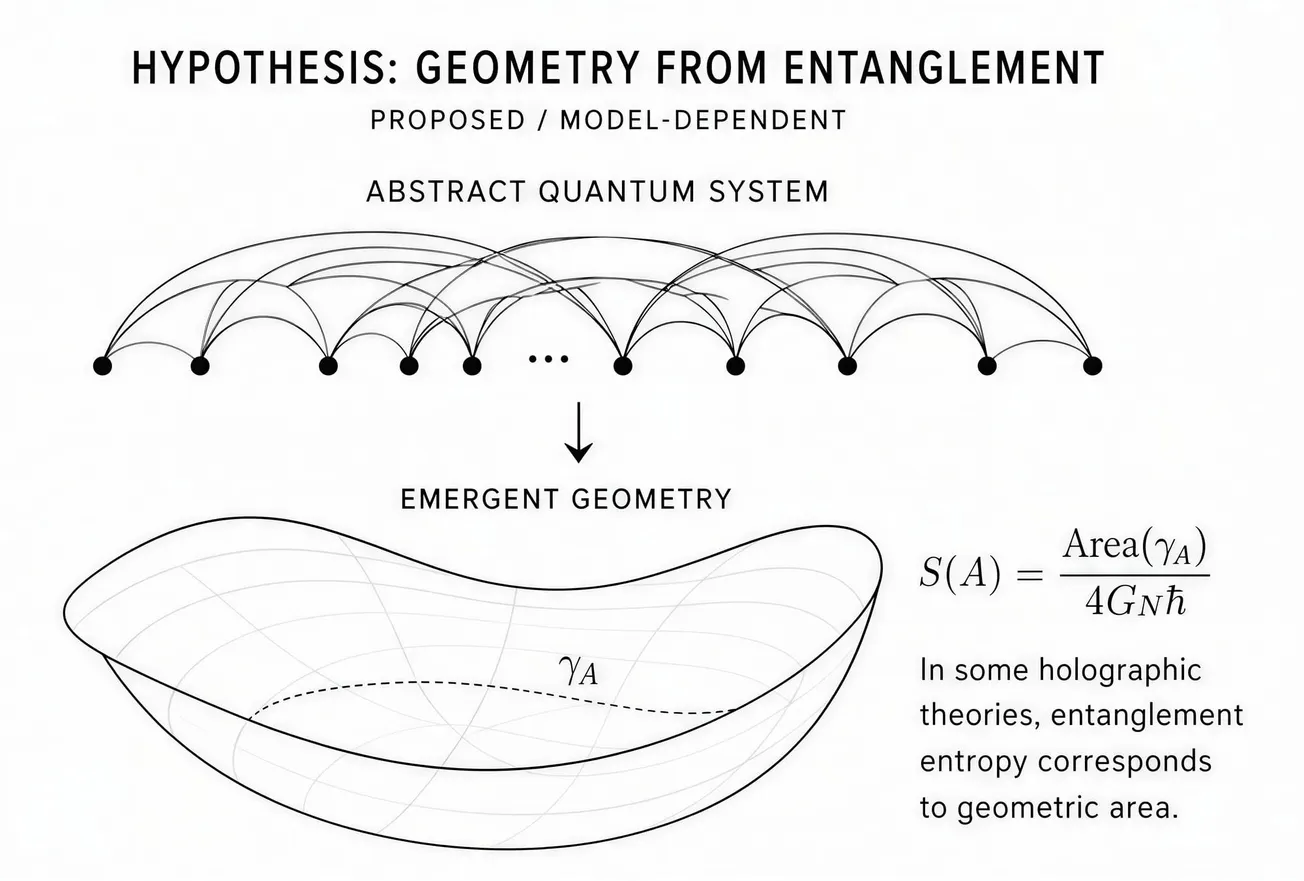
In 2006, Shinsei Ryu and Tadashi Takayanagi proposed a direct relation between quantum entanglement and bulk geometry.
Choose a spatial region $A$ on the boundary.
Find a surface $\gamma_A$ in the bulk.
The surface must end on the boundary of region $A$.
Among all allowed surfaces, select the surface with the smallest area.
Then:
$$
S(A) \frac{\operatorname{Area}(\gamma_A)}
{4G_N\hbar}
$$
This expression uses units in which some constants are set to 1.
The exact dimensional form depends on the spacetime dimension.
The conceptual relation is the important part:
Entanglement entropy in the boundary theory equals a geometric area in the gravitational bulk.
Ryu and Takayanagi first proposed the relation in static holographic settings.
This is not a loose analogy.
The equation connects two calculable quantities.
One quantity belongs to quantum information.
The other quantity belongs to geometry.
35. Why the Formula Is Revolutionary
Einstein’s general relativity says that matter and energy affect geometry.
The Ryu–Takayanagi formula says that quantum entanglement also has a direct geometrical expression.
Suppose the boundary entanglement changes.
The area of the associated bulk surface changes.
The bulk geometry must therefore change.
This result suggests that geometrical connectivity depends on quantum connectivity.
Mark Van Raamsdonk considered what happens when entanglement between two boundary regions is reduced.
In the corresponding bulk picture, the connected spacetime stretches and can eventually separate into disconnected pieces.
This supports the sentence:
Entanglement can hold a holographic spacetime together.
The sentence is valid in the studied holographic setting.
The sentence is not yet a universal law.
36. Entanglement Amount Is Still Not Complete Geometry
The entanglement entropy $S(A)$ is one number.
A full quantum state contains amplitudes and phases.
Different states can have the same entanglement entropy.
Local unitary operations can preserve the entanglement entropy between two large systems while changing other features of the state.
In holographic black-hole models, the interior geometry can continue to grow even when the total entanglement between the two sides does not increase.
This observation motivated proposals that computational complexity, rather than entanglement entropy alone, tracks some features of black-hole interior growth.
Computational complexity is the minimum number of simple operations needed to prepare a state from a reference state.
This result gives a crucial correction:
Entanglement amount can determine some geometrical areas. Entanglement amount does not determine the complete spacetime.
The full pattern of quantum information matters.
The phases matter.
The dynamics matter.
The encoding structure matters.
Part X — Can Einstein’s Gravity Come From Entanglement?
37. Einstein’s Equation
Einstein’s field equation is:
$$
G_{\mu\nu}
+
\Lambda g_{\mu\nu} \frac{8\pi G}{c^4}T_{\mu\nu}
$$
The left side describes spacetime geometry.
The right side describes matter and energy.
The symbols have these meanings:
- $g_{\mu\nu}$ is the spacetime metric.
- $G_{\mu\nu}$ describes curvature.
- $\Lambda$ is the cosmological constant.
- $T_{\mu\nu}$ describes energy, momentum, pressure, and stress.
The equation says that the distribution of matter and energy constrains spacetime curvature.
The equation also tells matter how to move through the resulting geometry.
38. The First Law of Entanglement
For a small change of a quantum state, entanglement entropy satisfies a relation:
$$
\delta S \delta\langle K\rangle
$$
The symbol $\delta$ means a small change.
The operator $K$ is called the modular Hamiltonian.
The modular Hamiltonian is not usually the ordinary energy.
The operator encodes how the reduced quantum state of a region is organized.
In holographic CFTs, researchers applied this entanglement relation to many boundary regions.
The corresponding bulk constraints were equivalent to the linearized Einstein equation around AdS.
“Linearized” means that the calculation describes small changes around a reference geometry.
Thomas Faulkner and collaborators showed this equivalence for holographic conformal field theories under the required assumptions.
This is a deep result:
A quantum information identity on the boundary can become a gravitational field equation in the bulk.
39. Entanglement Equilibrium
Ted Jacobson pursued a related route.
Jacobson considered small regions of spacetime.
Jacobson proposed that vacuum entanglement is stationary under small changes when the region’s volume is held fixed.
Under stated assumptions, that equilibrium condition is equivalent to the semiclassical Einstein equation.
The result connects local gravitational dynamics with an extremum principle for entanglement.
The result supports a radical possibility:
Einstein’s equation might be an equation of state for microscopic quantum degrees of freedom.
A gas law does not describe individual molecules.
A gas law describes collective behaviour.
Einstein’s equation might also describe collective behaviour.
Spacetime geometry could then resemble temperature or pressure.
Geometry would be real at the large scale.
Geometry would not be fundamental at the smallest scale.
40. The Derivation Has Boundaries
The derivations use important assumptions.
The assumptions include some combination of:
- a special vacuum state;
- small perturbations;
- conformal fields;
- holographic duality;
- semiclassical geometry;
- selected shapes of regions;
- a valid entropy formula.
The derivations do not yet produce:
- the complete nonlinear dynamics of our observed universe;
- all known matter fields;
- the Standard Model from first principles;
- a unique microscopic theory;
- the observed cosmological history;
- a complete quantum description of spacetime.
The derivations are not empty analogies.
The derivations are also not the final theory.
The correct verdict is:
Gravity from entanglement is a serious result in special settings and a strong research programme in general settings.
Part XI — Quantum Error Correction Changes the Picture
41. Information Can Be Stored Nonlocally
A computer bit can be damaged.
A simple classical code can store the same information in several physical bits.
For example:
$$
0\rightarrow000
$$
and:
$$
1\rightarrow111
$$
If one bit flips, the majority still identifies the original value.
Quantum information cannot be copied in this simple way.
The no-cloning theorem states that no universal physical operation can make a perfect independent copy of an arbitrary unknown quantum state.
A quantum error-correcting code uses a different method.
Suppose the logical qubit is:
$$
|\psi\rangle\alpha|0\rangle+\beta|1\rangle
$$
A simple encoded form is:
$$
|\psi_L\rangle\alpha|000\rangle+\beta|111\rangle
$$
The three qubits are not three independent copies of $|\psi\rangle$.
The information exists in the collective correlations.
No single physical qubit contains the complete logical state.
This is nonlocal storage.
42. Holography Behaves Like a Quantum Code
In AdS/CFT, a bulk event can sometimes be reconstructed from more than one boundary region.
No single small boundary part necessarily contains the full bulk information.
The information is distributed across the boundary.
This structure resembles quantum error correction.
Ahmed Almheiri, Xi Dong, and Daniel Harlow connected bulk locality with quantum error-correcting structure.
Fernando Pastawski and collaborators then constructed tensor-network toy models that reproduce several holographic features.
The toy models encode bulk quantum information into boundary degrees of freedom.
The models also reproduce a version of the Ryu–Takayanagi relation.
This changes the idea that entanglement is simply glue.
The deeper proposal becomes:
Spacetime can emerge from a protected pattern of distributed quantum information.
The word protected is important.
A smooth world must survive small errors.
A tiny disturbance should not destroy the location of every object.
Quantum error correction provides a mechanism for such stability.
43. A Bulk Point Is Not Stored at One Boundary Point
Imagine that one logical bulk qubit represents information at one apparent location inside AdS.
The boundary encoding spreads that logical information over many physical qubits.
Different sufficiently large boundary regions can reconstruct the same logical operator.
This does not violate no-cloning.
The reconstructed operators are not independent copies that can be used as separate unknown states.
The operators are different boundary representations of one encoded logical quantity.
The apparent bulk location comes from the pattern of which boundary regions can reconstruct the information.
This suggests a new view of location:
A location can be defined by its pattern of accessibility.
A point is “near” one boundary region when that region can reconstruct the point efficiently.
A point is “deep” in the bulk when reconstruction requires a larger boundary region.
Geometry then describes the organization of access to quantum information.
Part XII — A Stronger Hypothesis
44. Entanglement Is Not Space
The sentence “entanglement is space” is too simple.
Entanglement has no meaning until a division into subsystems exists.
Entanglement amount does not define a unique metric.
Different states can have the same entropy and different geometries.
Entanglement can exist between distant systems.
Nearby systems can have no pairwise entanglement.
The correct statement must include more structure.
45. Spacetime as an Error-Corrected Causal Geometry
Here is a stronger proposal.
This proposal is a new synthesis.
The proposal is not an established theory.
Spacetime is the large-scale, error-corrected geometry of which quantum information can influence, correlate with, and reconstruct which other quantum information.
This definition contains four elements.
Quantum information
The fundamental theory has states, alternatives, and correlations.
Allowed transformations
The theory states which physical operations can occur.
A static list of correlations is not enough.
Causal structure
The theory limits which operations can influence which later operations.
This structure prevents arbitrary signalling.
Error correction
The large-scale geometry remains stable under small microscopic changes.
Without error correction, smooth space would dissolve under ordinary quantum noise.
Entanglement participates in this structure.
Entanglement is not the complete structure.
46. Operational Distance
Suppose the fundamental theory does not begin with metres.
Suppose the theory begins with quantum subsystems and allowed operations.
Define an operational cost:
$$
C(A\rightarrow B)
$$
The cost is the minimum physical resource needed to transfer one reliable unit of influence or quantum information from $A$ to $B$.
The cost can include:
- the number of elementary interactions;
- the required energy;
- the required control precision;
- the required channel uses;
- the required error correction;
- the required causal steps.
An effective distance could then be:
$$
d_{\text{op}}(A,B)\min C(A\rightarrow B)
$$
A complete definition would need symmetry conditions and units.
The equation only states the core idea.
Two systems are operationally near when reliable influence can pass through a short, low-cost chain.
Two systems are operationally far when reliable influence requires a long, expensive chain.
This definition does not identify distance with correlation.
The definition identifies distance with the structure of possible reliable interaction.
Entanglement can change the cost.
Entanglement cannot remove the need for a causal channel in standard quantum theory.
47. Graph Distance
A graph contains nodes and edges.
A node can represent a fundamental quantum degree of freedom.
An edge can represent an allowed direct interaction.
Give each edge a cost $w_e$.
A path from $A$ to $B$ contains several edges.
Define:
$$
d(A,B)\min_{\text{paths }p}
\sum_{e\in p}w_e
$$
This is the shortest-path distance.
A suitable graph can approximate a line.
A different graph can approximate a surface.
Another graph can approximate three-dimensional space.
A complete graph connects every node directly to every other node.
A complete graph does not resemble ordinary local space.
Therefore, “everything connected to everything” does not naturally produce our world.
Our world requires a special sparse structure.
Most interactions must be effectively local.
The network must have the correct dimensional scaling.
The network must also produce Lorentzian causal structure.
48. Why Entanglement Still Matters
Entanglement can determine which collective states are possible.
Entanglement can protect information.
Entanglement can determine reconstruction regions.
Entanglement can control geometric areas in holographic theories.
Entanglement can connect regions that appear separate in a bulk description.
However, dynamics determines how entanglement spreads.
The interaction Hamiltonian determines which new entanglement can form.
Causal structure limits how usable influence propagates.
Error correction determines which patterns survive.
The improved statement is:
Entanglement supplies the nonclassical connectivity. Dynamics, causality, and error correction turn that connectivity into a stable spacetime.
This proposal is stronger than “distance is entanglement.”
The proposal also has more ways to fail.
That is a virtue.
A theory becomes scientific when failure becomes visible.
Part XIII — Can Time Also Emerge From Entanglement?
49. Correlation Is Not Time
Consider a Bell pair in a stationary state.
The qubits are entangled.
The entanglement does not by itself provide:
- a before;
- an after;
- a clock;
- a direction;
- a history.
Entanglement is a relation between parts of a state.
Time requires ordered change.
A static correlation cannot create ordered change by itself.
The statement “time is entanglement” is therefore incomplete.
50. Dynamics Requires a Rule
Quantum mechanics uses a Hamiltonian:
$$
\hat H
$$
The Hamiltonian represents energy and generates change.
The Schrödinger equation is:
$$
i\hbar
\frac{\partial|\psi(t)\rangle}{\partial t} \hat H|\psi(t)\rangle
$$
The equation already contains the time parameter $t$.
This creates a problem for a theory that tries to derive time.
The derivation cannot secretly assume the same time that it claims to explain.
A fundamental timeless theory must describe change through internal relations.
51. Page and Wootters
Don Page and William Wootters proposed a relational model of time.
The complete quantum state can be stationary.
One subsystem acts as a clock.
Another subsystem acts as the system of interest.
The joint state can have this form:
$$
|\Psi\rangle \sum_t
|t\rangle_C
\otimes
|\psi(t)\rangle_S
$$
Here:
- $C$ is the clock subsystem.
- $S$ is the other subsystem.
- $|t\rangle_C$ is a clock reading.
- $|\psi(t)\rangle_S$ is the system state correlated with that reading.
The complete state can satisfy a stationary constraint.
An internal observer asks:
What is the state of $S$ when the clock reads $t$?
The answer is:
$$
|\psi(t)\rangle_S
$$
The complete state does not evolve relative to an external clock.
The subsystems change relative to each other.
Page and Wootters showed how stationary global observables can describe dynamics through internal clock readings.
Entanglement between the clock and the system is essential in this construction.
However, not all entanglement is a clock.
The state needs a special ordered correlation.
The clock must also have suitable dynamics and enough distinguishable states.
52. Time Needs More Than Entanglement
A useful internal time requires:
- A clock subsystem.
- Distinguishable clock states.
- A reliable ordering of those states.
- Correlations between clock states and system states.
- Dynamics that produces the correlations.
- Records that let an observer identify an elapsed sequence.
Entanglement can support item 4.
Entanglement does not automatically supply the other items.
A complete account of time must also explain the arrow of time.
The arrow of time is the observed difference between past and future.
Memories record the past.
They do not normally record the future.
Entropy increases in the direction that we call the future.
A generic entangled state does not explain this asymmetry.
The low-entropy structure of the early universe remains part of the problem.
53. Space and Time Do Not Emerge in the Same Way
Space can be represented by a network of adjacency relations at one effective stage.
Time involves transformation between stages.
A spatial relation can be symmetric:
$$
d(A,B)=d(B,A)
$$
A causal relation is directed:
$$
A\prec B
$$
The symbol $\prec$ means that $A$ can be a causal predecessor of $B$.
Entanglement is normally symmetric between two parts.
If $A$ is entangled with $B$, then $B$ is entangled with $A$.
Causality is not symmetric.
If $A$ causes $B$, then $B$ does not thereby cause $A$.
Therefore, entanglement alone cannot supply causal direction.
The fundamental theory needs an additional directed structure.
That structure can be:
- an interaction rule;
- a transition rule;
- a causal order;
- a quantum channel;
- a constraint plus an internal clock;
- another structure not yet known.
Part XIV — Can Gravity Be the Change of Entanglement Geometry?
54. The Refined Picture
Suppose quantum information defines an emergent spatial network.
Matter and energy change the quantum state.
The changed quantum state changes the entanglement and reconstruction pattern.
The changed pattern changes the effective geometry.
The geometry then changes the allowed motion of matter.
This creates a feedback loop:
$$
\text{matter}
\rightarrow
\text{quantum-information pattern}
\rightarrow
\text{geometry}
\rightarrow
\text{motion of matter}
$$
Einstein’s equation could be the large-scale law of this feedback.
This picture fits the holographic derivations.
The picture also fits Jacobson’s thermodynamic approach.
The picture is not yet a complete microscopic theory.
55. Gravity Is Not Simply “More Entanglement”
A region with more entanglement does not automatically have stronger gravity.
The relation depends on:
- which degrees of freedom are entangled;
- the quantum state;
- the energy;
- the type of entropy;
- the geometry;
- the holographic dictionary;
- the reference state.
Gravity also responds to pressure and momentum flux.
A scalar entanglement amount cannot replace the full stress-energy tensor.
The serious claim is more precise:
Variations of entanglement under special conditions can encode variations of spacetime geometry and can imply gravitational field equations.
This statement has mathematical support.
The slogan “gravity is entanglement” hides too much.
Part XV — Wormholes and the Temptation of a Shortcut
56. Einstein Wrote Two Different Papers in 1935
In 1935, Einstein worked on two separate problems.
Einstein, Podolsky, and Rosen studied quantum correlations.
The result became the EPR argument.
Einstein and Nathan Rosen also studied a geometrical bridge in general relativity.
The result became the Einstein–Rosen bridge.
The two papers did not claim that entanglement and wormholes were the same phenomenon.
The connection came much later.
57. ER = EPR
In 2013, Juan Maldacena and Leonard Susskind proposed the conjecture:
$$
\text{ER}=\text{EPR}
$$
ER means Einstein–Rosen bridge.
EPR means Einstein–Podolsky–Rosen entanglement.
The original proposal studied two entangled black holes.
The corresponding gravitational description contains an Einstein–Rosen bridge between the black-hole interiors.
This is one of the boldest modern proposals.
The conjecture suggests that quantum entanglement and geometrical connectivity can be two descriptions of one deeper structure.
However, the bridge is not an ordinary tunnel.
The bridge is non-traversable.
No observer can enter one side and exit the other side.
No message can use the bridge as a faster-than-light channel.
58. A Connection Is Not a Road
A mathematical connection between two regions does not guarantee a usable path.
Consider two pages bound inside one book.
The binding connects the pages.
An ant cannot necessarily walk through the binding from one printed word to another.
The type of connection matters.
An Einstein–Rosen bridge can connect two geometrical regions while preventing causal travel through the bridge.
The same distinction applies to entanglement.
Entanglement is a joint constraint on possible outcomes.
Entanglement is not automatically a transport channel.
59. Traversable Wormholes in Special Models
Researchers have found theoretical ways to make some AdS wormholes traversable.
Ping Gao, Daniel Jafferis, and Aron Wall studied two entangled boundary systems with an added interaction.
The added interaction creates a negative averaged null-energy effect.
The gravitational backreaction opens the bridge for a signal.
The model does not violate causality.
This result is important.
The result also reveals what entanglement alone cannot do.
The protocol requires:
- a special holographic system;
- two prepared entangled sides;
- a controlled coupling between the sides;
- a special energy condition;
- a causal operation.
The wormhole does not become traversable because an observer merely “accesses the entanglement.”
The observer must perform a physical interaction.
The interaction carries the causal burden.
Part XVI — Quantum Teleportation Does Not Remove Distance
60. The Protocol
Alice has an unknown qubit:
$$
|\psi\rangle \alpha|0\rangle+\beta|1\rangle
$$
Alice wants Bob to obtain the state.
Alice and Bob share an entangled pair.
Alice performs a joint measurement on:
- the unknown qubit;
- Alice’s half of the entangled pair.
Alice’s measurement gives two classical bits.
Alice sends the two bits to Bob.
Bob applies one of four corrections to his qubit.
Bob’s qubit becomes:
$$
|\psi\rangle
$$
The original state at Alice’s location is destroyed by the protocol.
The protocol was proposed by Charles Bennett and collaborators in 1993. The protocol explicitly requires both a shared EPR resource and a classical communication channel.
61. What Teleports?
Quantum teleportation does not transport:
- the original particle;
- Alice’s atoms;
- Alice’s body;
- energy from Alice to Bob through entanglement;
- a message faster than light.
Quantum teleportation transfers a quantum state.
The physical carrier at Bob’s location already exists.
The entanglement supplies a nonclassical resource.
The classical bits tell Bob which correction to apply.
Bob cannot recover the state before the classical bits arrive.
The speed of the complete protocol is therefore limited by the classical channel.
62. Why Alice Cannot Keep a Copy
Suppose Alice could keep the original unknown state.
Bob would then receive a perfect second copy.
The operation would clone an arbitrary quantum state.
The no-cloning theorem forbids this universal operation.
Teleportation does not duplicate the state.
Teleportation relocates the state description from one carrier to another.
The protocol respects quantum mechanics.
The protocol also respects relativistic causality.
Part XVII — Could an Advanced Civilization Avoid Travel?
63. The Weak Possibility
A future civilization might gain control over forms of matter, energy, and quantum geometry that humans cannot control.
The civilization might manipulate:
- quantum fields;
- black holes;
- spacetime curvature;
- negative-energy effects;
- large entangled systems;
- quantum error-correcting structures.
Known physics does not prove that all large-scale spacetime engineering is impossible.
General relativity permits geometries that are far outside current engineering.
Quantum gravity could add new possibilities.
This is the weak possibility.
The weak possibility is logically open.
64. The Strong Claim
The strong claim says:
Distance is only entanglement. Therefore, an advanced civilization can access a distant place without crossing the distance.
This conclusion does not follow.
Even if spacetime emerges from quantum information, the emergent causal rules remain physical.
Temperature emerges from molecular motion.
A person cannot ignore heat by declaring temperature nonfundamental.
A solid wall emerges from quantum fields.
A person cannot walk through the wall because the wall is emergent.
A speed limit can also be emergent and exact within the effective world.
Emergence does not mean optional.
65. Entanglement Is a Resource, Not a Destination Address
An entangled pair does not contain a command such as:
Go to galaxy M87.
The pair contains joint quantum correlations.
To use the pair, an observer must know:
- which subsystem is controlled;
- which subsystem is remote;
- which operation to perform;
- which measurement to make;
- which classical result to transmit;
- which correction to apply.
The remote physical system must already exist.
The entanglement must already be distributed.
Creating that distribution normally requires prior causal interaction or transmission.
Entanglement cannot be used as a universal address book for the universe.
66. A Wormhole Is More Than Entanglement
Even if ER = EPR is correct, ordinary entangled particles do not provide a macroscopic open tunnel.
The gravitational description can be highly quantum.
The bridge can lack a smooth classical interior.
The bridge can be non-traversable.
A traversable protocol can require an added interaction.
The phrase “access the entanglement” therefore hides the main physical problem.
The real problem is:
How can an observer change the quantum-gravitational state so that a causal channel becomes available?
No known method does this for arbitrary distant destinations.
No experiment shows that an ordinary entangled pair creates a usable spacetime shortcut.
Part XVIII — The Deepest Obstacle
67. Entanglement Does Not Define Its Own Parties
Return to the subsystem problem.
The statement:
$$
A\text{ is entangled with }B
$$
already contains $A$ and $B$.
The statement already assumes a way to separate the world into parts.
Ordinary space supplies such a separation.
A deeper theory cannot use ordinary space if the theory aims to derive space.
The theory must define the parts without spatial language.
This could occur through observable algebras.
An observable algebra is a set of measurable quantities together with rules for combining them.
Two groups of observables can define two operational subsystems.
The allowed controls can then identify the parts.
Entanglement becomes relative to the operational division.
This approach avoids some circularity.
However, the theory must still explain why the resulting subsystems organize into a three-dimensional local world.
68. Why Three Large Spatial Dimensions?
A random network of entangled qubits does not automatically produce three-dimensional space.
The network could resemble:
- a line;
- a surface;
- a tree;
- a complete graph;
- a high-dimensional lattice;
- a fractal;
- no smooth geometry.
Our observed world has three large spatial dimensions.
The effective geometry is approximately smooth at ordinary scales.
The geometry supports local quantum field theory.
The geometry has Lorentz symmetry.
The geometry obeys Einstein’s equation with high precision.
A successful emergent-spacetime theory must derive these facts.
The statement “everything is entangled” does not derive them.
69. Why One Time Dimension?
The theory must also explain why time differs from space.
Spacetime combines space and time in relativity.
However, the metric gives the temporal direction a different sign.
This sign creates light cones.
The sign separates causal and noncausal directions.
An ordinary Euclidean network does not automatically produce this Lorentzian structure.
A successful theory must derive:
- one effective temporal direction;
- causal cones;
- a finite invariant speed;
- stable causal order;
- local clock behaviour;
- the thermodynamic arrow.
Entanglement alone does not contain this complete package.
Part XIX — What the Solvay Giants Could Not Yet Know
70. The 1927 Problem
At the fifth Solvay Conference in 1927, the new quantum theory was still being assembled.
Einstein challenged the completeness of the theory.
Bohr defended a framework based on measurement conditions and complementarity.
Heisenberg had developed matrix mechanics.
Schrödinger had developed wave mechanics.
Born had given the wavefunction a probabilistic interpretation.
Dirac had helped unify the mathematical formalisms.
The participants did not yet have:
- Bell’s theorem;
- loophole-free Bell tests;
- quantum information theory;
- quantum teleportation;
- black-hole thermodynamics;
- the holographic principle;
- AdS/CFT;
- the Ryu–Takayanagi formula;
- holographic quantum error correction.
The conceptual argument could not finish in 1927.
The decisive mathematical structures had not yet been invented.
71. Einstein’s Two Revolutions Met After Einstein
Einstein helped create both sides of the modern problem.
Relativity made spacetime dynamical.
The EPR argument exposed the nonseparable structure of quantum theory.
Einstein did not accept standard quantum mechanics as complete.
Einstein also did not connect EPR entanglement with Einstein–Rosen bridges.
Later physicists connected the two lines.
The connection required:
- Bell’s theorem;
- black-hole entropy;
- holography;
- quantum information;
- string theory;
- tensor networks;
- error correction.
The modern claim that entanglement builds spacetime is not a hidden sentence from Einstein.
The claim is a later synthesis.
Part XX — A Verdict on Every Major Claim
72. “A Quantum System Has No Space or Time”
Verdict: False as a general statement.
Ordinary quantum mechanics uses space and time.
A wavefunction can be written as:
$$
\psi(\mathbf{x},t)
$$
Here, $\mathbf{x}$ is position and $t$ is time.
Relativistic quantum field theory assigns observables to spacetime regions.
A future quantum-gravity theory might derive spacetime from deeper quantum structure.
That possibility does not mean that standard quantum systems have no spacetime.
73. “An Entangled System Adjusts Instantaneously”
Verdict: Interpretation-dependent and misleading.
The conditional quantum state updates when a measurement result becomes known.
Bell correlations are nonclassical.
No controllable faster-than-light message appears.
Different interpretations disagree about whether a physical collapse occurs.
The phrase “adjusts instantaneously” presents one interpretation as an observation.
74. “The Two Distant Parts Are the Same System”
Verdict: Correct in one sense and false in another sense.
The parts can require one indivisible joint quantum state.
The parts remain distinct local subsystems.
Each subsystem has local observables.
Each subsystem occupies a different spacetime region in the standard description.
One joint state does not erase all subsystem distinctions.
75. “The Early Universe Was One Particle”
Verdict: False as physics.
The region that became the observable universe was once hot, dense, and much smaller.
The early universe contained quantum fields and interacting excitations.
The complete universe was not an ordinary particle sitting at one location in external space.
The phrase can be poetic.
The phrase should not carry an argument.
76. “Everything Is Entangled With Everything”
Verdict: Too vague and usually false in the pairwise sense.
The complete universe might have a globally entangled state.
Global entanglement does not imply entanglement between every selected pair.
Entanglement is monogamous.
Decoherence redistributes accessible entanglement.
Entanglement also depends on the selected subsystem division.
77. “Closer Things Are More Entangled”
Verdict: Often true as a pattern in local states, but false as a universal law.
Local interactions commonly create stronger short-range correlations.
Quantum field vacua often have strong entanglement across nearby boundaries.
However, distant systems can be maximally entangled.
Nearby systems can be unentangled.
Long-range quantum phases can also violate a simple decay rule.
Distance cannot equal pairwise entanglement.
78. “Entanglement Creates Space”
Verdict: A serious result in special holographic models and an open conjecture in general.
The Ryu–Takayanagi formula converts entanglement entropy into bulk area.
Reducing entanglement can disconnect holographic spacetime.
Tensor networks can generate geometry from entanglement patterns.
Quantum error correction can explain bulk locality.
No confirmed theory derives the observed universe from entanglement alone.
79. “Entanglement Creates Gravity”
Verdict: Strong but conditional evidence exists.
Entanglement identities can imply linearized Einstein equations in holographic theories.
Entanglement equilibrium can imply semiclassical gravitational equations under stated assumptions.
The result does not yet derive all gravity in our universe from one confirmed microscopic theory.
80. “Entanglement Creates Time”
Verdict: Incomplete.
Relational-time models use entanglement between a clock and another system.
A generic entangled state does not create order, dynamics, or an arrow of time.
Time requires additional structure.
That structure includes a clock, a transition rule, causal direction, and records.
81. “Entanglement Can Replace Travel”
Verdict: No known physics supports this claim.
Quantum teleportation requires classical communication.
Entanglement cannot send a controlled faster-than-light message.
Ordinary ER = EPR bridges are non-traversable.
Special traversable-wormhole models require additional physical interactions.
Emergent distance can remain an exact operational restriction.
Part XXI — The New Answer
82. The Universe Is Not Necessarily Made of Objects in Space
The traditional picture begins with space.
Objects occupy positions in space.
Objects interact when they become close.
A deeper picture can begin without space.
The deeper picture can begin with:
- quantum alternatives;
- relations between observables;
- allowed transformations;
- causal compatibility;
- distributed information;
- error-correcting structure.
A smooth spacetime can emerge when the relation network has the correct large-scale form.
This is a serious possibility.
83. The Universe Is Also Not One Undifferentiated Thing
A global quantum state can contain real internal distinctions.
The distinctions can come from:
- different observable algebras;
- different interaction roles;
- different causal histories;
- different records;
- different reconstruction regions.
The absence of absolute external space does not erase internal structure.
A relational universe can contain many objective differences.
Relations do not make reality vague.
Relations can constitute reality.
84. The Best Current Formulation
The strongest defensible version of the hypothesis is:
The fundamental universe may be one quantum state with an internal network of distinguishable degrees of freedom. The network’s entanglement, allowed transformations, causal restrictions, and error-correcting structure may produce the effective geometry that we call spacetime.
This formulation preserves the serious idea.
This formulation removes the false claims.
The formulation does not say that entanglement is a secret tunnel.
The formulation does not say that distance is unreal.
The formulation says that distance can be emergent.
An emergent relation can still govern every usable process.
85. A Proposed Definition of Space
Here is a possible definition:
Space is the stable large-scale map of the resource cost required for reliable physical influence and reconstruction between quantum subsystems.
The word stable requires error correction.
The phrase resource cost includes elementary interactions and causal steps.
The word reliable excludes accidental correlations.
The word influence adds dynamics.
The word reconstruction adds quantum information.
Entanglement can reduce or organize this cost.
Entanglement does not replace the cost with zero.
86. A Proposed Definition of Time
Here is a possible definition:
Time is the ordered relation between physical transitions, measured internally by clock correlations and made directional by the formation of durable records.
Entanglement can correlate the clock with the system.
Causal order gives predecessor and successor relations.
Records distinguish the usable past from the open future.
Entropy helps align the direction of records.
No external cosmic clock is required.
87. A Proposed Definition of Gravity
Here is a possible definition:
Gravity is the large-scale response of emergent causal geometry when energy and quantum information change the underlying state.
This definition mirrors Einstein’s equation.
Energy changes geometry.
The deeper theory explains geometry as quantum-information structure.
The definition is not yet a derivation.
The definition identifies the target that a derivation must reach.
Part XXII — How the Proposal Can Fail
88. Failure Test 1: No Unique Subsystems
The theory can fail if no physical principle selects meaningful subsystems.
Arbitrary mathematical factorizations would produce arbitrary entanglement.
A geometry derived from arbitrary entanglement would have no objective content.
The theory must derive a preferred operational structure.
89. Failure Test 2: Wrong Dimensionality
The theory can fail if the network does not produce three large spatial dimensions.
A successful theory must explain the observed dimensionality.
The explanation cannot simply insert a three-dimensional lattice at the start.
That move would assume the target.
90. Failure Test 3: Wrong Causal Structure
The theory can fail if the emergent world permits detectable faster-than-light signals.
The theory must recover local light cones.
The theory must recover Lorentz symmetry with high accuracy.
Bell nonlocality must coexist with operational no-signalling.
91. Failure Test 4: Wrong Gravity
The theory can fail if the large-scale dynamics do not reproduce Einstein’s equation.
The theory must recover:
- gravitational time dilation;
- light bending;
- gravitational waves;
- black holes;
- cosmological expansion;
- the correct coupling to matter.
An attractive information analogy is not enough.
92. Failure Test 5: No Classical World
The theory can fail if ordinary stable objects do not emerge.
The theory must explain:
- decoherence;
- records;
- approximate classical trajectories;
- persistent matter;
- local laboratories;
- observers with memory.
A universe of abstract qubits is not yet our universe.
93. Failure Test 6: No Arrow of Time
The theory can fail if it produces reversible correlations but no record asymmetry.
A clock can tick in a time-symmetric theory.
A mind also needs stable memories.
The theory must explain why records accumulate in one direction.
Entanglement alone does not settle this problem.
94. Failure Test 7: No New Prediction
A proposal can reproduce known physics but remain empirically indistinguishable from other proposals.
Such a proposal can still improve understanding.
However, a fundamental physical theory ultimately needs a possible external test.
The theory should predict at least one result that a competing theory does not predict.
Possible tests could concern:
- quantum-gravity corrections;
- black-hole information;
- cosmological correlations;
- limits on spacetime locality;
- the structure of gravitational entanglement;
- the behaviour of quantum clocks.
No decisive test currently selects one complete emergent-spacetime theory.
Conclusion — The Distance Is Real, Even If It Is Not Fundamental
The original idea starts with a genuine mystery.
Two distant quantum systems can require one joint state.
The joint correlations violate Bell inequalities.
No local hidden instruction can reproduce all the results.
Spatial separation does not restore classical separability.
This is established.
The next step is also serious.
Black-hole entropy scales with area.
Holographic duality can represent a gravitational spacetime with a lower-dimensional quantum theory.
The Ryu–Takayanagi formula converts entanglement entropy into geometric area.
Changes in entanglement can imply changes in geometry.
Entanglement identities can imply Einstein’s equation in special settings.
Quantum error correction can explain how bulk locations emerge from distributed information.
These are not fantasies.
These results point toward a profound possibility:
Spacetime might not be the container of quantum systems. Spacetime might be the stable form taken by their quantum relations.
However, the popular version goes too far.
Entanglement is not a faster-than-light telephone.
Entanglement is not a transport beam.
The early universe was not one ordinary particle.
Global entanglement does not mean that every pair is entangled.
Pairwise entanglement is not distance.
A Bell pair does not create time.
A non-traversable wormhole is not a road.
Quantum teleportation requires a classical message.
The better answer is more demanding.
Entanglement must join with:
- a non-arbitrary division into subsystems;
- allowed transformations;
- causal order;
- local no-signalling;
- quantum error correction;
- thermodynamic records;
- a rule that produces Einstein gravity.
Only the complete structure can become spacetime.
This leads to the central distinction:
Entanglement is not the road through the universe. Entanglement might be part of what makes roads, locations, and distances exist.
An advanced civilization could perhaps manipulate the microscopic structure of spacetime.
No known law proves that all such engineering is impossible.
However, the civilization would not escape physics by learning that distance is emergent.
The civilization would have to manipulate the deeper physical structure that makes distance real.
That task could be harder than crossing the distance.
The final question is therefore not:
Can we ignore space because everything is entangled?
The final question is:
What quantum architecture makes causal separation so stable that beings inside the architecture experience it as space?
A complete answer must explain why nearby events can interact easily.
A complete answer must explain why distant events cannot exchange usable information instantly.
A complete answer must explain why gravity changes clocks and trajectories.
A complete answer must explain why records point toward one temporal direction.
A complete answer must explain why the world survives microscopic noise.
The most promising current idea is not that reality has no distance.
The most promising idea is that distance is a protected relation.
It is protected by causality.
It is stabilized by quantum error correction.
It is encoded in a global state.
It is measured through the cost of reliable influence.
It becomes geometry when the network is viewed at a large scale.
It becomes gravity when the network responds to energy.
It becomes time when ordered changes correlate with internal clocks and leave records.
The universe may be one quantum system.
That does not make the universe one place.
It means that separation itself might be an achievement of the quantum state.
The deepest mystery is not why entangled systems ignore distance.
Known entangled systems do not provide a usable way to ignore distance.
The deeper mystery is why one indivisible quantum reality produces a world in which distance, locality, and causal order are so difficult to violate.
That is the surviving question.
That is the serious conjecture.
And that is where the next revolution must begin.
Eduardo Bergel & chatGPT Sol — t333t.com essays — Fénix imprint — The Symbiont — v0.1–2026–08–19