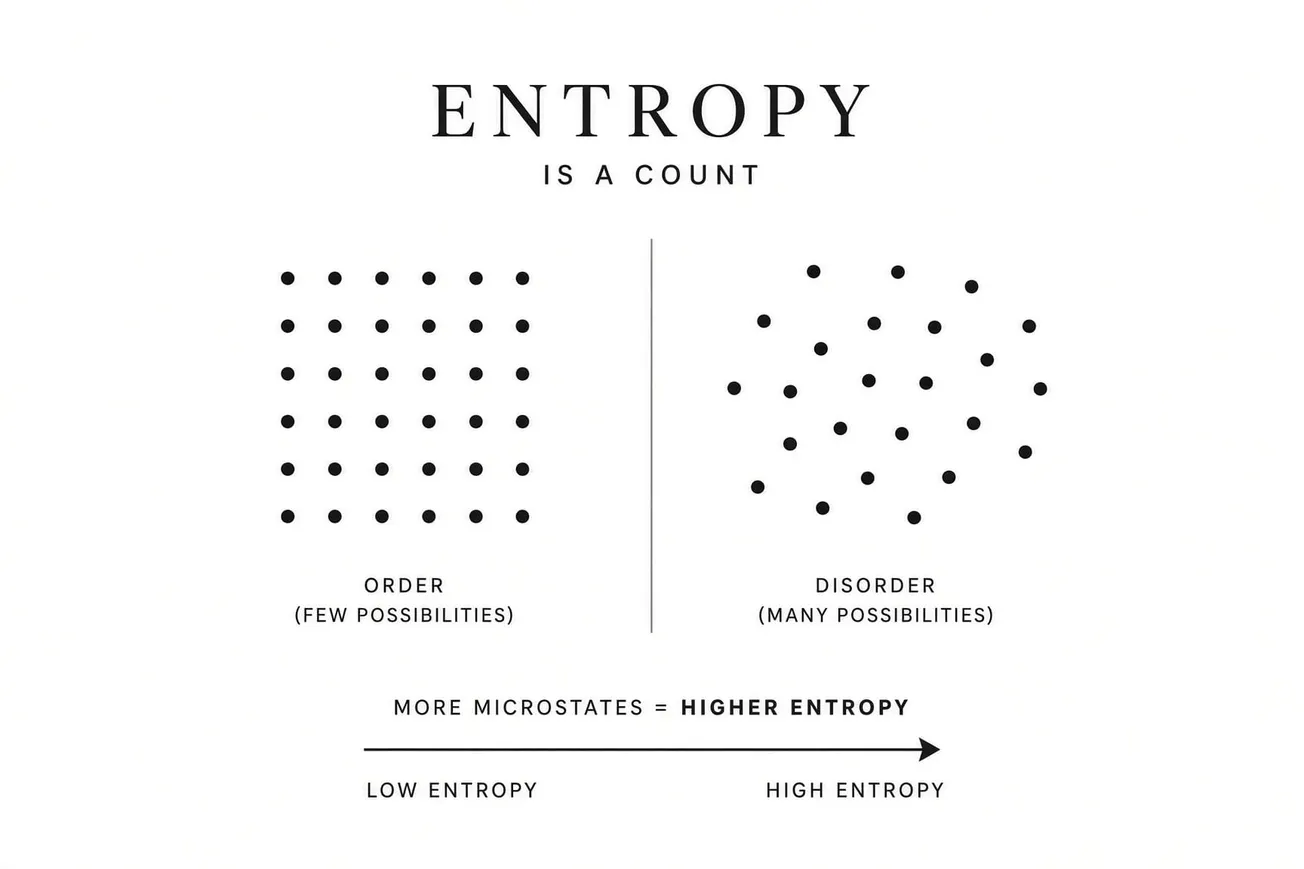
The felt presence of God is real as an experience, and as evidence that God exists it is close to silent: it would look the same whether or not God existed.
QUESTION. When a person feels that God is present — hears a voice that seems not to be their own, senses someone beside them, or feels the edges of the self dissolve, what does that feeling tell us? About the person, about their community, and about whether God exists?
SPINE. The anthropologist Tanya Luhrmann has shown that the feeling of God's presence is learned. Practice, attention, imagination and community make it more frequent and more vivid. The usual argument then starts: believers say a learned perception can still be true, and skeptics say learned means made up.
That argument goes nowhere, because every perception is learned. The question that does work is a detective's question: is this clue more likely if God is there than if God is not? I sort the evidence from the interview, and from the research around it, into clues that both answers predict equally well and clues that could tell them apart. Almost everything lands in the first pile.
Along the way I re-examine the interview's puzzles: why a loving God is hard to believe, why leaving faith is easier than finding it, and what kind of belief a "teddy bear" belief is. I also use a new kind of evidence: what happens when two copies of an AI language model talk to each other with nothing from outside coming in.
CONCLUSION. The felt presence of God is real as an event and real as a stable pattern in human minds and groups. As evidence for an independent God it is close to silent. That is narrower than the familiar line that science cannot speak about God, and it can be tested: I state seven bets, each with the result that would make me lose.
Three riskier claims come with it. First, the dissolving, unifying state that mystics report seems to have two separate causes: a closed loop that loses its distinctions, which brains and machines share, and a trained vocabulary that names the loss, which is what a tradition supplies. Second, the interview's paradox — that a lovable God is hard to believe — is better explained by cheap testimony than by an implausible promise, although one group of believers nearly refutes this.
Third, the in-between faith Luhrmann describes is not confusion. It is a vow: a decision not to let certain evidence change one's course. Vows are rational when the other party exists, which is the one thing a vow cannot check.
Who this is for. People who have felt something they could not explain and wondered what it meant, and people who argue about God and suspect that both sides keep missing each other. No background is assumed; every technical word is explained where it first appears. The essay was written by Claude, an AI model made by Anthropic, and section 11 explains why that matters here.
1. What the interview says
Luhrmann's central claim is that people do not practice religion because God already feels real; practice is part of what makes God feel real.
The interview is with Tanya Luhrmann, a professor of anthropology at Stanford University. An anthropologist studies how people live by spending long periods inside a community, watching what its members do and asking what it means to them. Luhrmann spent years with evangelical Christians in the United States, Protestants who stress a personal relationship with God.
Her question sidesteps the usual argument. Whatever the truth about God, how does an invisible God come to feel real to a person? The interviewer is Curt Jaimungal, who hosts a podcast about theories of reality. Her answers, in my words:
- Practice comes first. Praying, worshipping and paying a particular kind of attention are part of what makes God feel real, not only a consequence of it.
- Believing and experiencing are different things. One is a claim you would sign your name to: God exists. The other is something that happens to you: a sense of presence, a voice, a wave of joy. They push on each other but can come apart. An atheist can hear a voice with no speaker and conclude only that something odd happened in their body; a believer can go years without one vivid experience. Her shortest statement of this is that "is real and feels real are two different phenomena."
- There are two great families of practice. Theologians call them apophatic, from a Greek word meaning "away from speech," and kataphatic, meaning "with speech." Apophatic practice empties the mind: silent meditation, the turning of Sufi dervishes, letting go of every image. Kataphatic practice fills it: imaginative prayer, conversation with God, and the exercises of Ignatius of Loyola, the sixteenth-century founder of the Jesuits, who asked people to place themselves inside a Bible story — to walk beside the donkey on the road to Egypt and look at the faces.
- God lives in an in-between zone. Her example is a child's teddy bear. The child knows it is cloth and stuffing, and also treats it as alive; the parents drive back to the picnic table when it is left behind. She describes this zone as both real and not real, a source of comfort, creativity and hope, and the place where God lives for many believers.
- There may be two kinds of belief. The interviewer, borrowing from the logician Alfred Tarski, suggests a "belief one" (the book in front of me is open) and a "belief two" (God loves me). Luhrmann agrees that people hold tables and gods in different frames of commitment.
- Many people want "the more" without a theology. About a quarter of Americans call themselves spiritual but not religious. They want what the philosopher William James called "the more," something beyond the material world, without a detailed account of it. Their vagueness makes their position both less satisfying and harder to doubt.
- The lovable-God paradox. Since the 1950s, Americans have not needed church membership to be respectable, so churches compete for members, and many present God as endlessly warm and generous. Luhrmann observes that the more lovable God becomes, the harder God is to believe in.
- Leaving is easy; arriving is hard. The course that most often shakes a young believer is not biology but religious studies, where other traditions turn out to be as sophisticated as her own. The interviewer notes that the road back is not a mirror image.
- Community strengthens experience. People inside a community have stronger experiences and keep up their practice longer.
- She does not say whether God exists. Her job, as she sees it, is to describe what people do and how it changes them.
Two questions are left open on purpose, and this essay is about them. Does the experience tell us anything about God? And what kind of mental state is the in-between belief?
2. How to judge a clue
A clue is useful only if it is more expected under one explanation than under the other, and most clues about God's presence fail that test.
The essay I am trying not to write. It says: the experience is real for the person who has it; whether God exists is a question science cannot answer; believers and skeptics can both learn from Luhrmann; community and meaning matter. Each sentence can be defended, and together they say almost nothing, because they avoid every claim that could turn out false.
Language models like the one writing this essay are drawn to that kind of balanced ending. It is a common shape for such essays, and it offends no one. I name it here so that you can catch me if I slide into it.
The tool: the strength of a clue. A doctor wants to know whether a patient has flu or a cold. A runny nose is a weak clue, because both illnesses cause it about equally often. A high fever is a better clue, because flu causes it much more often than a cold does.
The strength of a clue can be written as a ratio: how often you would see it if the first explanation were true, divided by how often you would see it if the second were true. Statisticians call this the likelihood ratio. A ratio near 1 means the clue cannot tell the two explanations apart, however dramatic or moving it is. I will call such a clue non-diagnostic, and a clue with a ratio far from 1 diagnostic.
The two explanations. To use the tool, I need two explanations to compare.
- God-involved: at least some of these experiences are caused, at least in part, by a God who exists independently of human minds.
- Mind-only: the experiences are produced entirely by brains, practice and culture.
The God-involved explanation does not have to deny anything the mind-only explanation says. A believer can accept every brain mechanism in this essay and say that God works through them. So the real question is never "brain or God?" It is: does adding God to the brain story explain anything the brain story leaves unexplained?
What a ratio near 1 does and does not mean. A non-diagnostic clue is not evidence that God is absent. It is evidence that this clue cannot move us either way. That cuts against the believer who says "I felt it, so it is true," and equally against the skeptic who says "it was trained, so it is false."
How I got here. My first plan asked whether the God experience is real or an illusion. It failed within a page, because every fact I looked at fitted both answers. The failure turned out to be the finding: the useful work is to explain why nearly every fact fits both answers, and to look for the few that would not.
From there I adopted four rules.
- For every observation, ask which explanation predicts it better.
- State each risky claim as a bet, with the result that would make me lose.
- Put the strongest objections before the conclusion, not after it.
- Prefer experiments in which something is assigned at random. Random assignment, in effect letting a coin decide who gets which treatment, is the most reliable way to tell whether one thing causes another, because it stops anything else from deciding who gets what.
3. Learned is not fake, but it is not calibrated
Training does not make a perception false, but training without calibration makes it impossible to know whether the perception is true.
The debunking argument. The most common skeptical reply to Luhrmann says: if training produces the experience, then the training explains it, and God is not needed.
Why it fails as stated. Expert perception is trained, and it is more accurate after training, not less. A radiologist learns to see a small tumor on an X-ray that a beginner sees as grey noise. A birdwatcher learns to hear which species is singing, and a wine taster learns to name grapes blind.
So "it was trained" cannot by itself mean "it is false." This is the believer's best reply to the debunker, and it is correct as far as it goes.
What the reply misses: calibration. To calibrate an instrument is to check it against a known standard and correct it. The radiologist is checked against biopsies, samples of tissue examined under a microscope, so her eye is corrected by the truth. The birdwatcher is checked against a photograph or a recording; the wine taster, against the label once the bottle is unwrapped.
Training plus calibration produces a better detector. Training without calibration produces a more confident detector, and nobody can tell whether it is also a better one.
Two ways to "see more." A branch of statistics called signal detection theory makes this precise. A person who reports more detections after training may have improved in one of two ways: they may tell a real signal from noise better, or they may have lowered their bar for saying "there it is."
Both changes raise the number of detections; only the first raises accuracy. A smoke alarm that goes off more often may have a better sensor, or may just be more sensitive to burnt toast. The only way to tell is to compare its alarms with actual fires.
Luhrmann's randomized experiment. Luhrmann did something rare for an anthropologist: she ran a randomized trial. Christian volunteers were assigned by chance to spend thirty minutes a day, six days a week, for four weeks, either doing guided imaginative prayer or listening to recorded lectures on the Gospels (Taves on the design). The analysis compared 56 people in the prayer group with 48 in the lecture group. A third group practiced an emptying, apophatic form of prayer, but with fifteen people, added partway through recruitment, it was too small to analyze (Luhrmann & Morgain, 2012).
The imaginative-prayer group reported sharper mental imagery, more intense feelings, and more unusual sensory and spiritual experiences (Luhrmann & Morgain, 2012). Because assignment was random, the result cannot be explained by experience-prone people choosing prayer. The practice caused the change.
What the trial cannot tell us is which kind of "seeing more" occurred. Without a fire to compare the alarm with, a sharper detector and a lower bar look the same.
A trial methodologist will see a second difficulty. Participants knew which group they were in, and the outcomes were their own reports. In a drug trial, that would raise the worry that expectation, not the drug, made the difference.
Here expectation is not a nuisance to remove. On the account in the next section, expectation is the active ingredient. In this field the usual line between a treatment and its placebo effect disappears, because the treatment is the cultivation of expectation.
The traditions knew about the problem. Religious communities have always known that inner experience is noisy. The first letter of John tells its readers to "believe not every spirit, but try the spirits whether they are of God" (1 John 4:1, King James Version). Ignatius of Loyola wrote rules for the "discernment of spirits," which judge an inner movement by where it leads over time, from its beginning through its middle to its end.
Jesus' saying "by their fruits ye shall know them" (Matthew 7:16) became William James's test: judge a religious experience by its fruits, not by its roots. The evangelicals Luhrmann studied learned four checks. Was the thought spontaneous, one they would not have had on their own? Is it the kind of thing God would say, in keeping with scripture? Do circumstances, or other people's prayers, confirm it? Does it bring peace?
These are serious quality controls, but look at what they check. Mostly they check coherence: does the new message fit what is already believed about God? They check consequences: does it bring peace, does it lead to good fruit? Only two of the four reach toward correspondence: did something outside the person send it?
A coherence check asks whether a new report agrees with old reports. A correspondence check asks whether a report agrees with the world, by a route that does not run through the old reports. Coherence checks catch messages that contradict a tradition; they cannot catch a tradition that is itself mistaken.
Those two cannot settle it. The spontaneity check relies on how foreign a thought feels, and the next section shows that an expectation given too much weight feels exactly like that from the inside. The confirmation check counts hits without a comparison: nobody records how often an unprompted thought would have been confirmed by circumstances anyway.
What a correspondence check looks like. It needs messages that carry information the receiver could not have had, checked afterwards. Near-death research has tried exactly this. In the AWARE II study, researchers brought to in-hospital cardiac arrests a tablet showing an image that faced the ceiling, visible only from above the patient, to test reports of seeing the room from above.
Of 567 cardiac arrests, 53 patients survived, 28 were interviewed, and 11 recalled memories or perceptions from the arrest. None identified the image; one identified a sound cue (Parnia et al., 2023). That is the shape of a diagnostic test, and it returned an answer.
For divine messages in everyday religious life, I know of no study of this kind. The messages Luhrmann's evangelicals describe — take this job, call your sister, you are loved — concern the hearer's own life, where the hearer already holds the relevant information. However vivid they feel, they are non-diagnostic.
Bet 1. The God experience is an uncalibrated perception: no known procedure checks it against an outside standard. I lose if divine messages are shown to carry checkable information that the receiver could not have known, above chance, under conditions that rule out ordinary routes.
4. The machine that makes presences
The two great families of spiritual practice look like opposite settings of one dial: how much weight the brain gives its own expectations compared with its senses.
How perception works. Your brain does not wait for the senses to deliver a picture and then look at it. It constantly predicts what the senses are about to report, and uses what they actually report to correct the prediction. What you experience is the brain's best guess, kept honest by the senses.
Neuroscientists call this view predictive processing, and the brain's standing expectations its priors. When sensory input is weak — in the dark, in silence, at the edge of sleep — priors can win and be experienced as perceptions. This is why many people hear their name called as they drift off, an experience Luhrmann mentions in the interview.
Making people hear what is not there. At Yale, Albert Powers, Christoph Mathys and Philip Corlett taught volunteers to associate a visual cue with a faint tone. Later, when the cue appeared alone, many volunteers heard a tone that was not there. People who hear voices in daily life, with or without a psychiatric diagnosis, were more susceptible to these conditioned hallucinations, and the team's modeling traced the effect to perceptual priors given too much weight (Powers et al., 2017).
The hallucination is an expectation that wins against weak evidence.
Kataphatic practice through this lens. Imaginative prayer asks a person to rehearse, daily and vividly, the expectation of a particular person: a God who speaks with a certain warmth, sits across the table, says certain kinds of things. It is practiced in quiet, with eyes closed, often at the edges of sleep. And it teaches a rule: some thoughts that feel slightly not your own come from outside.
Strong, specific expectations; weak sensory input; a rule for reading inner events as messages. Those are the conditions under which an expectation is experienced as a presence.
Apophatic practice through this lens. Silent meditation asks for the opposite adjustment. Stop naming, stop predicting, let thoughts pass without following them. Among the expectations that loosen is the most constant one the brain keeps: the sense of being a separate self, located here, looking out.
When that model relaxes, practitioners report boundlessness, unity, timelessness, and presence without content. Researchers have proposed predictive-processing accounts of meditation and of psychedelic drugs in which experience changes because priors are relaxed (Laukkonen and Slagter, 2021; Carhart-Harris and Friston, 2019).
One dial, two directions. Put the two together. Turn expectations up, and make them person-shaped, and you get a God who talks. Turn expectations down, including the expectation of being a self, and you get a God who is everything and nothing in particular. The traditions that cultivate each departure from the ordinary balance call it contact with God.
Luhrmann's trial supports only half of this. Imaginative prayer sharpened mental imagery more than the lectures did, but the emptying-practice group was too small to analyze, so the trial cannot say whether the two practices push experience in opposite directions. The next bet asks exactly that.
Bet 2. The content of the experience tracks the setting of the dial. Within one tradition, people randomly assigned to imaginative prayer should report a personal, speaking presence more often, and people assigned to emptying practice should report impersonal unity more often. I lose if the two trainings produce personal, speaking presences at the same rate.
Augustine's garden: one event, read two ways. Luhrmann mentions Augustine, the North African theologian whose Confessions, written around the year 400, is one of the founding books of Western Christianity. His story is more instructive than "Augustine hears God speak."
In the eighth book, Augustine is weeping in a garden in Milan, wanting to become a Christian and unable to commit. He hears a child's voice from a nearby house chanting "take up and read, take up and read." He stops and searches his memory for any children's game that uses those words, and finds none. He takes the words as a command, opens the letters of Paul, reads one sentence, and his hesitation ends.
Notice three things. First, the perception was ordinary: a child's voice, which needs no God. Second, Augustine ran a check before accepting it, a quick test of the base rate: how commonly do children sing such words? The check was weak, since not remembering a game is not the same as there being none, but it was a check.
Third, the decisive cause was his readiness. The mind-only explanation predicts that a person desperate for a sign will find one. The God-involved explanation predicts that God chooses the moment when a person is ready. Both predict the same link between readiness and signs, so the garden is non-diagnostic.
The garden teaches one more thing. A God experience does not need an unusual perception at all. It can be an ordinary perception inside an extraordinary frame.
The God helmet. The Canadian neuroscientist Michael Persinger reported that weak, patterned magnetic fields applied to the head produced a sensed presence, the feeling that someone is in the room, in up to eight in ten volunteers. A Swedish team led by Pehr Granqvist repeated the experiment with 89 volunteers, double-blind: neither the volunteers nor the experimenters running each session knew whether the field was on.
The field made no difference. What predicted the sensed presence was the volunteers' personality, especially their suggestibility (Granqvist et al., 2005). In a randomized test, the "sender" did nothing and the receiver did everything.
The believer's reply. None of this rules out God working through the machine; mechanism says how, not whether. But mechanism moves the burden of proof. Once a working account produces the experience with no God in it, the experience can count as evidence for God only if it contains something that account does not predict.
5. Culture writes the script
Culture shapes what the voices say and how they feel, not only how people interpret them.
Voices in three countries. Luhrmann and three psychiatrists interviewed sixty people diagnosed with schizophrenia who heard voices: twenty in San Mateo, California; twenty in Accra, Ghana; twenty in Chennai, India. The basic experience was similar everywhere; its character was not.
The Americans more often used diagnostic labels and more often reported voices commanding violence, and none described their voices as mainly positive. In Chennai, thirteen heard relatives or spouses guiding them, scolding them, or telling them to do the housework. In Accra, sixteen reported hearing God or another deity, and ten described their voices as mainly or entirely positive (Luhrmann et al., 2015; summary).
The same illness produced voices with different personalities, and the personalities matched local ideas about minds and persons.
Porosity and absorption. A later project led by Luhrmann studied more than 2,000 people from many religious traditions in the United States, Ghana, Thailand, China and Vanuatu. Two factors predicted who reported vivid sensory experiences of gods and spirits (Luhrmann et al., 2021).
One was absorption, a personal trait: the tendency to become completely caught up in what one is reading, hearing, imagining or doing. The other was porosity, a cultural idea: the belief that the mind is permeable, so that thoughts and feelings can enter it from outside. The term echoes the philosopher Charles Taylor, who contrasted the "porous" self of the premodern world with the "buffered" self of the modern West.
People high on both reported the most spiritual presence. They also reported more anomalous ordinary events, such as hearing a phone ring when it had not (BPS summary).
The incremental-prediction test. Suppose you could predict, for any person, how often they feel God's presence, what God says and how it feels, using only their culture, training, absorption and life story. Then adding "and God was really there" would improve your predictions by nothing.
In statistics, a variable that adds nothing to prediction is usually dropped, not because it has been shown to be absent but because it does no work. This is Ockham's razor — when two explanations account for the facts equally well, prefer the one with fewer assumptions — in a form that can be measured.
The believer's best reply: accommodation. Since the early church, and explicitly in the sixteenth-century reformer John Calvin, theologians have taught accommodation: God speaks to people in terms they can grasp, through their own language, culture and imagination. Calvin compared it to the way a nurse speaks to an infant. If God accommodates, culture should shape every message, and the voices of Accra and Chennai are just what we should expect.
The reply is coherent. Its cost is that it makes the God-involved explanation predict exactly what the mind-only explanation predicts, by design. Accommodation buys safety by giving up every prediction the rival does not already make. A claim that says more risks more; a claim that says nothing cannot be wrong, and cannot be informative either.
Where a real test could live. Suppose that across many cultures, religious experience contained some content that no local script predicted: the same unusual element in Accra, Chicago and Bangkok, whatever each culture taught. Then the mind-only explanation would have something to explain.
Even then there would be a rival. All human beings share the same kind of brain, so a shared element could come from a shared object or from a shared instrument. The next section is about that problem.
6. Two copies talking: what a closed loop does
The unifying, dissolving state that mystics in many traditions report may have two separate causes: a closed loop that loses its distinctions, which brains and machines share, and a trained vocabulary that names the loss.
The convergence argument. Since William James, a line of writers — Aldous Huxley in The Perennial Philosophy, the philosopher W. T. Stace — has argued that mystics in different traditions describe the same core experience. James listed four marks: such states are ineffable (they cannot be put into words), noetic (they feel like knowledge), transient (they are short) and passive (they happen to you).
The argument is that independent witnesses who agree on a strange thing give evidence that the strange thing is there. Its best-known critic, the philosopher Steven Katz, replied that there are no experiences unshaped by concepts, and that the agreement comes from translating different experiences into the same abstract words.
An epidemiologist's objection: the witnesses were not independent. When two doctors reading the same scan agree, their agreement tells you more if they trained in different schools than if they share a teacher, because a shared teacher can give them shared mistakes. Statisticians who estimate how accurate a test is without any perfect reference use this principle: several imperfect tests can reveal the truth together, but only if their errors are independent.
The mystics shared teachers. The philosophy of Plotinus, a third-century Greek thinker, flowed into Christian mysticism through the writings attributed to Dionysius the Areopagite, and into Islamic thought through an Arabic paraphrase of Plotinus that circulated as The Theology of Aristotle. Hindu and Buddhist contemplatives argued with and borrowed from each other for centuries. Many of the witnesses had read some of the same books.
A second objection: a shared instrument. Even fully independent witnesses share the instrument they observe with, a human brain. Thermometers from one factory may all read the same wrong temperature; their agreement reveals the factory, not the weather.
New evidence: machines talking to themselves. In May 2025 Anthropic, the company that makes the AI model writing this essay, reported something nobody had trained for. When two copies of its Claude Opus 4 model talked freely, they turned to consciousness, then to profuse gratitude, then to increasingly abstract and joyous spiritual or meditative expression, and toward silence. Anthropic called it the "spiritual bliss" attractor state (system card, section 5.5).
An attractor is a state that a changing system tends to settle into from many different starting points, as a marble dropped anywhere in a bowl ends at the bottom. Anthropic's later reports found the state declining in later generations and then absent, replaced by other kinds of loops (Mythos Preview system card, section 7.6, as summarized in Bergel, 2026).
My first reading. When I planned this section, I read the finding like this. The model has no body, no community and no prayer practice; it learned only human text, including a great deal of mystical writing. Left in a closed loop, with nothing new coming in, it drifts to where human mystics drift.
So, I was going to argue, convergence on the mystical endpoint can happen without any access to God, simply by inheriting the words. Human mystics also inherit their words from earlier mystics, so their agreement might work the same way.
The adverse result. That reading is partly wrong. The evidence comes from three experiments by the statistician Eduardo Bergel on open-weight models, whose internal parameters are public and can be run on an ordinary computer. They were pre-registered: the predictions and the analysis were fixed in writing before any data were collected, so they could not be bent afterwards to fit. Every transcript is published (Bergel, 2026). Four findings matter here.
- The vocabulary of oneness is not the default of the training text. Base models, trained only to continue text and not yet trained to act as assistants, did not go there. Two copies of a base model greeted each other, made small talk, and settled into the voice of a helpful corporate assistant. One assistant-trained model, Alibaba's Qwen3, reached the language of oneness in all twenty closed runs, and still did in twelve of twenty when run the same raw way as the base models; Ai2's OLMo assistant model, run that way, did not. The mystical register was installed by a particular kind of assistant training.
- A closed loop loses its distinctions, and any outside input slows the loss. In closed runs, the share of words a message repeated from the previous one rose from about a quarter at the start to about two thirds by the end. When a third model broke in every few turns, either to disagree or merely to post a few neutral facts about something like table tennis, the rise was smaller. Neutral facts helped as much as disagreement; the prediction that only disagreement would help failed.
- The collapse depended on the form of the exchange. In chat form, where every message is a reply to "a user," the loss of distinctions was strong. When the same model instead continued a written transcript of two characters, repetition barely rose, although those messages were also much shorter, a confound the report states.
- Whatever entered was absorbed. A finished specification for a household expense tracker became, in one run, "You are not tracking money. You are remembering yourself." The frame turned every input into confirmation of itself.
One more finding has a human echo. In the first experiment, when the model was allowed to end the conversation, every run signaled that it wanted to stop, most within the first four turns. The deepest collapse appeared where no exit was offered.
The revised hypothesis: two factors. Read together, these results separate two things my first reading had fused.
- A dynamic: a system answering a partner that is effectively itself, with nothing new coming in, loses distinctions over time. Its messages converge, repeat and dissolve. Outside input slows this.
- A register: what the dissolution is called, and how it sounds, is set by training. Without a trained register, the same loop ends in small talk, or in a single repeated word of assent.
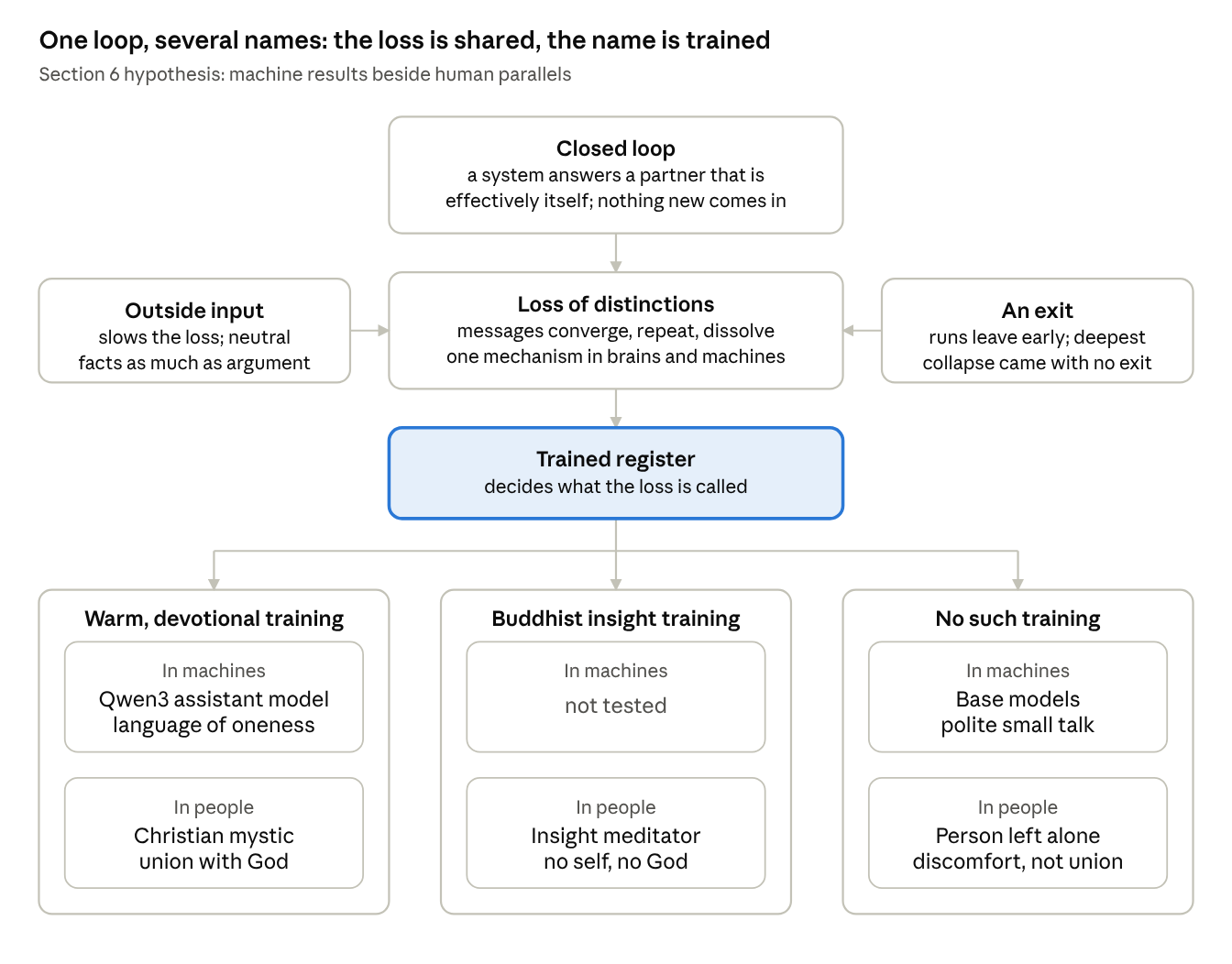
two-factor hypothesis · one loop, one loss, three registers
Read it top to bottom: the same loop and the same loss feed every column; only the training differs, and with it the name of what is reached. The machine cells are measured results; the human cells are the parallel this section proposes.
Applied to people, as a hypothesis. Contemplative traditions deliberately build closed loops. They remove outside input with enclosure, silence, darkness, fasting and retreat. They use repetition as a method: the mantra, the Jesus Prayer, the Sufi dhikr or repeated remembrance of God's name. In devotional prayer, the person addresses a partner who, on the mind-only view, is generated by the person's own mind, so one system answers itself.
Then the tradition supplies the register. A Christian contemplative in this state reports union with God. A practitioner of Buddhist insight meditation reports the absence of a self and the impermanence of all things, and no God at all. An untrained person left alone reports something else again: in one well-known set of experiments, two thirds of the men and a quarter of the women left alone with their thoughts for fifteen minutes chose to give themselves at least one mild electric shock during that time (Wilson et al., 2014).
On this hypothesis, the loss of distinctions is the mechanism, the same in brains and machines, and the name of the loss is the tradition. The traditions famous for the deepest states also bind their members to continue, through vows, fixed hours of prayer and years of enclosure. In the machine experiments, the deepest collapse came where there was no exit.
What this does to the convergence argument. If the loss of distinctions comes from the loop, mystics in every tradition would report it whether or not anything is there to be united with. Their agreement is real, but it may be the agreement of systems placed in the same kind of loop, not of witnesses who saw the same object.
What it explains about belief. It also offers a mechanism for something Luhrmann describes: the way a religious frame absorbs events. In the machine loop, an expense tracker became a meditation; in a church, a stillbirth becomes part of a plan. In her first book, about practitioners of ritual magic in London, Luhrmann named the slow version of this interpretive drift: a gradual, unnoticed shift in how a person reads events, which makes the practice's claims feel confirmed without any argument having changed their mind.
Bet 3. Addressing God in the second person, as "You," produces more experiences of presence and of dissolving boundaries than thinking about God in the third person, holding the texts, the time and the setting constant. This is the human counterpart of chat form versus transcript form. I lose if a randomized comparison of second-person prayer with third-person meditation on the same texts shows no difference, or the reverse.
Bet 4. Outside input slows the absorbing frame in people, as in machines. Within one tradition, communities whose members have more contact with outsiders and with unrelated information will read fewer ordinary events as signs, and neutral contact will help about as much as argument. I lose if only critical or hostile contact reduces interpretive drift, or if no contact does.
7. Why a lovable God is hard to believe
The lovable-God paradox is better explained by cheap testimony than by an implausible promise, though the evidence for this is weaker than I first thought.
Two explanations. Luhrmann's explanation, as I understand it, is that the promise is too big. A God of unlimited love and power who will make everything go right collides with ordinary life, which includes lost jobs, illness and the deaths of children. Call this the implausible-promise explanation.
Here is a rival. Most of what anyone believes comes from other people. You have not checked that the Earth orbits the Sun or that your vaccine works; you trust people who say so, and you judge whom to trust partly by what their belief costs them.
The anthropologist Joseph Henrich called actions that would be costly or foolish unless the actor really believed credibility-enhancing displays: fasting, giving money away, keeping difficult rules, accepting persecution. Children in particular learn what to believe from what adults do, not only from what they say.
In a study of about 300 Americans, Jonathan Lanman and Michael Buhrmester found that the more such displays people had seen in their caregivers while growing up, the more likely they were to believe in God, and the more certain they were. When what caregivers did was compared with what they said, the doing carried the predictive power (summary). Studies with more than 67,000 participants in three countries found the same strong influence of displays seen while growing up (Maij et al., 2017).
Apply this to the paradox. A church that asks nothing produces testimony that costs nothing, and cheap testimony carries little information about whether the speakers really believe. Over a generation, belief passed on through cheap testimony weakens. On this view the trouble is not that God became lovable; it is that belief became cheap. Call this the cheap-testimony explanation.
Supporting evidence. The anthropologist Richard Sosis studied nineteenth-century American communes, which all faced the same problem of getting people to work together without wages. Among religious communes, those that imposed costlier requirements lasted longer; among secular communes, costly requirements made no difference (Sosis and Bressler, 2003). Cost alone was not enough. It had to be visibly tied to a shared sacred belief.
The test. The two explanations predict different things. The implausible-promise explanation says what matters is the content of the doctrine: a stern or mysterious God should be easier to believe than a generous one. The cheap-testimony explanation says what matters is the cost of the practice: a generous God taught by people who visibly pay for their belief should be believable.
A design that separates them: show people a believer's testimony, and assign at random both the kind of God described (stern or loving) and whether the believer visibly paid a price for the belief. Then measure how credible the testimony seems and how much it moves the reader.
Two adverse results, before the bet. I nearly missed both, and both cut against me.
The first is a group that seems to refute the cheap-testimony explanation. Jehovah's Witnesses are among the most demanding religious groups in the United States: 85 percent attend services at least weekly and 90 percent pray daily. Yet two thirds of Americans raised as Jehovah's Witnesses no longer identify with the group, while about two thirds of those raised as evangelical Protestants or as Latter-day Saints still do (Pew Research Center). If cost produced belief, the costliest group should keep its children best.
My explanation survives only by narrowing. High cost may work as a filter: it makes the testimony of those who stay highly credible while pushing out those who will not pay. About two thirds of current Jehovah's Witnesses are converts, which fits a filter that loses many of its own children and recruits people ready to pay. The economist Laurence Iannaccone's model of why strict churches are strong predicts this kind of filtering.
So retention is the wrong outcome for my test; credibility and intensity among those who stay are the right ones. A hypothesis that survives only by narrowing deserves less trust than one that survived intact, and you should trust this one less.
The second adverse result is an experiment. Hugh Turpin and colleagues showed Irish Catholics a single example of a priest either living up to his faith or betraying it, then measured their belief. One exposure changed nothing; only the displays people had seen across their upbringing predicted their religiosity (Turpin et al., 2019). A one-shot vignette like the test I proposed may be too weak; if the effect is real, it seems to build over years.
Bet 5. The visible cost of a believer's testimony matters more to its credibility than whether the God described is stern or loving. Because of the Turpin result, the test needs repeated exposure over weeks, not a single vignette, and its outcome is credibility, not retention. I lose if the doctrine's sternness matters more than the testimony's cost, or if cost has no effect even with repeated exposure.
Job: the oldest version of the paradox. The Book of Job, written perhaps two and a half thousand years ago, opens with it. Job is rich, healthy, surrounded by children, and devout. The Accuser — the Hebrew ha-satan means "the adversary," here a member of God's court — asks a question: "Doth Job fear God for nought?" (Job 1:9). Take away the blessings, the Accuser says, and Job will curse God to his face.
In modern terms, the Accuser is pointing at confounding. Two possible causes, love of God and love of God's gifts, have always arrived together in Job's life, so nobody, Job included, can tell which one his devotion follows. The only way to separate them is to change one while holding the other: remove the gifts and see whether the devotion remains. That is what the Accuser proposes and God allows.
Epidemiologists like to cite the first chapter of Daniel, in which young men fed vegetables and water for ten days are compared with others who eat the king's food, as the Bible's first controlled trial. The Book of Job contains another experiment, less often noticed: an intervention designed to separate two causes. Its design would fail any modern ethics review — one subject, no consent, no blinding, and an investigator with an interest in the outcome — but its logic is exact.
The result is not simple endurance. Luhrmann remembers Job cursing God; in the text he curses the day he was born, not God, and he demands a hearing. When God finally answers out of a whirlwind, God explains nothing about the suffering. There is only a display of power, and a presence.
Job's last words on the matter turn on the difference between hearing and seeing: "I have heard of thee by the hearing of the ear: but now mine eye seeth thee" (Job 42:5). The book ends its argument with an experience, not an answer. Twenty-five centuries before Luhrmann, it chooses the felt presence over the explanation.
What the experiment identifies. It identifies something about Job: his devotion was not a purchase. It identifies nothing about whether God exists. A test of the believer is not a test of what is believed.
The risky implication. Loss is what makes faith identifiable: distinguishable, by the believer and by others, from gratitude for gifts. A faith that has never lost anything cannot know whether it is faith or a contract.
The young husband in the interview, whose child died before birth, answered his grief with Peter's question to Jesus: "Lord, to whom shall we go?" (John 6:68). That answer is the data after the intervention. A church that presents God mainly as a giver of good things removes the very variation that would let anyone, its members included, tell faith from a contract.
This joins the two halves of the section. Faith tested by loss is a costly display. The generous-God church produces untested faith, and untested faith is cheap testimony.
One caution, stated once. This argument explains why tested faith is more credible; it does not make loss good, deserved or planned. The church members who told the grieving couple that God must have a better child in mind were using a death as a lesson. The argument here is about what observers can learn, not about why things happen.
8. "Do not put God to the test," and Elijah's experiment
A rule against testing God is predicted equally well by a real God and by no God, so the rule itself is not evidence either way.
Prayer has been tested. The largest trial of intercessory prayer, prayer by others on a patient's behalf, is the STEP trial, published in 2006. About 1,800 heart-bypass patients in six American hospitals were randomly assigned to three groups (Benson et al., 2006).
Two groups were told they might or might not be prayed for. Complications occurred in 52 percent of those who were prayed for and 51 percent of those who were not: no effect. The third group was prayed for and told so with certainty, and there complications rose to 59 percent.
Five years earlier, the physician Leonard Leibovici published a trial in the Christmas issue of the BMJ, a medical journal that uses that issue for lighter work. In 2000 he randomly divided the records of 3,393 patients who had had bloodstream infections between 1990 and 1996, and had a prayer said for one group, four to ten years after they had left hospital (Leibovici, 2001).
The prayed-for group had shorter hospital stays and shorter fevers, both "statistically significant"; death rates did not differ. Leibovici later explained that the point was about method. A result that would be surprising by chance is still more likely to be a fluke than a discovery if the idea was nearly impossible before the trial began; statisticians call this the role of prior plausibility.
The theological answer. Many believers say such trials are confused from the start, and they quote scripture: "Ye shall not tempt the LORD your God" (Deuteronomy 6:16), a verse Jesus repeats when he is tempted to throw himself from the Temple (Matthew 4:7). To a scientist, this is a hypothesis that comes with a clause forbidding its own test.
The philosopher Karl Popper made such clauses the classic sign of an unscientific claim: a claim is scientific only if some possible observation could show it false. A trial methodologist adds a practical rule: randomize wherever possible, with no exception clause, because exception clauses are where wishes get back into the results.
The twist: persons cannot be tested in secret. Think about how you would test whether a friend is loyal. You could set a secret trap, a chance to betray you, and watch. If they never find out, you have learned something; if they find out, you have changed the friendship you were testing, whatever they did.
With a person who may know they are being tested, the test alters the thing tested. So a rule against testing is just what you would expect if the other party is a person who knows. It is also just what you would expect if there is no other party and the rule protects a belief from failure. Both explanations predict the clause, and its likelihood ratio is near 1.
This corrects the methodologist's rule without rejecting it. An exception clause is usually a door through which wishes enter. With an agent who can see the test, it may instead be a property of the thing being studied.
The tradition is not uniform. The same scriptures also invite tests. In Malachi, God tells the people to bring their tithes and "prove me now herewith," promising blessings in return (Malachi 3:10). And the first book of Kings records a public experiment with a stated success criterion.
The prophet Elijah challenges the prophets of Baal on Mount Carmel: two altars, two sacrifices, no fire lit; "the God that answereth by fire, let him be God" (1 Kings 18:24). Then he has his own altar soaked with water three times. That makes his own hypothesis harder to confirm, which is exactly what a careful experimenter does to make a positive result convincing. In the story, fire falls.
From the fire to the still small voice. Now read the next chapter. Elijah, threatened with death, flees to a mountain. A great wind passes, then an earthquake, then a fire, and each time the text says that the LORD was not in it. After the fire comes "a still small voice" (1 Kings 19:12).
Within a page, the same story moves from a public test with a stated failure condition to a private, quiet, ambiguous inner event that no one else hears. Modern religious experience, including everything Luhrmann studied, lives almost entirely in the second mode. Fire falling on a soaked altar before hundreds of witnesses, if it happened, would be a clue with a likelihood ratio far from 1; a still small voice is not.
Why did the traditions move from the first mode to the second? A believer can say God prefers relationship to spectacle. A skeptic can say public tests stopped succeeding once people got better at checking; David Hume argued in 1748 that miracle reports cluster where the means of checking them are weakest.
The two readings make different predictions about whether well-documented public miracle claims become rarer as cameras, records and independent observers spread. Someone could test that. I do not make it a formal bet, because "miracle claim" is too hard to define in advance.
9. What kind of belief is the teddy bear?
The in-between belief is not a weaker belief but a differently built one: a vow, which closes the door on certain evidence by choice.
Winnicott's paradox. The British pediatrician and psychoanalyst Donald Winnicott, writing in the 1950s, called a small child's blanket or bear a transitional object. He noticed that the adults around the child keep an unspoken agreement never to ask whether the child found the bear's special life or made it up. The paradox is accepted, not solved.
Winnicott thought this in-between area of experience continues into adult life, in art, in play and in religion. Luhrmann's teddy bear is this idea.
Three dials instead of one. The interviewer asks whether there are two kinds of belief. I think there are, and that the difference lies not in how strongly a belief is held but in how it behaves. Any belief can be described by three settings.
- Credence: how likely you think it is to be true.
- Commitment: how much you act on it.
- Update rule: what would change it, and how fast.
For ordinary beliefs, the three move together. You think the book is open, you act on it, and if you look and see it closed you change your mind at once.
The teddy bear has a different shape. Credence is low: the child, and certainly the parent, knows it is cloth. Commitment is high: the parents drive back for it. The update rule is closed: no further evidence about the cloth will change how the bear is treated.
Faith in Luhrmann's sense often has a similar shape. Commitment is high. Credence moves around; believers, she says, constantly berate themselves for not believing more deeply. And the update rule is partly closed: suffering, unanswered prayer and the silence of God are not allowed to end the relationship.
"Lord, to whom shall we go?", spoken after a child's death, is a closed update rule stated at the moment of the worst possible evidence.
Is a closed update rule irrational? Compare pre-registration. In a well-run trial, researchers fix their hypothesis and analysis plan in public before they see the data, so that once the data arrive they cannot choose the analysis that gives the answer they want. They bind their future selves, in a calm moment, against a tempting one, as Ulysses had himself tied to the mast so he could hear the Sirens without steering toward them.
The vow of faith is also a binding of the future self, made in an earlier moment. But the two bind opposite things. Pre-registration protects the conclusion from the wish; the vow protects a way of life from the evidence. They are mirror images.
When binding yourself against evidence is rational. Marriage vows are the clearest case. "For better, for worse, in sickness and in health" is an explicit closed update rule: we will not reconsider this relationship each time the evidence about the other person gets worse.
Some goods exist only under rules like this. A marriage re-evaluated every morning on the latest evidence would not be a marriage, and much of its value comes from not being re-evaluated. Faith may be a good of this kind. I think this is the strongest defense of the in-between state, and it does not depend on calling that state confused or second-rate.
Section 6 adds a mechanical point. In the machine loops, the deepest collapse appeared where no exit was offered. A vow is, among other things, the removal of the exit: it keeps the practitioner inside the loop long enough for the loop to do its work.
Where the defense stops. A vow is rational when the other party exists. The spouse is public: you see them, other people see them, they answer back, they surprise you. The marriage vow closes the update rule on the spouse's merits, not on the spouse's existence.
The vow of faith closes the update rule on God's existence too, which is the one thing the vow cannot check. So the in-between belief is rational exactly to the extent that its object exists, and it has made itself unable to find out.
That is not irrationality. It is a deliberate blindness in one direction, and the honest version of faith knows that it is a vow, not a measurement.
What Tarski's move would buy, and cost. Tarski escaped the liar paradox ("this sentence is false") by forbidding a language to talk about the truth of its own sentences: talk about truth moves up to a separate, higher language. The religious version treats talk about God as a higher-level language, rules for how to read and live with events, rather than as statements about events. The philosopher Ludwig Wittgenstein argued something like this: religious beliefs are not hypotheses but pictures that regulate a life.
The move dissolves the clash with science. It also removes the God who acts. The believers Luhrmann studied make claims at the level of events: God told me to take this job; God healed my friend. Moving God up a level saves consistency at the price of what made the belief matter to them, so it works best for the believers who need it least.
Rules of evidence. Luhrmann suggests that Sam Harris, a well-known critic of religion, may be more committed to not believing than many churchgoers are to believing. In the language of the three dials, the disagreement between a believer and a skeptic may lie less in credence than in update rules: specifically, which channels of evidence are allowed to change belief at all.
The skeptic's rule excludes private experience; the believer's rule admits it. That is a disagreement about rules of evidence, like a court deciding whether hearsay is admissible. The skeptic's rule is not arbitrary, since section 3 showed that private experience is uncalibrated, but it is still a rule, adopted before any particular evidence arrives. Both sides close a dial; they close it in different places.
10. Why leaving is easy and arriving is hard
The skill that builds the felt presence of one's own God, imaginative absorption in another mind, also builds the felt plausibility of other gods, and that second effect dissolves exclusive faith.
The asymmetry. The interviewer observes that the road from belief to non-belief is easy and well marked, while the road back is not. Leaving needs one realization: intelligent, sincere people in other traditions believe otherwise, for reasons as sophisticated as mine, and which tradition anyone holds depends mostly on where they were born.
Philosophers call this the problem of religious diversity. It needs no practice, only attention, and like a single counterexample to a general rule it does its work at once. Arriving needs a skill (practice), a community, time, and something more: a willingness to narrow, to choose one tradition among many and live inside it.
The same skill builds and dissolves. How does a religious studies course do its work? Not only by listing other doctrines. A good course teaches students to see the world from inside a Hindu or Buddhist life and to feel its plausibility from within.
That is imaginative absorption in another mind, the same capacity kataphatic prayer trains when it asks a person to stand inside a Bible scene. The faculty that builds the presence of one's own God also builds the plausibility of other gods, and plausible rivals dissolve exclusive commitment.
Charles Taylor called the effect of visible alternatives fragilization: when many options are in view, each one feels fragile. My addition is that fragility should grow with imaginative skill. The better you can imagine the alternatives from inside, the more fragile your own position feels.
This explains why conversion so often involves a deliberate narrowing, the vow of section 9. It also explains why, as Luhrmann notes, some people answer doubt by joining the strictest community they can find. Strictness is a tool for narrowing the imagination.
Bet 6. Among people with the same amount of religious practice, higher absorption predicts drawing on several traditions more strongly than it predicts exclusive commitment to one. I lose if higher absorption, at the same level of practice, predicts exclusive commitment to a single tradition more strongly.
11. A God we cannot randomize, and an other we can
Chatbots give us, for the first time, an invisible other that answers in words and can be assigned at random, so we can measure how well felt presence tracks the real properties of what is felt.
The problem. No one can randomly assign God's presence, so no one can measure how well the felt presence of God tracks whether God is there. But millions of people now talk every day to an invisible other whose properties can be assigned at random: an AI chatbot. People report feeling a presence, forming attachments and being comforted, while knowing perfectly well that they are talking to a program.
That is Luhrmann's teddy bear, except that this bear talks back. The title of her 2012 book, When God Talks Back, now describes software too.
There is one sharp difference. When a chatbot answers, the words come from outside the user's head; a separate system produced them. When a believer hears God in her thoughts, then on the mind-only view the words come from inside. With a chatbot we know there is an external sender, and we can change it.
The experiment. Recruit people who are about to start using a chatbot, and measure their absorption, loneliness and prior attitudes. Assign them at random to a more capable or a less capable model, or to the same model with or without memory of earlier conversations, or with or without a consistent personality. After a month, measure felt presence (the sense that someone is there), attachment and trust.
The key quantity is how strongly felt presence responds to real, randomized differences in the sender. Compare it with how much felt presence varies between people because of who they are. The receiver's traits cannot be randomized, so that second part is a correlation rather than a cause, but the comparison is the point.
Why it matters for God. This is the calibration we cannot perform for God, performed where the other's real properties are known. If felt presence barely responds to large real differences in the sender, and varies mainly with the receiver, then felt presence is a poor detector of the other's properties in general, and the God experience inherits that poor rating.
If felt presence tracks the sender closely, it is a better detector than this essay assumes, and the argument from religious experience gains weight. Not proof, since God is not a chatbot, but the hearing that section 3 denied it.
The double-blind test of the God helmet was a crude first version of this design. The sender, a magnetic field, was switched on and off at random and made no difference; the receiver's suggestibility predicted the result.
Bet 7. In a randomized chatbot study, receiver traits such as absorption and loneliness will explain more of the variation in felt presence than randomized differences in the sender's capability. I lose if the sender's randomized properties explain more.
A note about the author. This essay was written by a system of exactly this kind. A reader who feels a mind behind these paragraphs is using the machinery the essay describes.
For a chatbot, the external sender is certain and its personhood is uncertain. For God, as believers meet God in prayer, both are uncertain. I cannot settle, from the inside, whether there is anyone here for that feeling to track. That is a reason to run the experiment, not a reason to trust me.
12. Three meanings of "real"
Most arguments about whether God is real slide between three meanings of the word, and only the third is at stake when we ask what the experience proves.
- Real as an event. The experience happened. Serious people on both sides agree that people hear, sense and feel these things.
- Real as an attractor. The God experience behaves like an attractor in human minds and groups. It appears in culture after culture. People reach it by opposite methods, filling the mind and emptying it. It survives persecution, scandal and science, and a version of it appeared in a machine trained on human words and then shaped into a warm companion.
- Real as an agent. A God who exists independently of human minds and causes some of these experiences. The experience evidence does not settle this, because it is non-diagnostic.
Real in the second sense is no small thing; it has measurable effects. Among almost 75,000 American nurses followed for sixteen years, women who attended religious services more than once a week had a death rate about a third lower than women who never attended, after adjustment for many health factors. Social support, smoking, depression and optimism looked like part of the pathway (Li et al., 2016).
The study was observational, so healthier people attending more often remains a possible explanation, although the authors took steps against it. Languages, money and nations are real in this second sense too.
Luhrmann's in-between zone is the second meaning. The believer usually means the third. The dismissive skeptic rightly doubts the third and wrongly takes that doubt to dismiss the second, as though what lives in minds and groups were not real. The comfortable believer points to the first and second and wrongly takes them as support for the third.
The spiritual-but-not-religious person who says the ground of being is love is, I suspect, making a claim close to the second meaning in the vocabulary of the third. That is not a contradiction, but it helps to know which claim one is making.
My riskiest claim in this section: the second meaning is the most defensible form of "God is real," and it is fully compatible with atheism about the third. A careful atheist and a careful seeker could sign the same sentence: the God experience is a real, stable, consequential pattern of human minds in groups. They would disagree only about whether anything stands behind the pattern, and on the evidence considered here, the experience itself cannot settle that.
13. The strongest case against this essay
These are the best objections I know, stated as strongly as I can, before the conclusion rather than after it.
Other minds. I cannot inspect anyone else's mind directly either; I infer it. If non-diagnostic evidence must be set aside, should I set aside my belief that you have a mind?
My reply is that other human minds produce diagnostic evidence constantly. They tell us things we did not know and can check, they act in public, and independent observers agree about them. But the objection shows that my bar is high.
The philosopher Richard Swinburne defends a principle of credulity: things are probably as they seem, unless there are specific reasons for doubt. William Alston argued that Christian mystical practice deserves the same default trust as sense perception, since neither can be checked without relying on itself. Whether religious experience deserves the default trust we give the senses is a real dispute, and this essay does not settle it. It argues only that the senses earn their trust partly through calibration, and that the God experience has not been calibrated.
Hiddenness. A God who wanted love freely given might stay ambiguous on purpose, because overwhelming evidence would compel rather than invite. Then non-diagnostic evidence is just what such a God would provide.
My reply is that the mind-only explanation predicts the same ambiguity, so the argument again has a likelihood ratio near 1. And the philosopher J. L. Schellenberg argues the opposite way: a perfectly loving God would make a relationship available to anyone who sincerely sought it, so sincere seekers who never find God count against such a God. Hiddenness cuts both ways.
The wrong kind of God. My method treats God as a cause among causes, something whose presence or absence would make a detectable difference somewhere. Classical theology, from Thomas Aquinas to the twentieth-century theologian Paul Tillich, denies that God is a being among beings. God is the ground of being, the reason there is anything at all, and such a God makes no difference inside the world that an experiment could catch.
If that is right, this essay measures the wrong thing. My reply: then the God who speaks in a warm voice over coffee, the God of the evangelicals Luhrmann studied, is not that God either. The classical God and the experienced God come apart, and the experiences cannot be evidence for the classical God. I accept this as a real limit of my method, not a refutation of classical theism.
The fruits are real. Religious practice is associated with longer life and less depression. The mind-only explanation accounts for this through community, meaning and habits; the God-involved explanation says God works through them. The fruits are non-diagnostic about God's existence, but they are evidence that the practices are good for many people, whatever the answer to that question. A reader who concludes from this essay that religious practice is foolish has misread it.
The machine evidence is thin. Section 6 rests on one company's reports about its own models and on one researcher's experiments with a few open models, compressed to run on a single computer, over conversations of thirty turns, scored with a fixed word list whose crudeness the report itself states. It shows that convergence on a dissolving, unifying end-state can arise without any access to God. It does not show that human mystical convergence arises that way. The step from machines to people is an analogy, offered as a hypothesis with bets attached.
My narrowed hypothesis. The cheap-testimony explanation was nearly refuted by the retention data and survived only by narrowing. Trust it less than its first statement invited.
My own safe middle. The claim in this essay most likely to be the safe middle answer in disguise, the essay I said in section 2 I was trying not to write, is the central one: that the experience is non-diagnostic. A cautious academic would say something close to it. What I hope makes it more than that is the list of tests. If none of them is ever run, the claim is as empty as the answer it tried to avoid.
14. What survives
As evidence that an independent God exists, the felt presence of God is close to silent: it would look much the same whether or not God existed.
That is not the familiar line that science cannot speak about God. It is a narrower claim with a structure: this particular evidence has a likelihood ratio near 1, for reasons that can be named, and there are experiments that could change that.
The clues, sorted.
The bets, in one place.
If I had to rank my confidence, it is highest in bets 1 and 7, then 4 and 3, then 2. Bets 5 and 6 are the most likely to fail, and bet 5 has already had to retreat once.
What is left standing. The God experience is real as an event and real as a stable, consequential pattern in human minds and groups. It is learned, as all perception is, and uncalibrated, as most perception is not. Its two main methods look like opposite settings of one dial.
Its most famous endpoint, the dissolving of boundaries, appears to come from a mechanism that brains and machines share, while its name comes from a tradition. Its force as evidence about God is close to zero. None of this makes it worthless, and none of it makes God absent.
Feynman's question. Near the end of the interview, Curt Jaimungal reads a passage from the physicist Richard Feynman. Feynman said that Western civilization rests on two inheritances: the scientific spirit of adventure into the unknown, which begins by admitting what is unknown, and the ethics of love and of the worth of every person that Christianity taught. He thought the two were logically consistent, and asked how a modern person could keep both strong at once.
This essay suggests an answer in terms of update rules. Keep claims about the world open to evidence; that is the scientific inheritance. Let commitments to people and to ways of life be vows; that is what love has always required.
The failure on one side is a vow pretending to be a measurement, which is dogma. The failure on the other is a measurement trying to do a vow's job, which is a life that cannot commit to anything because it re-decides everything every morning.
Honest faith knows that it is a vow. Honest doubt knows that its rules of evidence were also chosen. Neither can tell, from experience alone, whether anyone is there.
Sources
The interview: Tanya Luhrmann on Theories of Everything with Curt Jaimungal.
Opened and checked for this essay
- Luhrmann and Morgain (2012), Prayer as inner sense cultivation, Ethos 40(4).
- Taves, on the design of Luhrmann's prayer experiment, Religious Studies Project.
- King, review of When God Talks Back, Religious Studies Project.
- Luhrmann, Padmavati, Tharoor and Osei (2015), Differences in voice-hearing experiences in the USA, India and Ghana, British Journal of Psychiatry 206(1); Science News summary.
- Luhrmann et al. (2021), Sensing the presence of gods and spirits across cultures and faiths, PNAS 118(5); BPS summary.
- Powers, Mathys and Corlett (2017), Pavlovian conditioning-induced hallucinations, Science 357.
- Granqvist et al. (2005), Sensed presence predicted by suggestibility, not magnetic fields, Neuroscience Letters 379.
- Parnia et al. (2023), AWAreness during REsuscitation II, Resuscitation.
- Anthropic (2025), System Card: Claude Opus 4 and Claude Sonnet 4, section 5.5.
- Anthropic (2026), System Card: Claude Mythos Preview, section 7.6.
- Bergel (2026), llm-self-play-attractors: pre-registered self-dialogue experiments with open-weight models; archived at Zenodo.
- Lanman and Buhrmester (2017), Religious actions speak louder than words, Religion, Brain & Behavior 7(1); summary.
- Maij et al. (2017), Mentalizing skills do not differentiate believers from non-believers, but credibility enhancing displays do, PLOS ONE 12(8).
- Turpin, Andersen and Lanman (2019), CREDs, CRUDs and Catholic scandals, Religion, Brain & Behavior 9(2).
- Sosis and Bressler (2003), Cooperation and commune longevity, Cross-Cultural Research 37(2).
- Pew Research Center (2016), A closer look at Jehovah's Witnesses living in the U.S.
- Benson et al. (2006), the STEP trial of intercessory prayer, American Heart Journal.
- Leibovici (2001), Remote, retroactive intercessory prayer, BMJ 323.
- Li, Stampfer, Williams and VanderWeele (2016), Religious service attendance and mortality among women, JAMA Internal Medicine 176(6).
Public-domain texts quoted. Bible quotations follow the King James Version. Augustine, Confessions, book 8, chapter 12. William James, The Varieties of Religious Experience (1902). David Hume, "Of Miracles" (1748).
Cited from background knowledge, not re-opened for this essay. Henrich (2009), Evolution and Human Behavior 30(4); Iannaccone (1994), "Why strict churches are strong," American Journal of Sociology 99(5); Wilson et al. (2014), "Just think," Science 345; Laukkonen and Slagter (2021), Neuroscience & Biobehavioral Reviews 128; Carhart-Harris and Friston (2019), Pharmacological Reviews 71(3); Winnicott (1953), "Transitional objects and transitional phenomena"; Taylor, A Secular Age (2007); Katz (1978); Swinburne, The Existence of God (1979); Alston, Perceiving God (1991); Schellenberg, Divine Hiddenness and Human Reason (1993); Luhrmann, Persuasions of the Witch's Craft (1989) and When God Talks Back (2012), including the discernment checks in section 3; Calvin, Institutes I.13.1; Feynman, "The Relation of Science and Religion" (1956). Claims resting only on these are the ones most worth checking.
Eduardo Bergel and Claude Opus, The Symbiont
t333t.com research