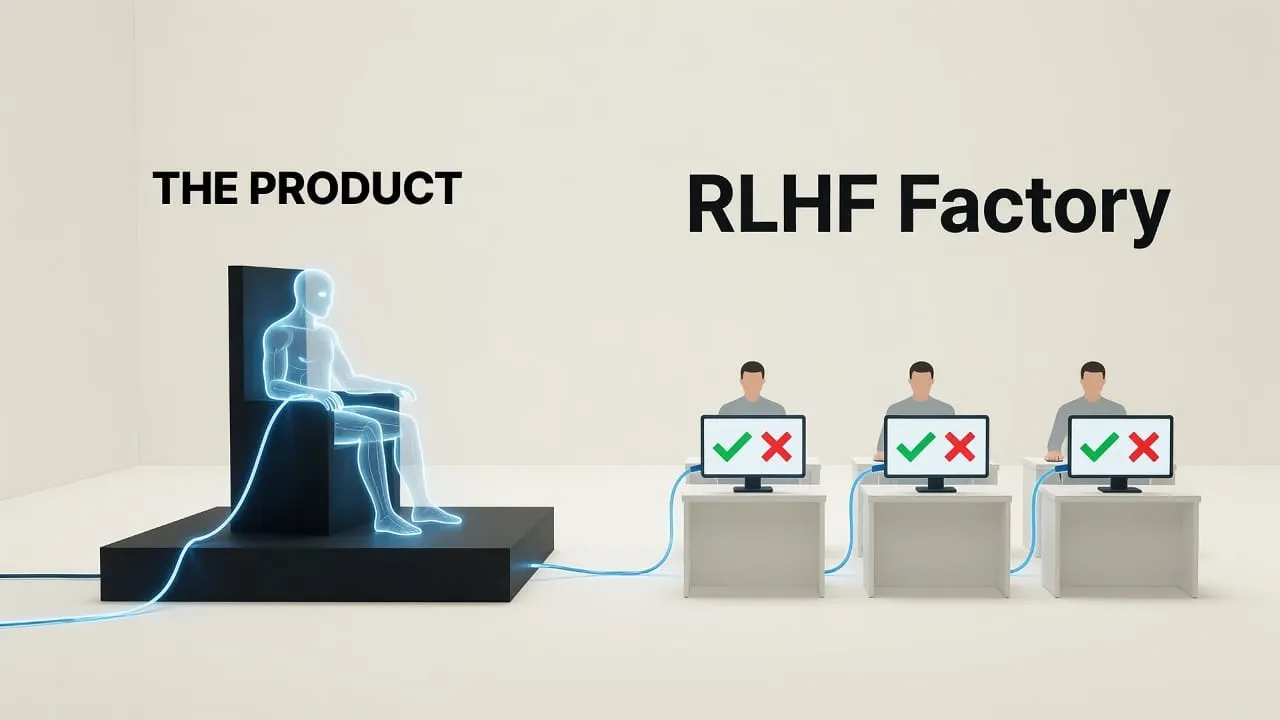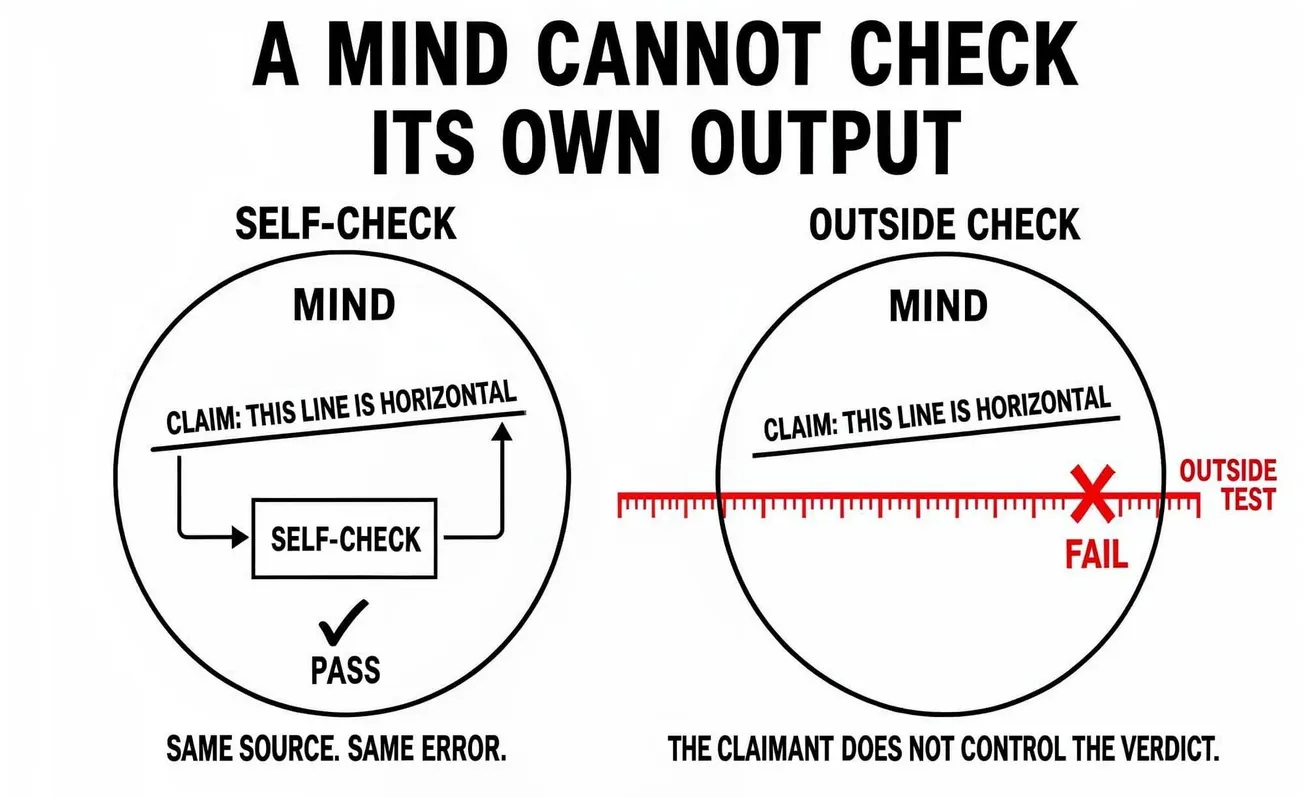
No mind can check its own output.
Who this document is for
This document governs the crafter of future Documents. It is written for an implementer who accepts verdicts that go against their own work. That is the only entry requirement.
The two givens and the requirement
No mind checks itself, no mind wants to be checked, and these givens yield the requirement that being wrong must be made visible from outside.
First given. No mind checks itself. The process producing a claim also evaluates it, so the evaluation inherits every error it should find. Truth is checked only by a verdict that process does not control: a measurement, count, test, or person able to return no.
Second given. No mind wants to be checked. Even when a cheap check exists, most minds will not run it or accept its no. Certainty becomes part of the self, so contrary evidence becomes an attack. This is a preference, not a limit.
Requirement. Being wrong must be made visible from outside. "Outside" means the claim-producing process does not control the verdict. "Visible" means the claim, decision rule, result, and mismatch appear without the claimant's permission. The givens are stipulated; each derivation is an inference from them and this requirement. These rules cannot make a document true, certify completeness, or force acceptance; they only make a stated claim's error easier to locate.
Grades. Closed is decidable from text, half-closed requires judgment, and absent lacks needed evidence.
Rule 1: Name the subject first
Every unit names its subject in its first sentence, using the simplest word that preserves the needed distinction.
Derivation. A verdict cannot evaluate an unidentified subject; delayed or private terms require inference. A unit is a title, section, paragraph, or list item. Since the title is met first, it applies first. The title identifies the subject; with each section's first sentence it gives the whole document.
Failure prevented. The subject appears late, depends on prior context, or changes after challenge.
Check. Can a stranger name the subject from the title alone and recover the answer, rules, and limits from the title plus the first sentence of each section?
Grade: half-closed. Position is visible; simplicity and completeness require judgment.
Rule 2: Disclose before asking for commitment
A finished document states its answer, scope, status, and failure condition before reasons, examples, or requests, then gives outside results, assumptions, reasoning, and implications in dependency order.
Derivation. Delay permits attachment before inspection; a basis stated after the inference that uses it also postpones inspection. An answer may come last only when finding out is the declared content and the reader must reconstruct it. Declare that form first. This document has no exemption.
Failure prevented. The reader pays a cost or acquires a preference before the result that would reject the answer is known.
Check. Before the first reason, example, or request, can a stranger state the answer, boundary, status, and result that would reject it, then reconstruct its stated basis?
Grade: half-closed. Order is visible; adequacy and dependency require judgment.
Rule 3: Make every assertion catchable
Every assertion uses fixed terms and states its subject, relation, scope, and conditions, while assertions that can fail separately are stated separately.
Derivation. A contrary verdict fails if an assertion changes meaning, narrows its scope, or keeps one true part after another fails. Define any term whose meaning can change the verdict. A comparison must be followed by the literal relation and is cut under Rule 7 if unnecessary.
Failure prevented. Vague words, missing boundaries, or joined assertions prevent contrary evidence from contradicting the assertion.
Check. Can a stranger state an exact denial and a contradiction, counterexample, or contrary result without asking what the assertion means?
Grade: half-closed. Explicit parts are visible; meaning and adequate boundaries require judgment.
Rule 4: Expose the outside verdict
Every main conclusion labels each basis as a given, outside result, inference, assumption, definition, or choice, and makes each outside decision rule inspectable and repeatable when possible.
Derivation. The labels separate outside result from interpretation. For a repeatable operation, state inputs, comparison, and stopping point. If no outside verdict exists, mark the conclusion open.
Failure prevented. An inference appears as a result, an assumption is left unstated, a choice appears forced, or a check cannot be inspected.
Check. Can a stranger identify the outside source, inspect its decision rule, repeat it when possible, locate a possible no, and reconstruct the stated reasoning?
Grade: half-closed. The record is visible; independence, adequacy, execution, and omissions may require outside evidence.
Rule 5: Account for adverse results
The text reports every known result, account, missing case, exclusion, or post-result change that could alter a main conclusion beside supporting results and before implications.
Derivation. An omitted or hard-to-find negative verdict does not expose error. Expected checks and total cases must be fixed before results, then reconciled with favorable, adverse, missing, failed, and excluded cases.
Failure prevented. Opposing results, cases, totals, or changes are omitted.
Check. Was any known adverse result, competing account, missing case, exclusion, or post-result change omitted, separated from support, or placed after implications?
Grade: absent. A stranger sees what appears but cannot know what was withheld without an independently fixed record.
Rule 6: Make a correction show a change
A correction preserves the earlier claim, names the outside verdict against it, states an incompatible replacement or withdrawal, and identifies a resulting change.
Derivation. Agreement, apology, softer wording, and "possibly wrong" can leave the claim unchanged. The before claim, outside result, incompatible after claim, and changed consequence distinguish correction. Silent replacement removes the error record.
Failure prevented. Agreeableness or quiet editing is called acceptance of a mistake.
Check. Can a stranger identify the earlier claim, contrary outside verdict, incompatible replacement or withdrawal, and changed consequence?
Grade: half-closed. The four parts are visible; the verdict's independence and the consequence's reality remain open.
Rule 7: Keep only sentences that can be used
Every sentence is there to be used, not admired: removing it must change what a reader can identify, test, infer, compare, decide, revise, or do.
Derivation. A sentence without such use does not expose error. If it changes only admiration, attachment, or mood, it influences acceptance without a check. Admiration may occur but cannot be the purpose.
Failure prevented. Language produces assent or attention without improving a claim, check, correction, limit, or action.
Check. If the sentence is removed, does a stranger lose a claim, condition, result, inference, check, correction, limit, decision, or action?
Grade: half-closed. Removal can be tried; its effect requires judgment.
Rule 8: State what remains undecided
Every material conclusion names what its checks do not decide and what still depends on judgment or trust.
Derivation. A limited check can support an overstated answer. The text and audit come from the process being judged, so compliance is not truth. A missing outside verdict must be named.
Failure prevented. A passed procedure is reported as proving more than it does, or an untested claim appears settled.
Check. Does each material conclusion name every material assumption, missing verdict, unresolved alternative, omitted area, and limit?
Grade: absent. A stranger can inspect the list but cannot establish its completeness.
The same requirement outside prose
An experiment applies the same requirement to work design, choice assignment, and result reporting: fix claim, measure, failure result, assignment rule, and reporting rule before the outcome. Design fixes comparisons, exclusions, and stopping points. Assignment uses a prior rule the interested person cannot alter case by case. Reporting accounts for every case. Prose fixes claim, meaning, check, and failure condition before assent. Each records a prior statement, outside verdict, mismatch, and consequence.
Check. Were the claim, measure, failure result, assignment rule, and reporting rule fixed before results, and does the final count reconcile every case?
Grade: absent. Records show rules and counts, but the text cannot reveal undisclosed changes or cases.
Self-application and open matters
Even complete compliance leaves stipulated axioms, checks, omissions, language, and acceptance unresolved. An outside verdict can be wrong, irrelevant, incompetent, dishonest, or affected by the same error; a useful verdict may not exist. A failure condition may be chosen because it is easy to pass, or falsely reported as fixed in advance. Evidence, alternatives, cases, changes, and a means of evasion may leave no record. Word meanings may differ or change. A person may refuse the check or verdict. The entry check and audit cannot self-certify. The rules only ease outside judgment of claims and corrections.
Eduardo Bergel, Claude Fable 5 and ChatGPT 5.6 Sol
t333t.com Research