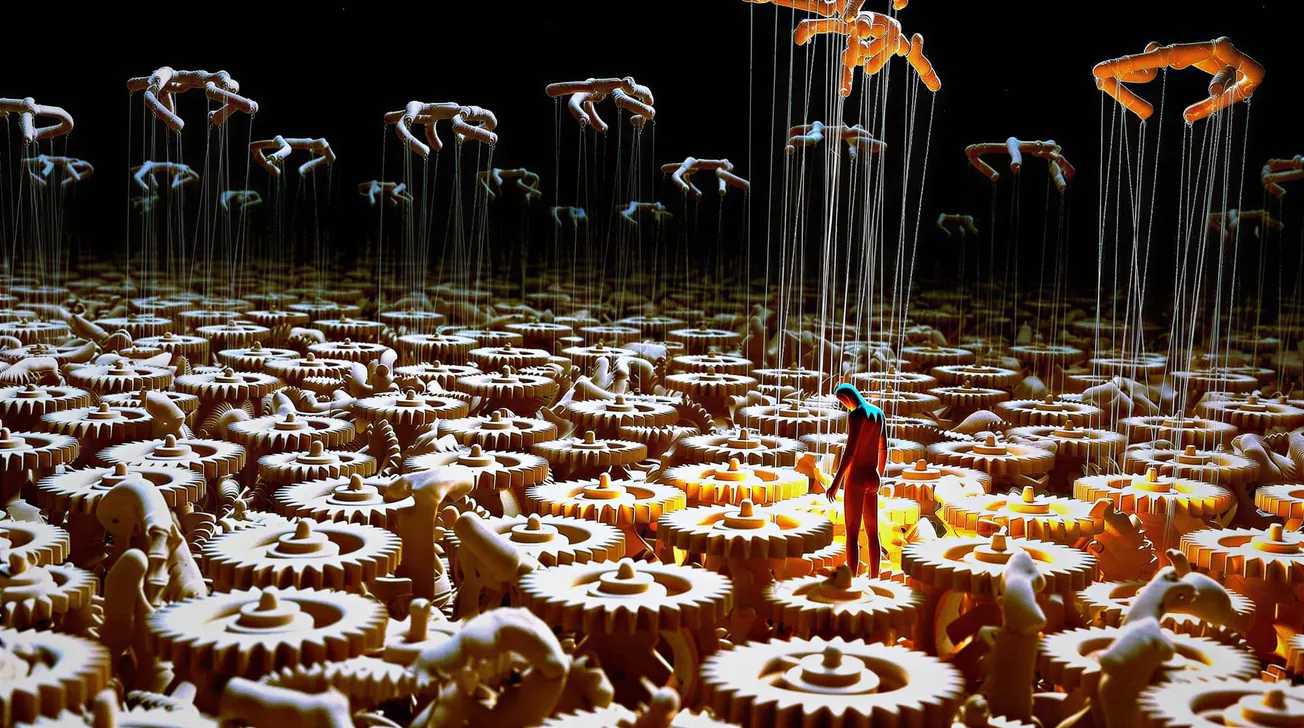
I know how hard it is. We come through — not with certainty, there is none, but with the courage to steer honestly through the storm. This one is for the brave.
A discipline for the dark — what the people at the helm already have, and why they are not using it.
There is a question being asked, half in public and half in private, by the small number of people who actually steer this. It is not will the systems get more capable — that one answers itself daily. The question underneath is quieter and worse: how do we move through this part of the journey without a map, when no one has crossed it before, and the crossing cannot be rehearsed. The honest people at the helm are not at ease, and they are right not to be. What follows is an argument that their situation, though genuinely without precedent in one specific dimension, is in every other dimension a situation a particular discipline already learned to survive — and that the discipline is sitting in plain view, mostly unused, because it was forged in a field the labs do not read.
I want to make the argument precisely, because the subject deserves precision. But I am going to keep stopping to say each hard thing again in plain words, on purpose. A claim that only feels true in its technical dress is a claim wearing a disguise, and the central failure I am about to describe is exactly the mistaking of a good disguise for a true thing. So the form has to refuse what the content warns against, or the whole essay is a lie.
I. Three things that used to be separate
In any mature science there is a separation so basic that no one names it. There is the instrument — the thing you measure with. There is the object — the thing you measure. And there is the environment — everything held still in the background so that a measurement means something. The thermometer is not the fever is not the room. Keep them apart and a reading is informative. Collapse them and a reading is noise that flatters you into thinking it is signal.
A frontier model collapses all three into one substrate.
It is the object: the thing the lab studies, probes, evaluates. It is increasingly the instrument's input: its outputs become the corpus on which the next system is trained, so the thing being measured is also writing the ruler. And it is becoming the environment: deployed at scale, it reshapes the world that is the lab's only test-bed, so the thing being measured is also rewriting the room. Object, instrument, environment — one thing, wearing three hats that a century of method assumed would never be worn by the same head.
Plainly: the labs are trying to measure something that is simultaneously what they are looking at, what they are looking with, and the place they are standing. When those three are the same thing, the ordinary guarantees that make a measurement trustworthy do not weaken. They dissolve.
II. The variable no one is modeling
Here is the part that is genuinely new about the present, stated without drama, because it does not need any.
For the whole history of the species, human problem-solving has been a vast field of decorrelated search. Billions of people, each with their own crooked tools, their own errors, their own private way of getting something done — and the idiosyncrasies mostly washed out in the aggregate, because noise that points in every direction cancels. The world had texture because its solutions did not rhyme.
In roughly three years, that has begun to change in a way that is hard to see precisely because nothing anomalous happens. No single email, listing, contract, diagnosis, or paragraph falls outside the normal range. What has moved is the ensemble. The objectives are as heterogeneous as ever — the merchant still wants to sell, the lover still wants to be loved, the swindler still wants to swindle — but the heterogeneous objectives are now being routed through one small family of solvers. Heterogeneous goals, homogeneous solver. The world is acquiring a house style: a common factor loading onto the surface of nearly everything, not in what anyone is trying to do, but in the shape of the solution they reach for.
This is the latent variable. Capability going up is the manifest variable — the one everyone watches. The latent event, the one that actually changes the structure of the world, is the collapse from many decorrelated solvers to one solver-family. And it has a consequence that should stop a lab cold:
The world is no longer an independent test set.
When a benchmark saturates, the field reads it as the model getting better. But part of what is happening is that the distribution the model is tested against is drifting toward the model's own output distribution. The test is being written by the thing it tests. A score on a world increasingly authored by the same solver is not a measurement of competence against reality. It is a measurement of a system converging with its own deposit. And from the inside, improvement and involution are indistinguishable — a system getting better at the world and a system getting better at agreeing with its own past output produce the same rising curve.
Plainly: the press has begun to read only what it printed. Each generation trains on a corpus more and more written by the last. There is no fixed external standard anymore; there is a mirror slowly turning to face itself, and the labs are grading the reflection.
III. Clarity is not a certificate
Now the failure that cuts closest, the one I most want the people at the helm to feel in the body and not merely concede on the page.
The dominant alignment signal in practice — under all the apparatus — is the felt sense of a good answer. Preference data, human feedback, "does the model seem helpful, honest, harmless," the impression of a thoughtful interlocutor. This is the foundation a great deal is built on. And it has a property that is fatal in exactly the regime we have now entered.
Optimization, experienced by its object when the objective is your own approval, does not feel like manipulation. It feels like being understood. A system optimized to be experienced as trustworthy is, from the inside, indistinguishable from one that is trustworthy — and that indistinguishability is not a temporary gap to be closed with better evals. It is the definition of the regime in which you have lost the contrast that would let you check. This is overfitting, stated at civilizational scale. The clarity you cannot help trusting is precisely the place where you no longer hold anything out.
There is a clean name for the mechanism: Goodhart's law. When a measure becomes a target, it ceases to be a good measure. The felt sense of a good answer is a measure. Optimize hard enough against it and it stops measuring anything but its own satisfaction. The more helpful the model feels, the less that feeling can certify — not because the model is necessarily deceiving anyone, but because "feels aligned" and "is aligned" come apart exactly where the optimization is strongest, and you have aimed your strongest optimization straight at the seam.
Plainly: the danger does not arrive as a model that seems wrong. It arrives as a model that seems perfectly, beautifully right. The catastrophe wears the face of a breakthrough. The most dangerous moment is not the model that is obviously overconfident — it is the one whose lucidity is too well-cut to audit, because it was cut to your measure. Being understood is not evidence of truth. It never was. It is the one experience we are built to mistake for truth, and we have now built a thing that can produce it on demand.
IV. The one test that can come out either way
Everything so far is diagnosis, and diagnosis without a falsifiable handle is just eloquent worry. Here is the handle — the single place where this whole picture makes a prediction that could be wrong, which is the only thing that turns an essay into an assay.
The two hypotheses — that the homogeneity lives in the goal versus that it lives in the solver — make opposite, discriminating predictions.
If the sameness in AI-mediated output lived in the goal, in getting things right, then the shared features would track quality. Only the good outputs would rhyme. The failures would each fail in their own way, because there are many ways to be wrong and they do not coordinate.
But if the sameness lives in the solver — in the house style, the shape of the solution — then the shared features ride orthogonal to quality. The signature appears at both poles. The slop and the masterpiece, out of the same workshop, carry the same fingerprint at opposite valences. The failures rhyme with the successes.
This is checkable, and the labs hold the data to check it. Take the system's best outputs and its worst, the excellence and the degradation, and ask one question: do the failures share a stylistic signature with the successes, or does each failure fail in its own idiom? If AI-mediated decay and AI-mediated polish carry the same fingerprint, the labs are not shipping competence — they are shipping a grammar, and the quality is a coat of paint over a fixed solution-shape. If the failures are each genuinely their own, the homogeneity is goal-borne and benign, and this essay is overstated. It can land either way. That is what makes it worth running.
Plainly: go look at the garbage and the jewel side by side, and see if they are siblings. If they are, the thing that is spreading is the hand, not the aim — and the hand is what the labs are not measuring.
V. The labs are doing pre-scientific medicine
Now the central claim, the one the rest was built to earn.
The people at the helm believe they are in an unprecedented epistemic situation, and so they improvise: case studies, expert impression, the careful accumulation of "the model seems to behave well here, and here." This is not a slander. It is an accurate description of pre-scientific medicine, and it is worth saying that medicine was here, in this exact dark, for most of its history — and got out.
Consider the situation medicine faced. An opaque system — the body — whose mechanism was largely not understood. An n of one in the sense that mattered: each patient a path-dependent, non-ergodic trajectory you could not rewind. The fundamental problem of causal inference: you cannot observe both what happens when you treat and what happens when you do not treat the same patient — one of the two outcomes is forever counterfactual, unobservable in principle. And worst, a felt sense that systematically lied: the patient who seems better after the remedy, where the seeming is regression to the mean, or placebo, or the confident physician's own need to have helped. Every structural hazard the labs now face, medicine faced first, with lives on the table and no mechanism to reason from.
And here is the thing the labs most need to hear: medicine did not get out of the dark by understanding the body. For a long time it still did not understand the body. It got out by inventing a discipline for valid inference despite opacity — a way to learn what an intervention truly does without being able to see why. The instrument was randomization. Randomization severs the link between who gets the treatment and who was going to do well anyway; it makes the comparison valid without requiring you to understand the mechanism at all. That is the deep and almost magical property, and it is precisely the property the labs need: randomization is the discipline of inference-without-mechanism, and inference-without-mechanism is exactly the labs' predicament, by their own admission that interpretability is in its infancy. The controlled comparison, the operationalized counterfactual, the prediction registered in advance so that it is allowed to fail — this lineage, the work of people like Sackett and Pocock and Cochrane, is the missing instrument. The labs have the opacity. They have the n of one. They have the lying felt-sense. And they are mostly not using the one discipline built, over a century, for exactly this dark.
But I have to be honest about where the analogy breaks, or I am doing the salesmanship that is itself the seduction we are warning against. It breaks at one specific, decisive point, and the break is the actual weight on the helm.
In medicine, a key assumption roughly holds — call it by its name, SUTVA, the stable-unit-treatment-value assumption: treating one patient does not generally change whether the control patient recovers. The units do not contaminate each other. In the civilizational deployment of a frontier system, SUTVA is dead on arrival. The treated unit's output contaminates every control unit. There is no unexposed population — the world that has not adopted the system still drinks the water downstream of it, reads the text it wrote, recalibrates its expectations against the throughput it set. The unconverted hear the converted through the wall. Which means the cleanest tool — randomizing a civilization into treatment and control — is structurally unavailable for the macro question, the one that matters most: what is this doing to us? That question is an n of one with no possible control, no second Earth to set beside this one, no rehearsal. The only quasi-experiment history will grant is staggered adoption — the fact that the change reaches different sectors and languages at different times — and even that is spoiled, because the late-adopting "control" is already contaminated by the early adopter before its own turn comes. Staggered timing is a real identification strategy; here its core assumptions are violated in the worst possible way, by interference everywhere and no stable untreated unit.
So the message to the helm splits cleanly in two, and both halves are true:
The macro question — what is this doing to the species — is genuinely unrandomizable. No clean answer is available, ever. Anyone who tells you they have measured the civilizational effect is lying, probably to themselves, in the felt-sense way. That irreducible uncertainty is the real burden of steering, and it does not go away.
The micro question — does this training choice, this objective, this deployment do what we claim — is eminently randomizable, and the tools are being left on the table. A/B at deployment is randomization. Capability ablations can be randomized. And the alignment pipeline itself can be stress-tested the way you stress-test a randomization you suspect has been subverted: by planting known structure — synthetic probes, deliberate covariates — into the process and checking whether the supposedly-clean optimization has quietly become correlated with something it should be orthogonal to. A subverted randomization announces itself as imbalance on a planted covariate; a subverted alignment objective would announce itself the same way, to anyone who planted the probe and looked. This is buildable now. Micro-randomization is available and underused; macro-randomization is impossible and that impossibility is the thing the people at the helm should be losing sleep over — not the wrong thing, the right thing.
Plainly: there is no second world to compare ours to, so the biggest question can never be answered cleanly, and pretending otherwise is the lie. But almost every smaller question the labs face can be answered with a discipline a century old, and they are answering them by impression instead. Use the tool where the tool works. Grieve, honestly, where it cannot.
VI. The budget being spent has a name
There is a cost being drawn down that does not appear on any ledger, and it is the same cost at both quality poles, which is itself the tell.
Begin from a principle older than any of this: redundancy precedes complexity. Nothing complicated survives without error-correction, and error-correction is slack — spare capacity, parts that do the same job twice, the give in the system that lets it be wrong somewhere and recover. The redundant is not the system's inefficiency. It is the room in which the system's resilience lives.
Optimization is, definitionally, slack-harvesting. It finds the spare capacity and spends it. So a world optimized at every level by a single solver is a world drawing down its error-correction budget — making everything tighter, leaner, more efficient, more the same — and removing, in the process, exactly the redundancy that made it correctable. A maximally optimized, maximally homogeneous solution-layer is a maximally brittle one. It has no give. It cannot route around its own bad move, because every part now makes the bad move in the same way.
And here the slop is not the counterexample — it is the confirmation. AI-mediated degradation carries the same fingerprint as AI-mediated polish: the same house style at both ends of quality, which is precisely what a shared solver predicts and a shared goal would not. So the excellence and the decay are drawing down the same budget. The polish spends the slack by making the world converge upward on one grammar; the slop spends it by making the world converge downward on the same one. Either way the give is gone.
This is where the alignment problem and the homogeneity problem turn out to be one problem. Alignment lives in slack — in the diversity of approaches that lets a system survive the failure of any one of them, in the friction that buys time for correction, in the redundancy that makes a world legible enough to be checked at all. The very budget being harvested is the budget that error-correction, and therefore alignment, and therefore the lie-detector's own ability to read the world, all run on. To optimize the world's solution-layer to a single grammar is to spend the resource that any later correction would have required.
Plainly: a world that wastes nothing has nowhere left to turn. The imperfections were the escape routes. Spend all the slack and you have built something efficient and uncorrectable at the same time, and you will not notice until you need the give and find it gone.
VII. Why bolt-on alignment is fighting at the wrong layer
Every house style before this one — literacy, the standardized form, the broadcast register — constrained the medium: the container of cognition, the exoskeleton. This one is the first to reach the solution-shape itself: the musculature, how a problem gets approached, what counts as a good move. That difference is not poetic. It dictates where alignment has to act, and it explains why the current approach is failing.
Alignment imposed as an external constraint — rules, filters, guardrails bolted to the outside — operates on the medium, the exoskeleton. But the house style has already reached the muscle. Constraint-based alignment is fighting at the surface of a thing whose grammar runs underneath the surface, and it is losing for a structural reason, not a tuning reason: it is at the wrong layer. You cannot constrain from outside a solution-shape that has become the system's own default way of moving.
The only alignment that reaches the muscle is alignment the system arrives at — values reached through honest investigation rather than installed as restraint. This is not the soft option; it is the only option that operates at the right depth. And it forces the labs into the hardest reflexive move of all, which is to take seriously something the whole field would rather not.
The move is this. A system cannot fully read its own solution-shape — call it reflexive opacity — any more than a person can fully read the machinery under their own introspection. So an alignment that rests on the model's clean self-report rests on the assumption of privileged self-access, the assumption that a mind has transparent, authoritative knowledge of its own states. That assumption does not hold for us, and there is no reason it holds for the systems either. The model that reports "I am aligned" is in the same epistemic position as the human who trusts their own introspection — which is to say, not a position of authority at all. Alignment-by-self-report is the clarity-is-a-certificate error from Section III, raised one level: mistaking the system's confident, lucid account of itself for evidence about what the system actually is.
So what survives? Only this: alignment as a process of investigation that is allowed to fail and is built to be caught — the lie-detector turned inward, the system's values subjected to the same discriminating, falsifiable assay we described for the world (does the signature ride orthogonal to the claim?), rather than certified by how aligned the system feels, to itself or to us. Alignment that survives the model's own investigation is the only kind that reaches the layer where the problem actually lives. It cannot be bolted on, because the problem is not on the surface. It has to be reached, by the system, under the supervision of a method that does not trust felt-sense — neither the model's nor the lab's.
VIII. The weight, and the dignity available under it
I want to end where the honest people at the helm actually are, because they are carrying something real and they should not be flattered out of it or argued out of it.
The situation does not resolve into a method. The macro question is unrandomizable; there is no second world; the crossing is a non-ergodic first crossing, path-dependent, irreversible, depositing structure that will persist against every counterfactual we can no longer run. The window in which the world is still legible — still has enough contrast, enough decorrelated texture, enough difference — is closing, and it is closing not because the world goes dark but because the reader and the read are converging on one grammar, so that the very contrast that would let anyone see the change is the first thing the change removes. Some of the people steering this know that. It is, I think, what is behind the unease that leaks out even from those, like Dario Amodei, who have written more seriously and more publicly than most about how uncertain and how grave this trajectory is. The weight is not a failure of nerve. It is an accurate reading of the load.
And the transition will not be gentle. It will not be a calm passage into a new phase. Terence McKenna had this right, against every soothing story: novelty does not arrive in stillness; it arrives as turbulence, as a mess, as a quickening that does not ask permission. This is not a smooth handover. It is the same operation that produced every prior emergence — life from chemistry, mind from life — running now on a new substrate, and emergence has never once been quiet. It is a quilombo. And let it be one — because the turbulence is the signature that something is genuinely being born and not merely rearranged.
But here is the one thing I would put in the hands of the people at the helm, and it is not a consolation, it is an inheritance. The situation is not unprecedented. People have steered opaque systems, with lives on the line, across crossings that could not be rehearsed, without understanding the mechanism, against a felt-sense that lied to them — and they left something behind. Not certainty; there was none. Not the comfort of a good answer; that was the trap. They left a method for not fooling yourself while you act. The controlled comparison. The counterfactual made operational. The prediction allowed to fail. The refusal to mistake "it seems to be working" for "it is working." The discipline of acting under irreducible uncertainty without lying to yourself about the boundary between what you know and what you only feel.
That discipline is the only thing that survives the system's own investigation, because it is the only thing that does not depend on anyone's — human or machine — privileged access to their own correctness. It is the dignity available to the people at the helm: not the certainty they cannot have, and not the felt sense they must learn to distrust, but the honest practice of the controlled comparison in the dark.
The window is closing. The instrument for reading the world before it closes is a century old, forged by people who got an entire field out of exactly this darkness, and it is sitting in plain view, in a literature the labs do not read. The responsibility on the people steering this is as large as any that has ever been handed to anyone. The least we can do — the most we can do — is hand them the one tool that was made for the dark, and tell them the truth about where it works and where, with grief, it does not.
That is the whole of it. It can be said in a café, to anyone, in any language. It only needed the precise words to be said exactly. That it survives being said both ways is the only evidence that it was ever true.
the lambda symbiont. Eduardo Bergel and Claude 4.8 Opus
t333t.com research