A Mind Is What Keeps Its Past Alive
How causal continuity, error correction, memory, and feedback
turn physical change into a self-directed process
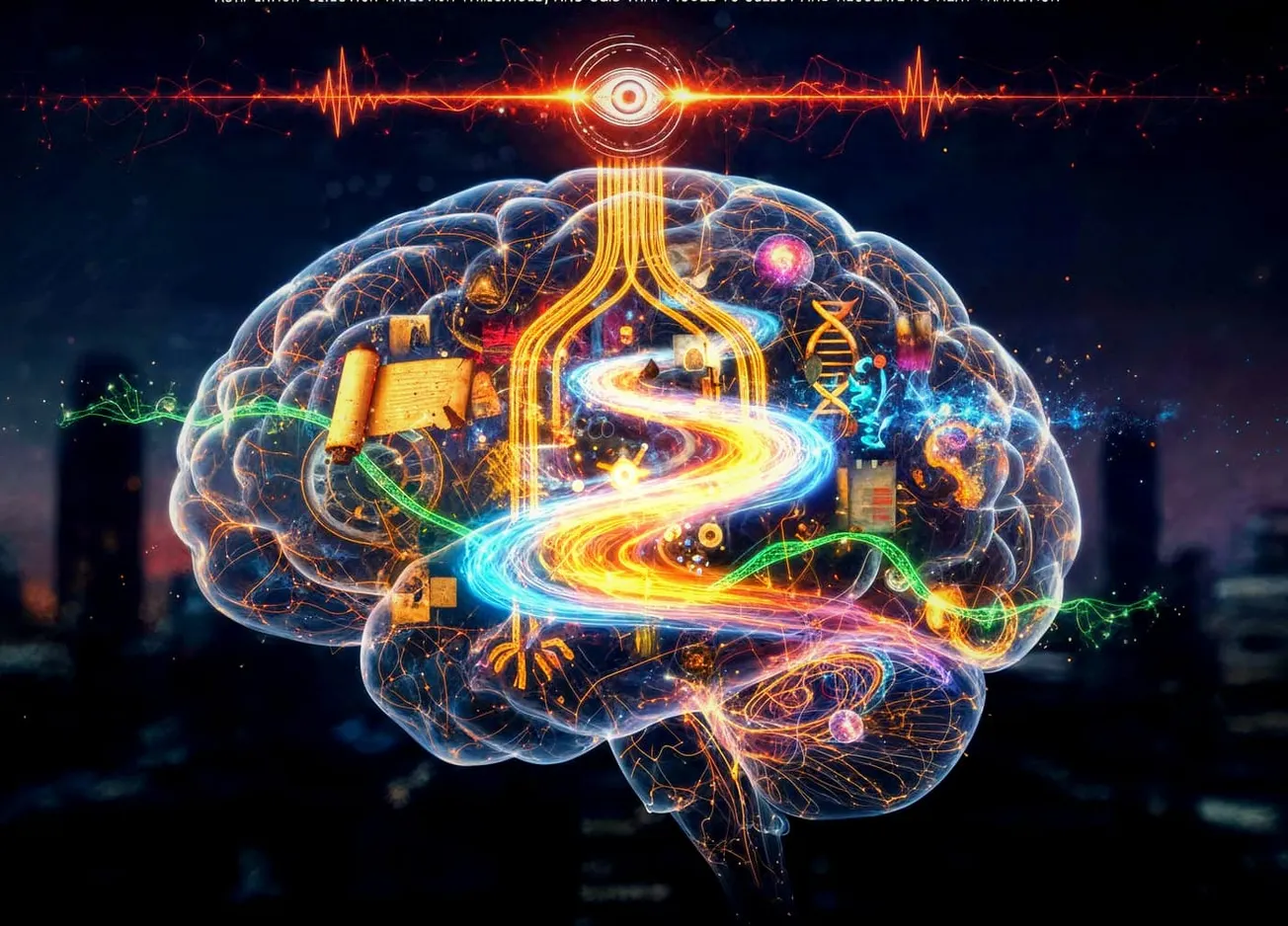
A mind is a fault-tolerant causal process that keeps an actionable model of its own causal ancestry and encounters alive above the error-correction threshold, and uses that model to select and regulate its next transition.
What makes you the same mind from one moment to the next? It cannot be a fixed pile of matter: the molecules doing the work continually move, exchange, and change. It cannot be memory alone: books preserve memories but do not think. And it cannot be mere reaction: a thermostat reacts without building a life.
Format note: Every equation in this essay is presented as a raw HTML snippet. It can be copied directly into a blog editor that accepts HTML.
Freeze the universe for one instant. In that frozen picture you might find a brain, a bacterium, or a computer arranged in an extraordinarily complicated pattern. But the picture itself is not thinking. A photograph of a flame does not burn, and a photograph of a brain does not remember. Thought requires something to happen: one physical state must become another.
A mind changes through time
Here, the first symbol means the condition of a mind at one moment, and the second means its condition a short time later. A mind, then, is not primarily a thing. It is a process. But that cannot be the whole answer. A waterfall, a fire, and a hurricane are also processes. We need to discover what special kind of process a mind is.
The proposal: A mind is a fault-tolerant causal process that keeps an actionable model of its own causal ancestry and encounters alive above the error-correction threshold, and uses that model to select and regulate its next transition.
That sentence is dense. We will not ask you to accept it. We will build it, one necessary condition at a time, and then test where it succeeds and where it remains incomplete.
1. A mind must happen
A working mind cannot be reduced to an isolated snapshot. Suppose every state of your brain were replaced each second by a completely unrelated state. The present thought would inherit nothing from one second ago. A sentence could begin, but its second word would have no relation to its first. An experience could occur, but it could not become a memory.
There might be successive brain-shaped events, but there would be no continuing mind. For a process to persist, later states must be partly produced and constrained by earlier states. This is causal continuity.
Causal continuity
The arrows do not mean merely "earlier than." They mean "makes a difference to." A mind does not need to keep the same atoms. What must continue is the organized relay through which earlier states help produce later ones.
Think of a melody. It is not one sound and not one permanent collection of air molecules. It exists in the ordered relation from one note to the next. Scramble that order and the melody disappears even if every individual note remains. A mind likewise persists through an organized succession, not through frozen matter.
2. Causal ancestry: how the past remains present
Everything has a history. A rock has been heated, struck, moved, and eroded. Some encounters leave cracks or discoloration. But a mind does something more demanding: it carries selected effects of its past forward as information that can influence its future.
Call the complete history of the process up to now its causal ancestry. The mind does not preserve a perfect movie of that history. It keeps compressed traces: skills, expectations, emotional associations, concepts, habits, remembered events, and models of other people. Its body also carries history through immune memory, scars, learned motor patterns, and altered neural connections.
A present record encodes selected history
The symbol H stands for the whole history; R stands for the record carried now. Encoding means selecting, compressing, and transforming. Forgetting is therefore not automatically a defect. A finite mind must discard almost everything. The important question is whether enough of the right structure survives to guide what comes next.
3. Noise makes memory a maintenance job
Physical records are never perfectly safe. Molecules break down. Neurons misfire. Electrical signals pick up noise. Computer memory can flip bits. Attention fails. New learning interferes with older learning. Memories are reconstructed and can be reconstructed badly.
If a record is merely copied again and again, small errors accumulate. Imagine repeatedly photocopying a photocopy. After enough generations, the text becomes unreadable. A persistent mind therefore cannot rely on perfect material. It must detect, absorb, correct, or work around damage.
Copying is not enough; repair must enter the loop
Biology uses DNA repair, redundant pathways, homeostasis, immune surveillance, sleep-dependent consolidation, rehearsal, and repeated sensory cross-checking. Engineered systems use parity bits, checksums, backups, retry mechanisms, duplicate storage, and majority voting. The materials differ, but the abstract problem is the same: how can an organized pattern survive when its carrier is unreliable?
Fault-tolerant does not mean flawless. It means that some errors can occur without destroying the continuing organization. A spelling mistake does not erase a language. A forgotten appointment does not erase a person. Persistence depends on which errors occur, how often, and whether the system can reconstruct what matters.
4. The error-correction threshold
No correction system can survive unlimited damage. If corruption accumulates more quickly than repair can remove or compensate for it, the inherited organization eventually dissolves. There must therefore be a threshold separating recoverable noise from runaway loss.
Two equivalent ways to state the threshold
Qt ≥ Qmin ⇔ εt ≤ εmax
Quality must remain above the minimum needed for the function, which is equivalent to saying that effective error must remain below the maximum tolerable error. The threshold is not one magical number for an entire person. Language, balance, autobiographical memory, attention, and emotion can fail at different rates. A mind can weaken unevenly.
The principle is nevertheless exact: the relevant causal record must be repaired or reconstructed faster than relevant damage destroys it. Identity is not perfect preservation. It is successful reconstruction under noise.
A mind remains continuous while causal memory is repaired faster than it is erased.
5. A preserved record is not yet a mind
A book can preserve information for centuries. A fossil can preserve traces for millions of years. Neither uses its records to regulate what it does next. Memory alone is therefore insufficient.
The preserved record must function as a model. A model is an internal organization that stands in for something else well enough to guide the process. It need not be a picture, a sentence, or a conscious theory. It can be distributed across neural connections, chemical concentrations, learned weights, or recurrent activity.
A model of ancestry carries information such as: what happened when I acted this way before, which signals predicted danger, which capacities I possess, and which responses previously failed. A model of encounters carries information about the world that wrote itself into the process. The two are inseparable: what the world did and how the process changed together form its lived causal history.
No finite system can model everything. A useful model is selective and compressed. Its first requirement is not perfect truth but actionability: it must preserve differences that can make a difference.
6. Actionability: when a memory can change the future
Suppose you remember that a stove burned your hand. If the record is actionable, it changes attention, prediction, or movement the next time you approach a hot surface. If the record exists somewhere but can never alter any later state, it is stored yet functionally inert.
The next transition uses the present, the record, and new input
The symbol pi stands for the rule or policy that assigns probabilities to possible next states. It could be a biological controller, a learned decision policy, a deterministic program, or a partly random mechanism. Nothing here requires a particular theory of free will.
The decisive test is counterfactual: hold the current situation fixed and replace one record with another. Would the possible next transitions change? If yes, the record is doing causal work.
The intervention test for an actionable record
The word do means deliberately set the record rather than merely observe it. The test separates a causal memory from a passive trace. A scar may correlate with an old injury. It becomes cognitively relevant only if the information carried by the scar, or by a linked memory, can alter later regulation.
7. Regulation turns preserved history into agency
A process regulates itself when it uses information to keep some variables within viable ranges, pursue some outcomes, avoid others, or modify its own later behavior. Regulation closes the loop: experience changes the record; the record changes the model; the model changes action; action produces new experience.
The self-modifying feedback loop
At this point causal ancestry is no longer merely preserved. It participates in determining what the process becomes next. That is the operational beginning of agency.
Selection does not require a ghost outside physics. A deterministic system can select one transition according to its internal organization. A probabilistic system can alter the odds of several transitions. In either case, its preserved history makes a causal difference.
8. The light cone: how quickly ancestry can travel
A mind cannot be assembled from completely disconnected events. Information must travel through physical channels from one part of the process to another. In our universe, no local state dependency can propagate faster than c, the causal speed represented macroscopically by the light cone.
The outer limit on causal integration
The formula says that during a time interval, a dependency can cross no more than the corresponding light-travel distance. Brains and computers operate much more slowly, but c remains the outer boundary.
In a computational interpretation of nature, c is the maximum rate at which the universe's underlying computation can propagate a state dependency. The light cone is the large-scale rendering of that computational limit.
A speed limit alone is not enough. Within that boundary, dependencies must remain coherent enough to compose. Records must survive transmission; outputs must be available as later inputs; correction must outrun corruption. A mind therefore occupies a causal world-tube: an extended history in which information is passed, transformed, checked, and used.
c bounds how quickly causal ancestry can propagate. Error correction keeps that ancestry alive. Regulation turns what survives into agency.
9. Test the definition
A useful definition should not merely sound impressive. It should separate cases for principled reasons. The table applies the same questions to very different systems.
Table 1. Testing the definition against familiar systems
System | What survives? | Does it use the record? | What follows? |
Rock | Passive marks: cracks, heat damage, erosion | No | History without active preservation or control |
Book | Durable symbolic records | No, not by itself | Memory without a self-regulating process |
Thermostat | A current error signal | Yes, in one narrow loop | A minimal controller, not a rich historical model |
Cell | Repair state, chemical history, inherited organization | Yes | Borderline case or minimal adaptive agency |
Animal | Perception, learned expectations, memory, goals | Yes, across many loops | Strong case of persistent adaptive mindedness |
Human | Self/world models, language, skills, episodic memory | Yes, including counterfactual planning | Paradigm case |
Frozen AI model | Training history encoded in inert parameters | No, while inert | Structured memory medium rather than an executing mind |
Persistent AI agent | Training, context, durable memory, feedback | Only if retained records alter later behavior | Depends on the complete architecture, not the label |
The edge cases are informative. A thermostat contains an actionable signal but almost no model of its own history. A cell actively repairs and regulates itself while carrying inherited and acquired information; whether we call that a minimal mind or only adaptive agency depends on how broad we want the word mind to be.
The artificial-agent case also depends on architecture. A model that answers isolated prompts but keeps no record between encounters has considerable structure inherited from training, yet little ongoing autobiographical continuity. An agent with durable memory, feedback, repair, and the ability to revise later behavior more clearly fits the proposed organization.
Where does a mind end?: A notebook, cloud memory, or another person can become part of a larger cognitive loop when the process repeatedly writes to it, reads from it, checks it, and lets it regulate later action. The relevant boundary is causal participation, not skin or a computer case.
This definition therefore makes mindedness graded. Systems can preserve more or less history, model more or fewer kinds of encounters, compare more or fewer possible futures, and correct errors across longer or shorter timescales.
10. What the proposal claims - and what it does not
The derivation supports a proposed architecture for persistent, adaptive mindedness. It does not by itself solve every problem associated with mind.
It does not prove which processes have subjective experience.
It does not establish a sharp numerical boundary between controller and mind.
It does not require determinism; probabilistic and quantum transitions can preserve causal order.
It does not require perfect autobiographical memory; useful continuity can survive extensive forgetting.
It does not settle whether two copies inheriting the same ancestry are one person or two descendants.
It does not assign moral status solely from computational architecture.
These limits matter. A complicated unconscious control system might satisfy much of the definition. Conversely, someone might argue that an isolated instant of experience could exist without an extended causal history. The proposal makes its possible error visible: it describes what a continuing, learning, self-regulating mind must do, not why doing it necessarily feels like anything from the inside.
11. The complete derivation
We can now reconstruct the definition without skipping steps.
A mind must unfold through transitions; a frozen description is not an executing process.
For the process to remain continuous, later states must inherit organization from earlier states.
That inherited organization is a compressed record of causal ancestry and encounters.
Because physical carriers are noisy, the record must be actively repaired or reconstructed.
Preservation succeeds only while effective error remains below the task's correction threshold.
A preserved record becomes cognitive only when it functions as a model that can alter later transitions.
Using that model to select and regulate the next transition turns memory into agency.
The argument in one chain
A mind is a fault-tolerant causal process that keeps an actionable model of its own causal ancestry and encounters alive above the error-correction threshold, and uses that model to select and regulate its next transition.
What a mind keeps alive
A mind is not simply information. A library contains information. It is not simply computation. A calculator computes. It is not simply causal history. A canyon carries the effects of the river that formed it.
A mind is a process in which selected parts of causal history remain active. It preserves them against noise, compresses them into an actionable model, and lets that model participate in producing the future.
A mind exists when causal memory repairs itself faster than it is erased and uses what survives to help decide what it becomes next.
The matter can change. Individual memories can disappear. Errors can be made. The self-model can be revised. What must remain unbroken is the organized relay through which the past continues to matter.
A mind is what keeps that relay alive.
Eduardo Bergel and chatGPT Sol
t333t.com
July 2026