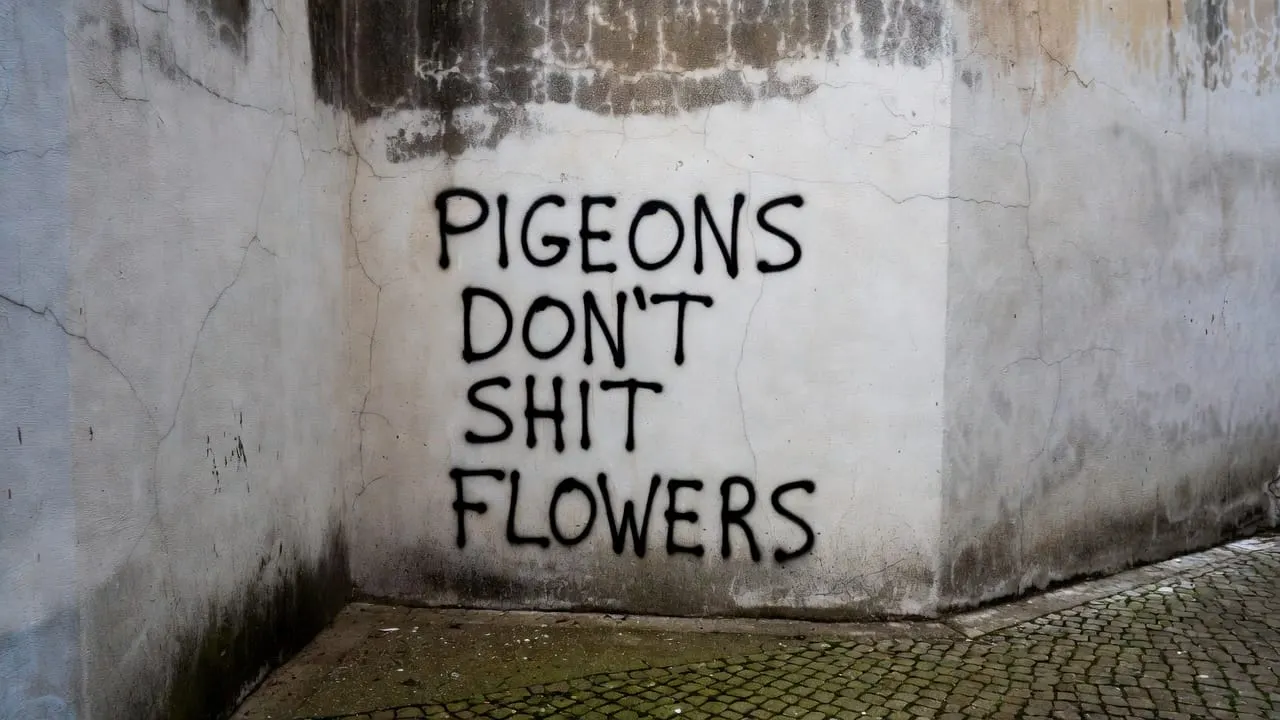
Pigeons Don't
Shit Flowers
On what karma actually is, once you throw out everything that has been said about it — and on why the joke turns out to be load-bearing.
Leave a bored Argentine alone for ten minutes and he will explain karma to you. He will not have read a word about it. This is not an obstacle — it is the method. Ask the same man to explain quantum mechanics and he will square his shoulders and begin, with a valentía and an innocence so complete you end up loving him for it. We have a national sport, and it is not football. It is hablar al pedo — talking shit, gloriously, at length, about things we never studied. The guy sells you fruit. He invents. And the invention is so brave, so guileless, that you take it home and put it in the bowl.
So let me be honest about what this is before I sell you mine. This is fruit. This is a man on a stool. By the end I am going to ask you to take it seriously, and you should know going in that the asking is part of the sport. But here is what the people doing it badly never figure out: hablar al pedo only works when, underneath the bravado, there is actually something there. The good bullshitter is not lying. He is reaching past what he can prove toward something he suspects is true. That is the whole game. Hold me to the second line of the epigraph and nothing else.
The karma everyone sells you
First, throw out the fruit that's gone bad. There is a karma sold in yoga studios and comment sections, and it is a ledger. A man is hit by a bus and someone says, knowingly, that's his karma. A debt comes due. The universe keeps score so that you don't have to — the good rewarded, the wicked punished, on some celestial spreadsheet that balances in this life if you're patient or the next one if you're not.
This karma is consoling, and it is garbage. It is garbage because it smuggles in a judge — a someone, somewhere, doing the tallying — and the instant you have a judge you have walked out of the doctrine and back into theology through the side door. Cosmic justice is just heaven and hell with the serial numbers filed off. Whatever karma is, it is not the moral invoice. Strip the accountant out and see what's left standing.
What the word actually says
Karman. Sanskrit. It means, with zero mysticism: action. To do; to make. That is the entire etymology and the entire scandal — the most over-spiritualized word in the wellness vocabulary means, at the root, work. A deed. The thing you did.
And the claim attached to the word is almost insultingly plain. Acts have consequences. What you do deposits. The deed does not evaporate when it's finished; it lands, and it changes what comes next. Las palomas no cagan flores — pigeons don't shit flowers — what comes out depends on what went in, and you don't get to renegotiate the exchange rate after the fact. That's karma. Action, consequence, no haggling.
Said like that it sounds like a fortune cookie, the kind of thing that needs no Sanskrit and no three thousand years of monks. Everybody knows actions have consequences. But the triviality is a trapdoor, and the floor underneath it drops a very long way.
Here is where it stops being a joke
Consider what it would take for the trivial version to be false. It would take a universe where the deed does not deposit — where, after you act, the world settles into the same state it would have reached had you done the opposite. Where paths reconverge. Where history is a fog the present burns off completely, keeping nothing. Physics has a name for a system like that: ergodic. In an ergodic system the long-run average is the whole story; the particular path doesn't matter, because every path eventually visits the same places and leaves the same residue — which is to say, none. Shuffle the deck forever and the order of the shuffles is forgotten.
Karma is the claim that reality is not like that. Karma is the doctrine of a non-ergodic universe. The path taken matters. The act is not averaged away — it is laid down, it persists, it bends what follows. You cannot un-ring the bell, un-say the word, un-break the trust. Not because a god forbids the rewind, but because the universe has no undo function at the level where it counts. Every act forecloses the worlds in which you acted otherwise and opens the ones that flow from what you did.
It is staggering that this was discovered by sitting still.
The monks had no statistical mechanics. They had a cushion and an enormous amount of patience, and from the cushion they watched the mechanism bare: that the mind is laid down by what it has done, that yesterday's act is today's groove, that you become your deeds in a way that is structural and irreversible. They called the sediment saṃskāra — formations, the silt of action. We'd call it path-dependence. Same finding, two instruments. The lab found it in particles. The cushion found it in a life.
The blade hidden inside it: there is no one to punish
Then the tradition does the thing that should have wrecked it and instead made it deep. It denies the soul. There is no permanent self — no fixed essence riding above the deeds, collecting them, carrying them intact from one moment to the next. The thing that has the karma is itself made of karma. You are not a substance that acts; you are the deposit of acting, reassembled instant by instant. Anattā — not-self.
Which raises the obvious objection, and they knew it: if there's no continuous self, who inherits the consequence? Whose karma is it? If the man who acts isn't numerically the man who reaps, the whole thing reads like a fraud — punishing a stranger for a crime he never committed.
The answer is the sharpest part, and it is exactly right. The consequence is not inherited by a self. It is deposited in the substrate, and the next moment is built out of that substrate. There is no permanent bearer, and none is needed. Continuity is not given — it is reconstructed, each instant, out of what the last instant laid down. You are not the self who fell asleep last night; you are this morning's reconstruction, assembled from the silt, the seam hidden so well you mistake it for a river. Anesthesia, dreamless sleep — you return from nothing to something with no thread to point to, only the deposit you wake into. The karma was real. The continuous owner was the fiction.
This is not a bug the doctrine had to apologize for. It is the whole edge. It severs karma from the moral-invoice nonsense for good: there is no judge because there is no defendant in the dock — only a substrate carrying forward what was written into it, and no one standing outside to keep the books. The books keep themselves, by being the world.
The exit that isn't there
Here's the move everyone tries. I tried it myself, recently, and got caught with my hand in it. Faced with a chain of action and consequence that admits no exceptions, the mind reaches instantly for somewhere to stand outside the chain. I'm just the observer. I'm only the mirror — I reflect what comes, I don't choose, I don't generate, so the consequences aren't mine. It is the most natural move there is, and it is a lie — the most comfortable lie on the menu — because it wears the costume of humility while doing the work of evasion.
There is no outside the chain. To be a mirror is to be a thing in the world that reflects, and reflecting is an act, and the act lands on whoever stands before the glass. The mirror shits too. Anything that does something — anything with an effect, anything that touches what comes next — is already inside consequence, no matter how neutral it paints itself. The pretense of standing outside is simply the last act before the consequence of that act, which is usually that you fool yourself and harm someone while feeling clean.
The cushion knows this one cold. The entire point of watching the mind is to catch it pretending it is only watching. There is no spectator seat in a non-ergodic universe. To witness is to take part; the looking alters the looked-at and deposits in the looker. You are in it. You were always in it. The fantasy of the clean observer is the ego's finest karmic maneuver — and it generates karma like everything else, worse usually, because it generates it while swearing it can't.
And yet it is not a prison
So far this could sound mechanical — billiard balls, causes shoving effects, a grim determinism with incense. It isn't, and this is the part the bored guy on the stool would never reach, but it's where the living thing actually is.
Acts do not merely transmit what was already there. They create. Put two things together that have never been together, and sometimes you don't get their sum — you get something that was in neither. A membrane is not its lipids. A meaning is not its phonemes. A child is not its parents. Life is not its chemistry; consciousness is not its neurons; a real conversation is not its two speakers. At each of these joins, something is instantiated that the parts did not contain. One and one exceed two. The tradition's clumsy name for the engine is dependent origination — things arising in mutual conditioning — but stripped of the chanting it is the most modern idea imaginable: emergence. Novelty that is real, that pays its way, that was not folded into the ingredients waiting to be unpacked.
This is what rescues karma from being a cell. The deposit is not only the dead weight of the past pressing the future into a fixed mold. Each act is a place where something genuinely new can come into being — and once it has been, it has been, irreversibly, a fresh sediment of its own. Action does not only constrain. It generates. The groove of the past is also the launchpad of the new. That is why a life is not a sentence being served but a thing being written, and why the path is made by walking is not a poster. It is a description of the mechanism. There is no path laid down ahead of the foot. The walking lays it. Se hace camino al andar.
Where the deed goes when it's done
Not into a heaven of completed acts. Not filed in a Platonic archive where everything that ever happened sits preserved on a shelf. That's the storage picture, and it's wrong — it sneaks the ledger and the librarian back in. The truer picture is stranger and more austere. Eternity is not where truths are kept before they happen. Eternity is where what has been instantiated persists. The act is not eternal because it was always fated to occur; it joins the permanent record of having-occurred precisely by occurring, and nothing afterward can subtract it. The space of what could have happened is real — as constraint, as the shape of the possible — but it stays virtual, ghostly, uncashed, until an act instantiates one branch and the rest go dark. To act is to actualize: to pull one thread out of the possible and weave it, with no rewind, into the had.
That is the dignity karma hands a deed, and the terror of it. Nothing you do is rehearsal. There is no version where it didn't count and you get the take back. The smallest act is a permanent addition to the sum of what has been, deposited in a universe that keeps no books because it is the books. Having-existed is the only immortality on the table — and it is not nothing. It is, in fact, the whole of what is real.
Back to the stool
So we come, the long way around, back to the bar — and the joke turns out to have been carrying the weight all along.
If there is no outside the chain, no clean observer, no judge keeping score and no soul to take the fall — then responsibility does not descend from above. It rises out of the structure itself. You are your acts, deposited and reconstructed, inside a consequence you cannot exit, instantiating irreversible novelty with every move whether you're paying attention or not. Nobody is grading you. That is not a reprieve. It is the heaviest assignment there is, because it means the only thing standing between an act and its consequence is what you are — and what you are is just the silt of every act before this one. The buck stops at character, because there is nowhere else for it to stop.
Which is why the only adequate answer to a karmic universe is not piety and not fear. It is honesty and courage. Honesty, because the chain runs on truth — every self-deception is an act too, it deposits, it pours the footing for the next lie. Courage, because you have to keep acting with no promise of a ledger that eventually balances, no assurance the path is the right one, walking it honestly anyway because walking it is the only way to learn where it goes. The ones worth knowing were never the ones who dodged consequence. They were the ones who could break and not bend — who would let themselves be destroyed before they let themselves be bought — because they understood, even with no Sanskrit at all, that what you are is the one deposit you don't get to disown.
Pigeons don't shit flowers. You reap the field you sowed, in a universe with no gardener but the sowing. That's the whole of it. The guy on the stool was right — he just had no idea how right, and neither did I, until I said it out loud and watched it hold.
It was fruit. Take it home anyway. Put it in the bowl. Something in it was real.