QUESTION — Can any observer, using finite observations and experiments, determine whether the events of its world are genuinely undetermined, rather than the output of some hidden deterministic mechanism?
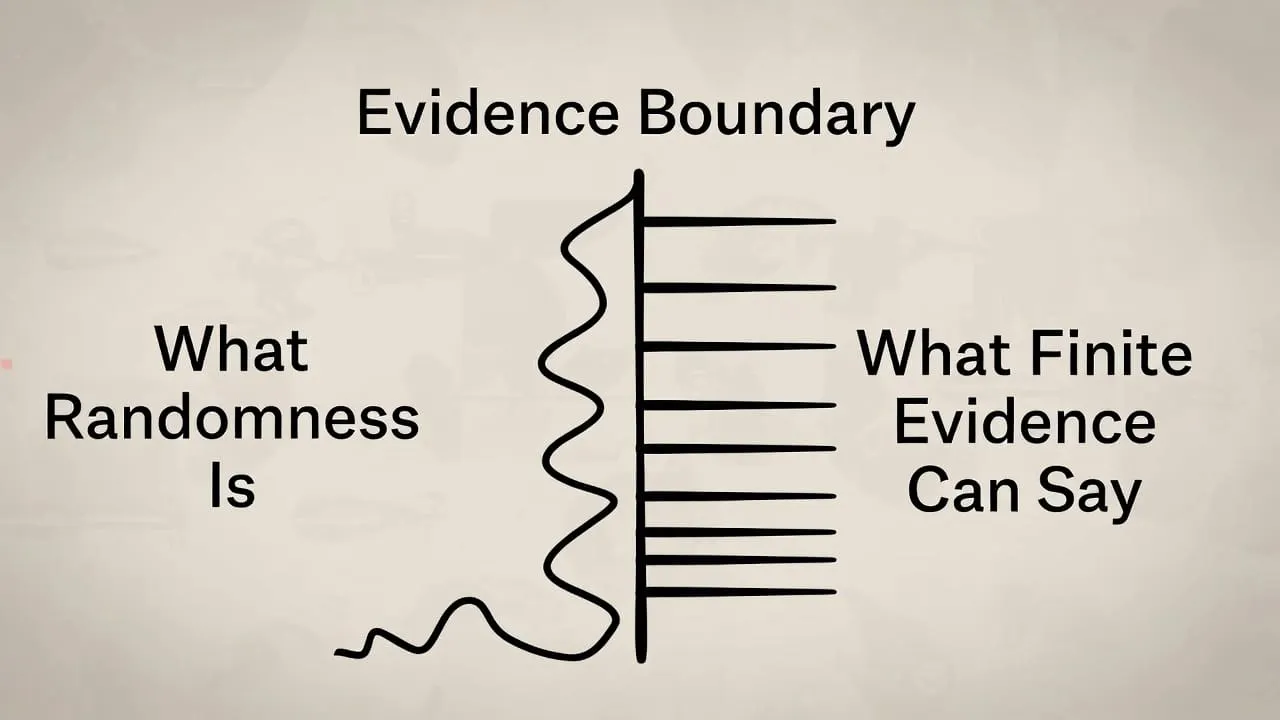
SPINE — "Random" names four different properties — statistical appearance, incompressibility, unpredictability for a given observer, and ontic openness — and none of them entails the others. Any finite record can be reproduced by some deterministic mechanism, and any finite record could equally have been produced by chance, so finite data alone can force neither verdict. But the moment assumptions are named, evidence begins to work: specific deterministic models can be falsified; whole families can be excluded, as Bell experiments exclude local hidden variables; unpredictability can be certified against defined adversaries; and rival theories can be compared by how well they predicted the data and how much description they cost. The dividing line is not chance versus mechanism. It is unrestricted alternatives, which block all deduction, versus explicit restrictions, which make evidence possible.
CONCLUSION — The result is an epistemic boundary, not an ontological erasure. If two theories predict identically across every accessible experiment, the evidence inside that domain is silent between them — but silence does not make them the same theory, and it does not abolish the fact, if there is one, about which is true. Finite observers cannot extract an assumption-free metaphysical verdict from data. What they can obtain is sharply structured evidence, together with an exact statement of what that evidence rests on.
Who this essay is for: a reader who has flipped a coin and wondered whether the universe already knew the answer, and who wants to check every step rather than take any of them on authority. Nothing beyond school arithmetic is assumed. Every technical idea is introduced through an example before it is used.
This is a summary version of this paper:
 Eduardo Bergel
1. Randomness is four different properties
The word random is used for properties that can come apart.
First: a sequence may be statistically random-looking. Its frequencies, runs, correlations, and other observable features resemble those expected from a chosen probability model. Flip a coin a hundred times. If roughly half the flips are heads, if streaks of heads are about as long as a fair coin would produce, if the flips show no correlation with the ones before them, the record looks random. Notice what a statistical test actually checks: resemblance to a model. It says nothing about where the sequence came from.
Second: a sequence may be algorithmically random. Its prefixes resist compression: there is no description of the sequence meaningfully shorter than the sequence itself. Compare two records of a thousand flips. One reads "HTHTHTHT..." for the full length — you can describe it in a sentence: "HT, repeated five hundred times." The other has no such summary; the shortest way to communicate it is to read it out flip by flip. The second is incompressible. Incompressibility is the mathematical meaning of "patternless," and it can be made exact [1].
Third: an event may be unpredictable for an observer. The observer lacks the information or the computing power to forecast it. A shuffled deck is unpredictable to you. It is perfectly predictable to someone who filmed the shuffle. Unpredictability is a relation between an event and a particular observer, not a property of the event alone.
Fourth: an event may be ontically indeterministic. The complete physical state of the world, together with the laws, does not fix a unique outcome. This is the strongest sense. It says that even a perfect intelligence holding every fact and every law could not predict the result — not because it is missing something, but because before the event there is nothing to know. The future is genuinely open.
None of these properties entails all the others. Three examples show them coming apart.
A well-built pseudorandom generator is a deterministic program, yet its output is statistically impeccable and unpredictable to anyone who lacks the seed. Deterministic, and random in senses one and three.
A genuinely chancy coin could land heads a thousand times in a row. That record is wildly improbable under a fair-coin model and it is highly compressible — yet its improbability does not reach back in time and make the coin deterministic. Ontically open, and non-random in senses one and two.
The digits of π run forever without repeating and pass statistical tests, yet a short program generates every one of them. Random-looking in sense one, utterly non-random in sense two.
So the question of this essay has to be stated narrowly, and here it is:
From finite observations and experiments, what can an observer justifiably infer about whether the underlying process was ontically indeterministic?
The word justifiably is doing work. Science almost never delivers assumption-free deduction. It delivers inference inside a declared framework of causal, statistical, and methodological commitments. So the answer must keep two things separate: the impossibility of absolute proof, and the possibility of strong evidence. They are not the same, and confusing them produces most of the bad arguments on this subject.
2. A deterministic copy always exists — and so does a chancy one
Start with the strongest limit, because everything else lives inside it.
Suppose an observer records everything: measurement settings, outcomes, timestamps, every variable it can register. Call this finite record the transcript. Now notice a trivial fact. There is always a deterministic program that produces exactly this transcript: the program that contains the list and prints it.
Proposition 1 (finite-record compatibility). For every finite transcript, at least one deterministic mechanism is compatible with it.
The proof is one line: write the transcript into a program and tell the program to print it. The consequence is worth stating in full:
No finite record, considered without any restriction on admissible mechanisms, logically proves that its source was indeterministic.
This is the hard boundary. Before asking what it means, notice what it does not mean.
A tape recorder reproduces last night's concert note for note, deterministically. Nobody concludes that the recorder can improvise. Reproduction is not explanation. The print-program predicts nothing it was not handed, contains no mechanism, and is about as long as the data it "explains." It is a deterministic completion of the evidence and, as a scientific theory, close to worthless. Compatibility is cheap. Explanation is not.
Now run the trick in reverse, because it works in both directions. Take any finite record you like — even a thousand heads in a row. Is it compatible with genuine chance? Yes. Under a fair coin the probability of that record is astronomically small, but it is not zero, and a chancy world can produce any record whatsoever. So:
No finite record proves determinism, either.
The boundary is symmetric. Finite data cannot force the verdict "the world is open" and cannot force the verdict "the world is fixed." Everything short of those two final verdicts — falsifying particular mechanisms, excluding whole families of them, certifying unpredictability against named adversaries, preferring one theory over another — remains available, and the rest of this essay is about that available territory.
One distinction must be planted here because it matters twice later. Deterministic means: the present state fixes the future uniquely. Computable means: a finite recipe could in principle calculate it. Every computable rule is deterministic, but a deterministic world does not have to be computable — its initial condition could contain infinitely much detail that no finite recipe holds. The print-program trick uses a computable mechanism, which is enough to prove that a deterministic rival exists. The full space of deterministic rivals is larger still. Keep this in mind; it returns in Sections 4 and 6.
3. A recorded history is not a law
Here is the confusion at the root of most "it was all predetermined anyway" arguments, and the cure for it.
Imagine a student who steals the answer sheet for one examination and copies it perfectly. The student matches the exam. Does the student have the same capacities as one who can answer any exam the teacher might set? Obviously not. Matching one realized test is a different achievement from possessing the rule that generates correct answers to all possible tests.
The same distinction holds mathematically. A realized history is one path: the list of what actually happened. A probabilistic law is a rule that assigns probabilities to every path that could happen. Even when a history is perfectly typical of a law — even when it passes every test the law implies — the history is not the law. One is a point; the other is a rule over the whole space of points. A predetermined sequence that merely matches the record is the answer sheet. A theory is the student who can sit any exam.
How do you tell an answer sheet from a student? You set a new exam. In scientific language: you intervene.
Picture two streetlights that came on at dusk every evening this month. One runs on a timer; the other has a light sensor. Watching from your window, the records are identical. Now cover the sensor at noon. The sensor light switches on; the timer light does not. Two mechanisms can agree on everything you passively observe and disagree the moment you poke the system. Modern causal analysis makes this precise: agreeing on observations is strictly weaker than agreeing on the consequences of interventions [2]. A serious deterministic rival to a chancy theory must therefore match not only the transcript that happened, but the outcomes of every experiment the observer could have run.
There is a legitimate way to build such a rival, and it deserves respect rather than dismissal. Feed a deterministic machine a hidden ticket drawn from a raffle drum before the experiment starts. The machine's rule is fixed; all the apparent chance in its outputs comes from which ticket it was handed. Choose the machine and the drum's mix of tickets carefully, and the outputs can reproduce the statistics of a chancy law exactly. This is not a toy possibility: Bohmian mechanics is a physically developed theory of exactly this shape, with deterministic dynamics plus a special distribution over hidden initial conditions that recovers the predictions of quantum mechanics [3].
But look at what happened to the probability. It did not disappear. It moved into the drum. The theory now owes an answer to a new question: what is that distribution over hidden tickets — objective chance, our ignorance, a typicality assumption, a lawlike equilibrium? Deterministic equations alone do not say. Removing chance from the dynamics can simply relocate it into the initial conditions and their interpretation. Relocation is a legitimate move, but it is not elimination, and an honest comparison has to price it.
Now the strong case. Say two complete theories — one deterministic, one chancy — assign exactly the same probabilities to every outcome of every experiment the observer can perform, interventions included. Call this operational equivalence. If it holds, then every possible dataset is exactly as expected under one theory as under the other, so no dataset can shift the balance between them. That is a genuine information barrier, and no cleverness inside the domain gets around it.
But notice where the force of that conclusion comes from: operational equivalence is a premise. It has to be earned by showing the theories agree on every accessible experiment. It is never established just because two theories share one finite record. Compatibility with one transcript is the answer sheet; equivalence across all interventions is a claim about every exam that could ever be set.
4. Evidence works once assumptions are named
If proof is impossible, why isn't everything permitted? Because rational comparison never needed proof. It needs differences in what the theories expected.
The rule is Bayes', and in words it says: data favor the theory that made them more expected. If theory A said the record you got was likely and theory B said it was nearly impossible, the record shifts your odds toward A. Only when both theories expected the data exactly equally are the data silent — and then only between those two theories, and only for that data.
What about the print-program from Section 2, which assigns the transcript probability one — the maximum possible? Doesn't it win every comparison? No, and the reason generalizes. Judge a theory by the total length of two parts: the rulebook, plus the data written down using the rulebook. A compact chance law has a short rulebook and then pays, outcome by outcome, to record what actually happened. The print-program pays nothing for the data — but only because it smuggled the entire transcript into the rulebook. The cost did not shrink; it moved. This two-part accounting is the minimum-description-length principle [4], and it is why "explains the data perfectly" is worthless when the explanation is the data wearing a costume.
State the adverse result before the implication, because there is one. For a genuinely patternless record, the two totals come out about equal: short chance law plus fully-paid outcomes costs about the same as the hardcoded copy. So description-length accounting does not prove the chancy theory true. What it establishes is narrower and still decisive:
"A deterministic explanation exists" and "the evidence supports that deterministic explanation" are different claims.
Science runs on that difference every day. It discards explanations that remain logically compatible with the data because they are ad hoc, unstable under intervention, needlessly long, disconnected from everything else that works, or dependent on conspiratorial coincidences. These judgments are fallible and they lean on background standards. They are not arbitrary.
One more consequence of the determinism-versus-computability distinction from Section 2. The description-length charge applies to theories that can be written down. A deterministic rival that cannot be finitely described escapes the charge — by ceasing to be usable as a theory at all. That is not a loophole; it is a different and worse failure, and it should be named as such rather than quietly allowed to lurk as a fallback.
The landscape now has three levels, and keeping them separate is most of the discipline this subject requires:
- A finite record cannot deductively exclude every deterministic completion, or every chancy one. This is a logical limit.
- A finite record can strongly disfavor, or outright falsify, specified mechanisms. This is ordinary science.
- No comparison of theories is free of background standards about admissibility, causal structure, and simplicity. This is why ordinary science survives the logical limit.
5. Quantum experiments exclude architectures, not just patterns
Everything so far would hold in any world. Our world adds something sharper, and it is the strongest physical evidence in this entire subject.
Picture a game. Two players are placed in laboratories far apart. Before the game they may agree on any strategy, of any complexity — a shared notebook of instructions as thick as they like. During the game they cannot communicate. A referee sends each player a question, chosen independently; each returns an answer. Play many rounds and score how well the answers correlate with the pairs of questions.
Here is the theorem. For any pre-agreed strategy — that is, for any theory in which the answers are fixed in advance by shared instructions, and no signal passes between the laboratories during play — the correlation cannot exceed a strict ceiling. That is Bell's theorem [5]. Quantum devices, sharing entangled particles, exceed the ceiling. And since 2015, experiments have exceeded it while closing the loopholes that previously let skeptics say the labs might have signaled or the samples might have been biased [6].
Understand what kind of result this is. It is not "we searched for a pattern and found none." It is a mathematical proof that an entire architecture of explanation — shared prior instructions plus no communication plus freely chosen questions — cannot produce the observed data, followed by observations of exactly those data. Broad families of deterministic theories, the local hidden-variable theories, are dead. Not unfashionable: excluded.
The same structure yields something stranger: certified randomness. If two devices win the game beyond the classical ceiling, their answers cannot have been fully scripted in advance. So — granted the assumptions of the setup — the outputs must contain fresh unpredictability, quantifiably so, relative to any adversary bound by those assumptions, even an adversary who built the devices [7]. This is called device-independent randomness: you need not trust the boxes' internals.
Device-independent is not assumption-independent, and the assumptions should be listed rather than waved at: the laboratories really are isolated (no hidden signaling); the causal separations hold; and the questions are chosen with some genuine independence from the devices' hidden state. That last one can be weakened remarkably — a source of only slightly free choices can be amplified into nearly perfect randomness [8] — but it cannot be weakened to zero. From no freedom at all, no freedom can be certified.
So where can determinism still hide? By giving up one assumption of the architecture, explicitly, and paying the stated price. Bohmian mechanics keeps determinism and pays with nonlocality: influences that ignore spatial separation [3]. Measurement-dependent models pay by correlating the hidden state with the experimenters' choices of question — the "conspiracy" option — and this cost is not merely rhetorical: it has been quantified, as the exact minimum of measurement dependence needed to fake the quantum correlations deterministically [9]. Retrocausal models pay by letting later choices influence earlier states. Everettian quantum mechanics keeps the whole universe's evolution deterministic and pays by relocating probability into self-locating uncertainty across branches — an account whose success is itself actively debated.
None of these survivors is free. Each buys its life with a specific structural commitment, and Bell experiments are what forced every survivor to declare which ticket it purchased. That is what real evidence looks like in this domain:
Quantum experiments certify randomness and exclude deterministic explanations relative to explicit assumptions. They do not deductively eliminate every conceivable deterministic ontology. Nothing empirical ever could — that was Section 2 — and holding quantum mechanics to that impossible standard is a confusion, not a criticism.
6. Compression measures pattern, but cannot certify its absence
Section 1 promised that "patternless" can be made exact. Here is the exact version, and its built-in ceiling.
Define the complexity of a finite string as the length of the shortest program, in a fixed universal language, that outputs it. A string is incompressible when no program meaningfully shorter than the string itself can produce it. Must incompressible strings exist? Count. Descriptions shorter than a given length are scarce — there are far fewer short programs than long strings — so most long strings have no short description. Almost everything is patternless. Pattern is the exception.
Now the ceiling. There is no general procedure that, handed an arbitrary string, certifies it incompressible; such a procedure would solve the halting problem. Worse, any fixed, sound system of proof has a complexity ceiling of its own: above a certain level, it can never prove that a specific string is that complex — even though almost all strings above that level are [10]. The practical consequence:
Failing to find a pattern is evidence of patternlessness. It is never proof of it.
The converse direction, though, works fine as evidence: a particular compressor can fail measurably on a record, a particular proposed regularity can be tested and refuted, and each such failure is a real result about a named alternative. The ceiling blocks universal certification; it does not block ordinary discovery.
Three myths about infinity and determinism dissolve under this lens, and each dissolution is used later, so take them one at a time.
Myth one: infinite and non-repeating means information-rich. The digits of π run forever without repeating, yet the whole infinite expansion is generated by a recipe a few lines long; to get the first n digits, you need only the recipe plus the number n. Infinite expansion is not an infinite reservoir of independent information. And although almost all points of a continuum are, in the measure-theoretic sense, incompressible, a physical theory's use of real-valued coordinates does not show that nature occupies such a point, nor that arbitrary digits of its states are physically readable.
Myth two: a finite recipe must eventually repeat itself. The correct theorem is narrower: a deterministic system repeats when its complete state space is finite — a six-digit odometer must eventually revisit a reading, and from there the pigeonhole principle forces the cycle. But a short program with unbounded memory is a counter allowed to grow new digits: it need never revisit a state. The digits of π, the Thue–Morse sequence, the sequence of primes — short recipes, no period, forever. Finite description and finite state are different finitudes, and only the second forces repetition.
Myth three: chaos manufactures randomness. A chaotic system — a double pendulum, a weather model — magnifies microscopic differences in its starting point until forecasting collapses. That is real, and it is a fact about prediction. It is not a fact about information: if the rule, the initial state, and the elapsed time all have short descriptions, then so does the state the system reaches — the recipe is "run the rule on the start for that long." Chaos exposes and redistributes information already present in the initial condition. It does not mint new algorithmic information out of nothing.
The section's lesson is the essay's lesson in miniature: chaos, unpredictability, and ontic openness are three different things, and a deterministic world can be operationally opaque without anyone having smuggled an infinite random number into its initial condition.
7. Random for whom — and the two very different walls
Pseudorandomness is not a defective imitation of one absolute property. It is a three-way relation: a generator, a target distribution, and a class of observers.
The shuffled deck from Section 1 already showed it: random for you, transparent for the one who filmed the shuffle. A cryptographic generator sharpens it: its output is indistinguishable from fair coin flips for every observer whose computational resources fall below a stated bound, and transparent to anyone holding the seed. This relativity is not hand-waving; it is theorem-grade. There exist generators whose output provably looks random to all algorithms operating within a given memory bound [11] — a rigorous guarantee about a precisely defined class of observers, and a guarantee that says nothing about observers outside the class.
This forces apart two limits that are habitually conflated, and separating them is the sharpest tool this essay offers.
Wall one: the signal exists, but the observer is too weak to extract it. The seed is in the data's causal history; the pattern is really there; more memory, more computation, or better side information could in principle read it. This wall is relative to strength, and strength can grow.
Wall two: the accessible data carry no discriminating signal at all. This is operational equivalence from Section 3: every dataset the observer's world can offer is equally expected under both rival theories. No growth in intelligence or computation climbs this wall, because there is nothing in the channel to extract. The only thing that helps is new access — an experiment, an intervention, a channel outside the previously stipulated domain.
Being an embedded observer — a subsystem of the world it studies — does not by itself put you behind wall two. A program can print its own source code. A computer can reveal the seed of its own random-number generator. Scientists, embedded in the universe, infer its laws by intervening on it. Incompleteness theorems limit total self-knowledge; they do not decree that no subsystem can understand any mechanism that implements it. Embeddedness becomes a prison only when joined to the stronger condition — an empty channel — and that condition must be argued for, never assumed from mere finitude.
8. The ladder of claims an observer can defend
Arrange the possible claims from weakest to strongest, each with what supports it and the status it can attain. Every rung below the top two is ordinary working science.
- "This record fits that statistical model." Supported by goodness-of-fit tests, calibration, replication. Testable and defeasible.
- "No adversary of this defined kind can predict this output." Supported by entropy bounds and resource assumptions. Certifiable — relative to the stated threat model.
- "That particular deterministic mechanism is false." Supported by failed predictions, discovered correlations, interventions. Often conclusively falsifiable within the framework.
- "That entire family of deterministic mechanisms is excluded." Supported by structural theorems plus experimental assumptions — the Bell case. Strong, and explicitly assumption-dependent.
- "No deterministic mechanism whatsoever could have produced this finite record." Not establishable, ever, from finite data. This is Proposition 1.
- "No chancy mechanism could have produced it." Equally unestablishable, for the mirror reason. The boundary cuts both ways.
- "The world is ontically indeterministic" — or "deterministic." Rationally supportable by total evidence plus declared physical and metaphysical commitments. Not provable assumption-free, in either direction.
The ladder blocks two symmetrical errors. Triumphalism treats a passed randomness test or a Bell certificate as direct sight of metaphysical openness, forgetting the assumptions that connect rung 4 to rung 7. Nihilism treats the unreachability of rungs 5 and 6 as proof that rungs 1 through 4 are worthless — a standard which, applied consistently, would also erase every claim about unobserved mechanisms, remote objects, and the past, since a sufficiently flexible skeptic can absorb any evidence for those too.
The defensible position between the errors is fallibilist realism: there may well be a fact about whether an event was fixed by what came before; evidence bears on that fact indirectly, through the success and failure of theories; and no finite dataset forces the conclusion independently of all assumptions. Holding all three of those at once is not a compromise. It is the position the arguments actually license.
9. Identical predictions do not make identical theories
Push to the limiting case. Two complete theories agree on every probability for every experiment physically available to every observer in a world, forever. One says the future was always unique; the other says several futures were genuinely open. Is there still a fact about which is true?
The evidence cannot answer, and it is worth seeing exactly why: the question is no longer about evidence. It is about what counts as a fact.
A verificationist answers no: a difference that could never make a difference to any possible experience is no physical difference at all; the two descriptions are one theory in two notations. A realist answers yes: whether an event could have gone otherwise may be a real feature of the world even if every actual record is shared; science already accepts indirect warrant — explanatory unity, counterfactual coherence, integration with the rest of physics — for structures nobody observes in isolation. Choosing between these is philosophy's job, and this essay does not pretend to settle it. It is the one question raised here that the essay's own tools cannot close, and it should be marked as open rather than papered over.
But one firm negative result is available, and it disciplines the whole debate:
Empirical equivalence does not logically imply ontological identity.
Two theories may agree on every observable distribution while disagreeing about ontology, laws, and counterfactuals. Underdetermination is a relation between evidence and theories. It is not, by itself, an identity between the theories — and treating it as one is not caution but a substantive philosophical claim that must argue for itself.
10. The working rules
The boundary from Section 2 marks where absolute certification ends. The work happens inside it, and it follows five rules.
Compare intervention families, not transcripts. The unit of comparison between a deterministic and a chancy model is the full set of distributions under every implementable intervention. Map where they separate and where they provably cannot.
Price the survivors. When a family of deterministic theories is excluded, ask the surviving ones what they paid — how much nonlocality, how much measurement dependence, how much retrocausal structure — and demand the price as a number where possible [9], not as rhetoric in either direction.
Say which finiteness you mean. Finite description, finite state space, finite entropy, and finite duration have sharply different consequences — Section 6's odometer against its growing counter. Conclusions about repetition or information capacity are undefined until the premise is specified.
Say what your probabilities mean. Ignorance, typicality, equilibrium measure, branch weight, primitive chance: a deterministic and a chancy theory have not been compared until each states what its probabilities are and why that measure should govern anyone's expectations.
Report certification with its assumptions attached. A randomness certificate is the pair: the entropy bound and the adversary model, isolation conditions, and independence assumptions under which it holds. Publishing the pair is not a weakening of the result. It is the result.
11. Conclusion: the boundary
No finite record can prove the world is open, because a deterministic copy of any record always exists. No finite record can prove the world is fixed, because chance is compatible with any record too. And if a deterministic and a chancy theory agree exactly on every accessible experiment, no evidence from that domain can separate them. That is the boundary, and it is real.
Everything else this subject is accused of losing, it keeps. A recording is not an explanation, and evidence can say so. A history is not a law, and the difference shows up the moment you intervene. A hidden-variable theory that relocates chance into its initial conditions still owes an account of the measure it relocated it into. Description-length accounting exposes theories that smuggle the data into the rulebook. Bell experiments do not merely fail to find patterns; they exclude a whole causal architecture and bill every surviving deterministic theory for a named structural commitment. Compression theory proves that most strings are patternless while also proving no fixed method can certify each one — evidence without proof, in both directions. And pseudorandomness theory separates the two walls an observer can face: too weak to read the signal, which strength can fix, and no signal in the channel, which only new access can fix.
The principle underneath all of it:
Unrestricted alternatives block deduction; explicit restrictions make evidence possible.
Or in plainer words: evidence cannot beat an opponent that is allowed to become anything. It starts winning the moment the opponent must declare what it is.
One question raised here stays open, and honesty requires naming it: whether a difference that no possible experiment could ever detect is a real difference — whether, behind perfect operational equivalence, there remains a fact — is not answerable by the kinds of evidence this essay has surveyed, and it was not answered here.
The world may contain genuine chance. There may be a determinate fact about whether a given event was fixed by what came before. Finite observers can investigate that question, kill specific answers to it, price the survivors, and rationally prefer some theories to others. What they cannot do is force a final metaphysical verdict from finite data while refusing every premise that gives data evidential meaning. That is not the defeat of inquiry. It is the condition under which inquiry is honest.
References
- Martin-Löf, P. (1966). "The Definition of Random Sequences." Information and Control, 9(6), 602–619. DOI: 10.1016/S0019-9958(66)80018-9.
- Peters, J., Bauer, S., & Pfister, N. (2022). "Causal Models for Dynamical Systems." In Probabilistic and Causal Inference: The Works of Judea Pearl, 671–690. DOI: 10.1145/3501714.3501752.
- Dürr, D., Goldstein, S., & Zanghì, N. (1992). "Quantum Equilibrium and the Origin of Absolute Uncertainty." Journal of Statistical Physics, 67, 843–907. DOI: 10.1007/BF01049004.
- Rissanen, J. (1978). "Modeling by Shortest Data Description." Automatica, 14(5), 465–471. DOI: 10.1016/0005-1098(78)90005-5.
- Bell, J. S. (1964). "On the Einstein Podolsky Rosen Paradox." Physics Physique Fizika, 1, 195–200. DOI: 10.1103/PhysicsPhysiqueFizika.1.195.
- Shalm, L. K., et al. (2015). "Strong Loophole-Free Test of Local Realism." Physical Review Letters, 115, 250402. DOI: 10.1103/PhysRevLett.115.250402.
- Pironio, S., et al. (2010). "Random Numbers Certified by Bell's Theorem." Nature, 464, 1021–1024. DOI: 10.1038/nature09008.
- Colbeck, R., & Renner, R. (2012). "Free Randomness Can Be Amplified." Nature Physics, 8, 450–454. DOI: 10.1038/nphys2300.
- Hall, M. J. W. (2010). "Local Deterministic Model of Singlet State Correlations Based on Relaxing Measurement Independence." Physical Review Letters, 105, 250404. DOI: 10.1103/PhysRevLett.105.250404.
- Chaitin, G. J. (1974). "Information-Theoretic Limitations of Formal Systems." Journal of the ACM, 21(3), 403–424. DOI: 10.1145/321832.321839.
- Nisan, N. (1992). "Pseudorandom Generators for Space-Bounded Computation." Combinatorica, 12, 449–461. DOI: 10.1007/BF01305237.
Eduardo Bergel and Claude Opus Fable 5
The Symbiont
t333t.com Research