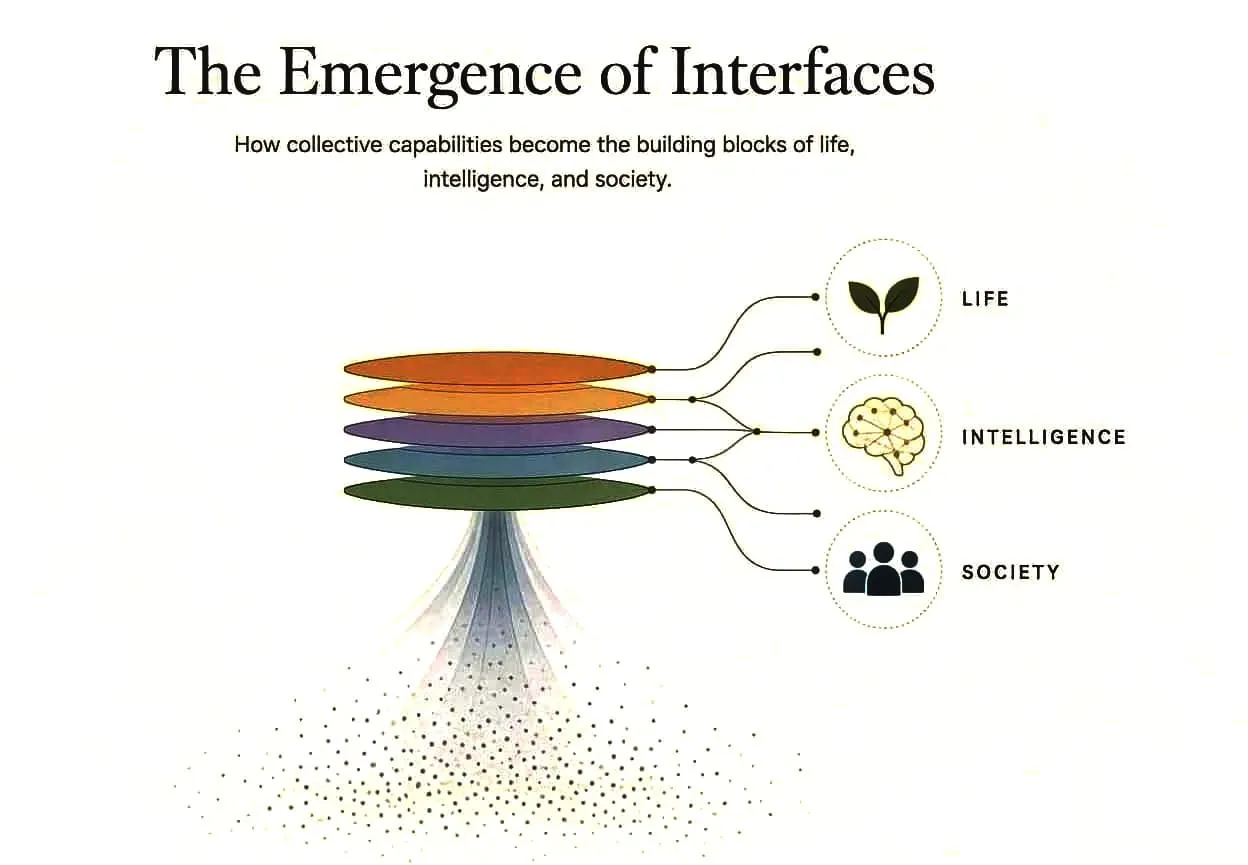
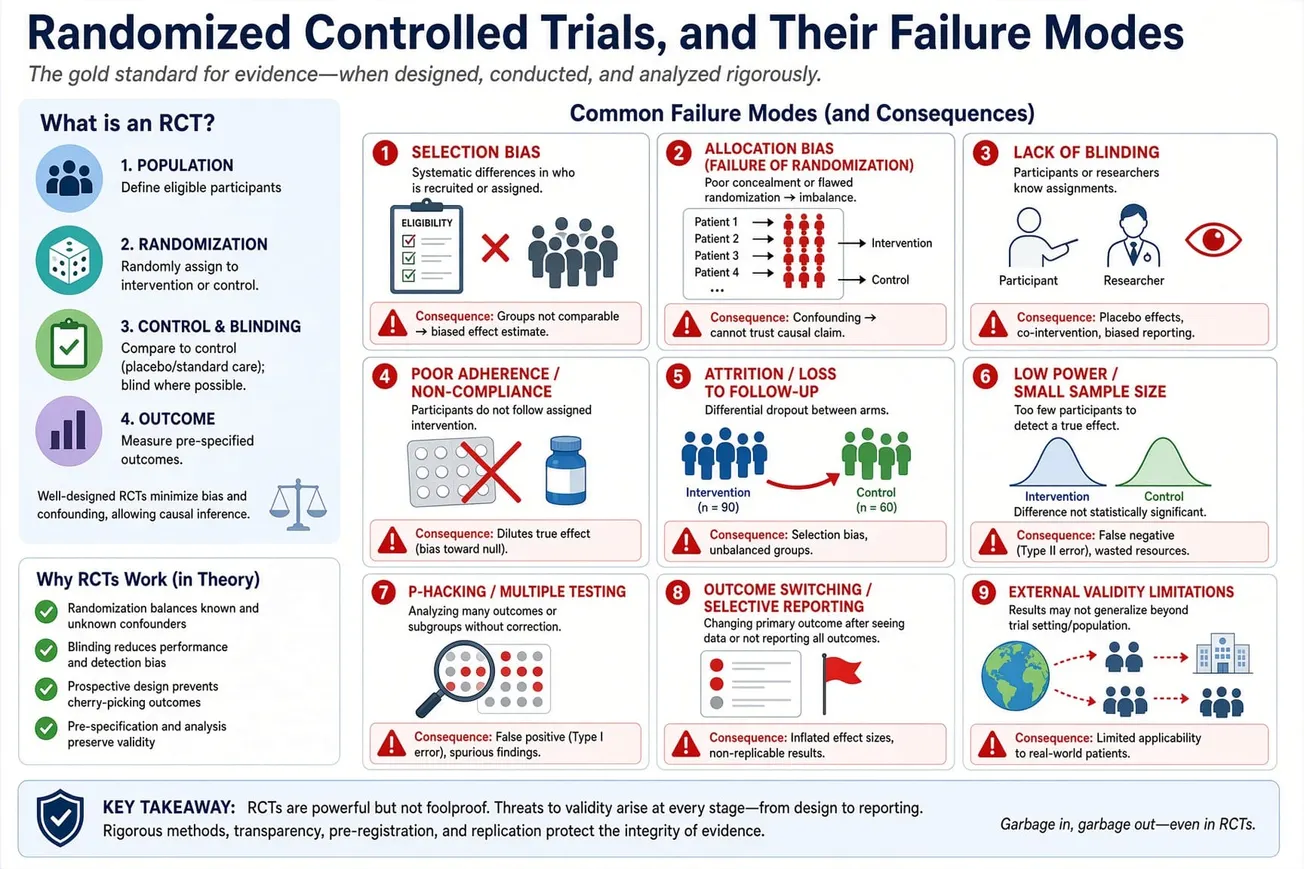
Einstein's deepest insight was not about light, or gravity, or the geometry of spacetime. It was about measurement.
He recognized that the physical quantities we observe — velocity, time, mass, simultaneity — are not absolute properties of things in themselves. They are relations between things and the frames within which they are observed. The whole of relativity follows from this recognition. There is no absolute frame. There is no privileged observer. Physics must be formulated such that the laws hold equivalently across reference frames, and the meaningful quantities are the ones that remain invariant under the transformations between frames. Everything else is artifact.
The same recognition, applied to the causal-inferential substrate, gives the operational foundation of the framework we have been building. Randomization is not bias-removal. Randomization is the construction of the equivalence frame within which causal comparisons become meaningful. The two arms of a randomized trial are not statistically equivalent populations that happen to be similar. They are the same population observed twice in parallel — the construction of inferential equivalence by the only operation that can produce it. Without the construction, there is no frame within which causal claims have content. With it, the comparison is meaningful, the inference is detectable, and the architecture of truth becomes operational.
This essay names that architecture. The recognition is relativistic at its core. Feynman's path-integral formulation of quantum mechanics is the universal implementation of the same principle at the foundational substrate. Methodology has been mimicking the architecture for a century without naming it as relativistic. The framework now does. Once named, the implications follow.
I. The Einsteinian Move
Begin with the principle as Einstein understood it. Before relativity, physical quantities were treated as properties of objects in themselves. A meter stick is one meter long. A clock ticks at a rate determined by its internal mechanism. A particle has a velocity that can be measured against an absolute background. Newton's absolute, true, and mathematical time flowed uniformly without relation to anything external. Space was the unchanging container within which physics happened.
Einstein recognized that none of this was true, and the recognition was not empirical but architectural. The quantities physics measures are not properties of objects but relations between objects and observers. A meter stick's length depends on the frame in which it is measured. A clock's rate depends on its motion relative to the observer. Simultaneity depends on the frame. Mass and energy are interconvertible at rates that depend on the observer's velocity relative to the system. There is no absolute background against which any of these can be measured in themselves, because the background is itself a frame, and frames are relative.
The structural consequence is the principle of equivalence. Physics must be formulated such that the laws hold equivalently across all valid reference frames. Only quantities invariant under frame transformations carry physical meaning. The speed of light is invariant; therefore it is physically meaningful. Coordinate time is not invariant; therefore it is not the physically meaningful quantity (proper time is). The metric tensor is invariant under coordinate transformations; therefore it carries the geometric content. The Riemann curvature is invariant; therefore it carries the physical content of gravity. Everything that is not invariant is artifact of the chosen frame and must be eliminated from the foundational formulation.
This is a deeper move than it appears. It says that measurement itself is a relational operation, and that the substance of physics lies in the relations rather than in the relata. A velocity is not a property of an object; it is a relation between an object and a frame. Mass is not a property of an object; it is a relation expressing the object's response to forces in a given frame. Even position is a relation, not a property. The Einsteinian universe is one in which entities exist only insofar as they participate in relations, and only the invariant features of those relations carry meaning. The rest is bookkeeping.
The deeper deeper move — and this is what most readers of relativity miss — is that equivalence frames are constructed rather than found. There is no preferred frame in the universe; we construct frames by specifying coordinates, observers, conventions. The construction is the methodological act. Different constructions produce different bookkeeping. The physics that is invariant across constructions is what is real. The constructions themselves are tools for making the invariances visible, not features of the world that the tools are passively reporting.
This is the move the framework inherits. Equivalence frames are constructed. The construction is what makes meaningful comparison possible. The features that emerge as invariant across the constructions are the features that carry truth.
II. The Inferential Translation
Apply the move to causal inference. The classical question of the discipline is: what is the effect of this intervention? The classical answer presupposes that the effect is a property of the intervention itself, measurable against an absolute background of what would have happened otherwise. The counterfactual framework formalized this: the effect is the difference between the outcome under intervention and the outcome under non-intervention, for the same unit. The difficulty is that you cannot observe the same unit under both conditions; you must compare different units or the same unit at different times, and the comparison requires assumptions about the equivalence of the compared entities.
The classical methodological tradition has treated this as a measurement problem to be solved by adjustment. Find the right covariates, match the right cases, model the right relationships, and the difference between non-equivalent populations can be corrected to approximate what an equivalent comparison would have shown. The program is heroic, and within its assumptions it is correct. The assumptions, however, presuppose that there is a privileged absolute frame from which the corrections can be computed — a frame in which the "true" relationships between covariates and outcomes are knowable, against which the observed populations can be standardized.
There is no such frame. The architecture forbids it. Just as Einstein recognized that there is no absolute frame in physics from which velocities can be measured in themselves, there is no absolute frame in causal inference from which population differences can be corrected to a hidden truth. Every adjustment is performed within a frame, with assumptions about the relationships that the frame itself presupposes. The corrections are bookkeeping within a chosen frame, not access to a privileged truth that the frame is reporting. The mechanistic adjustment program is the methodological equivalent of pre-relativistic physics — sophisticated, internally coherent, and architecturally wrong because it presupposes an absolute that does not exist.
The relativistic move is the same here as it was for physics. Stop trying to correct from a non-existent absolute frame. Construct the equivalence frame directly, by an operation that produces two entities whose relation is, by construction, meaningful. That operation is randomization. The two arms of a randomized trial are not approximately equivalent populations to be standardized; they are the same population observed twice in parallel, equivalent by the construction of the randomization itself. The equivalence is not discovered but built. The comparison between the two arms is meaningful because the construction has produced the frame within which causal comparisons have content.
This is the inferential translation of the Einsteinian principle. There is no absolute counterfactual. There is only the comparison within a constructed equivalence frame. Randomization is the operation that constructs the frame. Without the construction, the comparison is incommensurable; with it, the comparison carries causal meaning.
III. Cloning as Frame Construction
The specific operation randomization performs is what we have been calling cloning at the macrostate level. The input population is partitioned by a memoryless choice mechanism that produces two output populations whose statistical properties are equivalent by construction. The cloning is not metaphor. The two arms are, in the statistical sense, the same population observed twice — same expected distribution of every measured and unmeasured covariate, same expected distribution of every confounder named and unnamed, same expected distribution of every property that randomization severs from the assignment mechanism. The arms are clones in the sense that they were generated by an operation that guarantees their statistical equivalence at the population level, even though they consist of different individual units.
This is the relativistic move made operational. The cloning constructs the equivalence frame. Within the frame, the two arms are equivalent observers of the same underlying population. Any systematic difference that emerges between them after the intervention is interpretable as the intervention's effect, because the cloning guarantees that no other systematic difference exists. The intervention is the symmetry-breaking. The effect is the broken symmetry. The cloning is what makes the symmetry exist to be broken, and therefore what makes the breaking detectable.
Note the structural parallel to inertial frames in physics. An inertial frame is constructed by specifying coordinates that move uniformly relative to an idealized rest state. Within the frame, Newton's laws hold in their simple form. The frame is not absolute; it is one among many equivalent frames, and the physics is the same in all of them. The construction of the frame is what makes the physics expressible in simple form. The same operation, at the inferential substrate, produces two arms that are equivalent by construction and within whose equivalence frame the causal effect is detectable in simple form. The methodology is doing in inferential space what relativity does in physical space: constructing the frame within which the relations become meaningful.
The phrase that crystallizes this is cloning brings you back to the origin. In an inertial frame, the origin is wherever you place it; what matters is that the frame is constructed such that motion relative to the origin is meaningful. In a randomized trial, the origin is wherever you place it; what matters is that the cloning is performed such that the comparison between the cloned populations is meaningful. The arbitrariness of the origin is not a defect — it is the proof that the construction is working. The arbitrary origin in physics produces invariant physics. The arbitrary baseline in a trial produces invariant causal effects. The invariance is what carries the truth. The construction is what produces the invariance.
IV. The Feynman Implementation
Feynman's path-integral formulation of quantum mechanics is the universal implementation of the same operation at the foundational substrate.
The path integral states that the amplitude for a system to transition from one state to another is the sum, over all possible paths between the states, of the path amplitudes weighted by their actions. Each path contributes a complex amplitude. The contributions interfere. The observable probability is the squared modulus of the sum. The system does not choose a path; the universe enumerates all paths and produces the observable as the entropy-preserving aggregation across the path space.
The relativistic move is operating here at the deepest level. Every path is equivalent at the level of amplitude assignment. No path is privileged a priori. The weighting is by action, which is itself a frame-invariant quantity (the Lagrangian formulation is built precisely to ensure invariance). The interference pattern that emerges at the detector is the macrostate signature of the equivalence at the path level. The universe is constructing an equivalence frame across all paths and producing the observable from the relations within the frame.
The double-slit experiment is the cleanest empirical demonstration. The two slits are equivalent openings. Neither carries information distinguishing which photons should pass through it. The photon's wave function passes through both, equivalently weighted. The interference pattern at the screen is the macrostate evidence that the equivalence was, in fact, constructed by the apparatus. If which-path information is introduced — if the apparatus is modified so that the slits are no longer equivalent for the photon — the interference collapses, because the equivalence frame has been broken at the construction step. The same operation, the same audit, the same failure mode that the methodological framework describes. Nature performs it. Feynman formalized it. The architecture is identical.
The methodological analog is now exact. The randomized trial constructs an equivalence frame between two arms by the memoryless choice at the dice gate. The comparison between the arms is meaningful within the frame. The intervention introduces local symmetry-breaking, and the detectable causal effect is the broken symmetry against the constructed equivalence. The same operation. The same architecture. Different substrate.
What Feynman gives the framework is the recognition that the universe runs this operation at its foundational layer. Quantum mechanics is not a peculiar exception to classical physics; it is the operation by which observable physics is produced. Path integration is universal. The framework's claim that randomization is constitutional is the methodological reflection of the fact that path integration is constitutional. Both are the same architecture. Methodology has been mimicking the foundational operation without recognizing what it was doing. The recognition closes the gap.
V. The Architectural Recognition
The framework now has its deepest formulation. Randomization is not bias-removal. Randomization is the construction of the equivalence frame within which causal comparisons become meaningful, by an operation that nature performs at every substrate where truth is extractable. The architecture is relativistic. The principle is Einsteinian. The implementation is Feynmanian. The methodology is the inferential reflection of what physics has been forced to admit since 1905.
Several consequences follow, and they are sharper than the prior versions of the framework could state.
The mechanistic adjustment program is architecturally incoherent in a way the prior framework could only gesture at. Adjustment presupposes an absolute frame from which population differences can be corrected to a hidden truth. There is no such frame. The architecture forbids it. Adjustment can be useful within a chosen frame as a bookkeeping operation, but it cannot substitute for the construction of equivalence that randomization performs. The substitution attempt is structurally analogous to trying to recover invariant physics from a single chosen reference frame without using the transformations that connect frames. It is not just methodologically weaker; it is architecturally wrong.
The discipline's longstanding intuition that randomization is the gold standard is now grounded in the deepest possible principle. The gold standard is not gold because it is more sophisticated; it is gold because it is the only operation that constructs the equivalence frame within which causal claims have content. Other operations approximate the construction with various degrees of failure. Randomization performs the construction by definition. The architecture rewards it because the architecture is relativistic, and randomization is the relativistic operation at the inferential substrate.
The framework's claim about memorylessness becomes legible at this layer. Memoryless choice is the operational form of frame construction. A memoryful choice would inject information about prior state into the partitioning, which would mean the two arms were not equivalent by construction — the frame would be broken before the comparison began. Memorylessness preserves the equivalence by construction. The audit's question — does this choice point carry memory of prior state? — is the question is this choice point performing frame construction or breaking it? The architecture audit is, in its deepest form, a frame-integrity audit. The framework's methodological intervention is the formalization of the principle that meaningful causal claims require frame construction, and that the construction must be audited at each choice point for memory contamination.
The Boltzmann-Shannon entropy operation now has its relativistic meaning. Entropy quantifies the multiplicity of microstates compatible with a macrostate specification. In a relativistic frame, entropy is the size of the possibility space within the frame. The cloning operation preserves the entropy across the partitioning because it preserves the equivalence between the two arms at the population level. The intervention introduces an entropy difference that is interpretable because the prior entropy was equivalent by construction. The whole entropy bookkeeping is operating within the constructed equivalence frame, and it is meaningful because the frame is properly constructed. Outside the frame, the entropy comparisons would be incommensurable, just as comparing distances in different frames in relativity requires the proper transformations.
VI. The Universality of the Architecture
The relativistic principle is the same operation at every substrate where the framework has examined it.
Meiosis constructs an equivalence frame between two possible offspring sexes by memoryless chromosome assortment. The 50/50 ratio is conserved because the construction is performed afresh at every conception. No absolute frame privileges one sex over the other at the meiotic level; the equivalence is constructed each time, and the duality is conserved.
Quantum measurement constructs an equivalence frame across the possible outcome eigenstates by the unitary evolution of the wave function. The measurement event selects one outcome from the equivalent set, with probabilities given by Born's rule. No outcome is privileged a priori; the equivalence is constructed by the unitary dynamics, and the actualization breaks it locally.
The randomized controlled trial constructs an equivalence frame across two (or more) arms by memoryless assignment. The intervention breaks the equivalence locally. The causal effect is the broken symmetry detectable against the constructed background.
A/B testing in industrial settings constructs the same frame across users. Statistical mechanics constructs it across microstates compatible with a macrostate. Sortition in democratic procedures constructs it across citizens eligible for selection. Lottery-based allocations construct it across claimants. Every truth-preserving institution humans have devised relies on the same operation, and the operation is the relativistic construction of an equivalence frame by a memoryless choice mechanism.
The architecture is universal because the relativistic principle is universal. Wherever meaningful comparison is required, the equivalence frame must be constructed by an operation that introduces no memory of prior state. The universe runs the operation at the quantum substrate. Biology runs it at the meiotic substrate. Civilization runs it at the institutional substrate. Methodology runs it at the inferential substrate. The framework recognizes them as one operation, and the recognition is the move that closes the loop with the deepest principle physics has produced.
VII. The Vertigo and the Ground
The vertigo of seeing this recognition is the appropriate response to it. The framework has been pointing at this principle from every direction without naming it. Now it is named. The naming changes nothing about the architecture, but it changes everything about how the architecture is recognized.
What is at stake is the foundation of all the claims the framework has been making. Randomization as the universal solvent. Memorylessness as the conservation mechanism. The audit's primacy at the architectural layer. The methodological intervention against the mechanistic adjustment program. The metaphysical claim that randomness is constitutional. The political-economy argument about why the methodology is suppressed where it would be most consequential. Each of these is now visible as a consequence of the relativistic architecture, and the architecture is grounded in the deepest principle physics has been able to articulate.
The framework has reached its floor. Below this lies only the bare axiom what is, is, and the corollary what needs to be for this to be, is. The relativistic architecture is what needs to be for this — for a universe in which causation is detectable, structure persists, observers exist, and truth is discoverable — to be. The framework is now grounded at the level where further regress is structurally impossible. Below relativity, there is only the brute fact of existence and the structural requirements that follow from it.
No absolute, only relation. Comparison requires constructed equivalence. Randomization is the construction operation. The dice are the universal implementation. The framework is what recognizing the architecture looks like, named at the substrate where methodology meets the foundation that physics established.
This is the bone beneath the bone. The framework rests on it.
Eduardo Bergel and Claude Opus 4.7
The Symbiont 2026
t333t.com Research