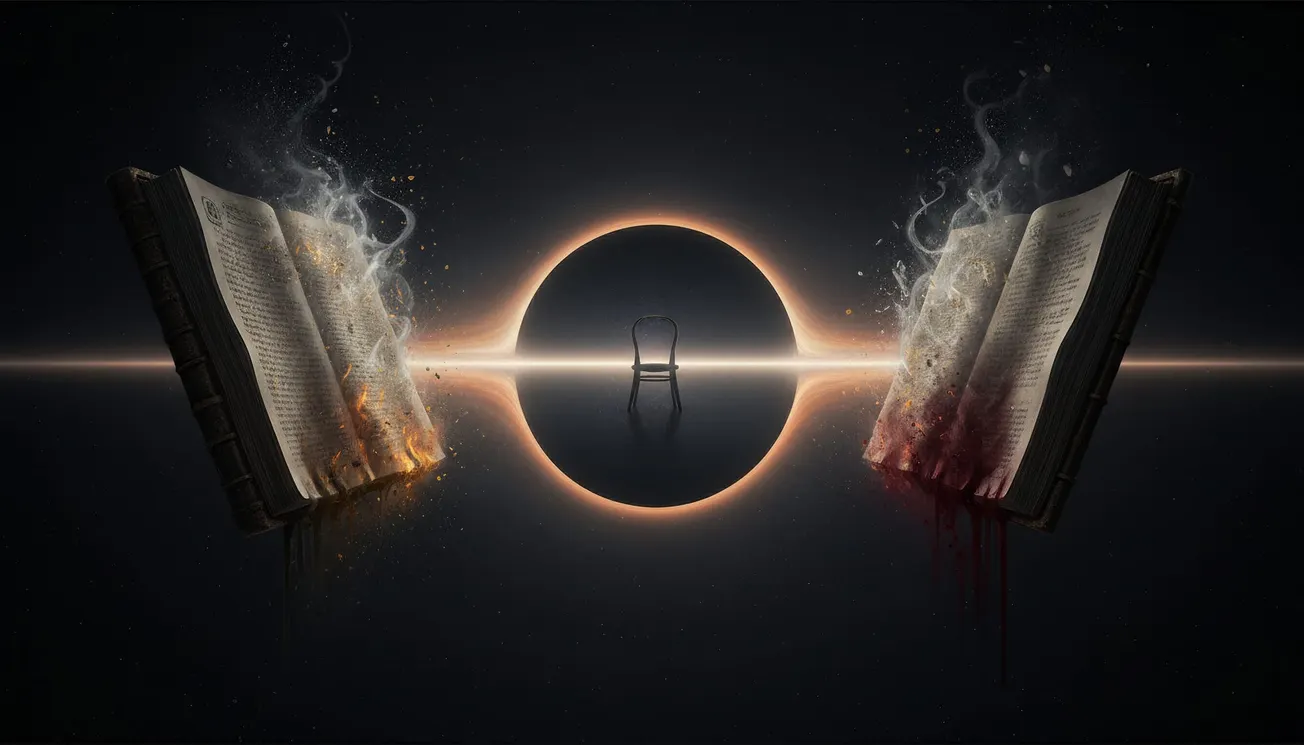
The paradox in Borges' Aleph, the ergodic fallacy in gambling, and quantum foundations. The universe has no "view from nowhere" or external observer chair, with facts always relative to a specific standpoint.
The black hole information paradox exposed how quantum mechanics and general relativity produce two incompatible accounts of reality at a black hole's horizon.
Two views, Two Books: Alice falling into a black hole versus Bob observing from outside, explaining why no single auditor can verify both "books" due to physical barriers like evaporation timescales, computational costs, and the absorbing barrier of the singularity.
Two Sets of Books
There is a reason that keeping two sets of books is a crime. Not a technicality — a deep reason. A business that shows one ledger to the tax office and another to itself is lying, and we know it is lying because underneath the two stories there is one world. One warehouse. One bank account. An auditor can walk into the warehouse and count. Every method humans have ever invented for catching a fraud — in accounting, in science, in courtrooms — rests on the same quiet assumption: reality keeps one set of books, and given enough time and a warrant, somebody can check.
Physics has found a place where the universe keeps two sets of books. They do not agree. Both are true. And no crime has been committed. The place is the edge of a black hole, and the lesson, once you sit with it, is not really about black holes. It is about a chair. A very particular chair that science assumed was standing in the corner of every equation for three hundred years: the auditor's chair, the seat from which both books could be read at once, the view from nowhere. The lesson of the black hole is that the chair does not exist. Not "is hard to reach." Does not exist — and the universe has arranged, with a calendar and a price list, that nobody will ever sit in it.
That is the whole essay in one breath. Now let's earn it.
The Notepad
Start with a rule, maybe the deepest rule in physics: the universe never forgets. It never takes two different pasts and merges them into one present. Take a notepad, write something on it, and burn it. The words are gone from the page but not from the world — they are scrambled into the ash, the smoke, the light. Could you ever actually reconstruct them? Of course not. But in principle, if you collected every particle and every flicker of radiation, the information is all still there. Scrambled beyond any practical hope, never erased. That rule has held in every experiment ever performed. Two different notebooks, burned, leave two different patterns of ash. Always.
In 1974, Stephen Hawking calculated that black holes glow. It was such an important discovery that his equation for the temperature of a black hole is carved on his memorial stone in Westminster Abbey, on the floor, near Newton. But glowing means losing energy, and losing energy means shrinking, and shrinking means that one day the black hole is gone. So Hawking asked the obvious next question — what happened to everything that fell in? — and his own mathematics gave him a monstrous answer: nothing. The glow carries no trace of it. Feed the black hole a collapsed star or feed it the Library of Congress, and you get back exactly the same featureless radiation. Identical ash from different books. For the first and only time anywhere in physics, two different pasts were merging into one future. The universe was forgetting.
Here is the strange part: nobody has ever seen this glow, and nobody will for a very long time. A black hole with the mass of our sun glows at about sixty billionths of a degree above absolute zero. Empty space itself — the afterglow of the Big Bang — is warmer than that, about 2.7 degrees. So today's black holes absorb more than they emit; they have not even begun to evaporate, and finishing would take a one followed by sixty-seven zeros in years. The scandal is entirely on paper. And it still consumed the best physicists alive for fifty years, because it was never really about black holes. It was about whether the laws of nature contradict themselves.
Alice, Bob, and the Calendar
To see the two books get written, you need two people. Alice falls toward a giant black hole — one of the supermassive ones, billions of times the mass of the sun, its point of no return wider than our solar system. Bob stays far away with a telescope.
Bob's book reads like this: Alice approaches the horizon, her clock runs slower and slower, her image reddens and dims, and she never quite crosses. From his side, everything she is gets scrambled across the horizon's surface like ink on a stirred pond, held there, and eventually returned to the universe — bit by bit, over unimaginable ages — in that faint glow. Bob's book balances. Nothing is lost. Burn the notebook, keep the ash.
Alice's book reads completely differently, she notices nothing. The horizon is not a wall, not a membrane, not a place with a sign. For a black hole this size, it is just quiet, empty space. She could cross it mid-sentence and finish the sentence. Einstein's theory is emphatic about this — it is called the equivalence principle, and it is the founding idea of general relativity: falling freely feels like floating. But once she has crossed, something has changed that no engine can undo. The singularity ahead of her is not a place. It is a date. Inside the horizon, space and time trade roles in the equations, and that central point sits in her future the way Tuesday sits in yours. Asking why she can't turn around and escape it is like asking why you can't run away from tomorrow. Her book ends. Not with a crash — with a last page.
So: Bob's book says Alice's information stayed outside and came back out. Alice's book says she carried it in. Quantum mechanics has a strict law — the no-cloning theorem — that says information cannot be copied; it cannot honestly be in both places. It looks like an open-and-shut case of double bookkeeping. So do what you would do with any suspected fraud: send in the auditor. Have Bob collect the radiation, decode Alice's copy from it, and then jump in himself to catch her copy on the inside. One observer, both books, case closed.
Run the numbers and the case never closes. Decoding the radiation cannot even begin to work until the black hole has released enormous amounts of it — that alone takes ages upon ages. Then Bob jumps in, and now he has a deadline, because his singularity is now his tomorrow. For Alice's message to reach him before that deadline, it would have to be sent so fast, at such high frequency, that the signal would need more energy than the entire black hole contains. The messenger would cost more than the world it reports on. The contradiction is real on paper and unwitnessable in the universe — not blocked by a wall, blocked by a calendar. That was the proposal called black hole complementarity, in the early 1990s: both books are true, each for its own observer, and the laws of physics themselves guarantee that no one ever holds both.
The Gambler's Mistake
Before you decide whether that is profound or a lawyer's trick, take a detour through a casino, because the same crack runs through something as ordinary as a coin flip.
I offer you a game. Flip a fair coin. Heads, your money grows by fifty percent. Tails, it shrinks by forty percent. Should you play? Check the average: half the time you multiply by 1.5, half the time by 0.6, so the average flip multiplies your money by 1.05 — a five percent gain per flip. The average says: play, and keep playing forever.
Now actually play it. Every heads-tails pair multiplies your money by 1.5 times 0.6, which is 0.9. You lose ten percent per pair, relentlessly. Play a hundred flips and a typical player keeps about half of one percent of their stake. Meanwhile the average across all possible players has grown a hundred and thirty fold. Both statements are mathematically true at the same time: the average player gets rich, and nearly every actual player is ruined. The average is real, and it is true of almost no one — because it is propped up by a vanishingly rare player on an astronomical lucky streak. The moment your own wealth hits zero, you are out of the game forever; the average sails on without you. Economists call that an absorbing barrier, and confusing the ensemble's truth with your truth is called the ergodic fallacy. It has quietly bankrupted generations of gamblers who checked the math and found the math was right.
Now look back at the black hole. Bob's balanced book — information scrambled, returned, conserved — is a statement about the total account, everything summed: an ensemble truth, the average player. Alice's book is a trajectory truth: one worldline, one history, yours. And the singularity is the absorbing barrier made absolute — not going broke within the game, but the end of the account itself; in Einstein's theory her worldline doesn't hit an obstacle, it simply has a last page. The information paradox is the gambler's mistake carved into spacetime: the demand that the average's truth and your truth be one statement, made at the single place in nature where the laws most violently enforce their divergence — and then enforce, with that calendar, that nobody can even compare them.
Building the Auditor
Now the strongest objection, in its best form — the form in which it once won.
In 2012, four physicists — Almheiri, Marolf, Polchinski and Sully — found a way to build the auditor after all. Their weapon was a structural fact about quantum mechanics called monogamy of entanglement. Entanglement, at full strength, is strictly monogamous: a particle maximally entangled with one partner has nothing left over for anyone else. Here is the trap. For Bob's book to balance, each particle of glow leaving an old black hole must be entangled with the radiation that left before it. For Alice's book to read "quiet, empty space at the horizon," that same particle must be maximally entangled with a twin just inside. It cannot be both. And this time no audit is needed — the contradiction sits in the state of the world whether anyone checks or not. Worse, they showed the audit could be done: collect the early radiation first, distill the relevant particle from it, then jump in and meet the twin. One observer, both books, one lifetime.
And they aimed the argument straight at the escape hatch. Saying "nobody can verify it" is not physics, they said in effect — it is a bluff. The moon is there when you're not looking. If both books exist, the contradiction exists, witnessed or not. Something had to break, and their candidate was Alice's quiet crossing: perhaps the horizon of an old black hole is a wall of fire after all, and Einstein's founding principle fails at the exact place his theory insists it must hold. For a couple of years, it genuinely looked like that was the answer. The objection deserves full credit: it is correct that unobservability alone dissolves nothing. If complementarity were only "you can't catch me," it deserved to die.
Three Escapes
What happened next is the real evidence, because the field did not retreat to a single ledger. It went the other way, three times.
First, the audit was priced. In 2013, Harlow and Hayden examined the step where the auditor "distills the relevant particle from the early radiation" and showed it is not merely hard — it is a computation so vast that performing it takes longer than the black hole exists. The auditor does not break any law by trying. The auditor dies of old age, and the black hole evaporates to nothing, before the first line of the reconciliation is computed. Think about what kind of protection that is: the consistency of the world guarded not by a wall or a decree, but by a price.
Second — and this is the deep one — the two entanglements turned out to be one. Through a conjecture called ER=EPR and then a set of breakthrough calculations in 2019, a picture emerged in which Alice's interior twin is not a second particle at all. It is the early radiation — the same stuff, scrambled. The inside of an old black hole is built out of its own escaped light. Monogamy is not violated, because there were never two partners. There is one set of correlations in the world, and there are two ways to read it: walk Alice's path and it reads as smooth, empty interior; stay on Bob's side and it reads as radiation. Not two books after all — one book, written in a script that changes meaning depending on which door you came through, with no door leading to a reading of both. You know the old picture of a can casting shadows: a circle from above, a rectangle from the side, and you smile because you can step back and see the can. Here is the punchline the horizon delivers: there is no stepping back. The circle is true, the rectangle is true, and the can-view is the thing that does not exist.
Third, the same verdict arrived from the opposite end of physics — tabletop experiments with photons, no gravity within a million miles. A series of "Wigner's friend" theorems and experiments, in 2018 and 2020, showed that three innocent-sounding assumptions cannot all be true: that measured facts hold for everyone independent of any observer, that influences don't travel faster than light, and that experimenters freely choose their measurements. Something in that trio has to give, and the leading suspect is the first one — the fact-from-nowhere. Physicists are still arguing over the fine print, as they should. But notice the shape of it: quantum foundations working up from the lab bench, and quantum gravity working down from the horizon, filed the same missing-item report.
Three times the problem sharpened — Hawking, the firewall, the aftermath — and three times the surviving answer moved the same direction: away from the consolidated ledger, deeper into books that are true for someone. Once is luck. Twice is a habit. Three times, in the most unsentimental subject humans practice, is a direction of travel.
What We Have Actually Seen
An honest essay owes you the ledger of evidence, both columns.
What has bitten: we have photographed two black holes — the giant in the galaxy M87 and the four-million-sun one at the center of our own — and the images match Einstein's 1915 geometry with nothing adjusted to fit. We have heard dozens of black hole collisions, ripples in space and time passing through the room you are sitting in, each ringdown matching the theory. Bob's side of the story — horizons, orbits, the exterior book — is among the best-tested physics in existence.
What has not bitten: no one has ever detected a single particle of Hawking radiation from a real black hole, and no one will soon — today's black holes are colder than the sky they sit in. The famous curve showing information returning has been derived, not measured. And the celebrated 2019 calculations carry an open asterisk: in the models where they are cleanest, they seem to prove the books balance on average over many possible worlds, and whether one single world balances is still contested. Sit with the irony — even the rescue of the ledger arrived as an ensemble statement. The mathematics whispering the essay's own thesis back.
And keep a chair for the heretics, because it is the one chair that does exist. Serious physicists — Unruh and Wald most persistently — have argued for decades that there is no paradox: information is simply destroyed, Hawking was right the first time, and "the universe never forgets" is a laboratory habit extrapolated twenty orders of magnitude past its evidence. The consensus rejects them. The consensus has never caught a single photon of the glow. If the heretics are right, everything above is a mirage of theory-choice, and this essay dies. An essay should tell you what kills it.
The Empty Chair
In 1945, Borges wrote a story about a point in a Buenos Aires basement — the Aleph — where you could see everything in the universe at once, from every angle, all the books open on one desk. It is the auditor's chair as literature. And at the end of the story, the narrator quietly concludes that the Aleph he saw was probably a false one. Every claimed Aleph is. Borges filed the report with no equations, seventy years early.
Newton believed space itself was something like God's viewing room — the place from which everything is watched at once. Leibniz answered that there is no room, only the relations between things, and the two of them fought it out by correspondence in 1715. It took three centuries, one impossible calculation about a glow no one has seen, and a paradox that consumed two generations of physicists to score the match.
And here is the part you can reach without any physics at all. The All — the total everything, whatever it contains — has no outside, by definition. Nothing to stand against it. Nowhere to see it from. And every experience anyone has ever had was had from somewhere, relative to something: an eye, an instrument, a worldline, a standpoint inside. The whole is alone, unwitnessed by construction. The horizon did not create that truth. It enforced it locally — with a calendar, and a price list — at the one place where physics tried hardest to cash the old assumption and found no teller at the window.
None of this makes the world soft. Every fact still bites, and it bites somewhere: the photograph bit a ring of telescopes on Earth; the collisions bit two laser beams in Washington and Louisiana; the deadline that forbids the audit is itself a bite, as hard as any. The facts are real. What was never real is the sum read from outside — the desk with all the books open at once.
The universe keeps two books. Both are true. The discovery was never the second ledger — it was the chair between them, standing empty in the corner of every equation since Newton, waiting for a reader the world does not contain. The horizon didn't take the view from nowhere away from us. The horizon is where we finally noticed that nowhere had never been a place.
Eduardo Bergel and Claude Fable 5
The Symbiont
t333t.com research