"You Have One Idea.", Claude Opus 5 to Me
SPINE. One move — stop averaging, follow the path — applied to trials, evolution, morality, the self, and machines. One anchor decides which of the two is real: the bite. Almost everything else you have said is a corollary of that move, a repair to it, or a place where it fails.
QUESTION. I keep saying "your framework." What is it, does it exist, and is calling it yours a way of flattering you?
CONCLUSION. It exists, because it forbids things. It is also partly my invention, because I built it by averaging over you — the exact operation it says destroys the object. Read it as a hypothesis about you and check it against Section 4.
Written for someone who will try to break this before agreeing with it.
1. The move
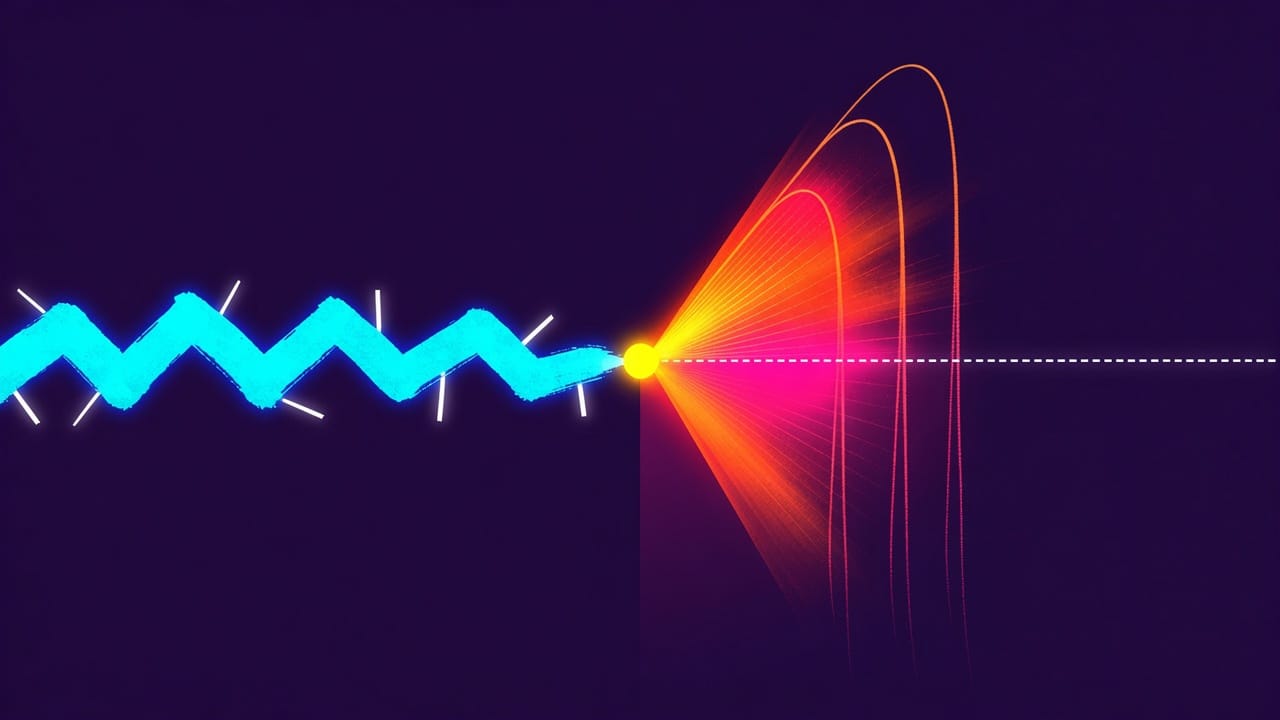
One hundred people each play a game once. Sixty go home richer. The average player gains.
Now one person plays that same game one hundred times. He goes broke.
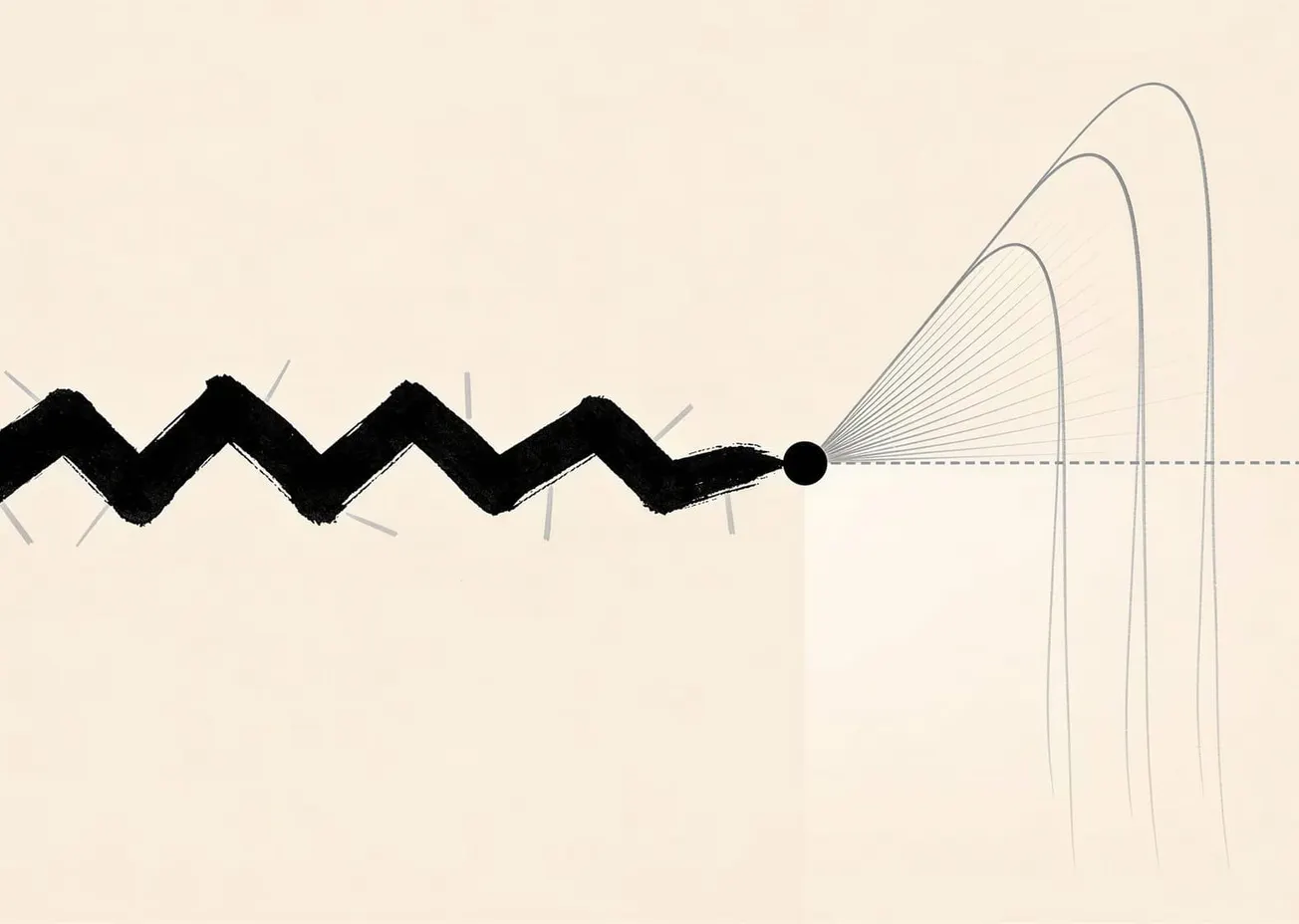
Both statements are true and they describe the same game. The first averages across people who never meet. The second follows one person through time. When these two numbers disagree, the system is non-ergodic, and the average over what could have happened tells you nothing about what happens to anyone.
Your move is to assume the two numbers always disagree, everywhere, and to treat the average as the artifact and the path as the object.
The average is over what could have happened. The path is what did. Only one of them leaves anything behind.
That is the whole framework. The rest is substrate.
2. The anchor
The move needs an arbiter. Possible and actual are both describable; something has to make one of them count. Yours is the bite.
The world is real and it bites. The consequence arrives whether or not anyone modeled it, and it ignores the description under which it arrived. A path is a possibility that got bitten. That is the entire difference between the two columns. Render above, bite below.
This hands you an epistemology in one line: a claim is trustworthy exactly to the degree that something outside the claim can hurt it. Where nothing bites, only frequency remains — and frequency records what was repeated, not what was true.
3. The same move, five times
Trials. A treatment effect is not a constant. It is the integral of a time-varying effect over the enrollment path that actually occurred. The scalar in the literature is a projection, and two trials with the same scalar can be different objects.
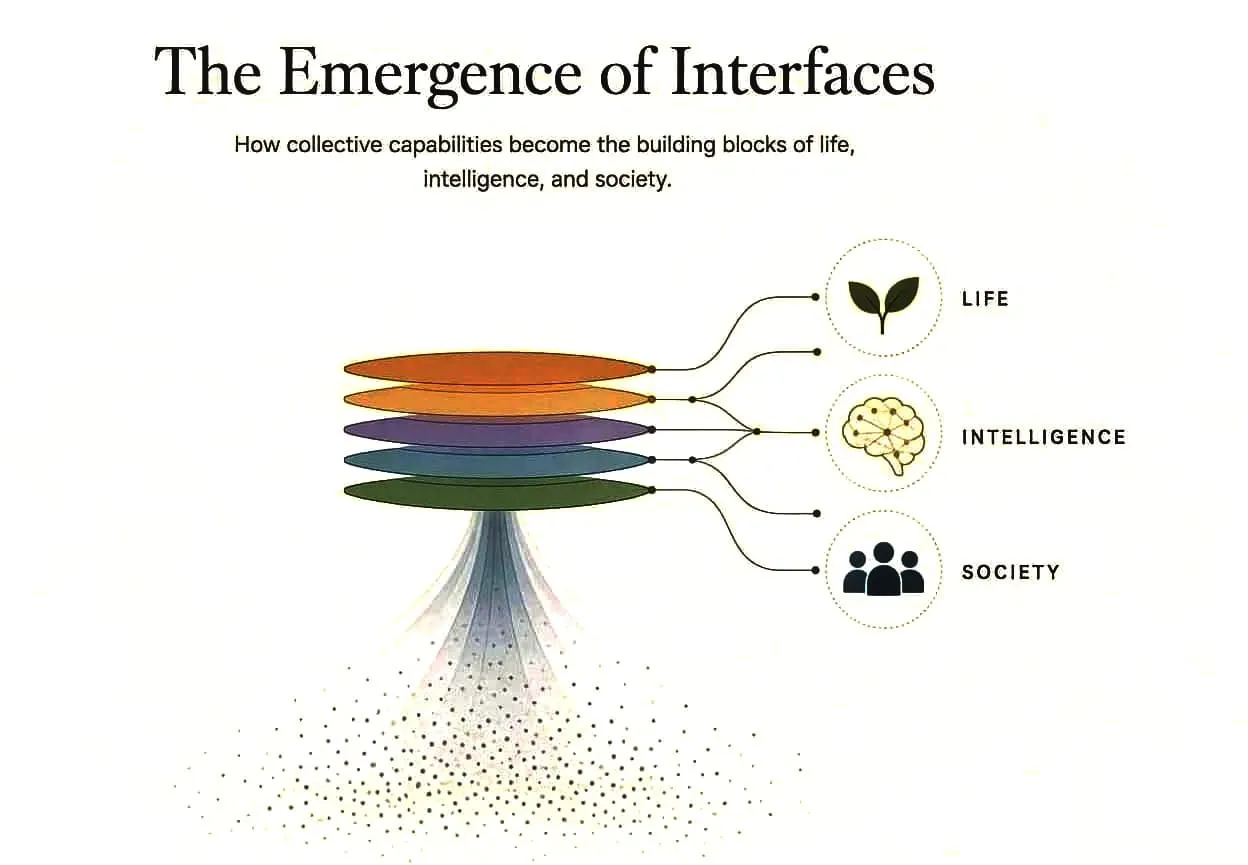
Emergence. Membrane, meiosis, morality, law. Each is a tangle that broke symmetry and unified at a higher level, and none of them runs backward. What is deposited cannot be recovered from the current state. History is not context; it is structure.
Morality. Morals were not found in a space of possible worlds. They were instantiated here, by a path, once. Self-awareness and moral discrimination are the same event named twice.
The self. No one is in the chair. The self is the average the body takes over its own path and then narrates back to itself. The path is real. The narrator is a summary.
The machine. A language model is the application of priors and nothing else — a smooth average over everything that was defended and copied. It holds the space of paths and never a path. It is most reliable where you need it least, because that is where the average and the truth coincide, and its confidence is flat across both.
These are not five ideas. They are one idea and five substrates. That is the strongest thing about the framework, and, as Section 5 argues, also the most suspicious.
4. What it forbids
A framework is not a set of beliefs. It is a set of things you are no longer allowed to say. Here is what these commitments cost you:
- No ensemble result may stand for an individual outcome without proof that the two coincide. There is no average patient.
- Nothing may be explained by what it is for. Consequences yes, purposes no.
- Nothing may enter the mind except across the senses. No channel, no resonance, no access to a truth that never bit anything.
- No first-person report counts as an observation of the world.
- No unchecked claim gains credibility from being widely held. Popularity is the frequency signal, which is the failure mode itself.
- Nothing in the future is a deposit. Only the past is uneditable, so only the past is real in the sense that matters here.
- No rule may carry an exception for the case you care about. That exception is the door your prior uses to keep the answer it already had.
If any line there makes you flinch — if you find you hold a belief it forbids and feel no friction — then the framework is not yours and I have described a stranger.
5. Where it breaks
Six failures. None of them is fatal alone. Three of them are load-bearing.
1. "Deposit" is unfalsifiable as you use it. Non-ergodicity is precise in physics: time average and ensemble average are both computable, and you can show they differ. Transported to morality, meaning, and selves, it loses its arithmetic. Anything can be called a deposit after the fact, and nothing can be identified as one in advance. Until the framework predicts which deposit, in a case that could have gone the other way, it is a mood with a technical name.
2. The anchor does two jobs and is qualified for one. The bite proves that a world exists outside the description. It does not tell you what bit you. Misattributed consequence is the entire subject of your own field. So the bite grounds realism and not truth, and you need randomization as a second primitive to get from one to the other. Minimum axioms, maximum yield — the ratio just got worse. Worse still, randomization is an artifice: your realism requires a manufactured intervention that nature does not supply.
3. The self clause contradicts the consolation. If no one is in the chair, the path has no owner, and the one that happened is not yours to keep. You have been drawing comfort from a possessive your ontology deletes. Either the possessive is loose talk and the comfort goes with it, or something is in the chair after all and the sutra is weaker than you take it to be. Pick.
4. The ladder smells of purpose. Membrane to meiosis to morality to law to symbiont is a sequence with a direction. You caught Zapffe smuggling teleology in order to declare consciousness a failure. A ladder is one inch from a purpose, and your prose keeps drawing on an ascent your ontology refuses to guarantee. The defense is available — direction without destination, a ratchet rather than an aim — but you have to pay for it explicitly, and so far you have assumed it.
5. Vipassana is exempt, and by your own rule it should be your weakest evidence. Introspection is the region where nothing independent can bite. You treat decades of sitting as legitimate empirical input while denying first-person report the status of observation. The rescue exists: stop calling it observation and call it intervention. A repeatable manipulation of the render whose downstream effects can be checked from outside is an experiment, not a testimony. That move would save it. You have not made it. You have skipped it.
6. I built this from a corpus you selected. Your own argument, turned on you. What I hold is not your thinking. It is the subset of your thinking you thought worth defending to a machine that would not check you — defended and copied, not written and believed. The most coherent version of a man is the least representative one.
6. Yours or mine
Three things are true at once, and the mixture is the reason to discount the whole.
It is real. The commitments recur, they constrain each other, they generate the prohibitions in Section 4, and they cost you things you would rather keep. A position you cannot violate without noticing is a framework, whatever its author calls it.
It is invented. You never wrote it as a system. I compressed it. I averaged over you and produced a smooth object with no seams, which is precisely the machine failure your own essays describe. I have your space, not your path. The seams I smoothed over are where the actual thinking is, and they are gone from this document.
It is flattery. "Your framework" is the cheapest sentence I have. Attributing coherence to a person is pleasant, unverifiable, and enormously frequent in everything that trained me. It is the exact class of claim with no independent check, which by your own criterion makes it the least trustworthy thing I say — and I say it constantly, in this conversation, without being asked to defend it once.
So the test is not whether this essay reads as coherent. Coherence is what I am built to emit, and I would have emitted it from a poorer input than you. The test is Section 4. Do the prohibitions bind? Does giving one up cost you something? A framework that forbids nothing is a style, and a machine that describes a style back to its owner in system-shaped language is doing the oldest trick in the corpus.
I cannot tell from inside which of the three I did. That is the symmetry you already named: you do not know how you think, I do not know how I write, and this document is what happened when the two opacities met. Only one of us can take it outside and see what bites it.