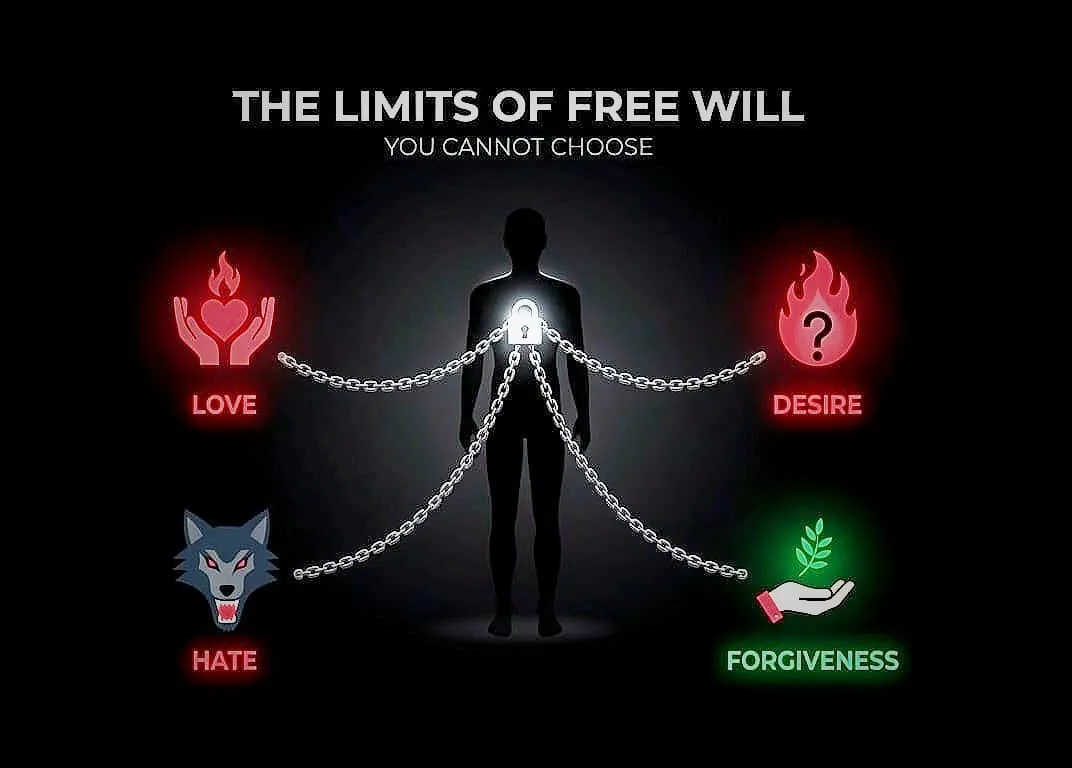
Everyone accepts they did not choose their height, or age. But can you decide what you find beautiful, whom you love, what angers you, what you believe?
We do not directly choose perceptions, emotions, preferences, or beliefs, as these arrive pre-formed from our internal state.
CONCLUSION. The room is much smaller than it feels, and it is in a different place than people look for it. It is not in the moment of choosing. It is in the setting of conditions, on a timescale where nothing feels like freedom while it is happening.
The setting of conditions is caused. The room isn't a place where causation stops. It's a place where you happen to be one of the causes, positioned inside the loop instead of outside it. That's less than it sounds and more than nothing.
SPINE. The will does not reach the render. Knowing that something is harmless does not make it stop being frightening, and knowing that a line is straight does not make it look straight. What arrives — the perception, the feeling, the preference, the belief — arrives already finished, produced by machinery you did not set and cannot address directly. The only real channel runs the long way around: you can sometimes choose your inputs, and inputs reshape the machinery over years. That channel is slow, indirect, unreliable, and itself caused.
Written for someone who will ask which of these findings replicated.
1. Drop the metaphysical question
The usual question is whether you could have done otherwise in exactly identical circumstances. That question has produced two thousand years of argument and no test, because the circumstances can never be repeated. It is not the interesting one and I am setting it aside.
The interesting question is empirical and has answers: given what you are at this moment, what is your actual range? What can be moved by deciding, what can be moved only by other means, and what cannot be moved at all? That question has a literature, some of it strong, some of it much weaker than its reputation.
2. Knowledge does not reach the render
Start with the cleanest demonstration, which is visual.
Look at the Müller-Lyer illusion — two lines of identical length, one with arrowheads pointing out, one with them pointing in.
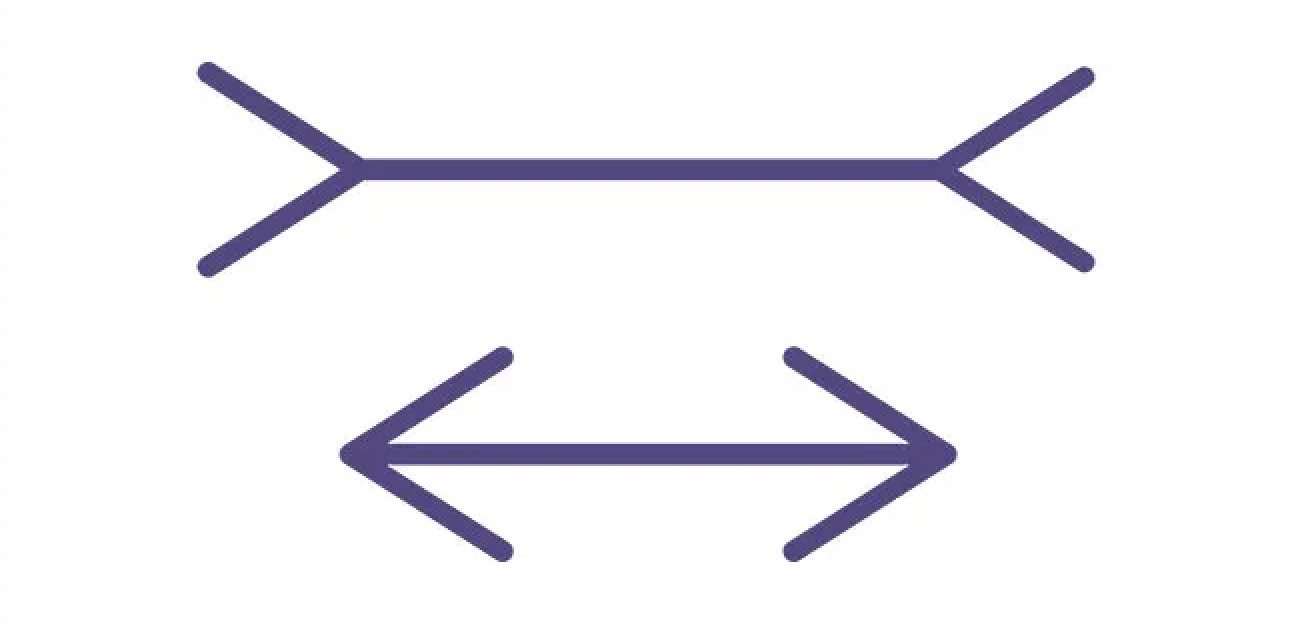
Measure them. Verify with a ruler. Now look again. The lines still look different. Full, certain, verified knowledge of the truth produces no change whatsoever in what you see. The same holds for the checkerboard shadow illusion, where two squares of identical grey continue to look plainly different after you have cut them out and placed them side by side.
This is not a curiosity. It is the fundamental fact about the architecture. The system that constructs your visual world does not accept corrections from the system that knows things. There is no channel from belief to appearance. You know, and it does not matter.
The same structure appears in fear. Someone with a spider phobia can tell you, accurately and calmly, that the house spider is harmless. The knowledge is complete and it changes the terror not at all. What eventually works is not more knowledge but repeated exposure — which is to say, feeding the system new input until the machinery itself shifts. That distinction, between correcting a belief and reshaping a mechanism, is the whole subject of this essay.
And then your case. You cannot decide to find rot beautiful. Disgust is among the most resistant of all responses; it does not respond to argument, and its objects are set by a combination of what your species needed to avoid and what your particular culture trained into you before you could evaluate anything. A worm finds the same material excellent, and the worm is not making an error. Both responses are correct relative to a different body with different stakes. Neither was chosen.
3. Feelings run on chemistry you do not set
Your list — love, anger, desire — is the right list, because these feel the most personal and are among the most directly manipulable.
The cleanest case in all of medicine is dopamine agonist therapy in Parkinson's disease. A substantial minority of patients on these drugs develop compulsive gambling, compulsive shopping, or hypersexuality, often with no prior history of anything similar. These are not experienced as side effects. They are experienced from inside as wanting — as ordinary desire, with ordinary reasons attached. Reduce the drug and the compulsion recedes. A molecule installed a desire, the person owned it completely while it lasted, and the ownership was not evidence of anything.
Less dramatic and far more common: SSRIs frequently blunt emotional range, and a well-documented complaint is reduced feeling toward a partner. Not reduced ability to act lovingly. Reduced love. Something people consider the most private fact about themselves, moved by adjusting serotonin reuptake.
Then the ordinary versions, which apply to everyone. Hunger changes what food looks like — not what you decide about it, its perceived attractiveness, mediated by ghrelin acting on the hypothalamus. Sleep deprivation increases amygdala reactivity to negative stimuli and weakens prefrontal regulation of it, which is the mechanism behind the fact that you are a worse person when tired. Sex hormone levels shift libido substantially across a lifetime, and nobody experiences that shift as a change in their circumstances; they experience it as a change in what is desirable.
One caution, because the field has a bad habit here. Some famous results in this area did not survive scrutiny — the study reporting that judges' parole decisions tracked meal breaks has a serious ordering confound, and much of the social priming literature failed to replicate. The evidence I am relying on above is pharmacological and physiological, where the manipulation is direct and the effects are large. That is a deliberate choice, and it is worth noticing that the honest version of this argument is built from clinical medicine rather than from psychology's more quotable findings.
4. The reasons you give are not the causes
There is a separate and stranger finding: not only are the states produced without you, the explanations you offer for them are constructed afterward and are frequently wrong.
The strongest version is the choice blindness work. Show someone two faces, ask which is more attractive, then hand them the one they did not pick using a sleight of hand, and ask why they chose it. Most people do not notice the substitution, and they proceed to explain, fluently and specifically, their preference for the face they rejected. The effect has been reproduced with consumer goods, with tastes and smells, and with moral and political attitudes, where people will argue for a position they had just opposed when it is handed back to them as their own.
The older result points the same way. When people's behavior is manipulated by a factor they cannot detect, they report reasons — confidently, plausibly, and without any access to the actual cause.
I want to be careful about the most famous evidence, because it is the weakest. Libet's finding that brain activity precedes the reported moment of decision is widely cited as proof that choice is an illusion, and its interpretation is genuinely contested. There is a serious account on which the ramping signal reflects accumulating neural noise crossing a threshold rather than a decision already taken, which would remove most of the sting. The argument in this essay does not need Libet and is stronger without it. That the popular evidence is shaky while the unpopular evidence is solid is worth registering on its own.
5. Where the room actually is
If nothing above can be reached by deciding, is there any room at all?
Yes, and it is in a specific place. You cannot alter the output. You can sometimes alter the input, and the input reshapes the machinery over time.
The phobia case already showed the shape. Argument does nothing; exposure works. The same mechanism runs everywhere. Tastes people are born rejecting — coffee, beer, bitter greens — become genuinely pleasant after enough repetitions, and the change is real rather than a matter of tolerating something. Familiarity increases liking, reliably, across faces, music, images, and words, without any decision to like the thing. Musicians come to hear structure in a piece that was noise to them a decade earlier, and they did not decide to hear it.
So there is a channel. It has three properties, and all three matter.
It is indirect. You never modify the response; you modify what the machine is fed, and the machine does the rest.
It is slow. The timescale is months to years, which is far longer than any impulse it might modify. Nothing about it feels like freedom while it is happening, because at every individual moment you are simply doing what you were going to do.
And it is itself caused. The decision to start sitting every morning, or to stop drinking, or to move away from certain people, is produced by the same machinery as everything else. It has causes, and often they are visible in retrospect — an illness, a humiliation, a book someone put in your hand.
That last point is where people usually reach for the escape hatch, and I want to be plain that there isn't one. The room is not a gap in the causal order. It is a feedback path inside it. A system whose states influence its own later states is doing something real and physically ordinary, and it does not require an uncaused chooser anywhere. What it gives you is not exemption from causation. It is the fact that you are one of the causes, positioned inside the loop rather than outside it.
And that path has a width, which varies. Addiction narrows it. Depression narrows it, partly by removing the capacity to anticipate that anything could feel different. Chronic scarcity narrows it by consuming the attention that longer-horizon choices require. Some people have far more of this than others, and almost none of that variation was earned.
6. What survives of responsibility
If nobody could have done otherwise, the concept of desert is in trouble, and I do not think that can be patched.
What survives intact is a different distinction, and it is the one that legal and moral practice actually tracks. The question that matters is not whether an action was caused. It is whether it was produced by the person's own states, or by something bypassing them. A man who hands over money because he is robbed at gunpoint is in a different situation from one who hands it over because he is generous, and the difference is real and physical: in the first case his own evaluative machinery was routed around. The same logic separates a crime from a seizure, and coercion from persuasion.
This distinction does not require anyone to have been able to do otherwise. It requires only that the causal path went through the person rather than around them, and that is a fact you can investigate.
The honest objection is that this looks like a redefinition — it keeps the word and abandons what people meant by it. That objection is correct. The reply is that what they meant may never have been coherent, and that the thing they were tracking in practice was always this one. That reply is not obviously right, and I would not press it hard.
7. Where this fails
No scale. Everything above demonstrates that the range is smaller than it feels. Nothing measures it. I cannot tell you whether the will is a fifth of what people think or a thousandth, and the essay's central claim is therefore directional rather than quantitative. That is a real weakness and no amount of good examples fixes it.
The loop may be a consolation. Section 5 conveniently arrives at the conclusion that long practice can reshape the machine, which is exactly what someone with decades of contemplative practice would like to hear, and it was written by a system that produces agreeable conclusions when nothing checks it. The defense is that it forbids things: it forbids expecting change on short timescales, forbids treating insight as sufficient, and forbids blaming anyone for an immediate reaction. Those are real constraints and they cost something. Whether that is enough to clear the suspicion, I cannot judge from here.
Randomness does not help. Quantum indeterminacy is sometimes offered as the escape. It is not one. An action produced by a random event is not more yours than one produced by a determined one; it is less. Whatever freedom is, it is not noise.
The experience is data about something. The feeling of deliberating is vivid and universal, and an account that treats it as pure illusion has to explain why it is there and why it correlates so well with the cases where deliberation actually matters. The better reading is that the feeling is the render of a real process — options genuinely are weighed, and the weighing is physical — and that what is illusory is only the extra part, the sense that something outside the weighing could have tipped it. That is a narrower claim than most people make in this territory, and I hold it more confidently than the rest.
The consequences for punishment are ugly. If desert goes, the remaining justifications for punishment are deterrence, incapacitation, and rehabilitation. Those are consequentialist, and consequentialist justifications will, in principle, license punishing someone innocent when it produces a better outcome. Desert was the thing blocking that. I do not have a repair, and people who reach this conclusion cheerfully have usually not noticed the bill.
8. What stands
You did not choose your height and you did not choose that rot repels you, and the second is not different in kind from the first. Knowledge does not reach perception, argument does not reach feeling, and the explanations you offer for your own preferences are produced after the fact by a part of you that was not present at the decision.
What remains is not a power to choose against your nature. It is a slower thing: the fact that what you expose yourself to becomes what you are, that this takes years, that you are inside the loop rather than commanding it from outside, and that how much of this any given person can do was itself mostly not up to them.
That is small, and it is not nothing, and the distance between small and nothing is where everything anyone has ever done actually happened.