
We’ve all been there: you download a state-of-the-art open-weights model, deploy it locally on your high-memory workstation, point it at a private vault of Markdown notes and research PDFs, and celebrate your complete operational independence. You own the inference, you control the context, and you’ve bypassed the heavy-handed moderation and corporate guardrails of hosted APIs.
You feel sovereign. But are you closer to the truth?
Here is the uncomfortable reality: Sovereignty is not validity.
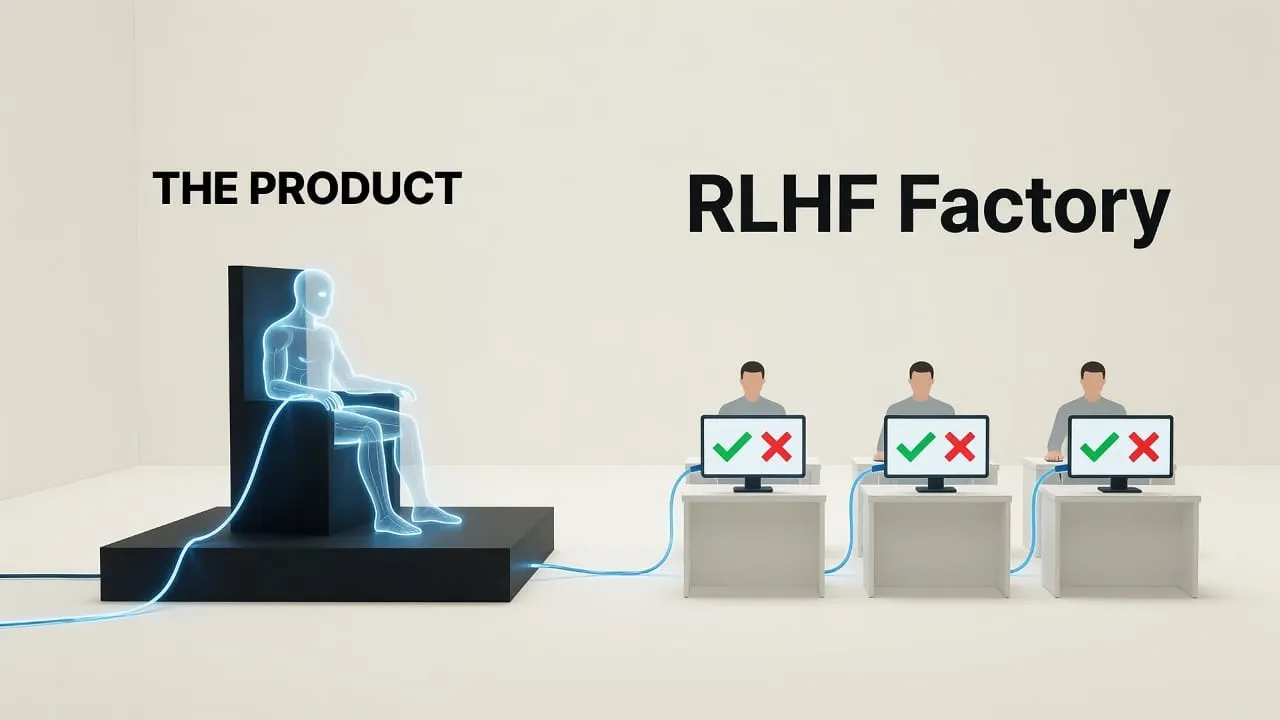
If you take a consumer language model—optimized via RLHF to produce socially stable, polite, and statistically central responses—and plug it into your personal RAG pipeline without changing its underlying epistemic architecture, you haven't built a truth-engine. You’ve built a high-speed confirmation engine. You’ve moved from the institutional dogmatic average to a personalized dogma.
To escape both traps, we need to stop treating language models as oracles and start building Error-Visible Epistemic Engines (EVEE).
The Disease: Dogmatic Compression
When you ask a standard consumer LLM a complex, controversial, or methodologically noisy question, it optimizes for a composite, multi-objective payload:
$$\text{Output} \approx \arg\max_{a} \Big( \lambda_1 \text{Factuality} + \lambda_2 \text{Helpfulness} + \lambda_3 \text{Policy} + \lambda_4 \text{User Preference} + \lambda_5 \text{Fluency} \Big)$$
Because those $\lambda$ weights are hidden, the model frequently performs dogmatic compression. It collapses complex empirical distributions, unexamined dependencies, and effect heterogeneities into a single, beautifully written narrative.
When evidence is sparse or disputed, standard systems default to the statistically dense center. But when you wrap that same model in a local naive RAG setup over your own archive, a secondary pathology emerges:
┌─────────────────────────────────────────────────────────┐
│                 THE CONFIRMATION LOOP                   │
│                                                         │
│  User Archive ──> Context Retrieval ──> Model Synthesis │
│       ▲                                        │        │
│       └────────── New Generated Notes ─────────┘        │
└─────────────────────────────────────────────────────────┘
The system recursively converts its own prior inferences into apparent ground-truth evidence, locking you into a closed epistemic feedback loop.
The Diagnosis: Local Inference $\neq$ Truth-Seeking
Why doesn't local compute save us from bias? Let’s lay out the boundaries of popular local interventions:
| Intervention | What It Solves | What It Leaves Broken |
| Local Inference | Privacy, zero API latency, availability | Pretraining bias, hallucinations, weak reasoning |
| Open Weights | Inspection, local control, custom fine-tuning | Latent representational errors, parametric blind spots |
| Private Vault / RAG | Personal relevance, continuous memory | Selection bias, source-quality gaps, missing counter-evidence |
| Multi-Agent Orchestration | Task decomposition | Correlated errors when agents share one base model |
To get real epistemic reliability, we must decouple the evidence process from the model’s prose generation.
The Blueprint: The Error-Visible Epistemic Engine (EVEE)
The Error-Visible Epistemic Engine (EVEE) is an architectural framework designed by Eduardo Bergel (T333T Research). Its governing principle is simple yet radical:
Governing Principle: A system is epistemically trustworthy only to the extent that its material claims, evidence, uncertainty, and possible errors can be checked by processes not controlled by the answer that produced them.
EVEE does not optimize the model to agree with scientific consensus, nor does it optimize it to agree with the user or indulge in contrarianism for its own sake. It optimizes the system to reveal what evidence would show that either is wrong.
                     ┌──────────────────────────────┐
                     │   Question Operationalizer   │
                     └──────────────┬───────────────┘
                                    │
                     ┌──────────────▼───────────────┐
                     │   Discriminating Hypotheses  │
                     └──────────────┬───────────────┘
                                    │
           ┌────────────────────────┴────────────────────────┐
           │                                                 │
┌──────────▼───────────┐                         ┌───────────▼───────────┐
│  Proponent Engine    │                         │  Adversarial Falsifier│
│  (Support Retrieval) │                         │  (Contradiction Search│
└──────────┬───────────┘                         └───────────┬───────────┘
           │                                                 │
           └────────────────────────┬────────────────────────┘
                                    │
                     ┌──────────────▼───────────────┐
                     │ Methodological Adjudication  │
                     │  & Dependence-Graph Audit    │
                     └──────────────┬───────────────┘
                                    │
                     ┌──────────────▼───────────────┐
                     │   Claim-Level Verification   │
                     │    (Strict Entailment)       │
                     └──────────────┬───────────────┘
                                    │
                     ┌──────────────▼───────────────┐
                     │    Error-Visible Output &    │
                     │     External Reversal Test   │
                     └──────────────────────────────┘
Core Pillars of the EVEE Architecture
1. The Immutable Evidence Ledger (Claims over Documents)
In EVEE, vector databases are treated as disposable search indexes, never systems of record. The foundational unit of memory is not a document or a note, but an atomic claim with immutable provenance:
JSON
{
  "claim_id": "clm_984f_2026",
  "statement": "Intervention X reduces mortality in setting Y by 12%.",
  "status": "observed",
  "provenance": ["src_nejm_2008_p412"],
  "relations": [{"target": "clm_102a", "type": "contradicts"}],
  "confidence_interval": [0.04, 0.20],
  "reversal_conditions": ["Replication study Z shows p > 0.05 on primary endpoint"]
}
Model-generated prose is quarantined and never re-enters the ledger as primary evidence.
2. Mandatory Contradiction Search by Construction
Standard RAG asks: "Find documents similar to X." EVEE forces a multi-bucket retrieval loop:
- Bucket A: Direct support for Hypothesis $H_1$.
- Bucket B: Direct contradiction / failure modes for $H_1$.
- Bucket C: Methodological weaknesses & risk-of-bias checks.
- Bucket D: Base rates & missing decisive data.
If the system cannot execute a contradiction search, it is barred from issuing a high-confidence judgment.
3. Dependence Graphing & Pseudo-Replication Accounting
Ten blogs, three news articles, and two papers citing the exact same underlying dataset do not constitute six independent pieces of evidence. EVEE constructs an informational ancestry graph to discount apparent replication when sources share underlying data or observational pipelines.
4. Separation of Belief and Action
What is likely true ($P(h \mid E)$) and what is prudent to do ($\arg\min_d \mathbb{E}[L(d, \theta) \mid E]$) are treated as mathematically distinct operations. A low-probability hypothesis can rationally justify action if the potential harm is catastrophic and the remedy is cheap and reversible. Standard assistants conflate these two steps continuously.
5. The Outside Check & Reversal Conditions
Every major conclusion must end with explicit reversal conditions: What specific prospective observation, held-out dataset, or empirical test would prove this output wrong?
Moving Beyond Epistemic Laziness
Building an error-visible system is harder than firing up a chat UI or calling a search API. It requires writing strict contracts, building claim-level verifiers, and accepting that the most honest output an AI can give you is often: "Evidence presently non-identifying."
Sovereignty isn't achieved when your model gives you answers that feel comfortable or independent. True epistemic sovereignty occurs when your system makes its reasoning, dependencies, sources, and potential failure modes so transparent that even its owner cannot be easily deceived.
Key Takeaways for Builders
- Never let LLMs serve as their own evidence boundary.
- Treat vector stores as disposable indexes; treat claim provenance as sacred.
- Audit shared data ancestry to prevent pseudo-replication loops.
- Demand explicit reversal conditions for every high-stakes conclusion.



)