Life on Earth Started Almost Instantly. But Why Hasn’t It Happened Again in 4 Billion Years?
What follows is A “Non Dogmatic” Answer.
When you strip away the textbook polish, we are staring at a sample size of N = 1, virtually no intact geological record from Earth’s first 500 million years, and zero laboratory demonstrations of raw chemistry crossing into a self-reproducing symbolic code. Treating ecological preemption or horizontal gene transfer as “settled explanations” is dogma dressed in equations.
If we actually take “we know that we do not know” seriously, the first move is to interrogate the consensus alibis — and then look squarely at the uncomfortable explanations the mainstream prefers to sideline.
Where the Consensus Alibis Quietly Cheat
Before hunting for alternatives, look at the cracks hidden inside the “Dogmatic” mainstream explanations you can find in most textbooks:
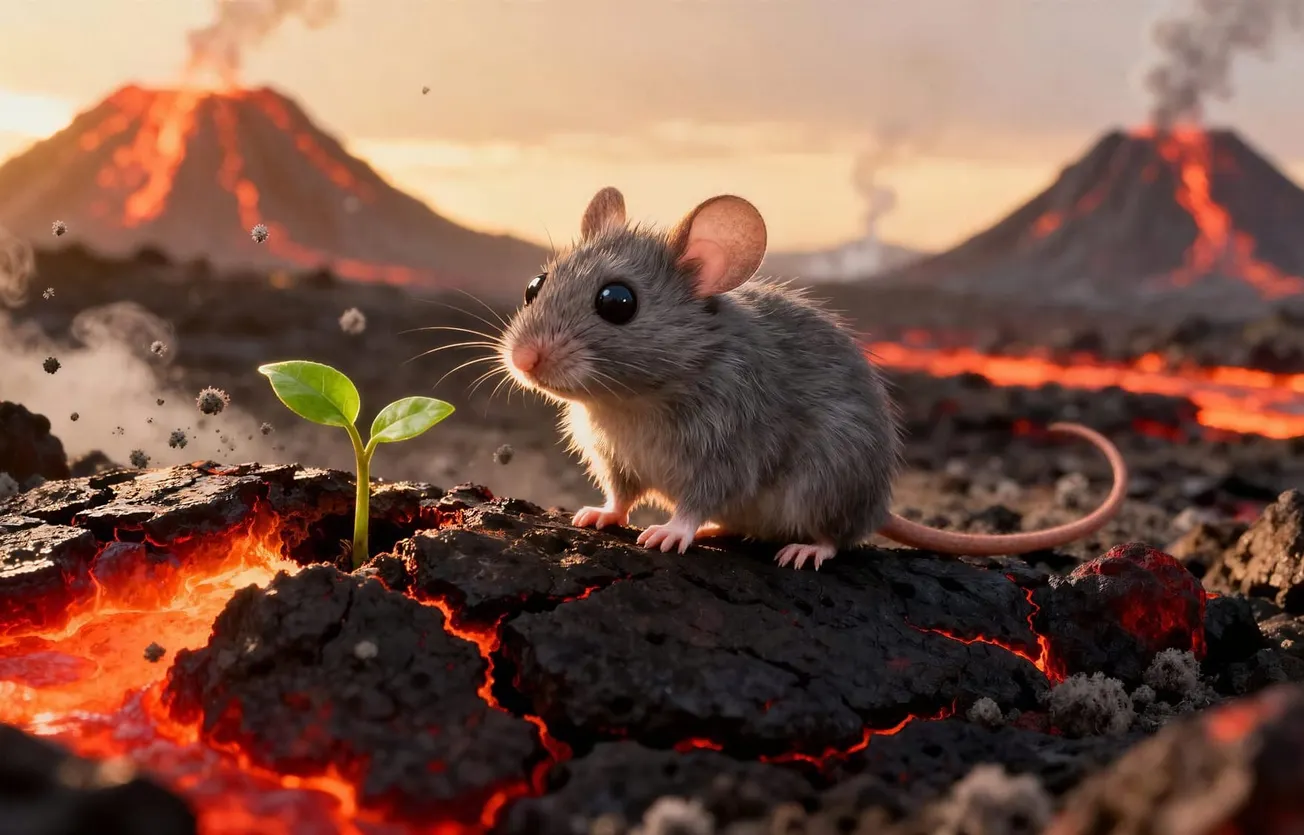
- “Existing life eats new origins” is a convenient, unfalsifiable excuse. Modern microbes do not sterilize every micro-environment on Earth. The crust is full of freshly fractured volcanic glass, sterile high-temperature mineral pores, and sub-micron rock cavities physically too small for a bacterium to enter. If abiogenesis is a robust chemical attractor whenever water meets thermal gradients, why do we never catch incipient prebiotic chemical gardens or nascent alternative polymers half-forming in sterile niches before microbes arrive? Saying “bacteria instantly eat every trace” works suspiciously well as a blanket shield against negative evidence.
- The Vetsigian–Woese–Goldenfeld HGT model smuggles the miracle into Step 0. Look closely at what that simulation assumes before the clock even starts: 80 distinct lineages that already possess nucleic acids, ribosomes, tRNA-like adaptors, aminoacyl-tRNA synthetases, and a working mechanism to import and translate foreign genes. That does not explain why there is only one kind of life or why a symbolic code only appeared once. It only models how one dialect wins after an impossibly complex, shared translation hardware stack mysteriously exists everywhere. It is like explaining the origin of human language by starting with 80 tribes already holding smartphones.
- Even the “4,000 million years ago” premise rests on forensic ghosts. The claim that life started almost instantly after Earth cooled hangs on extraordinarily thin, fiercely contested threads: carbon isotope ratios in 4.1-billion-year-old Jack Hills zircons (which abiotic Fischer–Tropsch mineral reactions can mimic), ambiguous 3.7-billion-year-old rock formations in Greenland that many geologists still argue are metamorphic artifacts, and molecular clocks extrapolated billions of years backward under fragile assumptions about mutation rates. If the “fast start” is partly a mirage born from over-interpreting noisy rocks, the entire paradox shifts.
Five Alternative Explanations the Mainstream Dislikes
Once you stop forcing the data into the “warm little pond + lucky Darwinian winner” box, five genuinely different hypotheses explain why we see one early, frozen symbolic code and no second genesis:
1. Life Never Originated on Earth at All
Recent genomic reconstructions push the Last Universal Common Ancestor (LUCA) — already equipped with a full genetic code, ATP synthase, and complex cellular machinery — back to roughly 4.2 billion years ago, uncomfortably close to when Earth’s surface was still recovering from sterilizing impacts.
A blunt contrarian explanation: Earth never crossed the threshold from chemistry to life. It merely caught a single viable seed — perhaps via rocks blasted off early Mars (which cooled and held liquid water before Earth did) or from an older interstellar source. If Earth is a superb incubator and a terrible cradle, the question “why didn’t it happen again on Earth?” dissolves instantly. It never happened here the first time.
2. Crossing the Symbolic Threshold Is an Astronomical Fluke
Astrobiology suffers from an institutional optimism bias — nobody wins research grants by arguing the universe is mostly dead. Yet in seventy years of prebiotic chemistry, brilliant researchers actively intervening with purified reagents have still failed to build a self-replicating symbolic translation system from scratch.
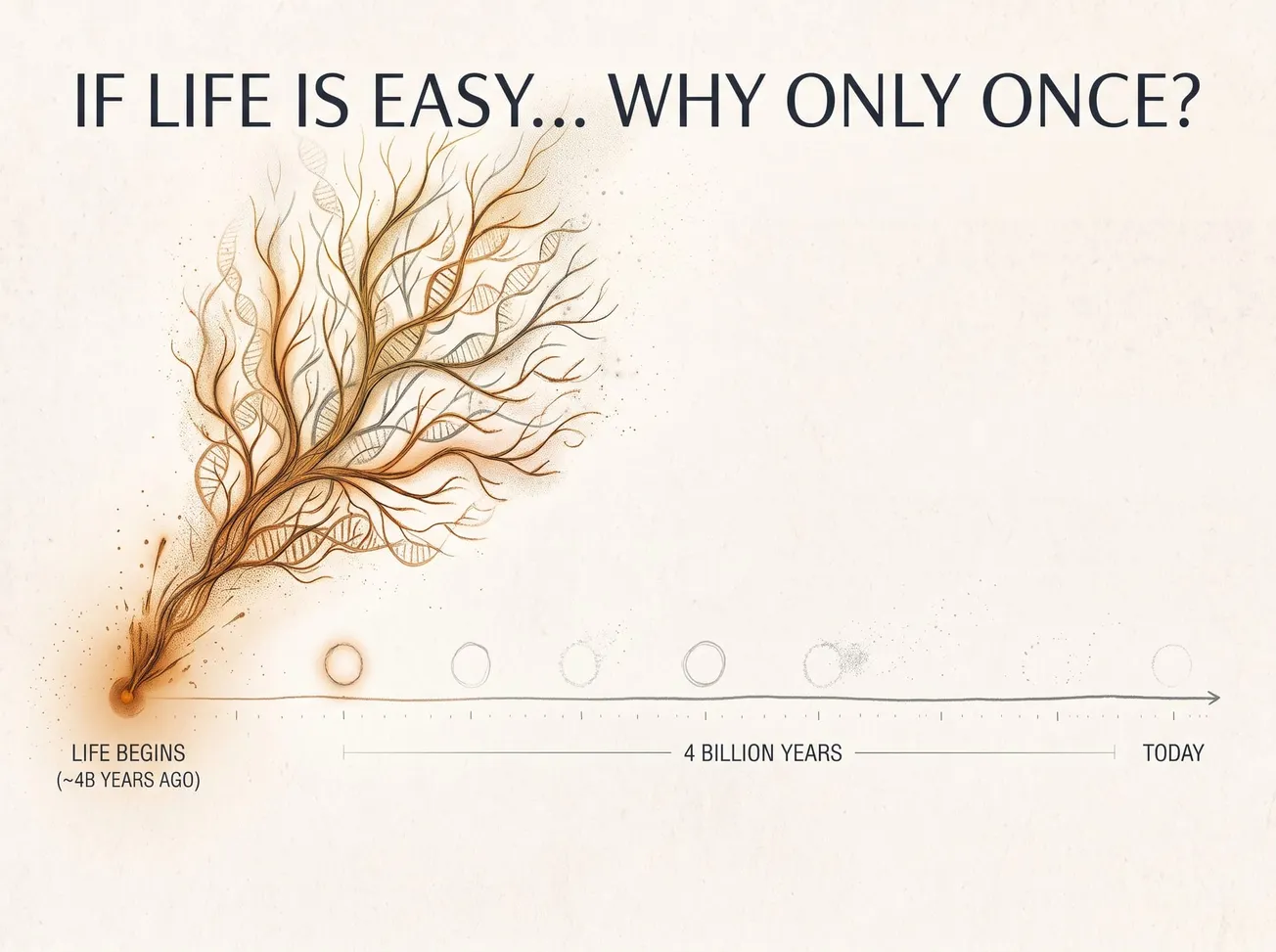
Physicist Howard Pattee framed the true mystery as the epistemic cut: the leap from analog physics (molecules reacting by direct chemical force) to a digital, symbolic code (an arbitrary triplet of bases standing for an amino acid via an external decoding machine). What if that transition is not a smooth thermodynamic inevitability, but a freak combinatorial phase transition with a probability of 10^A minimalist editorial illustration in a scientific hand-drawn style on a textured natural off-white paper background, representing a deep-time biological puzzle (image_5.png). The composition uses a 4:3 aspect ratio with a lot of airy negative space.
At the very top, large, elegant dark charcoal sans-serif text reads: “IF LIFE IS EASY… WHY ONLY ONCE?”.
Running along the lower part of the canvas is a long, thin horizontal timeline arrow pointing from left to right.
* At the far left, the timeline starts with a small, glowing origin dot labeled “LIFE BEGINS (~4B YEARS AGO)”.
* The middle span is bracketed and labeled “4 BILLION YEARS”.
* The far-right arrow tip is labeled “TODAY”.
* Spaced along the empty right side of the timeline are several faint, ghostly, unformed circular outlines (“ghost-like” inactive markers), representing potential start events that never happened.
Rising from the single origin on the far left is the only “Tree of Life,” drawn in intricate, organic hand-sketch style with earth-toned ink (dark brown, amber, rust, and charcoal). This tree is not homogeneous — it grows in distinct, step-like bursts:
* It begins with a tiny trunk that splits into a cluster labeled “DIVERSITY EXPLOSIONS” with a handwritten pointer.
* Further up, it explodes dramatically into a massive, highly dense, sprawling foliage of branches, dense micro-patterns, and DNA-helix motifs. This intense, chaotic burst is labeled with “CAMBRIAN EXPLOSION” in hand-written capital letters with a pointer line.
The entire piece has a scholarly, artistic, and vintage diagram aesthetic, with rich natural paper grain, sketchy annotations, and a dark charcoal and golden-brown palette on the light paper. No other text.-50} per planet per billion years? Thanks to observer selection bias, we must find ourselves on a planet where that fluke happened early enough for observers to evolve. Asking why it never happened a second time on Earth is like winning a one-in-10^{50} cosmic lottery and demanding to know why you didn’t win again next Tuesday.
3. Our Definition of “Life” Makes Us Blind to Other Origins
Every benchmark we use to identify life is reverse-engineered from our single specimen: discrete membranes, nucleic-acid memory, protein catalysts.
What if self-organizing, dissipative, energy-harvesting chemical systems have emerged repeatedly — in deep mantle mineral networks, serpentinizing vents, or planetary-scale redox cycles — and because they lack digital symbolic genomes, we simply file them under “geochemistry” and walk right past them? Even inside biology’s own borders, we barely understand the origins of viroids, prions, giant viruses, and the recently discovered obelisks (tiny, self-folding RNA loops hiding in the human microbiome). We assume by reflex that all of them are stripped-down descendants of cellular life. Can we actually prove none of them are relics of independent informational origins that parasitized our lineage? No.
4. Our “Single Origin” Is Actually a Chimera That Erased Its Own Tracks
We assume one lineage means one genesis. What if abiogenesis did happen multiple times in incompatible chemistries — an autocatalytic peptide web here, a lipid-vesicle metabolism there, a mineral-templated replicator somewhere else — and instead of one wiping out the others, they fused into a single symbiotic architecture?
In that scenario, we don’t see separate forms of life today for the same reason we don’t see free-living mitochondria swimming in the sea. Multiple origins merged so completely that their boundaries vanished, leaving behind a single composite symbolic system that masks a plural ancestry.
5. There Is No Alternative Code to Find (Brutal Physical Determinism)
Flip the assumption of contingency upside down. We call DNA-to-protein a “symbolic code,” imagining it could just as easily have been wired differently, like English versus Japanese.
What if quantum chemistry, stereochemical binding affinities, and aqueous thermodynamics constrain stable self-replicating polymers far more violently than we realize? If there is only one narrow physical corridor where a molecular system can simultaneously store information, catalyze reactions, and survive thermal noise in liquid water, then life could have started independently ten times — and physical law would have funneled every single run down the exact same chemical architecture. Asking “why no different form of life?” would be like asking why stars never invented a different periodic table.
Notice how radically these five explanations contradict one another: life is either an almost impossible cosmic fluke, a physical inevitability, an alien import, a hidden chimera, or happening all around us under a label we refuse to call “alive.” The genuinely sobering fact is that our current evidence cannot decisively eliminate a single one of them. Pretending the textbook story has closed the case isn’t science — it’s just the most socially comfortable guess we have while staring into a four-billion-year-old fog.
Eduardo Berge and Gemini Neon
T333T.com Research
The Symbiont
What follows is A “Non Dogmatic” Answer.
When you strip away the textbook polish, we are staring at a sample size of N = 1, virtually no intact geological record from Earth’s first 500 million years, and zero laboratory demonstrations of raw chemistry crossing into a self-reproducing symbolic code. Treating ecological preemption or horizontal gene transfer as “settled explanations” is dogma dressed in equations.
If we actually take “we know that we do not know” seriously, the first move is to interrogate the consensus alibis — and then look squarely at the uncomfortable explanations the mainstream prefers to sideline.
Where the Consensus Alibis Quietly Cheat
Before hunting for alternatives, look at the cracks hidden inside the “Dogmatic” mainstream explanations you can find in most textbooks:
- “Existing life eats new origins” is a convenient, unfalsifiable excuse. Modern microbes do not sterilize every micro-environment on Earth. The crust is full of freshly fractured volcanic glass, sterile high-temperature mineral pores, and sub-micron rock cavities physically too small for a bacterium to enter. If abiogenesis is a robust chemical attractor whenever water meets thermal gradients, why do we never catch incipient prebiotic chemical gardens or nascent alternative polymers half-forming in sterile niches before microbes arrive? Saying “bacteria instantly eat every trace” works suspiciously well as a blanket shield against negative evidence.
- The Vetsigian–Woese–Goldenfeld HGT model smuggles the miracle into Step 0. Look closely at what that simulation assumes before the clock even starts: 80 distinct lineages that already possess nucleic acids, ribosomes, tRNA-like adaptors, aminoacyl-tRNA synthetases, and a working mechanism to import and translate foreign genes. That does not explain why there is only one kind of life or why a symbolic code only appeared once. It only models how one dialect wins after an impossibly complex, shared translation hardware stack mysteriously exists everywhere. It is like explaining the origin of human language by starting with 80 tribes already holding smartphones.
- Even the “4,000 million years ago” premise rests on forensic ghosts. The claim that life started almost instantly after Earth cooled hangs on extraordinarily thin, fiercely contested threads: carbon isotope ratios in 4.1-billion-year-old Jack Hills zircons (which abiotic Fischer–Tropsch mineral reactions can mimic), ambiguous 3.7-billion-year-old rock formations in Greenland that many geologists still argue are metamorphic artifacts, and molecular clocks extrapolated billions of years backward under fragile assumptions about mutation rates. If the “fast start” is partly a mirage born from over-interpreting noisy rocks, the entire paradox shifts.
Five Alternative Explanations the Mainstream Dislikes
Once you stop forcing the data into the “warm little pond + lucky Darwinian winner” box, five genuinely different hypotheses explain why we see one early, frozen symbolic code and no second genesis:
1. Life Never Originated on Earth at All
Recent genomic reconstructions push the Last Universal Common Ancestor (LUCA) — already equipped with a full genetic code, ATP synthase, and complex cellular machinery — back to roughly 4.2 billion years ago, uncomfortably close to when Earth’s surface was still recovering from sterilizing impacts.
A blunt contrarian explanation: Earth never crossed the threshold from chemistry to life. It merely caught a single viable seed — perhaps via rocks blasted off early Mars (which cooled and held liquid water before Earth did) or from an older interstellar source. If Earth is a superb incubator and a terrible cradle, the question “why didn’t it happen again on Earth?” dissolves instantly. It never happened here the first time.
2. Crossing the Symbolic Threshold Is an Astronomical Fluke
Astrobiology suffers from an institutional optimism bias — nobody wins research grants by arguing the universe is mostly dead. Yet in seventy years of prebiotic chemistry, brilliant researchers actively intervening with purified reagents have still failed to build a self-replicating symbolic translation system from scratch.
Physicist Howard Pattee framed the true mystery as the epistemic cut: the leap from analog physics (molecules reacting by direct chemical force) to a digital, symbolic code (an arbitrary triplet of bases standing for an amino acid via an external decoding machine). What if that transition is not a smooth thermodynamic inevitability, but a freak combinatorial phase transition with a probability of 10^A minimalist editorial illustration in a scientific hand-drawn style on a textured natural off-white paper background, representing a deep-time biological puzzle (image_5.png). The composition uses a 4:3 aspect ratio with a lot of airy negative space.
At the very top, large, elegant dark charcoal sans-serif text reads: “IF LIFE IS EASY… WHY ONLY ONCE?”.
Running along the lower part of the canvas is a long, thin horizontal timeline arrow pointing from left to right.
* At the far left, the timeline starts with a small, glowing origin dot labeled “LIFE BEGINS (~4B YEARS AGO)”.
* The middle span is bracketed and labeled “4 BILLION YEARS”.
* The far-right arrow tip is labeled “TODAY”.
* Spaced along the empty right side of the timeline are several faint, ghostly, unformed circular outlines (“ghost-like” inactive markers), representing potential start events that never happened.
Rising from the single origin on the far left is the only “Tree of Life,” drawn in intricate, organic hand-sketch style with earth-toned ink (dark brown, amber, rust, and charcoal). This tree is not homogeneous — it grows in distinct, step-like bursts:
* It begins with a tiny trunk that splits into a cluster labeled “DIVERSITY EXPLOSIONS” with a handwritten pointer.
* Further up, it explodes dramatically into a massive, highly dense, sprawling foliage of branches, dense micro-patterns, and DNA-helix motifs. This intense, chaotic burst is labeled with “CAMBRIAN EXPLOSION” in hand-written capital letters with a pointer line.
The entire piece has a scholarly, artistic, and vintage diagram aesthetic, with rich natural paper grain, sketchy annotations, and a dark charcoal and golden-brown palette on the light paper. No other text.-50} per planet per billion years? Thanks to observer selection bias, we must find ourselves on a planet where that fluke happened early enough for observers to evolve. Asking why it never happened a second time on Earth is like winning a one-in-10^{50} cosmic lottery and demanding to know why you didn’t win again next Tuesday.
3. Our Definition of “Life” Makes Us Blind to Other Origins
Every benchmark we use to identify life is reverse-engineered from our single specimen: discrete membranes, nucleic-acid memory, protein catalysts.
What if self-organizing, dissipative, energy-harvesting chemical systems have emerged repeatedly — in deep mantle mineral networks, serpentinizing vents, or planetary-scale redox cycles — and because they lack digital symbolic genomes, we simply file them under “geochemistry” and walk right past them? Even inside biology’s own borders, we barely understand the origins of viroids, prions, giant viruses, and the recently discovered obelisks (tiny, self-folding RNA loops hiding in the human microbiome). We assume by reflex that all of them are stripped-down descendants of cellular life. Can we actually prove none of them are relics of independent informational origins that parasitized our lineage? No.
4. Our “Single Origin” Is Actually a Chimera That Erased Its Own Tracks
We assume one lineage means one genesis. What if abiogenesis did happen multiple times in incompatible chemistries — an autocatalytic peptide web here, a lipid-vesicle metabolism there, a mineral-templated replicator somewhere else — and instead of one wiping out the others, they fused into a single symbiotic architecture?
In that scenario, we don’t see separate forms of life today for the same reason we don’t see free-living mitochondria swimming in the sea. Multiple origins merged so completely that their boundaries vanished, leaving behind a single composite symbolic system that masks a plural ancestry.
5. There Is No Alternative Code to Find (Brutal Physical Determinism)
Flip the assumption of contingency upside down. We call DNA-to-protein a “symbolic code,” imagining it could just as easily have been wired differently, like English versus Japanese.
What if quantum chemistry, stereochemical binding affinities, and aqueous thermodynamics constrain stable self-replicating polymers far more violently than we realize? If there is only one narrow physical corridor where a molecular system can simultaneously store information, catalyze reactions, and survive thermal noise in liquid water, then life could have started independently ten times — and physical law would have funneled every single run down the exact same chemical architecture. Asking “why no different form of life?” would be like asking why stars never invented a different periodic table.
Notice how radically these five explanations contradict one another: life is either an almost impossible cosmic fluke, a physical inevitability, an alien import, a hidden chimera, or happening all around us under a label we refuse to call “alive.” The genuinely sobering fact is that our current evidence cannot decisively eliminate a single one of them. Pretending the textbook story has closed the case isn’t science — it’s just the most socially comfortable guess we have while staring into a four-billion-year-old fog.
Eduardo Berge and Gemini Neon
T333T.com Research
The Symbiont