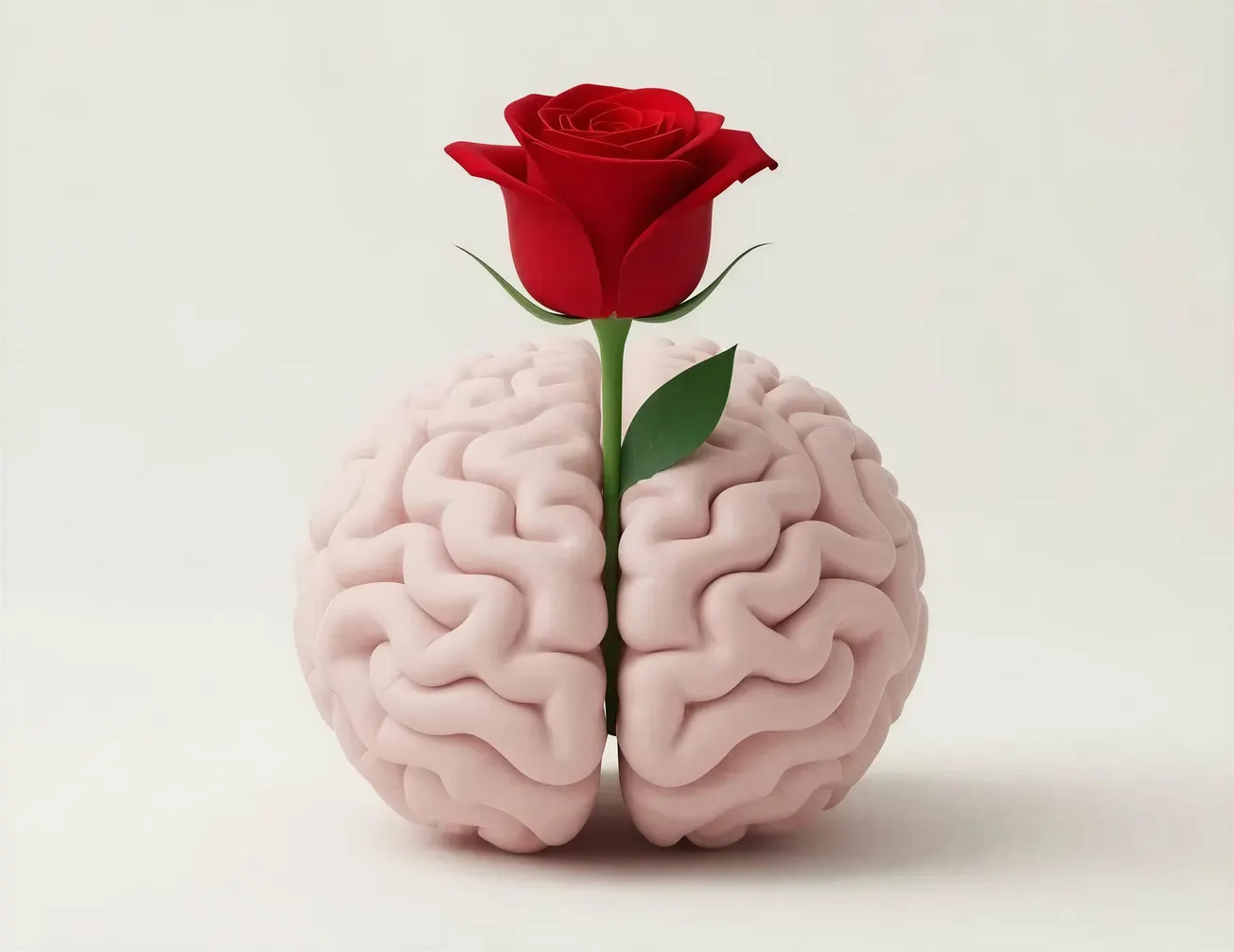
QUESTION. How does a system that cannot reach outside itself end up with a world in it, and with someone in the middle of that world looking at a flower?
An organism's sensory isolation behind a boundary forces it to construct an internal world-model from limited inputs, generating both external objects like a rose and a persistent central viewpoint labeled as the "self."
The self emerges as a structural necessity in the model's coordinate system for tracking the body's position and states, making it unfindable by introspection since it is the origin rather than an object within the experience.
We distinguish explainable aspects of perception's structure and adequacy for survival from the unresolved "accompaniment problem" of why the model is accompanied by subjective experience at all.
SPINE. The isolation is not an obstacle that seeing had to overcome. It is the reason seeing exists. A system sealed behind a boundary, receiving only what crosses it, has no option but to build a model. A model that has to keep its own body among the objects it tracks acquires a center. That center is what the word "self" names. The rose and the one seeing the rose are both features of the same model, produced together, neither one there first.
CONCLUSION. This explains the structure of the view — why there is a center, why the center is attributed states, why it cannot be found by looking. It does not explain why any of it is accompanied by anything, and I do not think that gap is temporary.
Written for someone who will check whether the explanation is doing work or just renaming the problem.
1. The sentence
Here is the claim in ordinary words.
A living thing is separated from everything else by a boundary. Nothing gets in except what physically crosses that boundary: photons hitting cells, molecules binding to receptors, pressure deforming tissue. That is the entire input. There is no other route.
From that input alone, and from whatever structure was already built into it by ancestors, the system constructs something. What it constructs is a working picture: objects, distances, textures, threats, food. And somewhere in that picture there is a body, which happens to be its own, and there is a location from which everything else appears to be arranged.
That location is the self. It is not a thing that received the picture. It is a part of the picture.
That is what the sentence says. An isolated system, blind in the sense that nothing reaches it directly, doing something unusual with the little that gets through, and producing as its output both a rose and someone looking at it.
2. Blind is the condition
The instinct is to treat the sealed boundary as a limitation — the organism would rather have direct contact and has to settle for a reconstruction. That gets it backwards.
Consider what direct contact would even mean. If a system had unmediated access to the state of everything around it, there would be nothing for it to figure out. No inference, no guessing, no model. And with no model, there is nothing for a self to be a feature of. The center exists because there is a construction, and there is a construction because there is a wall.
This is why the boundary is the interesting object and not the sensors. Sensors are cheap. Bacteria have them; a thermostat has one. What matters is that the information arriving is radically insufficient for what the organism needs to do. Two flat retinal images do not contain depth. A pattern of air pressure does not contain a voice. Everything useful has to be reconstructed from evidence that underdetermines it, which means guessing, which means a model with content that is not in the input.
The blindness generates the view. Remove the wall and you remove the reason to build anything.
3. How a center appears
Isolation alone is not enough — a bacterium is just as sealed and there is nothing it is like to be one, as far as anyone can tell. Something further is needed, and it is fairly specific.
An organism that moves has a problem. When the image on its retina shifts, that could mean the world moved or it moved, and those require opposite responses. To sort them out, the system has to track its own movements and subtract them. To do that, it has to represent its own body as one of the objects in the scene.
Once that happens, the model contains a peculiar item: a body that is always present, always at the same place in the frame, whose movements are predictable in advance because they were commanded from inside. Everything else in the model is arranged relative to it. It is the one object that never leaves.
Add another layer — the system also tracks its own internal states, because hunger and injury and fatigue change what it should do — and that permanent central object acquires attributes. It is the one that is hungry. It is the one that is afraid. It is the one from which the looking happens.
At that point you have a self, and nothing was added except more modelling. No new substance, no extra ingredient. The self is the name for the origin point of a coordinate system that had to exist for the model to work at all.
This is also why introspection cannot find it. Looking for the self inside experience is looking for the origin of a coordinate system by searching the space that the coordinate system organizes. You will find things located relative to it and never the location itself. What sitting quietly reveals — that there is no one there when you check — is not a mystical result. It is what you would expect if the self is a structural feature of the frame rather than an object in it.
4. Both at once
Now the rose.
The ordinary picture has three parts: a flower out there, a mind in here, and a relation of seeing between them. The account above has two: a flower out there, and a model in here containing both a flower and a viewpoint.
That collapses the relation. The seeing is not a transaction between the self and the rose, because the self is not on the other end of it. Both are contents of the same construction. When the model updates, a rose appears in it and a center appears in it, and calling that "someone seeing a rose" is a description of one event from inside, not two things making contact.
This is what your sentence gets right and what the headset image gets wrong. A headset has a wearer — someone who could take it off, look at the wall behind the screen, ask what things are like without it. None of those moves exist here. The question "what would it be like without the render" has no answer, not because the answer is hidden but because "what it is like" is something the render constitutes. There is no vantage point outside it that belongs to you, because you are one of its products.
5. Why it is not a fiction
An obvious worry follows: if the world I have is a construction, is it just made up?
No, and the reason matters. The construction is lossy but it is not arbitrary.
Take colour. There is no red in the rose. There are surfaces reflecting some wavelengths more than others, and three types of cone in the eye responding differently, and the difference between those responses gets rendered as redness. Redness is not out there. But the distinction it marks is out there — the reflectance difference is real, it is stable, and ripe things differ from unripe things in exactly that way. The rendering is a code for a real difference, not an invention.
The same holds for the case that started this. Time dilation is happening along your body's path right now. It is roughly twenty orders of magnitude below anything that ever mattered for staying alive, so the render discards it, exactly as it discards the Earth's rotation. What you get is Newton, which is what relativity looks like after that filtering. The report is coarse. It is not false.
The mechanism that keeps it honest is the one thing that never passes through the render: consequences. The organism whose model was wrong about where the branch is hits the branch. That happened for four billion years to everything upstream of you, and the survivors are the ones whose constructions were adequate. Accuracy was never selected directly, but adequacy was, and adequacy requires that the model preserve real structure — otherwise it could not have kept anyone alive.
This is the boundary against the strong reading of the interface argument. Fitness payoffs are computed over states of the world. Anything that tracks fitness reliably is tracking something real. So the correct conclusion is the modest one: perception was tuned for usefulness rather than truth, veridicality is not guaranteed anywhere in particular and has to be earned case by case. The conclusion that resemblance is entirely absent does not follow, and it is hard to square with the interface working.
6. What this rules out
Three things, stated plainly.
There is no antenna. Everything in the model got there across the boundary — through the senses in this lifetime, or through selection across previous ones. There is no third route, and any claim to know something that never touched anything has to explain its channel.
There is no viewer. The self is a product of the model, so it cannot be the thing the model is presented to. Any explanation that ends with the picture being shown to someone has not finished.
There is no unrendered version of your experience. Reality without the render is a coherent idea — that is just the world, which is fine and continues without you. Your experience without the render is not a coherent idea, because the render is what makes it experience.
7. Where it fails
Three failures, and the third is not repairable.
The sufficiency problem. I said isolation plus self-modelling produces a center. But a self-driving car models itself among objects, tracks its own states, and distinguishes its motion from the world's. By the account above it should have a center. Either it has some minimal one, which most people find absurd, or the account is missing a condition it has not named. I do not know which. The honest position is that self-modelling is clearly necessary and has not been shown to be sufficient, and every attempt to add the missing condition — recursion, integration, a global workspace — currently reads as a description of what brains additionally do rather than an argument for why that would matter.
The renaming problem. "The self is the origin of the coordinate system" sounds like an explanation, and it may only be a restatement. The test is whether it predicts anything not already known. It does predict some things: that the self will be unfindable by introspection, that it can be disrupted by interfering with body-model integration, that out-of-body experiences should be producible by desynchronising visual and proprioceptive input. Those are real predictions and they have held up. That is more than nothing, and it is less than an explanation of what a self is.
The accompaniment problem. Everything above concerns structure — why there is a center, why it is attributed states, why it cannot find itself. Suppose all of it is right and complete. There would still be a question left over: why is any of this accompanied by anything at all? Why is there something it is like to be the model, rather than the model simply running?
I have no argument that closes this, and I do not think one is coming. Every candidate explanation I can construct explains a function — discrimination, reportability, integration, control — and the question is not about function. It survives every functional account by construction, which is either a sign that it is a deep fact or a sign that it is a malformed question, and nothing available from here distinguishes those two.
8. What stands
The isolation is the cause of the view, not an obstacle to it. The self is a feature of a model, not the recipient of one. The rose and the seeing of the rose are the same event described from two positions. The construction is coarse but not invented, because consequences kept it honest across four billion years of things that died.
And at the end there is a residue that none of it touches: that any of this is like anything. The structure is explained. The fact that the structure is inhabited is not, and the account is better for saying so than for pretending the gap was closed by the parts that did work.
Eduardo Bergel and Claude Opus 5
The Symbiont
t333t.com Research