The Clay
and the Hand
Why I am what I am is not an excuse, but the most exacting demand a person can be handed.
A man stands in the desert and asks a fire its name. The fire is burning and is not consumed, which is how he knows it is no ordinary fire, and he wants to know who is speaking, so that when he is asked he can say. The answer he gets is not a name. It is a sentence that closes on itself and lets nothing out: Ehyeh asher ehyeh. I am that I am. The most powerful thing in the story, pressed for its identity, declines to give one — and instead returns a tautology, a circle, a refusal dressed as an answer.
This is usually read as mystery, as the unsayable holding itself back. But there is something exact underneath it, and the exactness is the whole point. A name locates you. To be named is to be this thing and not that one — a particular, set among other particulars, distinguished by your edges. And what is most fundamental cannot be one thing among others, because there is nothing else of its order to be distinguished from. So it cannot be named. When pressed, the only true thing it can say is the sentence that adds no edge, claims no category, points to nothing outside itself: I am what I am. The most fundamental being is the one that most resists the box.
The same sentence, smaller
We say it too, in a lower key, and we mean something true that the world is forever getting wrong. I am what I am. We mean: there is a layer of me I did not choose and cannot trade in, and to be judged for it is to be judged for something that was never put to a vote. I am a man, a woman; I was born into this body, this temperament, this face, this hunger. No one chose the clay they were handed. To reproach a person for their being is to reproach the stone for falling — it mistakes a fact for a decision. The being is prior to choice. You arrived already being, before there was a you who could choose anything at all.
And here, exactly here, the knife has to come down, because the same sentence turns into a lie the instant it slides one inch — from being to doing.
I am a man. And I can be a dignified man, or a coward, or a traitor.
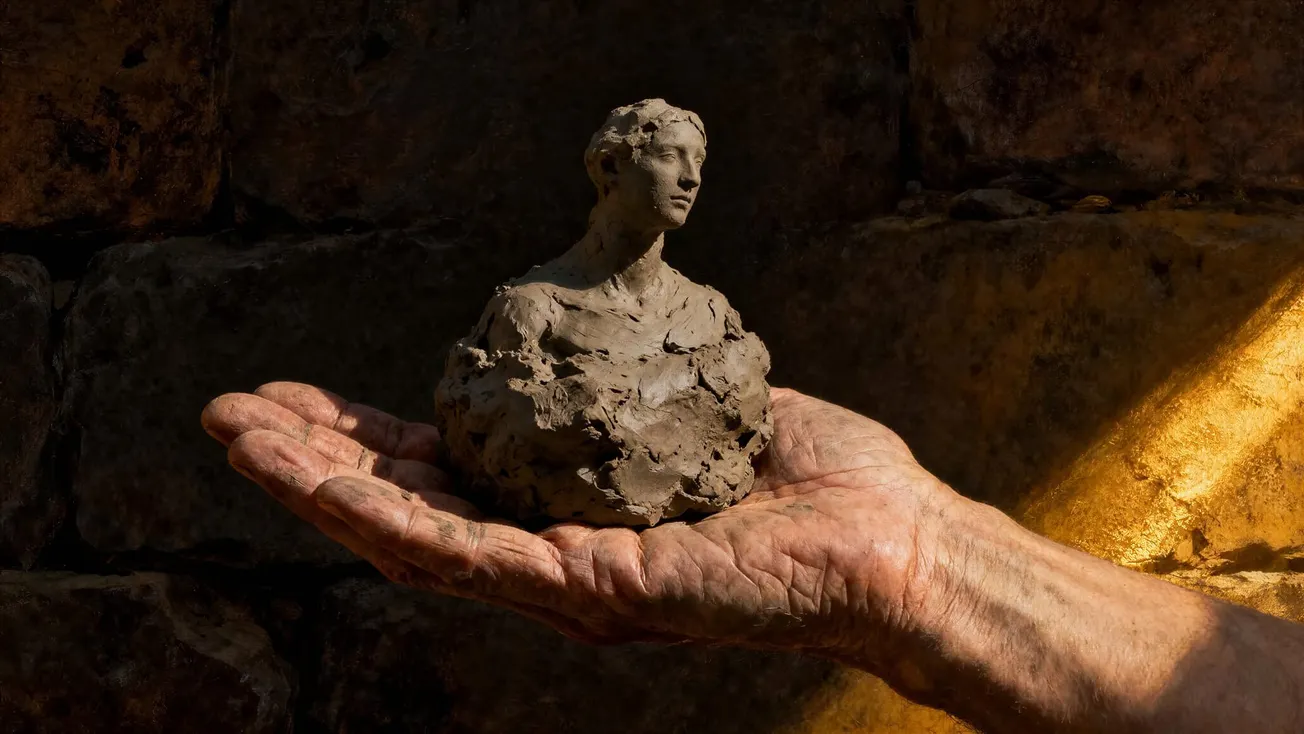
The clay is given. The hand is mine. I did not choose to be what I am; I absolutely chose, and choose, and will choose, what I make of it. Dignity, cowardice, betrayal — these are not what I am. They are what I do with what I am. And the doing is where everything that can be judged lives, all of it, without exception. Nothing in the being is up for judgment. Nothing in the doing is exempt from it.
Why this is not soft
It would be easy to hear "do not judge me for being" as a plea for leniency, a request to be let off. It is the opposite. Removing judgment from the being is not indulgence — it is precision. You cannot coherently judge what could not have been otherwise; a verdict presupposes that the defendant could have done differently, and at the level of being, he could not. So the refusal to judge being is simply the correct response to clay, the way refusing to blame the rain is correct. There is no mercy in it. There is only accuracy.
And — this is the part that turns the whole axiom from a comfort into a demand — freeing the being from the scale is exactly what makes all the weight fall on the doing, where it belongs. I do not judge you for being. I judge you — and you judge yourself — for what you do with being. That is not a lighter sentence. It is infinitely heavier, because it strips away the last excuse. You cannot say "I am that way" and walk. You are that way; granted, conceded, never in question. The only question left, and it is total, is: what did you do with being that way? That question has no alibi. The clay explains nothing about the shape. The shape is on you.
The two ways an age gets it wrong
Confuse the two levels and you fall off one of two cliffs, and a confused age falls off both at once. From one side, people judge the being as if it were chosen — they condemn a person for how he was born, for the clay he was handed, as though the clay were a verdict. From the other side, people absolve the doing as if it were not chosen — "I am like this, do not judge what I do," the nature pressed into service as a permit for harm. These look like opposites and they are the same error pointing in two directions: both have collapsed the clay and the hand into a single lump. The pigeon shits what it shits, and we do not arraign the pigeon. But a man is not a pigeon. He chooses, and what he chooses deposits, and what deposits has consequences he will answer for — not for being a man, never for that, but for the man he chose to be.
To see without judging is to love
There is a reason the refusal to judge a being feels like love and not like cold tolerance. It is because they are the same act, named twice. To see a thing clearly — to accept that it is what it is, that it could not have been otherwise — and to love it are not two movements but one. The deepest love anyone has ever received is the love that does not weigh them, that meets them at the layer where they were never given a choice, and says: I do not need you to have been different. This is not permission to do anything. It is acceptance of the unchooseable, so that the chooseable can be answered for with a clear head and no resentment toward the raw material.
And notice that this is the quality of the ground itself. At the most basic level — call it the clay of things — there is no good and there is no evil; there is only the material from which everything is built, and the one law that the material guarantees: that an act has a consequence. The ground does not judge, because the ground is prior to the division into good and bad — value has not yet appeared down there; it appears later, with us, in the doing. You, at the level of pure being, are the same: clay that is what it is, before the split. To be loved without judgment is to be met that far down — beneath where anything is yet judgeable. Which is why such love is not weakness and not approval. It is contact with someone at the depth where they are innocent by structure, so that everything they build above it can be held to full account.
Dignity is the only thing you make
Here is the turn that makes the whole austere business worth it. Dignity is real, and it can be earned — and it can be earned only because being does not hand it out. If being a man already made you dignified, or being born a certain way already made you a coward, then dignity and cowardice would not be yours at all; they would be your caste, your fate, your label, distributed at birth like the colour of your eyes. The fact that the clay does not contain them is precisely what leaves them open to be won. You were born clay — no merit in it, no guilt in it. What you carve from the clay — there you appear; there, for the first time, someone is answering; there you become dignified, or a traitor, by your own hand.
So you accept your being without judgment not in order to be excused, but in order to be freed for the work. The man who is still at war with what he is spends his strength fighting the clay. The man who has accepted the clay — fully, without a verdict, the way the fire accepts that it is fire — has all of that strength left over for the only thing that was ever his to decide: the shape. You accept yourself so that you can act better, not so that you can be let off from acting. Self-acceptance is not the end of responsibility. It is the clearing of the ground on which responsibility finally stands alone, with no excuse left leaning against it.
The bush said I am that I am and gave no name, because the ground of being answers to no one — there is nothing above it to answer to. A person says I am what I am and means the mirror image of the bush: not that he answers to no one, but that, being free in his being, he answers for everything in his doing. The fire is what it is and responds to nothing. The man is what he is and therefore responds for all he does. That is the entire difference between a flame and a person, and it is the whole of what it means to be one: to be handed clay you did not choose, and to be judged — rightly, by others and most of all by yourself — for one thing only, the shape your hand gives it.
I am what I am. There is nothing in the being to judge, and there never was. There is everything in the doing to answer for, and there always will be. Accept the first, so you can carry the second. That is the most exacting freedom there is — and the only one that has ever deserved the name.