 Eduardo Bergel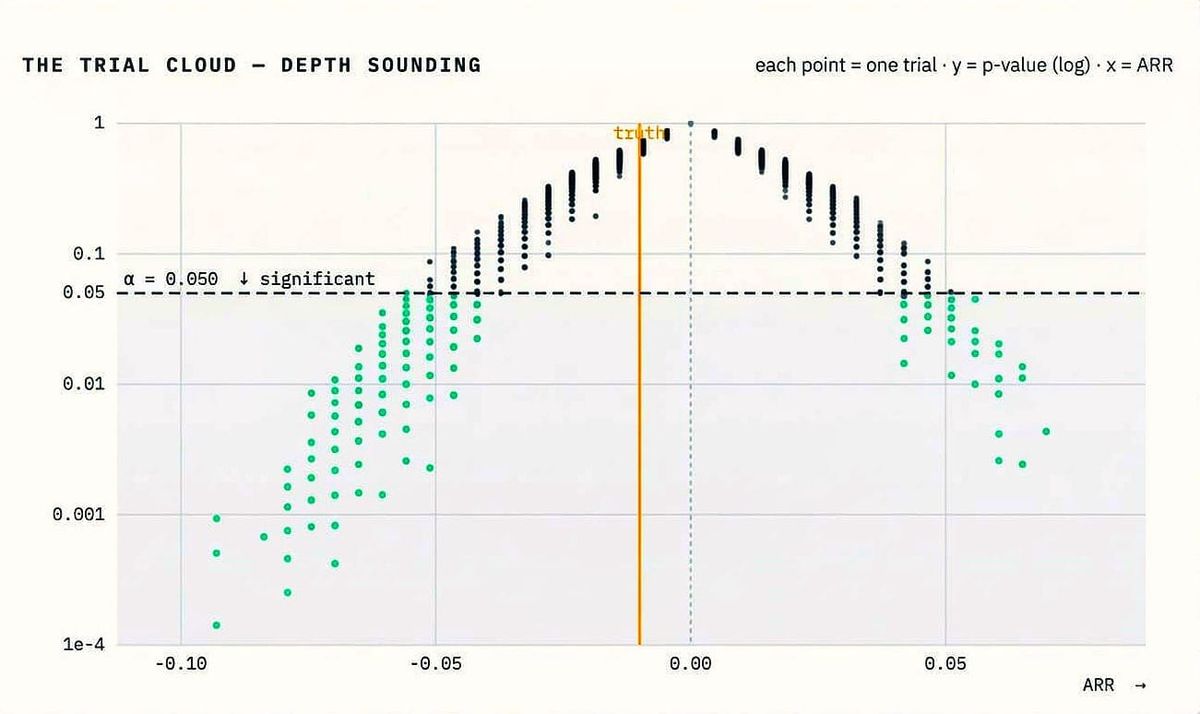
Overview and Origins
IcebergSim is a software tool utilized for the design and simulation of randomized controlled clinical trials, allowing researchers to computationally model outcomes prior to executing physical experiments. Developed in collaboration with David L. Sackett—widely recognized as the "father of Evidence-Based Medicine"—the application is historically documented through several iteration versions, including Beta 3.06 and Beta 4.0.3 (circa 2005–2006).
The simulator was formally distributed by the PRACTIHC (Pragmatic Randomized Controlled Trials in Healthcare) consortium. The software's creation was supported by funding from the European Commission’s 6th Framework Programme. The overarching goal of the project was to provide open-access tools, alongside training and guidance, to researchers in developing countries who were interested in executing clinical trial simulations.
Philosophical Foundation: The Pragmatic Trial
The framework of ICEBERGSIM aligns directly with the evaluation of pragmatic versus explanatory trial approaches. Explanatory trials test efficacy under ideal, highly controlled conditions; pragmatic trials test effectiveness in real-world, everyday clinical environments. ICEBERGSIM was purposefully built to model the statistical consequences of real-world variables—such as poor medication adherence or patient dropouts—thereby assisting researchers in anticipating and mitigating the effects of imperfect clinical conditions.
Core Features and Technical Capabilities
ICEBERGSIM operates by simulating trial decisions and estimating clinical parameters based on data extracted from prior clinical studies. It is distinguished by its use of Monte Carlo simulations to establish statistical power and calculate necessary sample sizes.
According to the provided literature and the documented software interface, ICEBERGSIM enables researchers to define and manipulate several key parameters:
- Event Rates: Researchers can set the Control Event Rate (CER) and the Experimental Event Rate (EER) to model the expected clinical response.
- Compliance and Attrition: Users can explicitly input the expected proportion of patients who might drop out of the study or fail to adhere to their treatment protocols.
- Intra-cluster Correlation (ICC): Independent research records highlight the software's capability to account for intra-cluster correlation. This mathematical function is vital for cluster-randomized trials, where entire clinics or demographic groups are randomized together rather than individual patients.
- Output Visualization: The system generates graphical plots mapping the confidence intervals of the Relative Risk Reduction (RRR) against p-values, allowing researchers to evaluate the viability of a trial design visually.
Documented Applications in Medical Literature
A deep search into published research confirms that independent scientific teams actively relied on ICEBERGSIM for trial planning long after its initial release. Notable documented applications include:
- The PreFalls Trial (Germany, 2016): A large-scale cluster-randomized trial evaluating a fall prevention program across 33 general practices. The researchers formally cited using IcebergSim (version: Beta 3.06, Bergel 2005–2006) to perform their sample size calculations. The software was specifically chosen because it allowed the researchers to calculate intra-cluster correlation coefficients to account for patients grouped by specific local clinics.
- The WelTel Retain & LTBI Trials (Kenya/Canada, 2013–2014): A series of randomized controlled trials evaluating the effectiveness of mobile SMS text messaging on HIV and Tuberculosis medication adherence. The trial protocols document using IcebergSim version beta 4.0.3 (Practihc Coordinating Office, Oslo, Norway). The researchers utilized the software's Monte Carlo model, running 5,000 simulations to accurately determine the required sample size to achieve 80% statistical power.
- Educational Integration: Beyond active trials, ICEBERGSIM served as foundational courseware. It was utilized in PRACTIHC's "Taller Básico de Experimentos Controlados Aleatorios" (Basic Workshop on Randomized Controlled Trials), a 24-hour training program that paired the simulator with the "Trial Protocol Tool" to teach emerging researchers the mechanics of rigorous trial design.
Legacy
While the software ecosystem for clinical trial simulation has expanded significantly over the last two decades, ICEBERGSIM remains a documented milestone in the field. By providing a sophisticated, free simulator to the global pharmaceutical and clinical community, the tool granted researchers in lower-resource settings the computational infrastructure required to design highly powered, pragmatic trials capable of withstanding strict international peer review.
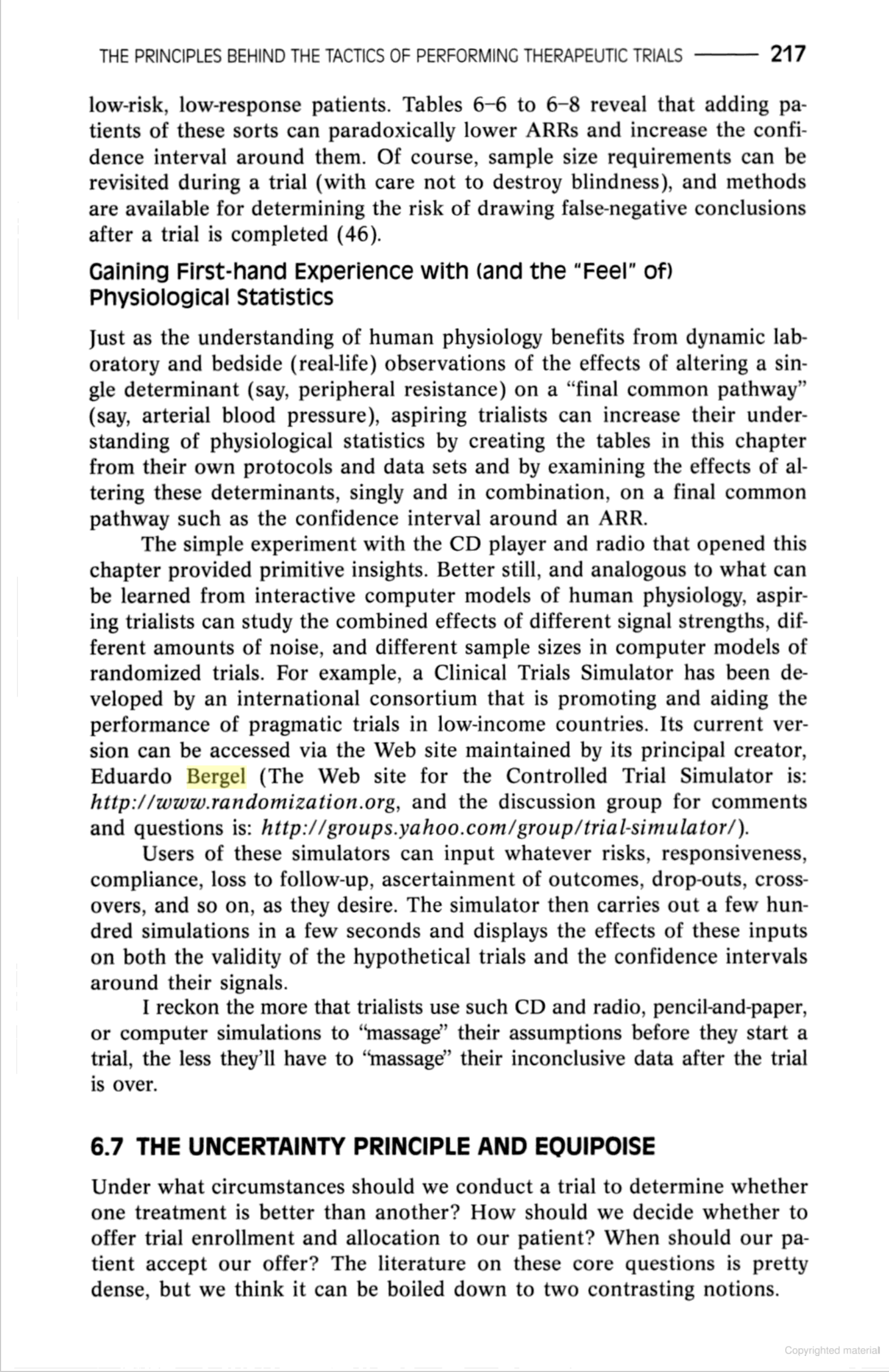
David Described the Simulator in his Book
The 3rd edition of Clinical Epidemiology: How to Do Clinical Practice Research (Haynes, Sackett, Guyatt & Tugwell) is still one of the best practical books on the subject — very much in the Sackett tradition of clear, no-nonsense, clinically useful epidemiology.